

Financial Incentives and an Adolescent Empowerment Program to Reduce Child Marriage in Rural Bangladesh
- Children
- Women and girls
- Youth
- Enrollment and attendance
- Age of marriage
- Women’s/girls’ decision-making
- Gender attitudes and norms
- Age of childbearing
- Fertility/pregnancy
- Financial literacy
- Incentives
- Soft skills
- Empowerment training
- Norms change
- In-kind transfers
- Monetary incentives
- Non-monetary incentives
- Parental engagement






Child marriage remains prevalent in many countries despite laws prohibiting the practice, leading to negative health and education outcomes for young women and their children. Researchers evaluated the impacts of an incentive program and an adolescent empowerment program on child marriage, teenage childbearing, and level of education in rural Bangladesh. Financial incentives conditional on delayed marriage reduced child marriage and teenage childbearing, and increased girls’ level of education. The empowerment program, on the other hand, did not succeed in delaying marriage.
Policy issue
Child marriage, a marriage before the age of 18, is related to negative outcomes for both women and their children. Women who marry early often leave school sooner, face more difficulties in marriage, and are less likely to access healthcare during pregnancy. Their children also tend to have worse educational and health outcomes. Despite legal bans in many countries and potential large gains in female education and employment that should encourage women to delay marriage and stay in school, child marriage remains widespread, affecting 640 million women and girls alive today.1 What factors make child marriage persistent in certain contexts? Can financial incentives and/or an empowerment program delay child marriage and increase schooling for girls?
Context of the evaluation
As of 2020, Bangladesh had the 8th highest level of child marriage in the world. Fifty-one percent of women aged 20-24 had been married before age 18. Nearly half of child brides gave birth before age 18 and they were over four times more likely to be out of school than unmarried girls.2 Parents were highly involved in the matchmaking process and dowries were common, despite being illegal.
This study took place in six rural sub-districts of south-central Bangladesh, where Save the Children was managing a food security program for pregnant and lactating mothers. In the same locations, Save the Children also designed and implemented an adolescent empowerment program called Kishoree Kontha.
For this study, eligible participants included all unmarried girls in the study communities who were aged 15-17 at the start of the program. At baseline, participants were 15 years old on average and 65 percent were still in school. According to survey data in the program districts, parents and women preferred an ideal marriage age much higher than the actual average age, which they reported was due to financial and social pressure. Husbands also rarely listed age as a top desirable attribute in a bride.
Details of the intervention
In partnership with the Bangladesh Development Society and Save the Children, researchers conducted a randomized evaluation to test the impact of a conditional incentive program and an adolescent girls’ empowerment program on child marriage, dowry price, teenage childbearing, and education.
Beginning in 2007, researchers randomly assigned 460 rural and semi-rural communities across six sub-districts to four different groups:
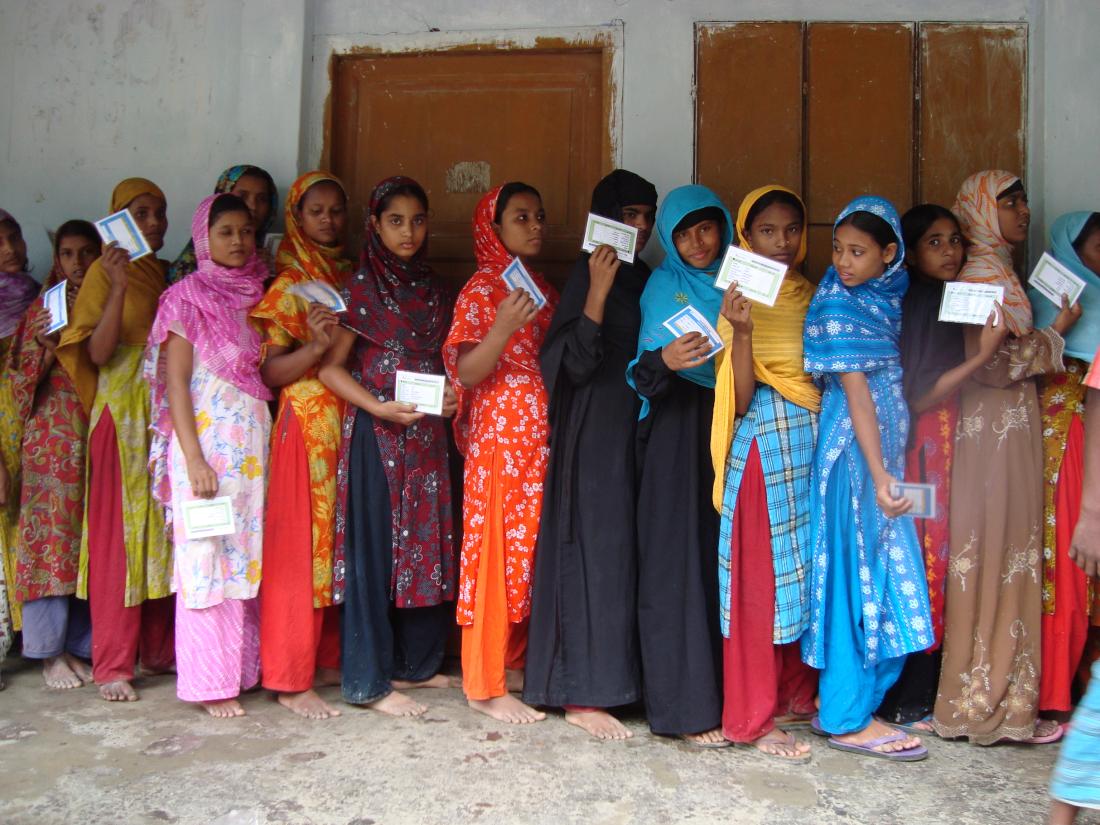
- Conditional incentive program (77 communities): All girls aged 15-17 and unmarried at the program start received ration cards indicating their eligibility to receive cooking oil every four months until they married or turned 18. Girls collected the oil by presenting their ration card, which was checked against a beneficiary list at oil distribution points. The value of the incentive was approximately US$16 per year. Cooking oil must be purchased regularly by every family in Bangladesh and thus is a close substitute to cash. Every four months, from April 2008 to August 2010, monitors conducted unannounced household visits to check that the girl was still residing in her parents’ home, and interviewed family members, neighbors, and community leaders about her marital status to verify continued eligibility. Monitors removed girls’ names from the eligibility list and took their ration cards away when they married or turned 18.
- Empowerment program (153 communities): In these communities, Save the Children invited all girls aged 10-19 to participate in a six-month cycle of their adolescent empowerment program, Kishoree Kontha or “Adolescent Girl’s Voice.” The program provided meeting places where up to twenty girls could meet five to six days a week to socialize and receive educational support and training on topics like negotiation, life skills, legal rights of women, oral communication, nutritional and reproductive health, literacy and numeracy. In half of these communities, the program also included financial literacy training. Program staff trained two to four girls per site to deliver the empowerment program to their peers, and staff checked in on sites every few weeks. For the study, researchers only analyzed data on the subset of girls aged 15-17 at program start, the same age range included in the conditional incentive group.
- Combined intervention (77 communities): All girls who met the eligibility criteria for the two interventions received both the conditional incentive and the empowerment program.
- Comparison group (153 communities): All girls received none of the interventions.
Researchers surveyed participants and their parents before the programs began and followed up with the parents one year and 4.5 years after program completion. While the first survey collected data on marital status, age, and education of all household members, the follow-up surveys asked parents about their daughters’ history of marriage, childbearing, and education. In total, researchers collected complete data on 15,576 girls.
Results and policy lessons
Overall, the conditional incentives reduced child marriage and teenage childbearing and increased years of schooling, without affecting the dowry or compromising the quality of a husband. On the other hand, the empowerment program did not affect child marriage or teenage childbearing, slightly increased years of schooling, and, in fact, increased the dowry brides had to pay. These results are consistent with the following model: delaying marriage signals that a young woman does not follow traditional gender norms, which can make brides less desirable to grooms. To avoid this stigma and signal their daughters’ conformity to desired conservative norms, parents may push their daughters to marry earlier than they would otherwise.
Researchers explain that the small financial incentive encouraged even the most conservative girls to marry later, thereby weakening the conservative reputation dynamics and decreasing early marriage for all girls. Whereas the empowerment programs reduced girls’ conformity to traditional norms preferred by men, which strengthened grooms’ beliefs that delaying marriage signals nonconservative values, making it riskier for women to wait to marry, and unintentionally increased early marriage.
Timing of marriage and childbearing: Girls in communities that received the incentive program were 4.9 percentage points (17 percent) less likely to marry before the age of 18 relative to girls in the comparison group. Younger girls—aged 15 at program start—were exposed to the intervention for a longer period and became even less likely to marry early, with a 7.4 percentage points (19 percent) reduction in their likelihood of marrying before turning 18.
These impacts extended to girls living in comparison communities that were close to the incentive communities, whom community members could mistake for incentive program participants. These girls became 2.9 percentage points (10 percent) less likely to marry before turning 18 compared to girls living in more distant comparison communities—an effect that was driven by less socially conservative girls.
Further, girls who received the conditional incentive were 1.6 percentage points (7 percent) less likely to have children during their teenage years. The empowerment program did not lead to any changes in the timing of marriage or childbearing, nor increase the effectiveness of the incentive program when combined.
Education: Girls who received the conditional incentive were 3 percentage points (6 percent) more likely to be in school one year after the program. This effect was larger for girls aged 15 (8.6 percentage points or 18 percent), who were also 5 percentage points (18 percent) more likely to remain in school 4.5 years after the program. Thus, girls who were younger at the incentive program’s outset, and therefore enrolled for longer, benefited most from the program.
Girls who received the empowerment program were no more likely to be in school after the program, although they completed 2 months of additional schooling relative to those in the comparison group (a 1.5 percent increase). Combining the incentive and empowerment programs was no more effective than providing the programs individually.
Dowry size and quality of match: Women in incentive communities did not pay different dowries for marrying later and saw no changes in indicators of the quality of the match, such as the husband’s education, age, or ability to generate income.
Meanwhile, women eligible for the empowerment program paid 6 percent (US$57) more in dowry for the same quality of matches relative to women in the comparison group. This suggests that brides can be penalized for participating in the empowerment program or being empowered.
Cost-effectiveness: The conditional incentive program was highly cost-effective. Researchers estimated that every US$1,000 spent on the program led to 4.9 years of delayed marriage, 1.1 averted child marriages, and 3.7 additional years of schooling.
Taken together, these findings suggest that child marriage in Bangladesh stems from a desire to signal adherence to traditional gender norms in the marriage market. Providing a financial incentive conditional on remaining unmarried was an effective approach to delay marriage for girls, as it allowed girls to delay marriage without appearing to follow nontraditional norms which are undesirable to prospective grooms in this context. On the other hand, an empowerment program that aimed to shift cultural preferences was limited by the signaling dynamics at play: girls pursued more education but were not able to delay marriage as the empowerment program made it even more important to signal being a socially conservative bride.
As a result of these findings, the researchers are currently working with a new implementing partner, BRAC NGO, to scale the financial incentive to 1,900 villages where BRAC operates the Social Empowerment and Legal Protection (SELP) program. As of 2026, approximately 5,000 adolescent girls had received the incentive.
United Nations Children’s Fund. 2023. Is an End to Child Marriage Within Reach? Latest Trends and Future Prospects, UNICEF, New York. Accessed July 28, 2024. https://data.unicef.org/resources/is-an-end-to-child-marriage-within-reach/
United Nations Children’s Fund. 2020. Ending Child Marriage: A profile of progress in Bangladesh. Accessed March 31, 2022. https://www.unicef.org/bangladesh/media/4526/file/Bangladesh%20Child%20Marriage%20report%202020.pdf.pdf