

Microcredit in Rural Morocco
- Rural population
- Earnings and income
- Asset ownership
- Credit



Researchers estimated the impact of a microcredit program, which was randomly rolled out in rural areas of Morocco. Thirteen percent of the households in treatment villages took a loan, and none in comparison villages did. Among households identified as more likely to borrow, microcredit access led to a significant rise in investment in assets used for self-employment activities, and an increase in profit, but also to a reduction in income from casual labor. Overall, there was no gain in income or consumption.
Policy issue
Microcredit is the most visible innovation in anti-poverty policy in the last half-century, and in three decades it has grown dramatically. With more than 200 million borrowers,1 microcredit has undoubtedly been successful in bringing formal financial services to the poor. Many believe it has done much more, and that by putting money into the hands of poor families (and often women) it has the potential to increase investments in health and education and empower women. Skeptics, however, see microcredit organizations as extremely similar to the old fashioned money-lenders, making their profits based on the inability of the poor to resist the temptation of a new loan. They point to the large number of very small businesses created, with few maturing into larger businesses, and worry that they compete against each other. Until recently there has been very little rigorous evidence to help arbitrate between these very different viewpoints.
Context of the evaluation
In the past, most microfinance services in Morocco have been concentrated in the urban and peri-urban areas, while people in rural areas used various forms of informal credit. The level of access to formal credit from a bank or financial institution is very low in these locations: the initial surveys of this project showed that only 6 percent of those in comparison villages borrowed from formal credit sources.
Between 2006 and 2007, Al Amana opened around 60 new branches in sparsely populated rural areas. The main product Al Amana offers in rural areas is a group-liability loan, and, since March 2008, individual loans for housing and non-agriculture businesses were also introduced in these areas. Groups are formed by three to four members who agree to mutually guarantee the reimbursement of their loans, with amounts ranging from MAD 1,000 (Moroccan dirhams) to MAD 15,000 (US$124 to US$1,855) per group member. Individual loans were also offered, usually for clients that could provide some collateral.
Details of the intervention
Within the catchment areas of new MFI branches opened in areas that had previously no access to microcredit, 81 pairs of matched villages were selected. Within each pair, one village was randomly selected to receive microcredit services just after the branch opening, while the other received service two years later.
The baseline survey was grouped in four waves to follow Al Amana' s timeline of branch openings between 2006 and 2007. Data on socio-economic characteristics, households' production, members' outside work, consumption, credit, and women' s roles in the household were collected among a sample of households. An endline survey was administered two years after Al Amana intervention started in each wave.
By the time of the endline survey, 17 percent of surveyed households living in treatment villages had taken a loan from Al Amana. Over three-fourths of those who had taken loans from Al Amana received group-liability loans, and borrowers were predominantly men. Households in areas where credit was offered had borrowed an average total of 10,571 MAD (US$1,310).
Results and policy lessons
Al Amana program increased access to credit significantly: households were 8 percentage points more likely to have a loan of some kind in treatment villages relative to comparison villages, where around one-quarter of households had loans. Improved access to credit helped to expand the scale of households' existing self-employment activities, including both keeping livestock and agricultural activities, but it did not help start new activities.
Across all households, microcredit offers generally increased sales, household consumption, and profits. However, effects on profits were mixed across business types. While more profitable businesses in microcredit villages increased their profits, profits fell for businesses in microcredit villages that already made relatively small profits. While overall self-employment income increased in villages offered microcredit, this increase was accompanied by a decline in income from day labor and salaried positions. This labor tradeoff resulted in no overall change in income levels between treatment and comparison villages.
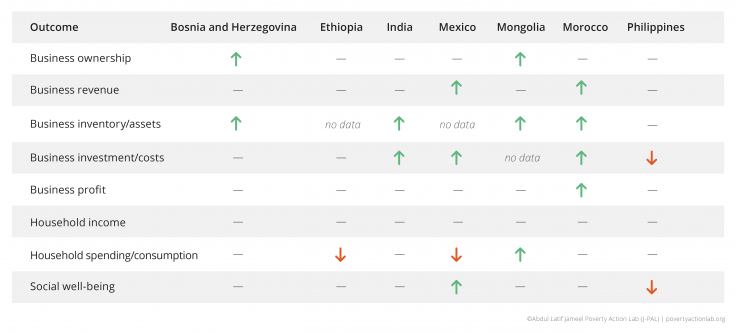
Note: Green (red) arrows represent statistically significant positive (negative) differences in outcomes between the treatment and comparison groups at the 90 percent confidence level or higher, dashes represent no statistically significant difference. For more detailed information on the outcomes summarized in this table, please see the full footnote for Table 2 on page 11 of "Where Credit is Due."
CGAP. "Financial Inclusion" https://www.cgap.org/topics/donors-investors.