
ASPIRE Fellows
The ASPIRE Fellows program offers young professionals with two to five years of experience the opportunity to work with J-PAL South Asia’s network of researchers, government partners and civil society organizations, embedding evidence-based approaches at scale within government systems.
This two-year engagement will provide young professionals in, or looking to transition to the development sector, with an opportunity to work with J-PAL South Asia’s government and implementation partners on integrating evidence-based approaches at scale.
For the first two months, the Fellow will be placed in J-PAL South Asia’s Delhi office and experience a meticulous onboarding process. They will be then placed in the designated government department / office, based on the location of the project assigned to them.
Goals

Convergence between J-PAL South Asia, policymakers and government systems, and technical partners involved in the scaling up of evidence-based interventions.

Locally grounded knowledge development around scaling by capturing insights and lessons learned through the process of piloting and scaling up evidence-based interventions across India.
Meet our fellows
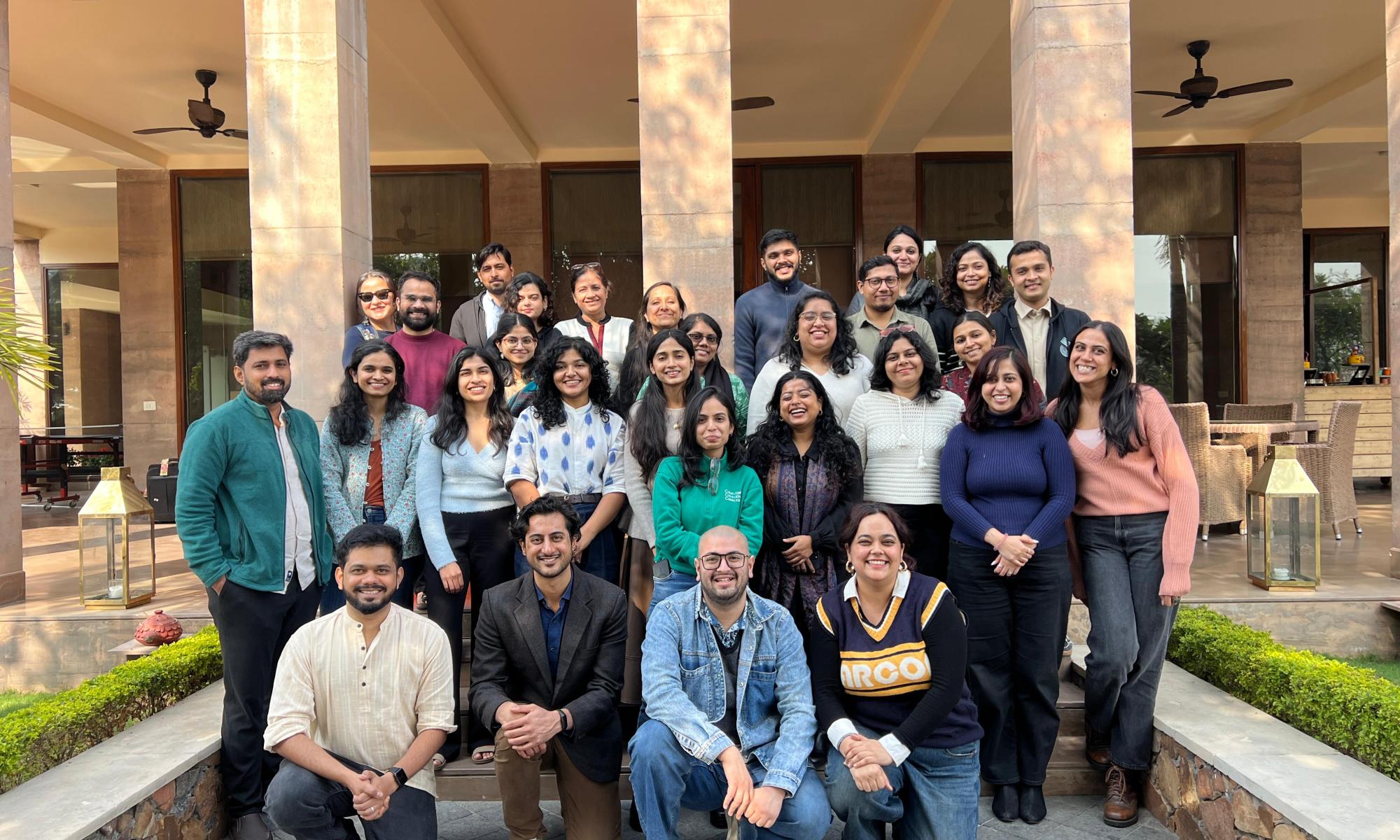
ASPIRE Fellows are dedicated young professionals working with J-PAL South Asia’s network to embed evidence-based approaches within government systems and drive impactful change.

Sanjana Chettri
Program: Deendayal Antyodaya Yojana National Rural Livelihoods Mission (DAY-NRLM)
Government Ministry: Ministry of Rural Development, Government of India
Profile: Sanjana Chettri is an ASPIRE Fellow at J-PAL South Asia, where she coordinates the learning and knowledge-building efforts on behalf of J-PAL South Asia for Deendayal Antyodaya Yojana National Rural Livelihoods Mission (DAY-NRLM), a flagship program under the Ministry of Rural Development (MoRD), Government of India.
In this role, she will be deployed at the MoRD, overseeing the establishment of a Gender Impact Lab to design and implement evidence-based solutions that tackle key challenges faced by rural women in India. She also coordinates initiatives to strengthen learning processes within the DAY-NRLM framework.
Before joining J-PAL South Asia, Sanjana’s impactful work included leading The School Mental Health Initiative with the Government of Delhi, a preventive mental health program benefiting adolescents in government schools. Her professional journey spans roles at Oxfam, Belongg, and 60 Decibels, where she gained expertise in research, project management, and coalition-building.
Drawn to the ASPIRE Fellowship for its focus on translating evidence into action, Sanjana is passionate about leveraging research to drive system-wide outcomes and lasting impact. Through mentorship and training as an ASPIRE Fellow, she aims to deepen her skills in managing large-scale programs and advancing public sector initiatives.
She holds a Master’s degree in Development Studies from SOAS University of London under the Chevening Scholarship and a Bachelor’s degree in Political Science from Lady Shri Ram College for Women, University of Delhi.
Nidhi Arun
Program: Remote Tutoring, Every Child Counts, and the Gender Equity Curriculum
Department: Department of School Education and Literacy (DoSEL), Government of Karnataka
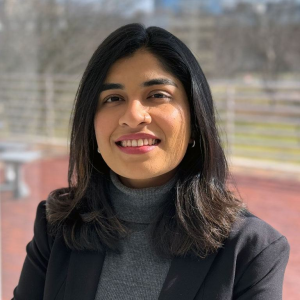
Profile: Nidhi Arun is an ASPIRE Fellow at J-PAL South Asia and supports the design, implementation and scale-up of innovative education programs piloted by the Department of School Education and Literacy (DoSEL), Government of Karnataka. In this role, she develops policy evidence and coordinates impact evaluations to strengthen math and tutoring interventions such as ConnectED, Maru Sinchana, Every Child Counts, and the Gender Equity Curriculum statewide.
Previously, Nidhi worked as a Program Analyst at the Indiana University Public Policy Institute where she evaluated community schools and economic development programmes for state government agencies. Through her professional experiences at the United Kingdom's Government Economic Service and International Finance Corporation, she has also developed expertise in working with public sector stakeholders and communicating with policy audiences.
Nidhi holds a Master of Public Affairs degree from Indiana University Bloomington and a Bachelor of Science in Economics from the University of Bath.

Varsha Raju
Program: Every Child Counts, and the Gender Equity Curriculum
Government Ministry: Ministry of Education, Government of India
Profile: Varsha Raju is an ASPIRE Fellow at J-PAL South Asia, where she supports J-PAL South Asia's strategic engagement with the Ministry of Education , Government of India, to embed evidence-backed education programs into national policy and large-scale implementation platforms. In this role, she helps synthesize evidence and coordinate with government stakeholders to advance the integration of evidence-based interventions such as Every Child Counts and the Gender Equity Curriculum. She also supports the scale-up of Every Child Counts under its second cohort of Ecosystem Expansion, contributing to the adoption of the early years play-based math curriculum across states.
Before joining J-PAL South Asia, Varsha was a Senior Program Manager at The Education Alliance, where she led the Governance and Technology workstreams under NIPUN Madhya Pradesh, the state's Foundational Literacy and Numeracy Mission. Her earlier experience includes a stint as a Data and Documentation intern at Good Business Lab. Drawn to the ASPIRE Fellowship for its focus on translating evidence into action, Varsha looks forward to deepening her expertise in building system-wide impact through government ecosystems.
Varsha holds a Post Graduate Diploma in Public Policy, Design and Management from the Indian School of Public Policy and a B.Tech in Instrumentation and Control Engineering from the National Institute of Technology, Tiruchirappalli.
Who can apply?
This opportunity is ideal for individuals who have a strong understanding of the government landscape, excellent communication and stakeholder management skills, a passion for translating research into action, creativity, and a keen interest in development.
 Education and Experience
- Master's degree (preferably in public policy, or international development) with minimum 2 years of work experience
- Bachelor's degree with a minimum 4 years of relevant work experience
- Demonstrated experience of working with government partners and other stakeholders will be strongly favored.
 Understanding of Monitoring and Evaluation
Demonstrate a keen understanding of the value of randomized evaluations, monitoring techniques, and their usefulness for policy decisions.
 Skills and Competencies
Communication: Attention to detail and excellent writing and presentation skills for communicating insights from academic papers in ways that policymakers understand. This requires clear, precise, non-technical writing, and creativity in presentation.
Time Management and Prioritization: Proven ability to handle several different projects/tasks at one time, successfully complete tasks assigned, and meet deadlines.
Language: Fluency in English (written and oral) and fluency in Hindi (written and oral) will be considered favorably. Each role will have regional language requirements based on the location. Please indicate proficiency in regional languages in the application form.
 Desireable
Strong interest in the thematic area of the project you have applied for, as demonstrated by coursework and / or professional experience.
What does it take to be an ASPIRE Fellow?
 Stakeholder Management and Facilitation
Communicate with state officials and partner organizations to support the dissemination and scale-up of evidence-based policies. Assist in preparing for meetings by creating collaterals and coordinating with state officials and implementing organizations.
 Program Management
Collaborate with government line departments and partner organizations to support scale-up goals. Summarize monitoring efforts and program evidence, and assist with dissemination.
 Technical Assistance
Write reports, optimize processes, create policy memos, manage project data, and coordinate between line departments.
 Support Organizational Learning
Promote locally contextual evidence and develop pathways for scaling evidence-based interventions at J-PAL South Asia.
How to apply?
If you are interested in this position, upload your CV, cover letter, and a short video introducing yourself and your interest in being an ASPIRE Fellow. Applications will be screened on a rolling basis.
For questions regarding the opportunity or the application process, contact: [email protected] and [email protected]

1. Application submission
Candidates submit the online application, including a CV, cover letter, and video submission.

2. Case study stage
Those shortlisted candidates would then complete a designated assignment or case study.
3. Interview rounds
The shortlisted candidates will undergo two rounds of interviews with the J-PAL South Asia team.
What projects can the Fellows be a part of?
Ministry of Rural Development
J-PAL South Asia and the Ministry of Rural Development (MoRD) have entered into a strategic partnership to embed rigorous evidence into national livelihoods policy and large-scale implementation platforms. As the knowledge partner to MoRD on ‘Samaveshi Aajeevika’ (Inclusive Livelihoods), J-PAL South Asia supports the expansion of an evidence-backed livelihood intervention based on the Graduation Approach, designed to lift women-led households out of extreme vulnerability and onto pathways toward sustainable self-sufficiency.
Through this collaboration, J-PAL South Asia works closely with the Ministry to strengthen data-driven decision-making as the program scales across states under DAY-NRLM. The partnership also includes the establishment of a Gender Impact Lab to generate new insights aligned with the Government of India’s vision of women-led development and to institutionalize the use of evidence within government systems.
Fellow requirements:
Will be based in New Delhi (embedded within MoRD), with travel to states as required. Requires strong written and oral fluency in English and Hindi. Demonstrated experience working with government stakeholders is strongly preferred.