J-PAL courses help implementers, policymakers, and researchers become better producers and users of evidence and equip learners worldwide with skills in data analysis and economics. Explore J-PAL's course offerings below.
In Person Open Enrollment Courses
J-PAL’s in-person, open-enrollment courses are designed for professionals from non-profit organizations, government agencies, and philanthropic foundations. Courses are held at set dates during the calendar year and are taught by J-PAL-affiliated researchers and senior staff.
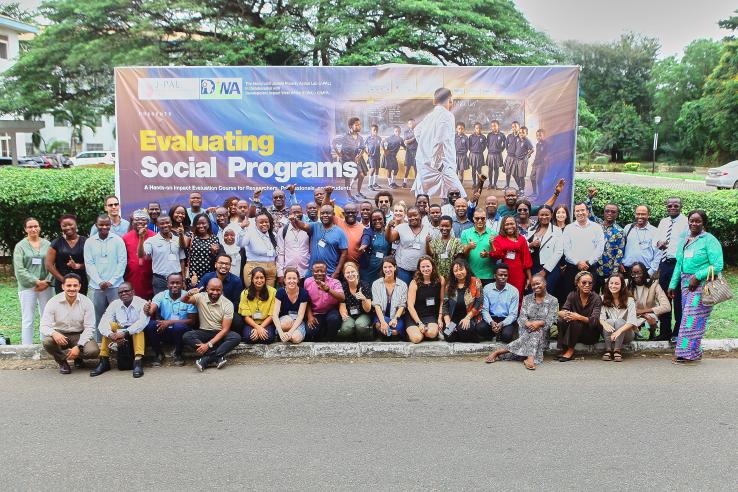
Evaluating Social Programs: J-PAL's flagship executive education course is a five-day training that equips participants with resources and knowledge to engage with randomized evaluations of social programs. Offered annually at several J-PAL offices around the world, the course is tailored to the needs of researchers, policymakers, and practitioners. Learn more about Evaluating Social Programs.
Measurement and Survey Design: This annual three-day course is hosted by J-PAL South Asia and introduces basic survey and data collection methodologies to researchers, M&E professionals, and other individuals interested in gaining essential skills for collecting high quality primary data. Learn more about Measurement and Survey Design.
Custom Courses
J-PAL can design a custom course for your organization with content tailored to a specific sector (e.g., health or education), geographic region, or level of technical detail. J-PAL custom courses can be taught in English, French, Spanish, Portuguese, and Indonesian. Learn more about J-PAL's custom courses.
Online Courses
J-PAL’s online training courses bring our materials on impact evaluation to a worldwide audience. Courses run in regular intervals in topics ranging from how to implement randomized evaluations to health research and policy. Learn more about our online course offerings.
MicroMasters in Data, Economics, and Design of Policy
The DEDP MicroMasters program is a collaboration between J-PAL, MIT Economics, and MITx. Through a series of graduate-level online courses, learners gain a strong foundation in microeconomics, development economics, and data analysis. Learners who receive the MicroMasters credential are eligible to apply to a Master's program at MIT. Learn more about the MicroMasters credential.
Diploma in Impact Evaluation of Public Policy and Social Programs
The Diploma in Impact Evaluation of Public Policy and Social Programs is a collaborative effort between the Economic Department of Pontificia Universidad Católica de Chile (PUC) and J-PAL LAC. Students in this program will get the necessary tools to design and understand the results of rigorous program evaluations. Learn more about the PUC Diploma.
Research Staff Training
J-PAL and IPA host research staff trainings annually for employees of J-PAL, IPA, and Evidence for Policy Design, or other research staff working on randomized evaluations led by J-PAL-affiliated researchers. Learn more about Research Staff Training.