Image

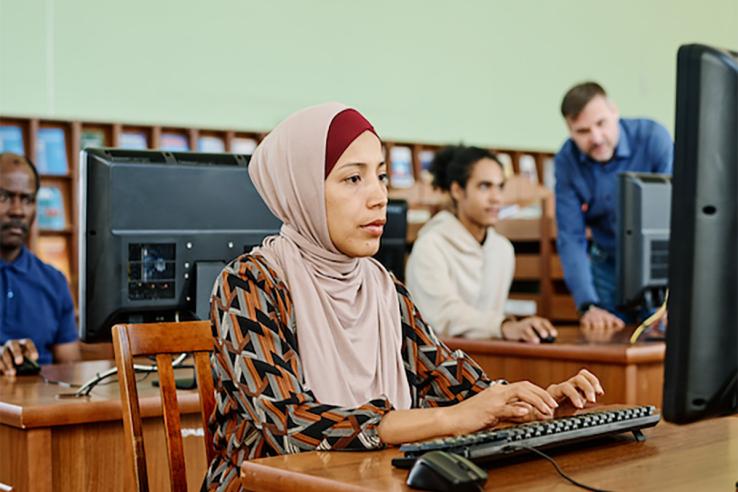
A new needs assessment by the Egypt Impact Lab (EIL) reveals Egypt's hidden labor market problem: job opportunities and worker qualifications aren't matching up. Drawing on the 2023 Egypt Labor Market Panel Survey (ELMPS), the assessment points to two findings: high reservation wages among the unemployed, and overeducation among those already working. In other words, Egypt’s labor market suffers from persistent mismatch. Unemployed workers can’t find the jobs they’re looking for and may be unwilling to accept the wages offered for available jobs. Employed workers, on the other hand, are usually overqualified for the jobs they have.
But before policymakers can address this mismatch, they need to understand (1) how widespread it is and who it affects most, and (2) which solutions actually work. A needs assessment can show us the first. Randomized evaluations can help us begin to answer the second.
Nationally representative labor market data offers a way to move past anecdotes, mapping how education, skills, and labor market demand intersect and pointing to where interventions could have the most impact. This matters now as Egypt is trying to support young labor market entrants. Decisions about how to help young people succeed depend on understanding the nature and drivers of this mismatch.
For the unemployed, the clearest signal of mismatch is in the gap between expectations and available opportunities. Many survey respondents reported preferences that did not align with earnings and occupations readily available in Egypt. Among the unemployed respondents, 90 percent held a minimum acceptable wage above what they’d likely earn in the informal private sector where jobs are most readily available. Even though this percentage is lower in the formal private (69 percent) and public sectors (64 percent), it remains high, reinforcing the disconnect between jobless workers’ expectations and what the labor market offers.
But the mismatch is not only about how much people expect to earn, it is also about the jobs they are willing to take. And the pattern extends to entire occupations, not just wages. At least 98 percent of unemployed women surveyed said that they would turn down industrial, delivery, driving, or agricultural work. These jobs are also unpopular among men, with 62 to 75 percent of survey respondents saying they would reject them.
On the other side of the labor market, those who are employed often accept jobs that do not match their qualifications. Among survey respondents who are employed, 51 percent are over-educated for the work they’re doing. Under-education affects just four percent. The gap is sharpest in the informal private sector, where nearly two-thirds of workers hold more education than their job requires.
Taken together, these findings point to a labor market caught between unmet expectations and underutilized education and skills. These aren’t two separate problems. They’re symptoms of the same underlying disconnect between what the labor market supplies and what it demands.
The headline number from the needs assessment is stark; 51 percent of employed workers are overqualified for their jobs. But a number like that raises an immediate question: overqualified in what sense? Is overeducation measured against formal qualifications, or against the competencies a job actually calls for? Employers might not agree with either definition. Yet, the distinction matters because the statistic is a qualification measure, comparing the level of education completed to the level required. It is not a direct read on whether education helped workers do the job.
Skill mismatch, which is tracked separately in the assessment, tells a less uniform story. For some skills, workers are more qualified than their job requires. Yet, how often this occurs depends on the worker’s sector, education level, and occupation. For bookkeeping roles, for instance, workers report an unused skill nearly twice as often as they report lacking one, while for skills like physical fitness and teamwork, over- and under-skilling occur in closer to equal measure.
On the surface, it looks like women face less mismatch than men. Women who have jobs are less likely than men to be overqualified. For women, 32 percent of survey respondents said they were overeducated, compared to 55 percent of men. At the same time, women tend to be more selective about the jobs and working conditions they are willing to accept. According to research by J-PAL affiliates, job attributes like security, working hours, and workplace composition can weigh as heavily as pay and family expectations.
There is an important caveat to consider, as this comparison only looks at women who are already working. In Egypt, as of 2023, only 18 percent of women were in the labor force, which is a decline from previous years. So saying that women are “less overeducated” does not necessarily mean they are more likely to find jobs that match their qualifications. It tells us only about the women who are or remain employed. Therefore, as most women are not working, it’s possible that some non-employed women may have previously struggled with mismatch.
If mismatch is this layered, what can policy actually do about it? Evidence points away from broad, one-size-fits-all fixes and toward targeted training tied to real labor demand.
Training helps most when it is tied to real labor demand. J-PAL's synthesis of rigorous research on vocational and skills training programs finds these programs tend to pay off when they add practical experience, job referrals, or a specific in-demand skill. Programs that combine soft skills, like communication and problem-solving, with technical training show particularly strong returns. In Egypt, for example, workers who received both hard and soft skills training found jobs more often than workers who received only one or the other.
EIL's needs assessment points to similar lessons. Overqualification, not a skill gap, is the more common problem in Egypt, and the pattern holds for specific skills. Workers report being overskilled in mathematics and statistics twice as often as they report lacking that skill (18 percent versus 9 percent), and over-skilled in basic literacy nearly five times as often (24 percent versus 5 percent).
The assessment also found that over-education among vocational secondary graduates does not vary by specialization, while university graduates in humanities, social sciences, and education are two to three times more likely to be over-educated than those in medicine, science, or engineering. This points to a credentials-over-skills problem that no training program can fix on its own. To help address this mismatch, the education system must better align the skills and degrees it provides with what the labor market actually needs.
Yet, matching and information interventions can only go so far if the jobs available do not meet what people need. In Jordan, a matching program offered youth more than 1,000 job matches, but produced only nine hires that lasted beyond a month. When researchers asked graduates why they turned down matches and offers, only eight percent pointed to low pay. Most said the job wasn’t on their career path, conflicted with gender norms, or carried a stigma they weren't willing to accept for themselves or their families. Egypt's Ministry of Social Solidarity conducted a randomized evaluation on job matching and childcare, finding much the same: neither childcare subsidies nor job matching raised women’s employment because the jobs on offer did not fit the conditions women needed.
Making sense of this mismatch was what our recent policy dialogue set out to do. In July 2026, EIL convened Egyptian policymakers, researchers, and development partners at the National Institute for Governance and Sustainable Development to discuss the needs assessment, which was the first completed study funded through EIL's competitive annual request for proposals. By putting a clear map of the problem in front of the people who design employment and education policy, this marks a first step from diagnosis toward action.
Yet the needs assessment raises as many questions as it answers. We now know how big the mismatch is, but we do not yet know what shrinks it. That's the kind of question only a randomized evaluation can answer, and a needs assessment cannot.
This is why EIL seeks to explore several evaluation avenues with government partners, using the needs assessment as a knowledge base. With over-qualification in Egypt’s labor market this widespread, an open question is whether training tied to specific, under-supplied skills, rather than more credentials, can close the gap. And because women are more selective about job conditions, not just pay, another avenue is testing whether remote and flexible work arrangements open up matches that today's rigid job structures foreclose.
Turning these from research questions into tested government programs is precisely the next step EIL is built to take. Learn more about our work at povertyactionlab.org/egypt-impact-lab.
Assaad, Ragui, and Caroline Krafft. Forthcoming. “Introducing the Egypt Labor Market Panel Survey 2023.” Middle East Development Journal.
Assaad, Ragui, and Esraa Mahmoud. 2024. “Evolution of the Structure and Quality of Employment in Egypt, 2012-2023.” Economic Research Forum Working Paper Series No. 1750.
Caria, Stefano et al. 2025. "The barriers to female employment: Experimental evidence from Egypt." G²LM|LIC Working Paper No. 92. February. https://g2lm-lic.iza.org/publications/wp/the-barriers-to-female-employment-experimental-evidence-from-egypt/.
Krafft, C., Assaad, R., & McKillip, Z. (2024). The Evolution of Labor Supply in Egypt through 2023. Economic Research Forum Working Paper Series, No. 1749.
Krafft, Caroline, and Carmen Armas-Montalvo. 2026. “Mismatch in the Egyptian Labor Market.” GLO Discussion Paper No. 1739.
OAMDI. 2026. “Labor Market Panel Surveys (LMPS). Version 2.2 of Licensed Data Files; ELMPS 2023.”