

UJALA Global Training Session for Farmer-Centric Initiative Leads
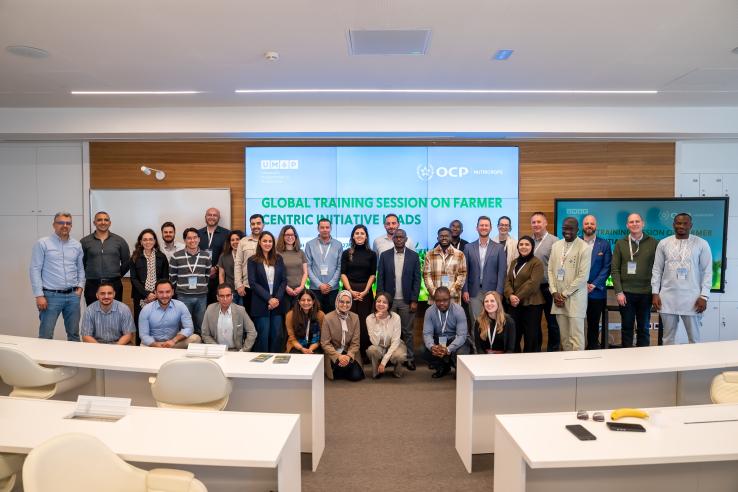
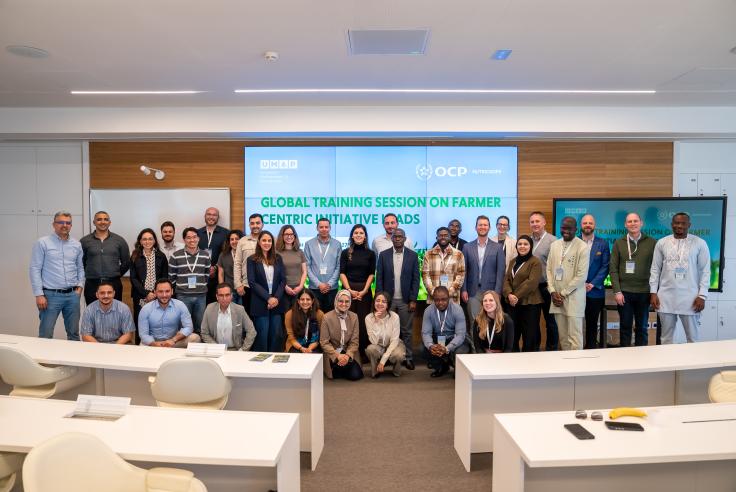
Building on this need, UM6P-J-PAL Applied Lab for Agriculture (UJALA), in collaboration with the OCP Nutricrops’ Impact, Learning and Farmer Adoption Service Line, hosted a training session for heads of farmer-focused programs at OCP Nutricrops, a UJALA partner, in Rabat, Morocco, at the Africa Business School (ABS) of University Mohammed VI Polytechnic (UM6P).
Following the first edition of the Custom Training Program in 2025, this three-day training brought together OCP Nutricrops teams from multiple country offices, alongside J-PAL, IDinsight, and Innovations for Poverty Action (IPA) researchers and staff, to deepen their understanding of randomized evaluations and their application to farmer-centric programs.
As UJALA expanded its focus from Sub-Saharan Africa to a broader set of countries globally, the 2026 training engaged OCP staff from a wider range of country offices and built their capacity in impact evaluation. In addition, this year’s program placed a stronger emphasis on applying randomized impact evaluation tools in practice, drawing more extensively on case studies and examples from ongoing UJALA-funded projects.
Strengthening understanding and application of randomized evaluations
The training focused on building participants’ capacity to design and interpret randomized evaluations. Participants revisited key concepts such as theory of change, outcome selection, and causal identification, while exploring how randomized evaluations help distinguish between correlation and causation, ensuring that observed changes in outcomes can be attributed to the intervention rather than external factors. Through lectures, applied exercises, and case studies, drawn from J-PAL-funded projects, the training grounded these concepts in real-world applications, illustrating how evaluations can test and refine agricultural interventions.
Building on these foundations, it also emphasized the importance of aligning evaluation design with implementation realities. As participants engaged with practical examples, they considered how data collection, rollout strategies, and coordination across country teams can shape both program delivery and the feasibility of evaluations, highlighting the need to design studies that are both rigorous and operationally viable.
From learning to practice
The training insights are directly relevant for organizations involved in designing and delivering agricultural programs. By strengthening their understanding of randomized evaluations, participants are better equipped to identify when rigorous evaluation is appropriate, engage effectively with researchers, and interpret evidence to inform program decisions.
Teams implementing input distribution programs, advisory services, or market-linkage interventions can use this knowledge to frame relevant evaluation questions, assess the feasibility of testing new approaches, and collaborate with researchers to generate credible evidence. Understanding how evaluations are designed - and what they can (and cannot) measure- also helps ensure findings are correctly interpreted and applied.
More broadly, the training reinforced the value of integrating evaluation thinking into program development, enabling implementers to shape research questions, support implementation, and use evidence to guide improvements.
Looking ahead
UJALA will convene similar trainings annually to strengthen the use of randomized evaluations across its network of implementing partners, drawing on learnings from ongoing and funded projects. UJALA will also explore more flexible formats, such as shorter or hybrid sessions, and locations beyond Rabat to broaden participation.
To learn more about UJALA’s work and upcoming events, visit our webpage.