Imagen


Hosted by the Wilson Sheehan Lab for Economic Opportunities (LEO) at Notre Dame, J-PAL North America, and Carrie S. Cihak (Beyond Measure), Evidence Matters is a collaborative learning series bringing together government, researcher, and community perspectives to advance evidence-informed solutions that increase economic mobility and equity. In June 2026, Evidence Matters held “Line Items to Impact: Incorporating Evidence into Local Budgeting,” a deep dive into the practical "how-to" of institutionalizing evidence-informed spending in local government. Jen Tolentino (Results for America) facilitated a discussion between Ricardo Basurto Davila (County of San Diego, CA), Ryan Flynn (The Lab @ DC), and Sam Quinney (Yale Tobin Center for Economic Policy) on how to make evidence-informed budgeting a lasting part of how government works. This blog highlights key takeaways from the webinar, which can be viewed in full here.
Every year, government leaders must decide how to spend limited dollars across competing priorities. While much of a government’s budget is accounted for by legal obligations, established programs, and debt payments, there’s usually a window in which policymakers have some discretion on how funds are allocated.
Deciding how to spend these "marginal dollars" is where evidence shines. It can help narrow the gap between what decision-makers hope will happen as a result of public funding and what actually happens. This critical information can help leaders decide where to commit scarce resources, improving the likelihood that public dollars will make a real impact for constituents.
That's the promise of evidence-informed budgeting.
At a recent webinar, leaders from Washington DC, which has used evidence in budgeting for years; San Diego County, which is just getting started on evidence-informed budgeting; and Results for America (RFA), which has deep expertise training governments on how to use evidence for budgeting, discussed practical strategies for embedding evidence into budget decisions.
Researchers, agency heads, nonprofit leaders, and community members each have a stake in evidence-informed budgeting, but each approach this work from different perspectives and may define “evidence” differently.
This communication gap can derail efforts at evidence-informed budgeting from the start. Therefore, a critical first step is to build a shared definition of evidence across these perspectives.
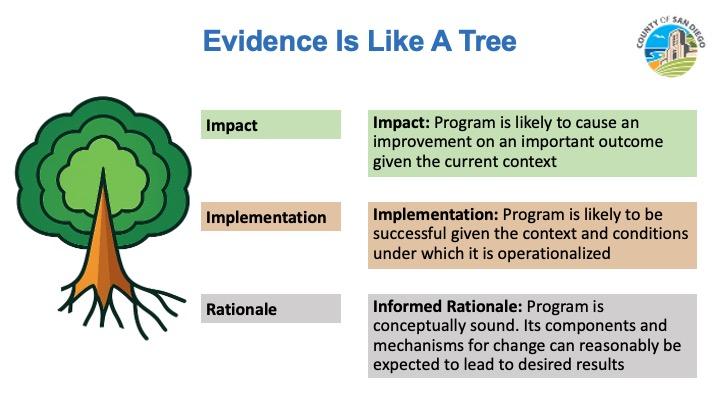
During the webinar, Ricardo shared San Diego County’s "Evidence Tree," a model they created and plan to use to define evidence across their organization:
Washington DC’s budget process emphasizes the value of impact evaluations for demonstrating causal evidence, but also uses a 1-4 rating scale to allow room for using other research designs to inform budget writers’ decisions. Jen shared a resource from RFA that outlines how different states and agencies define evidence in their contexts.
These definitions help ensure departments and other interested parties are on the same page while still leaving room for the practical realities of policymaking.
An evidence-informed budgeting initiative is likely to fail if it becomes a compliance exercise or another box to check.
Instead, Sam, who helped launch DC's evidence-informed budgeting process, emphasized the value of building relationships with agency staff to generate buy-in on the value of evidence: “Evidence should be a conversation starter on how to achieve better outcomes on shared goals.” It’s about learning, not accountability, Sam emphasized.
Moreover, Ryan noted that the Lab @ DC uses plain language explainers and engages in discussions with agencies to show how the evidence they cite will actually be used. This invites agencies to see the process as a dialogue, not a one-way submission. These conversations, he explained, help build the muscle for evidence-informed thinking beyond just the budget—bolstering impacts across government processes.
Evidence-informed budgeting also requires building relationships across teams and departments. Like forming shared definitions, it’s important to work together with different agencies to generate buy-in on the goals and process of using evidence to inform policy. Regarding his team’s collaboration with San Diego’s finance department, Ricardo quipped, "there's no romance without finance."
Creating and leveraging a sustainable process at scale can be difficult. Standardization can ease capacity constraints, but rigidity can stifle innovation and equity.
DC has been using their process for evidence-informed budgeting for nearly a decade. They rely on standardization to process the hundreds of budget proposals they receive each cycle, while maintaining flexibility using the following steps:
Their process balances rigor, equity, and innovation as key inputs of their evidence-informed decision-making. Ryan also explained that in DC, a proposal with more nascent evidence still has a chance of being funded if well-justified and innovative—especially if there are opportunities to evaluate the program in the future. As San Diego’s tree framework illustrates, a strong theory of change can provide a critical foundation for evidence-informed budgeting even if there is only nascent research on the program itself.
Governments don't need a decade of experience, perfect data, or gold-standard research to embed evidence in budgeting. Speakers cautioned against trying to transform everything at once. Instead, public sector leaders can start by picking one area of the budget process where they can authentically use evidence to make change happen.
Evidence-informed budgeting is about building a culture of learning within government. A culture where agencies ask, "what does existing research say about what works?" and, importantly, identify what needs further exploration. Creating processes that reward using and generating evidence in decision-making keeps the spotlight on continually improving outcomes for residents.