Imagen

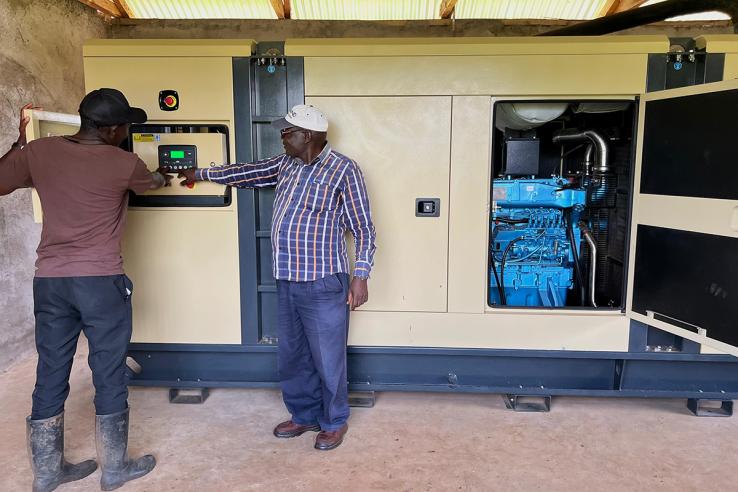
Electricity access has long been a major development priority, with Mission 300—the World Bank and African Development Bank’s commitment to connecting 300 million people in sub-Saharan Africa to electricity—as the latest example. There is good reason for the focus: no advanced economy has developed without abundant electricity, which is essential for economic activity and adequate living standards.
At the same time, growing evidence suggests that household electricity access by itself has limited average effects on jobs and incomes. Why is this the case? And what policies can turn electricity access into a catalyst for growth, job creation, higher incomes, and poverty reduction in Africa?
One approach is to design energy policies around productive use: how firms and people will use electricity to produce goods and services. Historically, some of electrification’s largest economic gains came when businesses used power to operate machinery, adopt new technologies, and expand production. These investments can raise productivity and employment while providing the steady electricity demand needed to sustain and improve power systems.
But in many African countries, this isn’t happening on its own. Firms hesitate to invest in electricity-intensive equipment when power is unreliable, costly, or prone to surges, while utilities and investors hesitate to expand supply without confidence that businesses will generate enough demand. As Moussa Blimpo has laid out, each side waits for the other to move first.
Recent research supported by J-PAL’s King Climate Action Initiative (K-CAI) helps illustrate the puzzle. Several randomized evaluations find that grid connections indeed improve access, but have limited average effects on socioeconomic outcomes, especially over short time horizons. In Kenya, subsidized grid connections increased household electrification but did not increase electricity consumption or produce detectable improvements in employment, education, or health. Similar findings emerged even a decade after connection in Rwanda. And in India, village electrification boosted welfare only in larger villages with higher levels of economic activity at baseline.
Taken together, these insights reinforce that connections alone may be insufficient to transform local economies, especially when households and businesses cannot afford appliances and machinery or face other constraints to growth. Household access and productive electricity use are complements, not competing priorities. Realizing those complementarities may require pairing expanded access with support that helps businesses invest and produce more. Quasi-experimental evidence from Nepal and India shows this potential. In Nepal, access to higher-capacity mini-grids enabled manufacturing growth and shifts into wage employment. In India, helping manufacturing firms improve energy efficiency increased both productivity and electricity consumption as firms produced more.
These findings point to a shift in how governments and development partners think about energy policy. Instead of measuring success primarily through new household connections, policy should also take into account whether electricity enables businesses to invest, expand production, hire more, raise incomes, and create demand. The best uses differ across settings; depending on a country’s characteristics and growth strategy, they might include agricultural processing, irrigation for farms, cold storage, manufacturing, mineral processing, electric mobility and charging infrastructure, and beyond.
Just as household electrification is more beneficial when people can actually put it to use, electricity is more likely to drive growth when firms have the finance, buyer linkages, infrastructure, digital connectivity, and technical assistance needed for expansion. Across Africa, high-speed internet attracted more foreign investment in districts with stronger electricity infrastructure. Kenya’s Export Processing Zones illustrate the same logic: they provide firms with electricity alongside roads, water, and other infrastructure, concentrating complementary investments around productive activity.
Complementarity is only one part of the equation: electricity demand also has to support financially sustainable power systems. Public support can help build that demand, but it is most useful when it helps firms become viable customers rather than creating indefinite dependence, by, for example, targeting firms or clusters with credible prospects for growth, requiring beneficiaries to contribute to costs, or tying continued support to investment or production. Large, reliable users—known as anchor customers—such as mines, food processors, telecom towers, and transport fleets can also provide the predictable demand needed to justify new grid infrastructure. Utilities also need tools to manage peak demand, recover costs, and encourage efficient electricity use. Evidence from Bangladesh finds that firm adoption of energy-efficient machinery spread through local learning: manufacturers were more likely to adopt efficient motors when nearby firms received them, suggesting targeted subsidies may generate broader spillovers. Prepaid metering, regional power trade, stronger transmission networks, and improved collection systems could further strengthen utility finances while enabling the productive use needed for industrial development.
We know more and more about household electrification and utility performance. We know much less about how to deliberately build productive electricity demand. Even as renewable energy technologies become cheaper, high financing costs continue to hold back investment in Africa. When clean power is the most affordable and dependable option for businesses, climate goals and economic growth can reinforce each other.
Policymakers need information on which policies—across finance, infrastructure, utility reform, and business support—catalyze productive electricity demand. Which approaches best reduce investment risk and the cost of capital? What mix of reliable power, equipment finance, market access, and technical assistance gets firms to invest? And as productive demand increases, does it create better jobs, raise household incomes, and draw surrounding suppliers and businesses into local growth?
These are questions that rigorous evaluation can help answer. African governments are already experimenting as they pursue economic growth and the energy transition; embedding evaluation in those efforts could show which approaches deliver the greatest gains for firms, utilities, workers, and households. Potential pilots include:
Electrification is not an end in itself, but an ingredient for economic transformation and improved well-being. J-PAL’s K-CAI-supported research has explored some of the questions discussed above, but much remains to be learned about how to break the chicken-and-egg problem between productive firms and sustainable power systems. Building that evidence can help turn energy access into growing businesses, more jobs, and higher incomes.