

Early Childhood Development at Scale through Home Health Visits
- Children
- Parents
- Children under one
- Families and households
- Cognitive development
- Health outcomes
- Nutrition
- Socio-emotional development
- Stunting
- Take-up of program/social service/healthy behavior
- Early childhood development
- Community health workers
- Parental engagement



Early childhood development (ECD) programs can nurture children’s healthy growth and potential, but scaling up these programs can reduce their effectiveness or even cause harm to children. Researchers in Bangladesh conducted a randomized evaluation to test the impact of integrating light-touch ECD support into an existing national child health program on early childhood development outcomes. Children who received the ECD support showed improvements in cognitive, language, and physical development, and their older siblings benefited, too.
Problema de política pública
Early childhood development (ECD) programs are a promising way to combat intergenerational poverty. Prior research suggests that ECD interventions can improve children’s wellbeing and future opportunities. However, ECD programs are difficult to provide at scale. To reach every parent and child in urban and rural areas, governments must set up the infrastructure efficiently. Could lower- and middle-income countries (LMICs) use existing service delivery platforms to effectively scale up ECD programs?
Contexto de la evaluación
In 2015, 42 percent of children in Bangladesh under 5 years old experienced stunted growth. To address this issue, the government launched the National Nutrition Services (NNS) program with support from Save the Children. This initiative provided families with nutritional supplements, growth monitoring services, and monthly home visits from community health workers to promote better nutritional practices. In addition to Bangladesh’s challenges in childhood nutrition, access to early childhood education has also been limited. Of children aged three to five, 13.4 percent participated in early childhood education at the time of study.
Detalles de la intervención
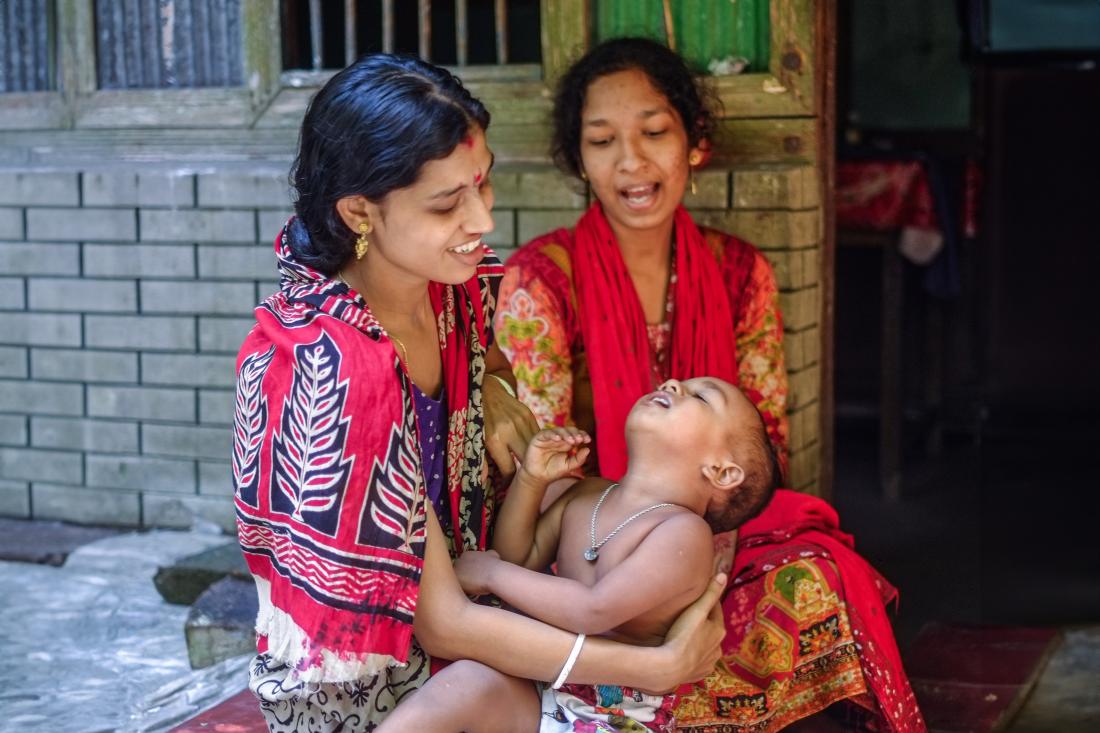
Researchers conducted a randomized evaluation to assess how an ECD program delivered through Bangladesh’s existing NNS program impacted children's development. By leveraging existing NNS program infrastructure and implementation support from Save the Children, the intervention was delivered at scale to more than 18,000 children aged 3-18 months.
Existing NNS community health workers delivered the ECD program. The average health worker had over 12 years of relevant nutrition experience but was not an early childhood expert, so Save the Children provided the workers with four days of ECD training plus periodic refresher training sessions. Most of the community health workers were female, and they usually engaged with mothers during their visits. They did not receive additional compensation to provide ECD services.
The evaluation took place over 15 months across 78 community clinics in the Barisal, Chittagong, and Sylhet divisions of Bangladesh. Each community clinic contained 33 households, each with children between 3 and 18 months old, that were included in the evaluation. The clinics and their corresponding households were randomized into two groups:
- Intervention group (39 community clinics): Families covered by these clinics received the ECD program on top of the standard NNS program. As part of the add-on ECD program, participating parents received regular ECD counseling during the monthly nutrition visits and the following educational materials: a card containing information on age-appropriate child stimulation practices (including everyday play and communication), two picture books, and a booklet that summarized the key information parents received during ECD counseling.
- Comparison group (39 community clinics): Families covered by these clinics received only the standard NNS program.
Before the program was implemented, the researchers surveyed the 2,574 households included in the study about their socio-economic status, parenting practices, and child development outcomes. One to three months after the program’s completion, the researchers administered the survey again, and the children in the survey sample participated in tests that measured their physical, cognitive, social-emotional, linguistic, and behavioral development outcomes.1
Resultados y lecciones de la política pública
Overall, the 3–18-month-old children in the intervention group made improvements in their cognitive, linguistic, socio-emotional, and physical development thanks to the additional support their parents received from NNS service providers. These results show promise in cost-effectively scaling up a light-touch ECD program through an existing government service.
Community health workers’ behavior: NNS service providers who received ECD training maintained their typical household visit duration of around 11 minutes. Within that time, they shifted about 3 minutes from nutrition discussions to cover ECD topics. This time reallocation did not equate to lower quality visits on the nutrition side. Service providers who received ECD training developed a greater appreciation for not only parent-child interaction importance, but also for child nutrition practices compared to their colleagues who did not receive ECD training.
Parents’ behavior: Mothers who received guidance from ECD-trained service providers engaged their children in a greater variety of play and learning activities beyond those provided through the ECD program. They also became more involved in family decisions, especially regarding their children’s health and development. Additionally, parents in the intervention group were also more likely to use NNS program services such as child growth monitoring.
Early childhood development: Children aged 3-18 months whose parents received ECD support showed improvements in their cognitive, language, and socio-emotional development. They scored 1.2 points (1.4 percent) higher on a cognitive test and 2.2 points (2.5 percent) higher on a language test than children in comparison households who scored an average of 84.3 points and 88.4 points, respectively. Their socio-emotional development also improved across multiple behavioral dimensions measured by a recognized nine-point rating scale, with increases of 0.17 to 0.2 points (3.2 to 6 percent) on various aspects of ECD and emotional development. These improvements are comparable to results from smaller-scale programs that offered service provider incentives.
Nutritional outcomes: Even though NNS service providers spent less time discussing nutrition, children who received the add-on ECD program had better nutritional outcomes than those who did not receive it. These children were 4.8 percentage points less likely to be too thin for their height (i.e. wasting) — a 40.7 percent reduction from the comparison group’s rate of 11.8 percent. They were also 2.9 percentage points less likely to be too underweight for their age — an 8.8 percent reduction from the comparison group’s rate of 33 percent. This result shows that the add-on ECD program may have encouraged parents to take-up the standard nutrition program.
Indirect effects on siblings: Siblings of the young children targeted by the ECD program also had better outcomes, suggesting that parents applied better childcare practices to all their children. Pre-primary age (5-7 years old) siblings were 6.2 percentage points more likely to attend school than siblings of the same age in comparison households (9.5 percent greater than the comparison group rate of 65 percent), and 10- to 14-year-old siblings were 1.5 percentage points less likely to be engaged in child labor (1.5 percent lower than the comparison group rate of 98.1 percent).
Balasundaram, Palanikumar, and Indirapriya Darshini Avulakunta. “Bayley Scales Of Infant and Toddler Development.” In StatPearls. Treasure Island (FL): StatPearls Publishing, 2025. http://www.ncbi.nlm.nih.gov/books/NBK567715/.