Understanding environmental challenges in Indonesia: The importance of collaboration, evidence, and context
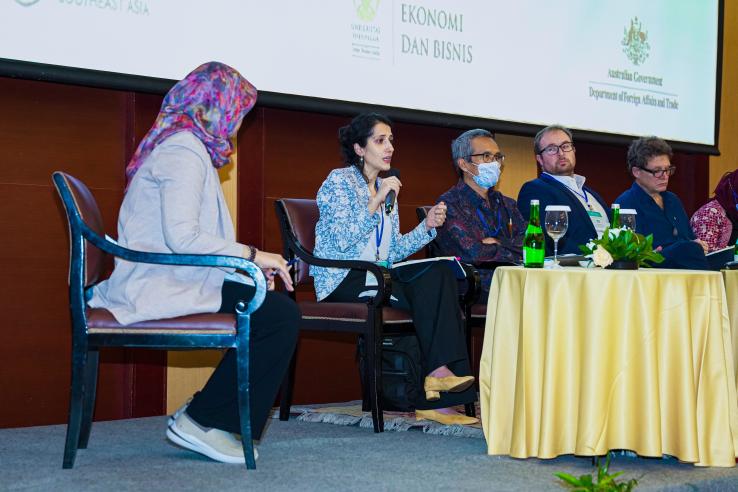
From left: Alin Halimatussadiah, Namrata Kala, Sudarno Sumarto, Ryan Edwards, Robin Burgess
To further support the important work by the Government of Indonesia (GoI) to build climate resilience and a sustainable environment, J-PAL Southeast Asia held a conference on October 25, 2022, to bring together policymakers and practitioners in the field. The conference shared insights from rigorous evidence that is aimed to support the efforts to increase climate mitigation and adaptation in Indonesia.
Like many countries across the globe, climate change increasingly poses a risk to the socioeconomic development of Indonesia. The consequences are disproportionately affecting people living in poverty. For example, extreme weather events have made agricultural and fishery activities more susceptible to failure, threatening food security and livelihoods. To help the nation mitigate and adapt to the effects of climate change, the GoI has set a target to reduce greenhouse gas emissions by 31.89 percent by 2030 and began the development of innovative policies, such as mangrove ecosystem restoration and community forest management. The government also made commitments to reduce the use of coal and oil and move towards sustainable energy sources.
The conference connected over 130 participants from government agencies, research and academic institutions, and nonprofit organizations (NGOs) to foster collaboration in seeking solutions to climate change. Attendees had the opportunity to hear opening remarks from two government officials. H.E. Nadiem Anwar Makarim (Minister of Education, Culture, Research, and Technology, Government of Indonesia) highlighted the importance of equipping Indonesian youth with the knowledge to combat the effects of climate change through education, while Ir. Sigit Reliantoro (Director General of Environmental Pollution and Degradation Control, Ministry of Environment and Forestry) emphasized that the key to sustainable development is making sure the goals are in tandem with environmental needs.
“Climate change is a crisis that we have to face together. We need a systemic socioeconomic transformation that puts forward our relationship with the environment to create harmony between development and environment.” — Ir. Sigit Reliantoro
Following the remarks, researchers, policymakers, and participants shared valuable insights on some of the most prominent themes when addressing Indonesia’s environmental challenges: forests and marine ecosystems, sustainable energy, air pollution, and urban transport.
Below are key takeaways from the conference:

Photo: Anemone Studio
1. Collaboration across sectors is key to addressing climate challenges
As the number of conversations surrounding the urgency of addressing climate change grows, so too are the efforts of policymakers, academics, and practitioners. Collaboration is essential given the involvement of many stakeholders. As highlighted by H.E. Nadiem Anwar Makarim in his opening remarks, “Stakeholders from different sectors must be involved in the discussion of tackling environmental challenges in order to have more comprehensive discussions and produce strategic solutions.”
In this regard, all sectors play an important role in addressing climate change. For example, while the government works to create policies and regulations to promote environmental sustainability and incentives to improve people’s access to climate change mitigation and adaptation programs, the private sector can invest in innovative technology and new disruptive business models. Academics, on the other hand, can help fill knowledge gaps on the real-world impacts of climate solutions through research. Conferences, such as this one, can be effective means to encourage collaboration among key stakeholders, build connections, and exchange knowledge that could help to provide solutions for improving environmental sustainability.
2. Data and evidence are needed for effective policies
Randomized evaluation is one of the methods that can be used to measure policy impact and generate rigorous evidence. Having reliable and accurate insights are particularly important to inform new policies or improve existing programs.
Zooming into the issue of deforestation, one policy approach to reducing forest burning is to provide payments for ecosystem services (PES), where individuals are paid to refrain from environmentally damaging behavior. An impact evaluation in Uganda showed that implementing PES can be an effective way to conserve forests. Nevertheless, when it comes to implementing PES in Indonesia, more research is needed. During the conference, Benjamin Olken (Scientific Director, J-PAL SEA) highlighted the importance of identifying the best way to design the policy to ensure its effectiveness.
Overall, employing research is key to supporting evidence-based policymaking. Evidence is especially valuable given that there are new innovative policies that Indonesia is exploring in response to climate change issues, such as emission monitoring systems, vehicle emission testing, and the development of an electric vehicle ecosystem.
3. Solutions should factor in the local context
Speakers and participants at the conference discussed different policy solutions that have been implemented globally to address different environmental challenges, such as the use of prepaid meters to reduce electricity consumption or the adoption of electric vehicles to cut air pollution. However, when adopting policies from other countries, it is important to take into account the local context. This includes weighing in not only the location, but also how the local condition, the general behavior of the communities, and the implementation capacity would look like in the new setting.
Take fossil fuel alternatives as an example. While the use of electric vehicles can be a solution to air pollution and has been adopted by several countries, participants at the conference pointed out that paying attention to the main energy source is crucial when pushing for its development. Policies related to the use of electric vehicles need to be aligned with local challenges, such as capacity constraints, to ensure that the solution meets local needs.
Way forward: Building an evidence base for the environment sector
Generating evidence to tackle climate change issues is an essential step towards a more resilient future. Supporting the wider adoption of rigorous evidence into policy and program formulation is essential, and can help policymakers and practitioners better understand the nexus between the environment and other sectors, such as gender, health, labor markets, and finance. As it becomes more pressing for Indonesia to adopt effective climate change mitigation and adaptation strategies, J-PAL looks to further support the work of academic researchers and policymakers by facilitating more government partnerships and generating more evidence to inform climate policy and programming.

Curbing deforestation in developing countries may be a cost-effective way to reduce carbon emissions and address climate change. Innovations for Poverty Action worked with researchers to evaluate the effectiveness of a payments for ecosystem services (PES) program, in which Ugandan landowners were paid not to cut forest trees on their property. During the study period, landowners who were offered contracts to conserve forest cleared 4 percent of forested land, compared to 9 percent in villages where the program was not offered. This equates to delaying 3000 metric tons of carbon dioxide per village from being released into the atmosphere, at a cost of 46 cents per ton.
Policy issue
Deforestation is the second largest source of human-created carbon emissions, after fossil fuels. When trees are cut, they stop absorbing carbon dioxide from the atmosphere, and as they decompose or are burned, they release stored carbon into the atmosphere. Curbing deforestation in developing countries is potentially a very cost-effective way to reduce carbon emissions and address climate change. The United Nations has established the REDD+ Programme (Reducing Emissions from Deforestation and Degradation) to reward low-income countries for preserving forested land. Despite growing interest and investment in reducing deforestation, little rigorous research has been conducted on the most cost-effective ways to do so.
One policy approach is to provide payments for ecosystem services (PES), where individuals are paid to refrain from environmentally damaging behavior, such as cutting down trees on their land. PES programs are increasingly popular, especially in developing countries, because they are voluntary so do not force people to protect the environment or impoverish them by taking away a key source of income. However, it is not clear what portion of payments go to forest owners who were not intending to cut down trees anyway. Furthermore, individuals could comply with the contracts for covered land to receive payment but shift deforestation activities to other land. This is the first randomized evaluation of a deforestation PES program, designed to measure its effectiveness and cost-effectiveness.
Context of the evaluation
Between 2000 and 2010, Uganda lost forest at a rate of 2.6 percent per year, the third highest of any country in the world. The rate is even higher on privately owned land, which represents about 70 percent of Ugandan forests. These forests are home to endangered chimpanzees, which may tourists travel to Uganda to see, and forested areas provide watershed and flooding protection.
The project took place in the districts of Hoima and Kibaale, which are located in the equatorial zone of western Uganda and have some of the highest deforestation rates in the country. These districts are predominantly rural and have a combined population of around 750,000 inhabitants. The PES project was specifically targeted at private landowners of forested land, as they are the ones who decide whether or not to clear trees from their land. Landowners in the area often cut trees to clear land for growing crops for their own consumption, or in some cases cash crops such as tobacco, or to sell the trees as timber or for charcoal production.
Details of the intervention
Innovations for Poverty action worked with researchers to test the impact of a PES program on forest conservation. Researchers randomly assigned 121 villages in the Hoima and Kibaale districts of Uganda to receive the PES program (60 villages) or to the comparison group (61 villages).
In the villages with the program, a local nonprofit, Chimpanzee Sanctuary and Wildlife Conservation Trust (CSWCT), offered owners of forested land a contract under which they could receive annual payments of 70,000 Ugandan shillings (equivalent to US$28) per hectare for conserving forested land. Landowners were required to refrain from cutting trees on their land (with some exceptions) and could receive additional payments for planting new trees on a portion of their land. The average landowner held two hectares of forest area, yielding the opportunity to earn up to US$56 per year (approximately 5 percent of average annual income). This amount was comparable with what landowners might earn for selling timber from a large tree, approximately US$20 to $40. CSWCT employees monitored compliance with the contract by conducting random spot checks to look for signs of tree cutting. The program lasted for two years.
Landowners were surveyed before the beginning of the program and 1.5 years after it began. Surveyors measured the GPS coordinates of landowners’ homes, which allowed researchers to independently confirm how many trees were around each landowner’s property using commercial satellites. A computer algorithm determined if each pixel in the satellite image (measuring 2.4 by 2.4 meters) contained a tree at the beginning and end of the study period.
Results and policy lessons
Even with relatively low participation rates, the PES program appears to have been an effective and cost-effective way of averting carbon dioxide release.
Take-up: Program take-up was relatively low, at 32 percent, even though the program was designed to be simple and low-risk for landowners (farmers would not receive payments if they cut down trees, but there were no other commitments or penalties). Qualitative interviews suggested that two-thirds of individuals who did not sign up were simply unaware of the program or faced logistical problems in the sign-up process. A small minority said that they did not sign up because they were not interested in the program.
Payments: The average landowner who participated in the program received the equivalent of US$113, approximately 80 percent of the maximum amount they were eligible to earn. The bulk of payments (89 percent) were for avoiding deforestation, rather than for planting new seedlings.
Effects on deforestation: Despite the relatively low number of participating landowners, the program resulted in significantly less deforestation in the villages were it operated. While tree cover in the comparison villages declined by 9.1 percent in the comparison villages over the course of the study, this number was 4.2 percent in the villages with the program. This resulted in an estimated cost of US$0.46 per ton of carbon delayed from entering the atmosphere, roughly half of the social cost of carbon—the overall negative economic impact of carbon pollution on society —which the United States Environmental Protection Agency estimates to be US$1.11 per ton for the delay induced by the program. By comparison, programs designed to reduce pollution such as subsidizing electric cars or providing incentives to upgrade to more efficient appliances can cost more than ten times the social cost of carbon emissions they avert.
Unintended effects: Some fear that PES programs only appeal to landowners who would have kept their forests intact without the program or that they cause landowners to shift tree cutting to other lands. Researchers did not find evidence for either of these concerns., In fact, the program appeared attract landowners who would have had higher rates of tree-cutting had they not been in the program, and satellite data showed that participants did not shift tree-cutting to other areas by colluding with their neighbors or by cutting down trees on areas not covered by contracts.
Effects on households: The program was financially neutral for most participants, as there were no increases or decreases in expenditures or borrowing. The program led landowners to patrol their own land more often, and they became less likely to allow landless neighbors to gather firewood on their property (even though collecting fallen wood was allowed). As non-landowners are generally poorer than landowners, the program may have had a negative impact on poorer members of the community.
The Amazon Forest–covering over nine countries in Latin America–has an essential role in the environment and climate. Which policies are the most effective in protecting it and reducing its deforestation? The blog post outlines some open policy questions for randomized evaluations to conserve the Amazon Forest best.
The Amazon Forest is the largest rainforest in the world, covering six million square kilometers spread over nine countries in South America. Many of the thirty million people inhabiting the Amazon live off the forest’s resources, extracting fruits, timber, and gold, and converting its land to crops and pasture for cattle grazing. Encouraged by weak enforcement, farmers claim parts of the forest as their own land, faking documents to be able to cultivate, sell, or rent it. Deforestation generates economic benefits but results in harmful by-products, such as pollution, violent conflict, disturbances in rain patterns, and greenhouse gas emissions. Individual decision-makers do not necessarily take into account the impact of these by-products on the common well-being and, as a result, their actions may have disastrous social outcomes.
Addressing deforestation within the Amazon is a growing area of focus for J-PAL’s King Climate Action Initiative (K-CAI), which is dedicated to effective and equitable climate action through real-world evidence generation and catalyzing the scale-up of high-impact solutions. The initiative has supported projects on climate change mitigation, pollution reduction, climate change adaptation, and energy access worldwide since 2020—including a randomized evaluation and a scaling project in Latin America and the Caribbean. However, more research in the region is needed.
The Amazon Forest’s immense size and its important role in the environment and climate warrant specific attention. The main question we want to answer is: which policies, or combination of policies, are the most effective in reducing Amazon deforestation? Several policies may, in principle, make sense and appear as plausible solutions for a problem, but without policy evaluations it is hard to compare them.
Evaluating policies to reduce deforestation
Despite the variety of policies by governments, companies, and NGOs in the Amazon Forest, little is known about their cost-effectiveness and causal impact on behavior. Rigorous policy evaluations can help fill this gap and shed light on policy design. A recent body of non-experimental research, mainly based on observational methods, tried to estimate the impact of conservation policies in the Amazon Forest. It found positive effects of environmental fines on conservation and reforestation, and that real-time monitoring alerts substantially contributed to enforcement. Moreover, indigenous land designation, conditional cash transfers, and subsidized loans were successful policies to reduce deforestation. However, there are still very few randomized evaluations studying Amazon conservation.
Randomized evaluations are powerful tools to understand the mechanisms through which policy could affect human behavior. In other contexts, rigorous evidence from randomized evaluations showed that paying farmers for conservation reduced deforestation in Uganda and that fixing incentives for environmental auditors improved compliance in India. Currently, K-CAI is supporting a scale-up of a payments scheme in Mexico that is adapting lessons from the deforestation evaluation in Uganda, and a training program for ecosystem protection in the Dominican Republic.
Randomized evaluations can provide useful answers to several open questions in conservation policy, and there are five areas with open questions of great relevance for the Amazon Forest.
- Command and control policies impose bans on deforestation, regardless of individual costs and benefits. For example, in Brazil farmers are obliged to leave eighty percent of their farm covered by native vegetation. This type of policy relies heavily on the government’s ability to enforce the regulation via inspections and sanctions, which raises several puzzling questions about how to design an enforcement system. What are the benefits of automating decision-making for inspections? What is the impact of early communication with farmers, and how should it be designed?
- Land tenure regulations dictate who owns the land and how they can use it. Approximately half of the Amazon Forest is covered by protected areas, which cannot be economically exploited. Moreover, sustainable timber use could effectively protect forests while allowing for partial deforestation. Land tenure regulation raises many relevant unanswered questions: Does assigning forests as protected territory reduce land grabbing? Are forest concessions more cost-effective than command and control policies? Which concession agreement terms are more likely to attract reliable, compliant companies?
- Monetary incentives, such as payments for ecosystem services or subsidized loans, could be set up in many different ways. The design of payment contracts is full of parameters to adjust, but their effects on behavior and conservation are not well understood. Should payments be made upfront or after an inspection? How much freedom should program participants have in setting conservation areas within their property? Which type of landholder—e.g., farm size, economic activity—is more sensitive to financial incentives?
- Accreditation of producers is often done by labeling organizations as a response to consumers worldwide who are concerned about the environmental costs of products they purchase. The rationale behind these accreditations is to enhance producers’ access to international markets or signal quality to concerned customers. But we lack understanding on how much and through which mechanisms labeling may affect conservation. To what extent does accreditation affect incentives to reduce deforestation? Which aspects of a certification agreement encourage producers to demand accreditation?
- Finally, ideas to foster sustainable practices in forest management are ubiquitous in the debate about forest conservation with socioeconomic development. With its rich biodiversity, the Amazon Forest offers valuable resources that can be exploited sustainably. It is debatable, however, to what extent it is possible to achieve productivity levels that simultaneously lift people out of poverty and keep the forest alive. Which sustainable harvesting practices generate enough income to lift people out of poverty? Do information campaigns or training help sustainable entrepreneurs access markets and succeed financially?
Looking forward
The questions above are only examples of a research agenda for randomized evaluations, which will help us better understand human behavior to design more impactful policies. The K-CAI team in J-PAL Latin America and the Caribbean (LAC) is currently reaching out to numerous implementing partners in Brazil and Peru to find ongoing or potential policies or programs that may benefit from a rigorous impact evaluation. These institutions include government agencies at national and subnational levels, finance providers, NGOs, and research organizations with experience in field evaluations on environmental topics. Our goal is to match J-PAL affiliated professors and implementing partners together to collaborate on projects in the Amazon Forest for K-CAI’s next funding round in spring 2023.
In Indonesia, there has been growing interest from governments at all levels to adopt a broader culture of evidence- and data-driven policymaking to meet the needs of the country’s most marginalized constituents. However, bridging research and policymaking is often not a straightforward process.
Read part one of this post on "Research to Action: Data Sharing for Policy and Program Evaluation."
In Indonesia, there has been growing interest from governments at all levels to adopt a broader culture of evidence- and data-driven policymaking to meet the needs of the country’s most marginalized constituents.
One important aspect of increasing evidence adoption is collaboration between policymakers and researchers. However, bridging research and policymaking is often not a straightforward process: the fast-paced policy environment, the wide range of actors that contribute to the decision-making process, and the relevance of existing evidence are some of the challenges that create barriers to achieving effective government-researcher collaborations.
With the goal of addressing these barriers, J-PAL Southeast Asia (SEA) hosted a webinar on May 17 featuring Anindito Aditomo, Head of the Agency for Standardization, Curriculum, and Assessment in Education, Ministry of Education, Culture, Research and Technology/MoECRT; Agus Eko Nugroho, Chairman of the Research Organization for Governance, Economy, and Community Welfare, National Research and Innovation Agency; Teguh Dartanto, Dean of the Faculty of Economics and Business, University of Indonesia; and Rema Hanna, co-Scientific Director of J-PAL SEA.
We also had the opportunity to hear opening remarks from Kirsten Bishop, Minister Counsellor of Governance and Human Development, Australian Embassy Jakarta; and a keynote speech from Teuku Faisal Fathani, Acting Director of Research, Technology, and Community Services, MoECRT; and Benjamin Olken, co-Scientific Director of J-PAL SEA.
Below are the key takeaways from the webinar.
1. A culture of evidence-based policymaking starts with the policy community learning from existing workable practices
Incorporating evidence into the process of policy formulation can at times be challenging for the policy community, as not everyone may have the same level of understanding on how to adopt evidence-based policies and programs at scale. Anindito Aditomo (MoECRT) noted that collaborating with experienced researchers can be an entry point to establish the first contact with the culture of evidence- and data-driven policymaking.
Anindito highlighted how the experience of MoECRT in collaborating with J-PAL SEA and INOVASI, A DFAT-funded initiative, have aided the ministry in overcoming institutional barriers when formulating important policy decisions such as Merdeka Belajar (Emancipated Learning), a comprehensive education reform which included the decision to terminate high-stakes national exit exams (Ujian Nasional).
Today, MoECRT regularly collects administrative data on exam results, classroom practices, headmasters, and teachers at the school level that equip MoECRT to tailor interventions to address regional problems.
2. A well-established research identity and an effective dissemination method are key to maintain the relevance of academic research
Research is most effective when it fills in existing knowledge gaps—a point highlighted by Teguh Dartanto (FEB UI) in the webinar.
When there is a policy window or a time-sensitive policy question that needs to be addressed, Teguh pointed out that researchers need to be ready to answer the call for collaboration. However, policymakers often experience difficulty in identifying who they should reach out to since it is sometimes unclear where the expertise of each researcher lies.
One way to address this is by building research clusters in universities. An example of this is the Institute for Advanced Research in Economics and Business at the University of Indonesia, which does not only aim to pave the way for more effective research collaboration but also to contribute to strengthening the identity of local researchers.
Furthermore, another window of opportunity is related to improving research dissemination methods. Due to the gap in expertise, not all academic papers are consumable by policymakers. Research results need to be translated into a more digestible format, such as policy briefs or white papers, and disseminated to a wider audience—something that is also core to the mission of J-PAL. Making the right information "viral" can serve as incentives for researchers to maintain the relevancy of their work.
3. Joint research funding and ease of conducting research collaborations are top priorities for the Government of Indonesia
Establishing joint research funds can also help to strengthen research collaborations. As mentioned by Teuku Faisal Fathani (MoECRT), less than 0.1 percent of Indonesia's GDP is allocated for research and development expenditure in 2019—compared to the ASEAN average of 0.7 percent.
Opening doors for private sector firms, donor agencies, and other organizations to match the research funds allocated by ministry agencies thus presents a strategic opportunity: not only will this set the stage for the creation of more evidence-based policies, but it can also help to strengthen interactions between academics, civil society, donors, and policymakers.
Another important point highlighted by Agus Eko Nugroho (BRIN) was related to the need for an effort to ease the process of setting up research collaborations.
Researchers and policymakers often face technical challenges that can potentially result in evidence being isolated in the academic sphere instead of being utilized properly for policymaking. In addressing this issue, much like J-PAL, BRIN works to connect both local and visiting researchers to relevant government agencies, to co-create research proposals, and establish a research agenda for long-term collaborations.
Looking forward
This discussion clearly demonstrated that government agencies and research institutions share the same goal: The creation of a mutually-aligned collaboration, one that will be able to respond to critical issues in Indonesia and ultimately improve people’s lives.
As awareness of the importance of evidence-based policymaking grows, so too is the demand for engagement between policymakers and academic researchers. J-PAL SEA continues to put government partnerships and effective dissemination at the forefront of our work, and we look forward to more discussions on how to build a sustainable culture of evidence-based policymaking that can lead to the generation of innovative solutions.