

The Abdul Latif Jameel Poverty Action Lab (J-PAL) is a global research center working to reduce poverty by ensuring that policy is informed by scientific evidence. Anchored by a network of more than 1,100 researchers at universities around the world, J-PAL conducts randomized impact evaluations to answer critical questions in the fight against poverty.
J-PAL co-founders Abhijit Banerjee and Esther Duflo, with longtime affiliate Michael Kremer, were awarded the 2019 Nobel Prize in Economics for their pioneering approach to alleviating global poverty.
Research
At J-PAL, we believe investing in rigorous research is essential to finding solutions to the world’s greatest challenges. Working with implementing partners, J-PAL’s affiliated professors conduct randomized impact evaluations to test and improve the effectiveness of social programs.
J-PAL researchers have led more than 2,600 randomized evaluations across a diverse range of topics, from clean water to microfinance to crime prevention. The research group at J-PAL helps create the infrastructure necessary to support our affiliates’ research around the world.
Research staff forge relationships with implementers on the ground and contribute to the design of survey instruments, data collection, statistical analysis, and data publishing. Together, affiliated professors and research staff have established J-PAL as a leader in running high-quality impact evaluations.
We also create practical research resources and make them accessible to all. We focus on tools designed to help researchers develop and carry out randomized evaluations, and to support those teaching the method to others.
Our comprehensive resource library features evaluation manuals, templates and examples of different analysis and survey tools, coding tools for STATA, guidelines on ethics and transparency, and sample lecture slides and case studies. J-PAL also provides affiliated professors with grants and technical assistance to promote research transparency.
In addition to generating research resources, J-PAL staff serve as “matchmakers,” helping connect affiliates with implementing partners to catalyze new research and innovation. Our funding initiatives for affiliated professors support randomized evaluations that seek solutions to policy challenges in governance, post-primary education, healthcare delivery, and child health, among other topics.
In this way, J-PAL research contributes to the ecosystem of knowledge and evidence on key questions in social policy and international development.
Informing Policy and Practice
J-PAL translates research into action, promoting a culture of evidence-informed policymaking around the world. Our policy analysis and outreach helps governments, NGOs, donors, and the private sector apply evidence from randomized evaluations to their work, and contributes to public discourse around some of the most pressing questions in social policy and international development.
J-PAL bridges gaps between researchers and policymakers. We understand that for data and research to be influential, it must address local priorities and be accessible to decision-makers.
We work with J-PAL affiliated professors to distill results from rigorous impact evaluations into lessons that are clear, concise, and relevant to policymakers. With an in-depth understanding of the landscape of high-quality scientific research, we develop and disseminate cross-cutting policy insights.
We build partnerships with governments, NGOs, and high-level decision-makers to support use of evidence to drive policy reform and catalyze adoption of evidence at scale. This includes providing funding, technical assistance, and embedded staff to help shape programs and policies that deliver results.
To date, more than 850 million people have been reached by programs and policies that have been informed by evaluations by J-PAL affiliated researchers.
Education and Training
J-PAL works to strengthen the capacity of researchers, policymakers, practitioners, and donors who generate, use, and advocate for evidence in decision-making. With a focus on learning and innovation, we deliver graduate-level open-enrollment online courses and tailored in-person training programs around the world to build skills for impact evaluation.
J-PAL’s suite of training resources includes in-person Evaluating Social Programs courses, customized courses for governments and other partners, and free open-enrollment online courses. Many of our lecture videos, case studies, and teaching resources on randomized evaluations are available online at no cost.
At our courses, participants discuss the importance of theories of change, effective outcome measurement strategies, and key considerations for evaluation design and implementation. Trainings also help decision-makers to distinguish relevant and high-quality evidence to inform policymaking.
J-PAL and MIT Open Learning have also developed a series of rigorous online courses as part of the MITx MicroMasters program in Data, Economics, and Design of Policy (DEDP).
DEDP MicroMasters participants engage with cutting-edge economics research and gain a strong foundation in microeconomics, development economics, public policy, and probability and statistics. Most DEDP MicroMasters courses are taught by MIT professors and are open to anyone interested in using evidence to promote effective policies and programs.
Past Updates
2024–25
2024 was a pivotal year for J-PAL, marked by consequential elections around the world and the rapid realization of AI's potential to reshape our world.
2023-24
The 2023-24 edition of “Improving Lives Through Evidence” is a call to action for urgent collaboration to achieve a shared vision for a better world. Instead of despairing at the size and stickiness of our problems, we must proactively collaborate on designing innovative solutions, rigorously testing them, and then working carefully to scale them up.
2022-23
As we enter J-PAL’s third decade, there is no shortage of challenges: Climate change, humanitarian crises, persistent bias and discrimination, and lagging early childhood development are all sobering reminders of how much urgent work there is still to do.
2021-22
The Covid-19 pandemic continues to disrupt people’s lives and communities across the world. Evidence-informed policymaking is key to ensuring that the most vulnerable are able to adapt. In the 2021-22 edition of "Improving Lives Through Evidence," learn how we forged partnerships for more equitable and evidence-informed policies in 2021, and how we will build on our vision in the new year.
2020-21
Last year brought new challenges and demanded innovative solutions. Read how our research, policy, and capacity building work evolved to adapt to lockdowns and meet new evidence needs in the 2020-21 edition of “Improving Lives Through Evidence."
2019-20
We launched many exciting initiatives to expand the frontiers of research and evidence-informed policy, and our existing research initiatives contributed funding to help launch 56 new randomized evaluations that test the most effective approaches to fighting poverty. We grew our online MicroMasters program and admitted the first class of students in our new Master’s in Data, Economics, and Development Policy at MIT. And we welcomed 20 top researchers to our affiliate network, while growing our talented team of research, policy, training, and operations staff worldwide.
2019 was also notable for an exceptional reason: J-PAL co-founders Abhijit Banerjee and Esther Duflo and our longtime affiliate Michael Kremer were awarded the 2019 Nobel Prize in Economics for their experimental approach to alleviating global poverty.
History
The Poverty Action Lab was founded in 2003 at the Massachusetts Institute of Technology (MIT) by professors Abhijit Banerjee, Esther Duflo, and Sendhil Mullainathan, with the goal of transforming how the world approaches the challenges of global poverty.
In 2005, the lab partnered with Community Jameel, an independent, global organization advancing science to help communities thrive in a rapidly changing world. Following the partnership, the lab was renamed the Abdul Latif Jameel Poverty Action Lab (J-PAL) in honor of the late Abdul Latif Jameel, the founder of Abdul Latif Jameel and father of MIT alumnus and Founder of Community Jameel, Mohammed Jameel KBE.
Today, J-PAL’s core staff includes more than 400 research, policy, education, and training professionals across seven offices worldwide.
J-PAL co-founders Abhijit Banerjee and Esther Duflo, with longtime affiliate Michael Kremer, were awarded the 2019 Nobel Prize in Economics for their pioneering approach to alleviating global poverty. In their announcement, the Nobel Committee noted, "The research conducted by this year’s Laureates has considerably improved our ability to fight global poverty. In just two decades, their new experiment-based approach has transformed development economics, which is now a flourishing field of research."
Our work is generously supported by visionary foundations, governments, and individuals. Major donors include Arnold Ventures, Co-Impact, Community Jameel, The Gates Foundation, The William and Flora Hewlett Foundation, King Philanthropies, The Alfred P. Sloan Foundation, The Target Foundation, The Australian Department of Foreign Affairs and Trade, The National Institutes of Health, and UK International Development.
Timeline

J-PAL publishes the 2025-26 edition of Improving Lives through Evidence, outlining key achievements and priorities for the coming year.
Pictured above, our AI team launches the AI Evidence Playbook at the India AI Impact Summit in February, a practical reference for policymakers, practitioners, and donors investing in or developing AI-enabled programs. It explains how to identify where AI can best help, how to design AI-enabled programs to work in their intended contexts, and how to evaluate programs to build evidence that helps prevent wasted resources and harm.
Our full-day session at the India AI Impact Summit brought together senior government officials leading national AI strategies, researchers evaluating cutting-edge AI applications, and leaders from global tech companies, nonprofits, and key funders. Together, they explored promising uses of AI across education, health, governance, and labor, focusing on what works and what must change for AI to deliver sustained impact at scale.
J-PAL launches the Evidence for AI in Health (EVAH) initiative to help guide the responsible use of AI for health in sub-Sarahan Africa, South Asia, and Southeast Asia. EVAH is supported by the Wellcome Trust, Gates Foundation, and Novo Nordisk Foundation, delivered in partnership with J-PAL and the African Population and Health Research Center.
Timeline
J-PAL publishes the 2025-26 edition of Improving Lives through Evidence, outlining key achievements and priorities for the coming year.
Pictured above, our AI team launches the AI Evidence Playbook at the India AI Impact Summit in February, a practical reference for policymakers, practitioners, and donors investing in or developing AI-enabled programs. It explains how to identify where AI can best help, how to design AI-enabled programs to work in their intended contexts, and how to evaluate programs to build evidence that helps prevent wasted resources and harm.
Our full-day session at the India AI Impact Summit brought together senior government officials leading national AI strategies, researchers evaluating cutting-edge AI applications, and leaders from global tech companies, nonprofits, and key funders. Together, they explored promising uses of AI across education, health, governance, and labor, focusing on what works and what must change for AI to deliver sustained impact at scale.
J-PAL launches the Evidence for AI in Health (EVAH) initiative to help guide the responsible use of AI for health in sub-Sarahan Africa, South Asia, and Southeast Asia. EVAH is supported by the Wellcome Trust, Gates Foundation, and Novo Nordisk Foundation, delivered in partnership with J-PAL and the African Population and Health Research Center.

J-PAL publishes the 2024-25 edition of Improving Lives through Evidence, outlining key achievements and priorities for the coming year.
Global Executive Director Iqbal Dhaliwal reflects on the end of USAID and the many collaborations between USAID, J-PAL, and members of our research network to pilot, evaluate, and scale innovative solutions to alleviate poverty.
J-PAL, with Community Jameel, launch the Alliance for Data, Evaluation, and Policy Training (ADEPT), a global network of universities, governments, and other members working to empower the next generation of policymakers, decision makers, and researchers with the tools to innovate, test, and scale the most effective social policies and programs.
J-PAL launches The Evidence Effect, a new resource on the future of global development, offering a series of practical lessons and examples of effective ways to improve the lives of people living in poverty.
J-PAL and the Energy Policy Institute at the University of Chicago (EPIC) launch the Emissions Market Accelerator (EMA), a new initiative that helps governments in the Global South design, build and implement cap-and-trade markets to reduce pollution.
J-PAL's research network grows to include 392 affiliated professors and 766 invited researchers.

The 2023-24 edition of Improving Lives Through Evidence is published, outlining key achievements and priorities for the coming year.
J-PAL Europe launches the Humanitarian Protection Initiative to help improve the protection of conflict-affected populations.
J-PAL Africa, the City of Cape Town, and Community Jameel launch the Water, Air, and Energy (WAE) Lab to to generate evidence-based solutions aimed at improving access to clean air, water, and reliable energy for Capetonians.
J-PAL's research network grows to include 359 affiliated professors and 667 invited researchers.

J-PAL celebrates its twentieth anniversary.
The 2023 edition of Improving Lives through Evidence is published.
J-PAL launches the Learning for All Initiative to generate evidence to identify education solutions for parents, schools, and governments.
J-PAL Europe launches the Displaced Livelihoods Initiative to help advance sustainable livelihoods for displaced and host communities.
J-PAL renames the MicroMasters® Program in Data, Economics, and Development Policy to the MicroMasters® Program in Data, Economics, and Design of Policy (DEDP) to reflect the expanded curriculum, which includes a Public Policy Track.
J-PAL South Asia launches the Solutions and Advancements through Research for Water and Air (SARWA) to increase access to clean air and water for millions of Indians.
J-PAL partners with University Mohammed VI Polytechnic (UM6P) and forms the UM6P-J-PAL Agricultural Lab for Africa (UJALA) to design and implement rigorous impact evaluations of policies and programs that improve food security in sub-Saharan Africa.
J-PAL's research network grows to include 324 affiliated professors and 632 invited researchers.
The 2021-22 edition of Improving Lives Through Evidence: Trusted Partnerships for Growth is published, outlining key achievements and priorities for the coming year.
J-PAL launches its eleventh sector, Social Protection, and an accompanying Social Protection Initiative to generate rigorous evidence on the effectiveness of social protection programs and to help partners apply evidence to decision-making. The new sector and initiative are chaired by Benjamin Olken (MIT) and Rema Hanna (Harvard).
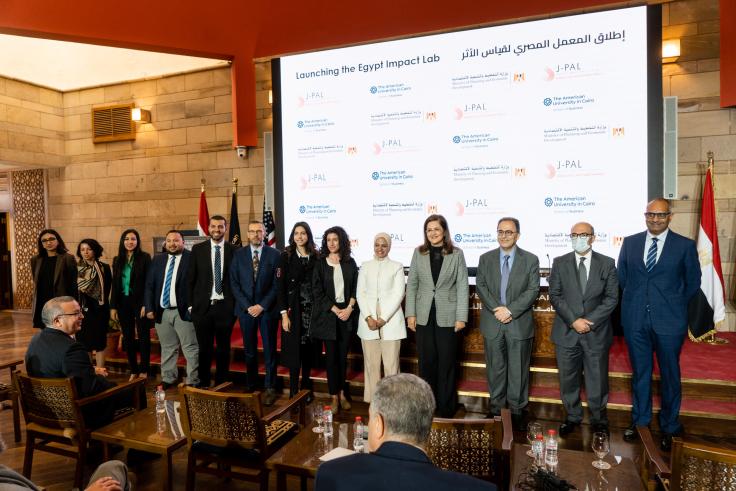
In partnership with Egypt's Ministry of Planning and Economic Development, J-PAL MENA launches the Egypt Impact Lab to strengthen the effectiveness of Egypt’s poverty alleviation policies through rigorous evaluation and innovation.
J-PAL South Asia launches the Alliance for Scaling Policy Impact through Research and Evidence (ASPIRE) to strengthen the culture of evidence-based policymaking in India.
Community Jameel and Co-Impact Lab announce a landmark partnership for J-PAL’s expanded Evidence to Policy work, with a particular focus in Africa, LAC, MENA, and South Asia.
J-PAL's research network grows to include 294 affiliated professors and 424 invited researchers.
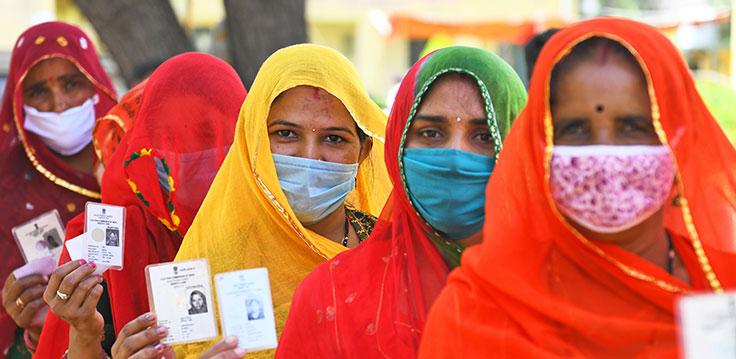
The 2020-21 edition of Improving Lives Through Evidence is published.
The Jobs and Opportunity Initiative is launched in Brazil (JOI Brazil) to evaluate innovative strategies that address the country’s most pressing employment challenges.
J-PAL South Asia launches the Indian Scholars Program to strengthen ties with India-based researchers.
The second cohort of thirteen Master's in Data, Economics, and Development Policy (subsequently renamed Data, Economics, and Design of Policy) students arrive safely at MIT.
The Digital Agricultural Innovations and Services Initiative, a partnership between J-PAL and CEGA, is launched to support innovative, policy-relevant research on the availability, quality, and reach of bundled digital agricultural solutions and services for small-scale agricultural producers.
J-PAL continues to respond to Covid-19.
J-PAL's research network grows to include 261 affiliated professors and 274 invited researchers.
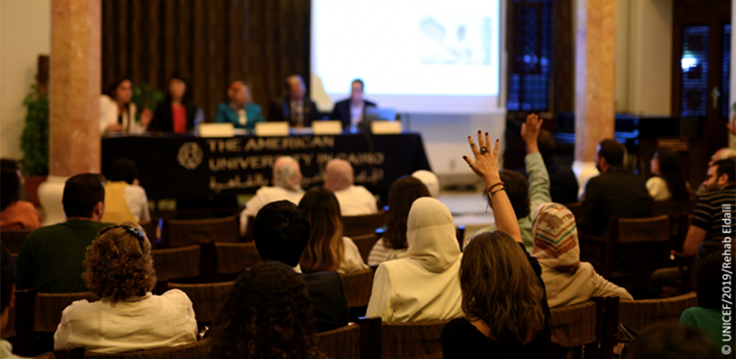
J-PAL Southeast Asia launches the Inclusive Financial Innovation Initiative to answer important policy questions at the forefront of the region’s economic growth.
J-PAL launches the Gender and Economic Agency Initiative to build a body of evidence on policies and programs to promote women’s work and enhance women’s economic agency in East Africa and South Asia.
J-PAL launches the $25 million King Climate Action Initiative (K-CAI) in partnership with King Philanthropies. The initiative will support innovative research and policy engagement to combat climate change and poverty around the world.
J-PAL launches the Jobs and Opportunity Initiative to generate a body of policy-relevant rigorous research that addresses pressing labor market challenges.
The first class of 22 students from 14 countries graduated from J-PAL and MIT’s joint Master’s in Data, Economics, and Development Policy program (subsequently renamed Data, Economics, and Design of Policy).
J-PAL North America launches the COVID-19 Recovery and Resilience Initiative, which aims to create a playbook of evidence-based policies to help communities in the United States recover in the wake of COVID-19.
J-PAL Middle East and North Africa opens at the American University in Cairo with support from Community Jameel, becoming J-PAL’s seventh regional research center.
J-PAL responds to the COVID-19 pandemic, taking major steps to ensure the safety of staff, researchers, research participants, and communities; and pivot research, training, and policy efforts to respond to urgent needs created by the pandemic.
J-PAL's research network grows to include 224 affiliated professors and 274 invited researchers.

The Innovation in Government Initiative launches, a series of scale-up innovation competitions open to teams of governments, J-PAL regional offices, and J-PAL affiliated professors in low- and middle-income countries. Winning teams will receive funding from J-PAL to support a broad range of technical assistance to governments to adapt, pilot, monitor, evaluate, and scale evidence-informed innovations.
The Innovations in Data and Experiments for Action (IDEA) Initiative launches, dedicating funding and technical assistance to increase the use of administrative data by governments, nonprofits, and private firms for evidence-informed decision-making.
The Africa Digital Identification and Finance Initiative (DigiFI) launches, studying the impact of innovative government and private sector payment systems and digital identification reforms on citizens and governments across Africa. DigiFI establishes the African Scholars program to create more opportunities for African scholars to develop and drive the research agenda on the African continent.
Teaching at the Right Level (TaRL) Africa, led jointly by J-PAL and Pratham, is selected as one of five initiatives receiving inaugural funding from Co-Impact, a global philanthropic collaborative for systems change.
J-PAL co-founders Abhijit Banerjee and Esther Duflo, above, with longtime J-PAL affiliate Michael Kremer, are awarded the 2019 Sveriges Riksbank Prize in Economic Sciences in Memory of Alfred Nobel. In awarding the prize, the Royal Swedish Academy of Sciences said, "The research conducted by this year’s Laureates has considerably improved our ability to fight global poverty. In just two decades, their new experiment-based approach has transformed development economics, which is now a flourishing field of research."
The European Social Inclusion Initiative launches, generating and sharing widely applicable lessons about which programs are effective at promoting the inclusion of migrants and refugees in Europe.
J-PAL's research network grows to include 194 affiliated professors and 229 invited researchers.

Iqbal Dhaliwal is appointed Global Executive Director of J-PAL. Previously, Iqbal served as J-PAL's Deputy Executive Director, and founding Director of its Policy and Communications group.
J-PAL launches Policy Insights, a library of policy lessons emerging from randomized evaluations. Combined with a detailed understanding of context and program implementation, Policy Insights are designed to be practical inputs for policy and program design.
J-PAL launches the Gender sector, focusing on producing cross-cutting insights on promoting gender equality and women's and girls' empowerment.
J-PAL launches the Firms sector, focusing on identifying how best to help private sector firms grow, innovate, and contribute to economic growth, and on understanding the impact of firms on workers' wellbeing in and out of the workplace.
J-PAL and the American University in Cairo (AUC) partner to create the J-PAL/AUC Initiative for Egypt. Through this partnership, AUC hosts J-PAL staff in Egypt, supports evaluations by J-PAL affiliated researchers, and collaborates with J-PAL on policy and capacity building efforts.
J-PAL North America launches the Education Technology Innovation Competition to support education leaders in using randomized evaluations to generate evidence on how technology can improve student learning, with support from the Laura and John Arnold Foundation and the Overdeck Family Foundation.
J-PAL's research network grows to include 174 affiliates professors and 194 invited researchers.

The Zambian Ministry of General Education commits to scaling up the evidence-backed Teaching at the Right Level approach to 1,800 schools in the country over the next three years, with support from the USAID Zambia Mission and USAID Development Innovation Ventures, and pilot funding provided by J-PAL's Government Partnership Initiative.
J-PAL and MIT Economics partner to launch the MicroMasters in Data, Economics and Development Policy (subsequently renamed Data, Economics, and Design of Policy), which offers learners from around the world the opportunity to take rigorous online classes in development economics. With the goal of empowering young professionals to hone their technical skills, the program reached over 10,000 learners from more than 180 countries in 2017 alone.
J-PAL Latin America and the Caribbean partners with Brazil's National School of Public Administration (ENAP) to develop and launch the first-ever massive open online course on impact evaluation to be offered in Portuguese. The course is an adaptation of J-PAL's flagship executive education course, Evaluating Social Programs, and will be included as a regular ENAP course offering, reaching 80,000 public officials every year. Funding for the course's development and launch was provided by J-PAL’s Government Partnership Initiative.
Former Executive Director Rachel Glennerster takes leave to serve as Chief Economist at the UK Department for International Development.
J-PAL launches three research initiatives to generate new randomized evaluations that focus on open questions relevant to policymakers: the Cash Transfers for Child Health Initiative, based at J-PAL South Asia; the Skills for Youth Program, based at J-PAL Latin America and the Caribbean; and the Crime and Violence Initiative. DFID awards J-PAL and IPA US$16 million to support innovative research in governance, crime, and conflict.
J-PAL's research network grows to include 159 affiliated professors and 140 invited researchers.
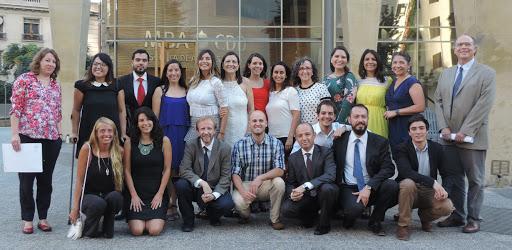
J-PAL Latin America and the Caribbean (LAC) and the Instituto Tecnológico Autónomo de México (ITAM) launch a partnership to boost research projects in Mexico and the region. Through this partnership, ITAM hosts J-PAL LAC staff in Mexico, supports evaluations by J-PAL affiliated researchers, and collaborates with J-PAL LAC on policy outreach.
J-PAL receives a grant from the Alfred P. Sloan Foundation and Laura and John Arnold Foundation to improve research quality, reproduce research results on a large scale, and launch online training programs for transparency and data security. This effort represents one of the first of its kind for randomized evaluations in the social sciences.
J-PAL LAC launches a Diploma in Impact Evaluation of Public Policy and Social Programs (Diplomado en Evaluación de Impacto de Programas y Políticas Públicas) in collaboration with the Economics Department at the Pontificia Universidad Católica de Chile. This rigorous one-year program is taught by J-PAL affiliated professors and offers high-quality education in development economics, impact evaluation methods, and evaluation management.
J-PAL's research network grows to include 142 affiliated professors and 128 invited researchers.

J-PAL launches the Government Partnership Initiative (GPI) with support from Community Jameel to build long-term partnerships between governments, J-PAL offices, and affiliated researchers to increase the use of evidence in policymaking.
J-PAL North America launches the State and Local Innovation Initiative to facilitate partnerships between US state and local governments and leading academic researchers from J-PAL’s global network to identify evidence-informed solutions to challenging social problems.
J-PAL's research network grows to include 128 affiliated professors and 101 invited researchers.

J-PAL launches an online version of the Executive Education course on edX, J-PAL101x: Evaluating Social Programs. Over 12,000 students from nearly 180 countries registered for the first course, and nearly 1,000 received certificates of completion.
J-PAL receives the Albert O. Hirschman Prize from the Social Science Research Council in recognition of their commitment to producing new social scientific knowledge that confronts deep practical and ethical issues.
J-PAL begins a long-term partnership with the Government of Tamil Nadu to institutionalize the use of evidence in policymaking by evaluating innovative programs, strengthening monitoring systems, and enhancing the officials’ capacity to produce and use scientific evidence.
J-PAL LAC and IPA begin a partnership with the Ministry of Education of Peru to implement an Education Lab (MineduLab) to design and evaluate low-cost, innovative, interventions to improve learning outcomes.
J-PAL launches the Crime, Violence, and Conflict sector.
J-PAL North America launches the U.S. Health Care Delivery Initiative with support from the Laura and John Arnold Foundation and the Robert Wood Johnson Foundation.
J-PAL's research network grows to include 107 affiliates and 79 invited researchers.
J-PAL begins a long-term partnership with the Ministry of Finance and Economic Planning of Rwanda to discuss scientific evidence and how their development policies can be informed.
J-PAL North America opens at the Department of Economics at the Massachusetts Institute of Technology (MIT) with support from the Alfred P. Sloan Foundation and the Laura and John Arnold Foundation.
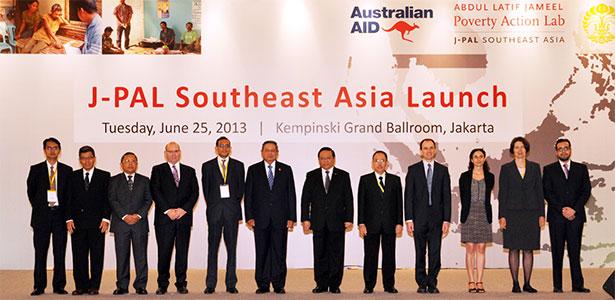
The President of Indonesia inaugurates J-PAL Southeast Asia established at the Institute for Economic and Social Research at the University of Indonesia with support from Australia's Department of Foreign Affairs and Trade.
J-PAL affiliate Raj Chetty wins the John Bates Clark medal, awarded to the top economist under age 40.
J-PAL's affiliate network grows to include 90 professors and 11 invited researchers.

J-PAL LAC and its partners Enterprise Solutions to Poverty (SEP), Innovations for Poverty Action (IPA), the Ministry of Economy and Finance (MEF), and the Ministry of Social Development and Inclusion of Peru (MIDIS) of Peru assembles the Quipu Commission to generate evidence that the government can use to design and implement better social policies.
MIT professor Ben Olken joins Abhijit Banerjee and Esther Duflo as Co-Director of J-PAL.
The Youth Initiative (YI) and the Post-Primary Education (PPE) are launched with support from the Nike Foundation, and Echidna Giving, the John D. and Catherine T. MacArthur Foundation, the Douglas B. Marshall, Jr. Family Foundation, and the UK Department for International Development.
Amy Finkelstein, Scientific Director of J-PAL North America, wins the John Bates Clark medal. The medal is awarded to the top economist under age 40.
J-PAL's affiliate network grows to 71 professors.
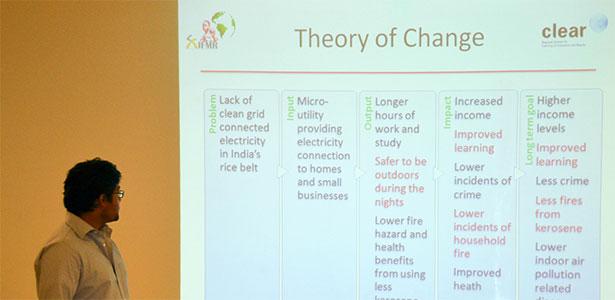
The Regional Centers for Learning on Evaluation and Results (CLEAR) is established at J-PAL South Asia with support from the World Bank to strengthen the monitoring and evaluation capacity of governments and civil societies.
J-PAL assembles the Compass Commission, a group of international and local academics who will identify the major social policy challenges in Chile and propose innovative programs and their evaluations to the Government.
J-PAL begins long-term partnership with India’s National Academy of Administration to conduct evidence workshops and trainings on impact evaluations for senior civil servants of the Indian Administrative Service (IAS).
J-PAL’s research is organized in seven sectors: Agriculture, Education, Environment and Energy, Finance and Microfinance, Health, Labor Markets, and Political Economy and Governance.
The Governance Initiative (GI) and the Urban Services Initiative (USI) are launched with support from The William and Flora Hewlett Foundation and the UK Department for International Development, and the Bill & Melinda Gates Foundation respectively.
J-PAL's affiliate network grows to include 64 professors.

Esther Duflo wins the John Bates Clark medal, awarded to the top economist under age 40. She is the second woman to win the award.
Esther Duflo presents a TED Talk on social experiments to fight poverty.
J-PAL creates a Board of Directors to provide overall strategic guidance and also help expand activities in research, capacity building, and policy outreach.
J-PAL Africa is established at the Southern Africa Labour and Development Research Unit (SALDRU) at the University of Cape Town in South Africa with support from The William and Flora Hewlett Foundation.
J-PAL's affiliate network grows to include 51 professors.

Iqbal Dhaliwal, above, joins J-PAL as founding director of a dedicated policy group established to bridge the gap between researchers and policymakers. J-PAL's policy analysis and outreach helps governments, NGOs, donors, and the private sector apply evidence from randomized evaluations to their work, and contributes to public discourse around some of the most pressing questions in social policy and international development.
J-PAL Latin America and Caribbean is founded at the Pontifícia Universidad Católica in Santiago, Chile with the support of the Colunga Foundation.
The Agricultural Technology Adoption Initiative (ATAI) is launched with the Center for Effective Global Action (CEGA) at the University of California, Berkeley, with support from the Bill & Melinda Gates Foundation.
J-PAL's affiliate network grows to include 43 professors.
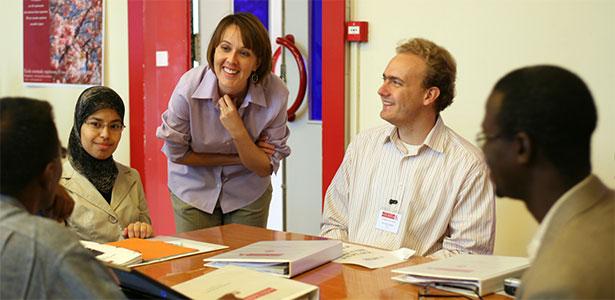
J-PAL Europe is launched at the Paris School of Economics in an effort to promote the use of randomized evaluations in high-income countries.
J-PAL receives the BBVA Foundation Frontiers of Knowledge Award for Development Cooperation. The awards seek to recognize and encourage world-class research and artistic creation, prizing contributions of lasting impact for their originality, theoretical significance and ability to push the frontiers of the world.
J-PAL's affiliate network grows to include 27 professors.
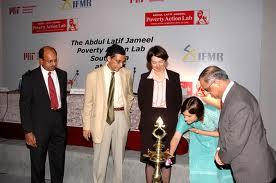
J-PAL South Asia is established at the Institute for Financial Management and Research in Chennai, India, with support of the Mulago Foundation.
J-PAL partners with the Young Global Leaders group to launch a scale-up initiative, Deworm the World, at the World Economic Forum in Davos. Deworm the World has since been scaled up to reach over 292 million children in India, Kenya, Ethiopia, Vietnam, and Nigeria.
J-PAL's affiliate network grows to include 15 professors.
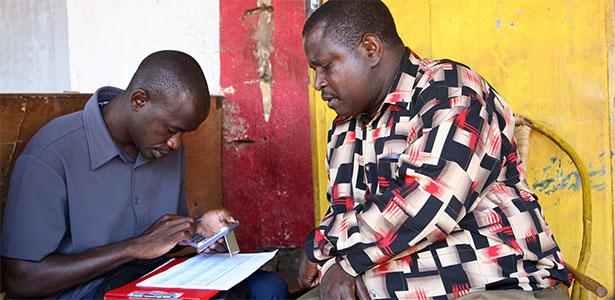
J-PAL receives core support from the William and Flora Hewlett Foundation, the John D. and Catherine T. MacArthur Foundation, the Nike Foundation, Russ Siegelman, and the Doug B. Marshall Jr. Foundation.
J-PAL's affiliate network grows to include 12 professors.
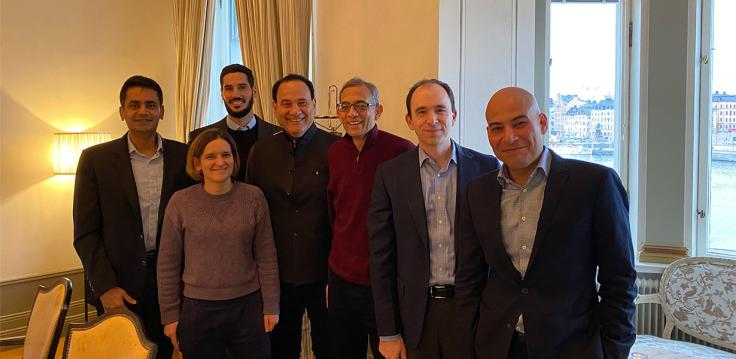
MIT alumnus Mohammed Abdul Latif Jameel, pictured above standing with J-PAL's leadership, backs the Poverty Action Lab with three major endowments, and the lab is re-named in honor of his late father, Abdul Latif Jameel, founder of the Abdul Latif Jameel company. J-PAL formally partners with Community Jameel, an organization established in 2003 to continue the Jameel family's tradition of supporting social and economic sustainability. Thanks to this support, J-PAL is able to grow significantly in the following years.
J-PAL establishes its training group, and provides its first executive education courses in Cambridge, United States and Chennai, India.
J-PAL's affiliate network grows to include 11 professors.


The Poverty Action Lab is founded at the Department of Economics at the Massachusetts Institute of Technology by professors Abhijit Banerjee and Esther Duflo and Sendhil Mullainathan. The objective of the center is to support the use of randomized evaluations, to train others in rigorous scientific evaluation methods, and to encourage policy changes based on results of randomized evaluations, all with the mission of reducing poverty through more effective policies and programs.
Five professors join the Poverty Action Lab in its first cohort of affiliates: Marianne Bertrand, Dean Karlan, Michael Kremer, Dan Levy, and Edward Miguel.
The lab begins a close partnership with Innovations for Poverty Action (IPA), a nonprofit founded by J-PAL affiliate Dean Karlan.