Andrea Adhi, J-PAL ’19, on using interdisciplinary research to support Indonesia’s most vulnerable during Covid-19
The Alumni Spotlight series highlights J-PAL alumni who are making an impact across industries and around the world. To nominate a J-PAL alum to be featured in a future Alumni Spotlight, please fill out this form.
Andrea Adhi is a former research manager at J-PAL Southeast Asia (SEA), where she managed randomized evaluations on branchless banking, migration, and more. Now at PUSKAPA, the Center on Child Protection and Wellbeing at Universitas Indonesia, Andrea leads their team focused on social inclusion and protection. She discusses how she and her team are working to understand and mitigate the impact of Covid-19 on vulnerable groups in Indonesia, particularly children, and how her experience at J-PAL and TNP2K is informing this work.
How did you come to pursue a career dedicated to improving social policy, and why is research your tool of choice?
I grew up asking questions and wanting to solve social problems, and studying economics was my way to do that. It’s possible that I was also influenced by my parents, both of whom have PhDs, and I acknowledge it’s a privilege to have a support system that embraces curiosity.
In university, I had the opportunity to work as a research assistant on a development project and as an assistant teacher for an econometrics class, which (to my surprise) was an enjoyable experience and taught me that I enjoyed working with data.
Poor Economics [authored by J-PAL co-founders Abhijit Banerjee and Esther Duflo] was also really influential on me—the concept of using small questions to solve big problems inspired me to use research to make an impact in society.
Prior to joining J-PAL, you worked as a data analyst at TNP2K, a Government of Indonesia research and policy agency targeting poverty and frequent research collaborator with J-PAL SEA. What did you learn there that has since shaped your career?
Working there was a valuable experience. TNP2K sits within the Government of Indonesia and uses evidence to ensure policy is more effective. I worked in the monitoring and evaluation unit, and my team supervised and controlled the implementation of poverty reduction programs and activities.
One of the projects I was involved with was PKH, a conditional cash transfer program in Indonesia. I worked on the endline study. It was my first job out of undergrad, and it was an incredible experience to go from learning theory in my econometrics books to working hands-on to evaluate this massive program (since published here).
It wasn’t easy—in addition to helping to conceptualize the study and working with a survey company, we also had to plan far in advance and get buy-in from the government in the form of interest and resources. I also learned that one of the hardest parts is what comes after analysis: advocating for the use of results, such as to continue or discontinue the program, improve some aspects, etc. Researchers need to work hand-in-hand with policymakers to make this happen.
For me, TNP2K was a great introduction to the research industry and sharpened my skills in analyzing data, developing survey instruments, and translating research questions into practice, but I felt I still needed to improve my methodological expertise and grow my network. To that end, I applied for and was gratefully selected as one of the awardees of a fully funded government scholarship for a master's degree in economics at Boston University. I’m hoping to one day pursue a PhD as well.
What are some of the most exciting projects you worked on while you were at J-PAL?
I joined J-PAL as a research associate. My first project was an exploratory study testing types of interventions that have the potential to facilitate collective action and, hence, improve local accountability in the context of village law implementation. This means we were examining the viability of the intervention for a future randomized evaluation, so I worked on the literature review, a series of interviews with stakeholders, and a pilot activity in selected villages.
After that, I got involved in the midline and endline stages of an evaluation of the impact of incentives and transparency on new financial products usage in Indonesia. That study gave valuable lessons in how to strengthen financial inclusion in Indonesia, particularly the branchless banking agent network.
I also helped manage a randomized evaluation assessing the impact of providing information about the quality of migration agencies to potential migrants on welfare and the migration market more broadly. After all, I am thankful to have experienced working on a variety of projects spanning all stages of the process!
To do this work, I needed to learn so many things by doing: project management, time management, resourcefulness, communication with stakeholders from the government to the survey company, attentiveness to detail, and more. It was a blessing to be able to experience field work, as it’s so different in practice from how it is in the literature.
It was also really rewarding to be part of a global network of J-PAL and IPA researchers, many of whom I met in J-PAL/IPA’s joint research staff training in Kenya.
You left J-PAL two years ago to lead PUSKAPA’s social inclusion and protection work. Could you tell us about the organization and your role in it? Can you give us an example of a project you are working on?
PUSKAPA is a think tank at Universitas Indonesia that focuses on child protection and well-being. We are an interdisciplinary team of researchers, policy thinkers, and program implementers who work with government and civil society to create inclusive solutions to ensure that all children have access to social care services, health, education, and justice opportunities.
I lead the social inclusion and protection team that focuses on ensuring children and vulnerable individuals can enjoy access to basic services and be safe from harm. We have several ongoing projects to address the issues. Some of them are generating evidence and advocating on how to improve the lives of children in cities and understanding and improving the child protection and social welfare system. We also work with other civil society organizations in advocating for the implementation of a national strategy to prevent child marriage and violence against children.
When you took over this workstream in late 2019, you could not have known how social protection would become so critically important just months into 2020, when Covid-19 upended Indonesia’s economy. How did the pandemic impact your work, and how did you and your team adapt?
The Covid-19 pandemic has magnified all the challenges we already had, and revealed the importance of child protection and welfare in preventing poverty and childhood violence, which hinder human capital and economic growth.
Policymakers sometimes understand these as separate things and try to address them in silos. As researchers, we need to take into account how problems are related in order to address them, especially during emergencies.
The Government of Indonesia, for example, provided cash transfers to support the poorest households during the pandemic. But since these were targeted to existing beneficiaries of health and education programs, some vulnerable groups, like those without legal identities or children outside traditional households, were left out. PUSKAPA worked with the Government of Indonesia to publish a policy paper on how to prevent and manage the impact of Covid-19 on children and vulnerable individuals.
We’re also concerned about those who live without electricity or proper sanitation or clean water, which have all been really important in the pandemic for accessing virtual education and staying healthy. The pandemic has made all these issues worse, but it’s also an opportunity for us to tackle these problems and make improvements throughout the system.
My team’s day-to-day work ranges from advocacy activities to capacity building to data collection and analysis, all of which have been virtual since early 2020. We’ve been working to understand the experience of children living in cities during the pandemic, particularly vulnerable children who are not typically included in official statistics. Because we want to be respectful of their time and are conscious of Zoom fatigue, we are conducting asynchronous interviews with children over Whatsapp and live chat. This allows them to respond to us over a call, voice note, text, pictures, and so on.
We just published a working paper on considerations for the design and implementation of this digital research project. There’s an opportunity here to make data collection even cheaper, faster, and more accessible, although we are conscious that there are groups that we cannot reach and more needs to be done to achieve inclusive online research.
How do PUSKAPA and J-PAL SEA’s activities align? What do you think the two organizations could learn from each other?
PUSKAPA and J-PAL both generate and use evidence to give recommendations to solve policy challenges, and seek to learn from other research as well as dialogues with policymakers. At PUSKAPA, we believe that we can only improve Indonesia’s human development trajectory by preventing and addressing problems at the intersection of poverty, violence and neglect, and emergencies. As this aligns with J-PAL’s mission, I look forward to opportunities for J-PAL and PUSKAPA to collaborate on potential solutions to children’s issues.
Our scope is more narrow but intersects with other sectors: In the context of children and their families and caregivers, we focus on increasing social inclusion and protection, strengthening the legal identity system, and providing access to justice. These are all interrelated—for example, to access government services, you need a legal identity. But if you are low-income or born in a remote rural area, there may be some barriers to getting a birth certificate.
At PUSKAPA, I’ve learned that advocacy starts from the very beginning of defining a research question. We’ve been undertaking interdisciplinary research and using cross-sectoral approaches to understand the situation and solve problems faced by children and vulnerable populations in Indonesia. It makes me keen to learn other research disciplines beyond economics to get a better understanding of system dynamics, and I think there are opportunities for J-PAL to incorporate more interdisciplinary research as well.
Amber Luong and Abhilasha Purwar first met on a J-PAL South Asia research team. Abhilasha has since co-founded Blue Sky Analytics, a climate tech startup, and Amber is now head of partnerships at Blue Sky. Read their story in our latest alumni interview.
Amber Luong and Abhilasha Purwar met while working on a J-PAL South Asia research team evaluating a novel emissions trading scheme in India. Abhilasha has since co-founded Blue Sky Analytics, a climate tech startup aiming to make geospatial data accessible to drive environmental impact, and Amber is now head of partnerships at Blue Sky. They joined us to chat about running a randomized evaluation at the intersection of economics and the environment, the experience of launching a start-up, and advice for J-PALers on joining the fight against climate change.
What first inspired you to build a climate-focused career, and how did that lead you to J-PAL?
Amber: I started my career in the financial sector, but as I learned about the urgency of climate change and the scale of transformation required to tackle it, I decided to pivot my career in that direction. I did extensive research on paths I could take, and in the course of that, I became particularly interested in the overlap between environmental challenges and development. After discovering J-PAL and randomized evaluations, I became very attracted to the idea of applying that standard of rigorous measurement to environmental challenges. I found out about Michael Greenstone’s pioneering work in that area in graduate school, so when a position opened up at J-PAL South Asia to manage his emissions trading scheme (ETS) evaluation—the decision to apply was a no-brainer.
Abhilasha: My answer is simply that Amber hired me for the ETS project! I had just finished my engineering degree and was working a very unstimulating job. I wanted learning opportunities and to grow in my career, and knew I’d have to try something different to find that. Despite having zero background in economics, I decided to apply for a research associate (RA) position at J-PAL—I ended up staying for two and a half years!
Abhilasha, you came from a background in the natural sciences—how did this prepare you for life as a J-PAL research associate, and what did you have to learn on the job?
Abhilasha: I was doing science research before J-PAL, which is similar to economics research in that it’s a lot of math, data analysis, critical thinking, asking the right questions, etc. It’s a form of logical thinking that applies across the disciplines and also to the software tech work we do at Blue Sky Analytics. The ETS project RAs were the only team of engineers at J-PAL, which made us the odd ones out, but it was a great experience both for us and the other RAs to be around people from different backgrounds. I also loved how gender-balanced the office was, especially having come from an engineering background that is very male-skewed.
Amber, could you tell us about the Emissions Trading Scheme evaluation you both worked on, and your responsibilities within it?
Amber: The idea behind the project was to implement and evaluate a new mechanism for regulating industrial particulate pollution in India. The ETS project was quite ambitious even by J-PAL standards—it involved a very close partnership with the Indian Government, including the Ministry of Environment, Forest, and Climate Change, and Pollution Control Boards at the Central and State levels.
The high-level idea was to introduce a form of cap and trade for particulate pollution in industrial clusters in India and evaluate its impact on measures like industry compliance, mitigation costs etc. But to enable that form of regulation first required introducing technology for monitoring pollution continuously at the factory level (known as CEMS). A critical step in the project was collaborating with the government on creating technical standards for the monitoring equipment, which would enable the rollout of the equipment in the pilot industries for the study. During my time on the project we also launched the baseline survey, so those two major activities were central to my time at J-PAL. My role was a combination of government relations, coordination with the primary investigators and J-PAL management, and overseeing the RAs in the field.
Amber, you worked with a technically diverse group on this project, including a team of engineers, academic economists, and stakeholders in government and the private sector. What did you learn from liaising across these groups, and what helped you do so successfully?
Amber: As a non-engineer, I found the technical learning curve of the project really daunting at first, and I wondered how I could even contribute meaningfully. But each milestone of the project required getting the buy-in of many parties, including government and industry representatives, who were often learning about CEMS and ETS for the first time, so it turned out that listening skills and clear communication mattered as much as the technical details. It is remarkable how much trust you can build by genuinely listening to and acknowledging your partners’ views—too many people equate communication skills with speaking skills, but that only covers one direction! When your speaking is informed by what you learn by listening, it can be game changing.
Abhilasha: Listening and condensing information is one of Amber’s superpowers, not to mention patience! This is very important when it comes to climate change, where you have to navigate so many people and so many opinions and so much jargon to get concrete actions done.
Abhilasha, are there any memorable moments from your time as an RA that influenced your path?
Abhilasha: Absolutely, I was 22 years old, in my first job, and very impatient. I was meeting with all these government officers who operated at a very slow pace, and had to learn to adjust to their speed. I’ve gained so much patience since, and this skill has been really helpful later in life.
I managed the Gujarat part of the baseline survey, which was about 300 factories, and I trained around 200 people to use the monitoring equipment. I was also often the only woman around for days at a time when I was out doing fieldwork. The environment around these factories was extreme—dirt and smoke and trucks, orange rivers, just no signs of humanity. I ended up cutting my hair off because the constant dirt was so bad! It made me question the whole approach to industrialization, which was fascinating to me as an engineer. It made me a more responsible scientist.
Abhilasha, you made the leap in 2018 to launch your own company, Blue Sky Analytics. What inspired you to found it, and what does Blue Sky aim to do?
Abhilasha: I had the chance to meet Esther and Abhijit early on in my J-PAL career and had a really transformative conversation with them about founding J-PAL. Being a CEO means taking your dream and installing it in everyone's head, getting them to make it their own dream too—that’s how organizations grow. These two people had a remarkable thought, and now hundreds of us at J-PAL do, too. This was a great starting point for me to become an entrepreneur later in life.
Working at J-PAL SA also made me more fearless, and exposed me to what it was like to work at an early-stage organization. My incredibly accomplished colleagues inspired me to go on to get a graduate degree in environmental management from Yale, and this in turn enabled me to later start my own company.
Becoming an entrepreneur is famously challenging—what has surprised you about the process of growing your company, and what were some of the obstacles you faced?
Abhilasha: We’ve never stopped running into obstacles! But the first thing we had to do was just jump off the cliff—99 percent of people aren’t entrepreneurs because they just don’t make the leap. I had my brother as a co-founder, and doing it together with him made the decision a little bit easier.
The challenges are constantly evolving, so I think what you learn as an entrepreneur is, more than solving one particular challenge, is just the art of solving the challenges. Over time you get a little bit more optimistic about your capabilities, and you'll know that you'll get to the other side. Learning to have fun and overcome the fear of failure also helps.
What do you see as today’s key opportunities in the fight against climate change, both for climate tech entrepreneurs like yourselves and for those engaged in research and policy change?
Amber: The latest buzzword in the climate tech space is “climate intelligence.” And like all new buzzwords, there are varying definitions floating around, but broadly I think of it as all of the different ways we can harness data to better understand how human activities, assets and infrastructure are (a) contributing to climate change and (b) impacted by climate change. This information has been produced at a more macro level for decades by the scientific community, but the difference now is the focus on understanding these impacts at a very granular level in order to inform mitigation and adaptation activities by the responsible companies, government bodies, individuals, etc.
It is critical to have timely, granular climate data because beyond outright greenwashing, there is a real risk of spending massive amounts of money and time on either ineffective or even (unintentionally) harmful activities under the auspices of climate action. Addressing what I feel is still our very superficial level of understanding in this area will require action (and ideally, a level of partnership and coordination) across all of the groups you mentioned.
Abhilasha: It's clear to me that the way we live our lives isn't sustainable. We're currently producing 55 billion tons of carbon emissions, and if we were taking any meaningful climate action, this would be decreasing year-by-year. Instead, this number is still increasing. What we lack right now is imagination; we need to do things differently—rather than incremental improvements, we need disruptive innovation.
Blue Sky Analytics is designed to foster disruptive innovation through making climate data available to everyone, like how Google helped democratize access to information years ago. The challenge is that there is a lot of inertia right now; it’s difficult to get smart people to work on new disruptive, imaginative work. Amber and I decided to leave behind the traditional path, and so can you—we hope more people join us!
What recommendations do you have for J-PALers and members of the evidence-to-policy community more broadly who would like to get involved?
Abhilasha: J-PALers are one of the smartest bunch of people who all have a very burning desire to do something other than for themselves and a sense of responsibility towards the world at large, but not enough of us take the plunge and try something radically different from the traditional development path. You have the brains and the talent to do it—so go out and make an impact.
Amber: If you want to get involved in the fight against climate change but stay within the J-PAL/IPA sphere, I am really encouraged to see growing numbers of evaluations of climate adaptation measures within vulnerable communities and other environment-focused projects. But even outside of the evaluation community, I see a real need for that same level of rigor in measuring impact, especially with the rising focus on measuring corporate sustainability (the organization Y Analytics comes to mind as an example).
Abhilasha: I would also caution J-PALers as economists to think about the environment as a system, because solving one problem can sometimes lead to ten new problems—everything is connected.
Amber: To that point, it’s also crucial to understand how human behavior intersects with climate change impacts, and in some cases, amplifies them—like the example of climate change-induced drought patterns coupled with overconsumption of water resources. Your time at J-PAL will have given you tools for understanding behavioral responses to policy interventions, but it is critical to also bolster your understanding of the dynamics of natural systems as well. We increasingly need to break down barriers between disciplines to really tackle these challenges effectively.
How has your time at J-PAL had an impact on your work at Blue Sky Analytics, if at all?
Amber: It's had a huge impact in two main ways. Blue Sky’s work is at the intersection of space tech and climate tech, with potential customers who could be insurance companies, financial institutions, government bodies, or researchers, among others. So it is again a similar mix of bringing new technology and new data sources to potential users who might not be familiar with their capabilities. This means we need to provide accessible explanations of our current data offerings but also listen carefully to customer needs and shape our product offerings accordingly.
My time at J-PAL has also shaped the way that I think about measuring impact, in a way that has not yet been widely embraced in the broader sustainability sector. As I alluded to earlier, I think there is a huge scope for advancing how we measure and understand the intersection of human activity and environmental impacts, and I want the datasets we create at Blue Sky Analytics to transform that understanding in actionable ways.
Learn more about Blue Sky Analytics.
Irwan joined J-PAL SEA’s research team in 2016 after completing his master’s in banking and finance. After two years at J-PAL working on research projects related to financial inclusion in Indonesia, Irwan transitioned to a program management role within Indonesia’s National Council for Financial Inclusion. Irwan joined us to share some of his lessons learned from working in the field and then becoming a member of an influential government agency.
The Alumni Spotlight series highlights J-PAL alumni who are making an impact across industries and around the world. To nominate a J-PAL alum to be featured in a future Alumni Spotlight, please fill out this form.
In this installment of our Alumni Spotlight series we speak with Irwan Setyawan, a former senior research associate at J-PAL Southeast Asia. Irwan joined J-PAL SEA’s research team in 2016 after completing his master’s in banking and finance. After two years at J-PAL working on research projects related to financial inclusion in Indonesia, Irwan transitioned to a program management role within Indonesia’s National Council for Financial Inclusion. Irwan joined us to share some of his lessons learned from working in the field and then becoming a member of an influential government agency.
What inspired you to focus your studies and career on financial inclusion?
As an undergraduate I helped one of my professors on a microfinance research project, which gave me the opportunity to go into the field and talk with people about banking. That’s when I realized that access to financial products is a luxury.
Less than half of Indonesians had a savings account in 2014, which is a pressing problem given that financial inclusion is an enabler of economic growth and economic development, and can improve welfare in many ways.
So then I asked myself, how can I contribute to this from Indonesia? That's why I was inspired to get a master’s in banking and work in this field. I love doing research, so becoming a full-time researcher was an easy choice! For me, the most exciting aspect of being a researcher is knowing that I can contribute to the development of something that I care about, and potentially make a difference in people's lives.
It’s also important to acknowledge that what works in Africa or Europe will not always work here in Indonesia. Elements like the policy and regulatory landscape, religion, and even social habits are very different. It’s so important to understand local context, and to my knowledge, there were far too few local researchers and experts on the ground working in financial inclusion. I was really drawn to fill that gap.
What were some of your greatest takeaways from working on the Research team at J-PAL SEA?
I first joined the team as a research associate, and in that position I was responsible for managing fieldwork, coordinating with our implementing partner, and communicating with the PIs and stakeholders.
Running a project in the field can be challenging! I had to spend a lot of hours in the field. I worked independently, which allowed me to really learn about the research process and gain project management skills. It was really a rewarding experience.
Proper communication was one of the most important parts of my work with stakeholders. For example, I had to be able to give constructive feedback to the partners in a positive and friendly manner. And when things didn't work out (as they often did not!), I needed to have a backup plan that worked.
Truly, I think that seventy to eighty percent of my time as an RA was spent on communication with partners. The success of the project largely depends on the effectiveness of our communication. For that reason, it's really important to have good communication with partners from day one and to treat them with kindness in order to maintain a good relationship. I also learned to set aside time every week to directly address any implementation concerns and brainstorm solutions with the stakeholders.
How do you think the field of financial inclusion has evolved, both worldwide and in Indonesia?
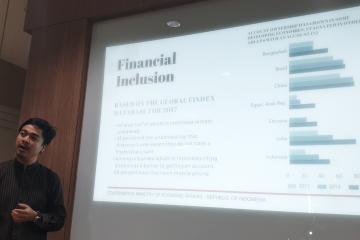
One of the top reasons so many remain unbanked is the distance from their homes to the financial institution. But alternatives are emerging: In Indonesia, for example, 69 percent of unbanked adults have a mobile phone. This has huge potential for us if we can leverage mobile phones—digital financial inclusion will be the key to the financial inclusion.
In addition, the growing numbers of “fintech” (financial technology) companies in Indonesia will become a major innovative vehicle to promote this digital financial inclusion. I think it offers an opportunity to narrow the gap right now, because fintech reduces the costs of banking and can be scaled up. That said, effective regulation is necessary, too, in order to provide a solid foundation.
Many J-PALers go on to work in government. Could you tell us a bit about your work within the Government of Indonesia?
Now I serve as a program manager for the National Council for Financial Inclusion of the Government of Indonesia (NCFI). My day-to-day now has so many meetings! But it’s been a rewarding experience overall, since I have been able to meet with various people from industries, regulators, government officials, donors, and development agencies.
Having conversations with all these people from different backgrounds has helped to broaden my perspective on how to approach financial inclusion problems. I think the opportunity to influence the policymaking process was the most intriguing reason why I decided to join the NCFI.
What do you think are some of the most effective strategies you've seen from researchers who want to work with governments?
Now that I sit on the other side of the table, I’ve noticed a few key things that researchers can do to improve their pitches.
- Do your research before the meeting: It’s true that while you’re in the meeting you will learn more, but it’s best to go in with a clear understanding of the government’s agenda and priorities. The good news is that you can usually find this kind of information on the government website or in the media!
- Keep it short: The person you’re meeting with might only have fifteen minutes to talk with you. Go in with a few clear slides or a concise written brief, avoid jargon and dwelling on methodology, and don’t be abstract with your proposal.
- Attitude is important: Policymakers don’t need you to tell them what the problem is—they want to hear your solution. It’s best to present your approach with a positive and humble attitude.
- Have a clear follow-up plan: The true impact of the meeting is determined by what happens after!
Finally, what advice would you have for those who are interested in transitioning from a research role to a government role?
The policymaking process takes time. There is much to learn: You’ll need to get used to new organizational structures, bureaucracies, different goals and objectives, and maybe different acquired skills. In Asia, it depends on the role, but interpersonal and communication skills are very important! If you are a person with a lot of patience and strong desire to make a difference, you may enjoy working in government.
Francisca de Iruarrizaga is a former policy and training manager at J-PAL LAC, where she worked to increase the use of evidence in Latin American policymaking and train policymakers in evidence generation and use. Formerly of the Chilean Ministry of Social Development prior to J-PAL, Francisca returned to work with the Government of Chile in 2018 to design and implement a sweeping set of measures to reform child welfare services. She shares her experience working both in and with the governments of Chile and Peru to drive evidence use in reforming social policy.
The Alumni Spotlight series highlights J-PAL alumni who are making an impact across industries and around the world. To nominate a J-PAL alum to be featured in a future Alumni Spotlight, please fill out this form.
Francisca de Iruarrizaga is a former policy and training manager at J-PAL LAC, where she worked to increase the use of evidence in Latin American policymaking and train policymakers in evidence generation and use. Formerly of the Chilean Ministry of Social Development prior to J-PAL, Francisca returned to work with the Government of Chile in 2018 to design and implement a sweeping set of measures to reform child welfare services. She shares her experience working both in and with the governments of Chile and Peru to drive evidence use in reforming social policy.
What drew you to focus on public policy and child welfare? Tell us a bit about your background and what you were looking for in a career.
It’s been a series of small decisions that led me to what I do now. In school, I often volunteered with disadvantaged communities around Santiago. When I started undergrad, I decided to study economics to get the tools to fight poverty and inequality.
After finishing my degree, I started work at the Ministry of Social Development, focusing on poverty measurement and designing a conditional cash program. But the poverty measurement work, which was the bulk of what I worked on, didn’t quite feel like the right fit for my interests.
I went through the process of thinking, if I want to reduce poverty and inequality, where should I focus? Everything I was doing then felt as though it were coming too late to make a change in people’s lives. It became clear to me that I wanted to focus on early childhood development, and particularly on child welfare, as what happens early on in the lives of children can have permanent consequences.
It’s also an area dominated by psychologists and lawyers, where there has been relatively little involvement from economists. I think there is a lot we can contribute in this space, but at least in Chile, this isn’t widely understood yet.
There have been many times in my career when people didn’t get why I, as an economist, study child development. For example, I interviewed many different organizations when writing my MPAID thesis on reforming the child welfare system in Chile. The people I spoke with always expected me to ask about their finances, and were very surprised when I told them I wanted to learn about how they worked with the kids.
How did you first learn about J-PAL?
I first heard about J-PAL through working with the former Minister of Planning in Chile, who had just finished his PhD in economics. He created Comisión Brújula, a joint academic-government commission organized with J-PAL to identify critical issues where we don’t have enough evidence and form a research fund to produce more. J-PAL had just opened an office in Chile and thought it sounded like an exciting opportunity to go deeper into this kind of work.
What were some of the most interesting things you worked on as a policy and training manager at J-PAL LAC?
I had a dual role in policy and training. I was really passionate about the policy side, where I worked to join the worlds of academia and policymaking, and I learned a lot about training. I ran a number of executive education courses on evaluating social programs in Peru, Brazil, and a personal favorite in Washington, DC with the Inter-American Development Bank and government officials from across Latin America. It was fascinating to teach J-PAL methods to policymakers around Latin America, each of whom brought their own practical experiences to the class.
I was also involved in the early stages of a very fruitful partnership with the Government of Peru. The Ministry of Finance, the Ministry of Social Development, and some professors from universities in Peru were involved, and we initiated the same process as Comisión Brújula in Chile. This entailed identifying the key questions where more evidence is needed, and conducting more research to answer them.
You have since returned to work in Chile’s government, where you are an advisor to the President on topics of early childhood development. What are some of the most engaging elements of your role now?
I was invited to help build a government program while I was working at the Pontificia Universidad Católica.
When Sebastián Piñera began his presidency of Chile in 2018, one of his key policy focus areas was “putting children first.” He brought together politicians, NGOs, and more to craft a new national plan to improve the lives of children in Chile, especially the ones suffering rights violations.
This big national agreement had three areas: Promoting child development to help each child reach their potential, intervening in the lives of at-risk children, and protection and rights restitution for children whose rights have been violated
At first, I was involved in the discussion and writing of the national plan. After that, my role has been to coordinate and help the implementation of the 94 agreed upon measures. Each ministry is in charge of implementing different measures, and my task is to help with coordination between the ministries, as many of the measures are interdependent.
I’m very satisfied that we’ve accomplished about 70 percent of our measures. We have a new institution for child protection, better trained child welfare professionals, better program design, and so on now, but there is still a long way to go to create lasting improvements the lives of children. We had twelve laws to approve, and half of them are still in Congress. Things that may appear simple on the outside take a lot of time for the government to work through.
How have you stayed connected to J-PAL in your work?
I have stayed very connected to J-PAL. When I was teaching at the university after my Master’s, I was invited to be a part of a project with the government of Peru focused on improving the programs run through the Ministry of Women and Vulnerable Populations. It was a great experience—we did a research project and then presented it to the government.
I also teach an undergraduate course on social program evaluation—it’s like J-PAL for undergraduates. I’ve co-taught it with a J-PAL affiliate and another J-PAL alum for over five years now! I love watching undergrads in the class have the same eye-opening experience I felt when discovering the impact economics can have in the lives of the most vulnerable people.