Imagen

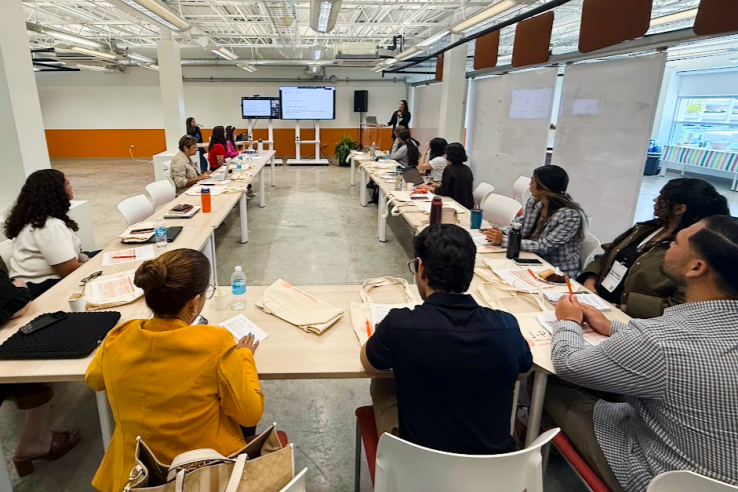
In this Learning Lab blog series, J-PAL North America highlights different applications of the Learning Lab model, a new approach to support leaders in generating and using evidence to improve lives. This post features the AprendeLab, an immersive capacity-building program that supported five Puerto Rican nonprofit organizations and government agencies in applying their evaluation skills to strengthen programs and better support their communities.
Over the last eight years, J-PAL North America has built relationships with agencies across Puerto Rico, developing a deep understanding of the island’s policy landscape, evaluation priorities, and challenges. When agency leaders expressed interest in more intensive evaluation capacity-building support, we sought to design a program that was responsive to their needs, setting the stage for the AprendeLab launch in the fall of 2025.
The AprendeLab is one of J-PAL North America’s Learning Labs, a suite of programming that brings together a cohort of leaders with a shared appetite to strengthen the use of data and rigorous evidence to address poverty in a specific sector or region. Like other Learning Labs, the AprendeLab provided four key components:
The Learning Lab model can be customized based on a particular cohort’s needs. For the AprendeLab, we drew from our experience and partnerships in Puerto Rico to adapt the program components to meet participant needs and goals. Key modifications included:
Rather than a compressed timeline, J-PAL North America designed the AprendeLab as a seven-month engagement with one to two monthly touchpoints to accommodate participants’ competing demands. This extended timeline gave them sufficient time to absorb and apply new concepts. Between sessions, participants had ongoing access to the J-PAL team through regular email communication and on-demand support.
As a result, this cohort remained actively engaged throughout the program and demonstrated a strong commitment to the learning process. At the conclusion of the AprendeLab, participants highlighted the value of having time between sessions to apply new concepts and tools in their work.
Rather than setting predetermined objectives, we shaped the program goals and curriculum around participant interests, priorities, and capacity-building needs, which were shared during an in-person training held in spring 2025 and subsequent follow-up discussions.
Together, J-PAL staff and participating organizations aligned on the following shared goals:
The extended AprendeLab format created opportunities to foster a strong community of practice. Participants built relationships at in-person events at the beginning and conclusion of the Learning Lab, as well as during months of virtual engagement, including peer-learning sessions. Most importantly, the content of the AprendeLab was grounded in the local context. For example, Professor Eduardo Lugo-Hernandez from Universidad de Puerto Rico at Mayagüez joined one session to discuss the role of community engagement in evaluation design, centering the conversation on local perspectives and experiences. In another session, participants exchanged ideas about common local data sources that informed their measurement strategies and shared lessons from their experiences.
J-PAL North America customized training content for this cohort, including delivering the program in Spanish and incorporating thematically relevant examples throughout the curriculum. Technical assistance sessions were also tailored to each organization’s programming and priorities, with flexibility to provide additional support on specific aspects of evaluation design and other topics as needed. For example, while some agencies had already established data systems and measurement indicators, others required more support in these areas.
Following the conclusion of the AprendeLab, J-PAL North America has continued to support participants at various stages of their evaluation journeys. For example, several teams continued to receive technical assistance to further refine their research questions and randomization plans. To support the next phase of this work, J-PAL is connecting teams with researchers to explore potential partnerships to launch impact evaluations. Once connected, partners work together to develop potential evaluations, assessing the availability of data needed to measure key outcomes and detect meaningful program impacts.
Projects advancing from the AprendeLab include:
Many of these teams are aiming to apply for evaluation funding from one of J-PAL North America’s Request for Proposals. We are proud to support this cohort in their goal to improve lives in Puerto Rico, and we look forward to seeing this important work progress.
The AprendeLab demonstrates how J-PAL North America’s Learning Lab model is customizable to a cohort’s goals and needs through flexible timelines, participant-driven goals, an emphasis on community and local context, and tailored content and technical assistance. Looking ahead, J-PAL North America will continue to build on the lessons learned from the AprendeLab as it expands and adapts the Learning Lab model to new sectors and geographies, including the upcoming Medicaid Learning Lab. These insights will help us continue refining the model and strengthening our ability to support government agencies and non-government organizations in generating and using evidence to address poverty in the United States.