New resource: Incorporating remote sensing data into randomized evaluations
A growing number of economists are incorporating remotely sensed (RS) data—satellite data in particular—into their studies. For randomized evaluations, remote data collection offers alluring possibilities: lower data collection costs, a longer time series of data both before and after an intervention, geographic spillovers, and more. However, the initial allure may obscure some practical challenges.
In a new set of guidelines, J-PAL affiliated professor and Co-Chair of J-PAL’s King Climate Action Initiative Kelsey Jack (University of California, Santa Barbara) and Kendra Walker (University of California, Santa Barbara)—with contributions from J-PAL affiliated professors Jenny Aker, Seema Jayachandran, Namrata Kala, and Rohini Pande, along with Ben Moscona, Sebastien Costedoat, Carlos Muñoz Brenes, Tamma Carleton, Robert Heilmayr, and Johanne Pelletier—outline some of the opportunities and challenges associated with using remote sensing data in randomized evaluations. The guidelines provide resources and recommendations to help social scientists, practitioners, and their collaborators effectively leverage RS data in their evaluations.
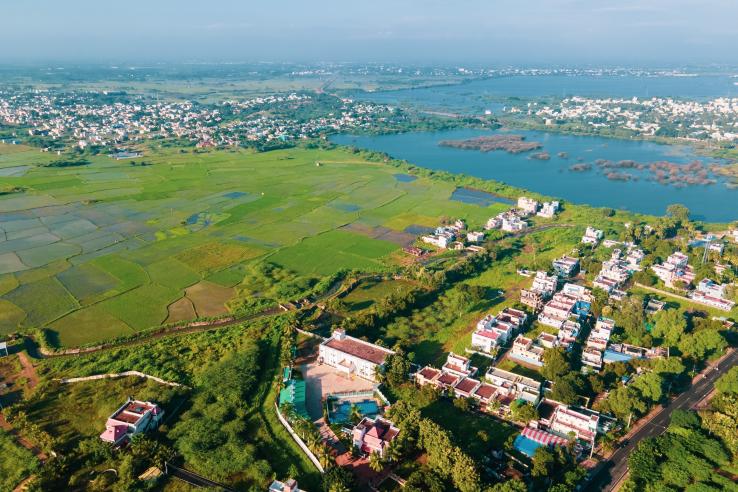
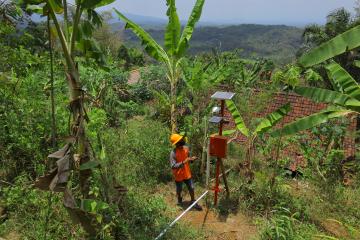
Remote sensing refers to collecting data from a distance. Examples of sensors used to collect RS data include on-site monitors, manned or unmanned aircraft systems, and satellites. Predictive models and machine learning methods are often used to interpret raw RS data, such as classifying a satellite image of a piece of land as forested or not. This interpretation stage is typically necessary to allow the researcher to use the data for their analysis.
The guidelines are organized around three main reasons that researchers conducting randomized evaluations might wish to include RS data: (1) increase statistical power, (2) measure different or more objective outcomes and (3) extend analysis to more time periods or locations. For example, RS data may be especially useful when evaluating environmental or agricultural interventions, such as forest cover, crop yields, land use, wildfire smoke and pollution concentrations, since environmental outcomes are often difficult to measure through surveys alone.
While the use of RS data in impact or program evaluation is not new, using RS data in randomized evaluations presents both new challenges and opportunities. Most notably, because randomized evaluations typically involve a substantial amount of researcher discretion over design decisions and primary data collection, researchers can tailor their sample, collect primary data, and interpret RS data to make the most of this new and exciting data source.
The guidelines are structured around the three primary motivations for incorporating RS data into a randomized evaluation and use case studies from Jack’s own experiences using RS data to evaluate the impact of rainwater harvesting techniques in Niger and of payments for ecosystem services on crop burning in India. In this blog, we will briefly highlight selected challenges associated with each of these motivations and examples of how to avoid common pitfalls.
Using remote sensing data to increase statistical power
The larger a study’s sample size, the more likely that the researcher will be able to detect the effect of an intervention if it exists. However, researchers often face logistical or financial constraints that make it difficult to collect primary data for a large number of participants. RS data can help predict outcomes for study participants not included in a survey or other primary data collection, making it possible to include more observations in the study, thereby increasing statistical power.
While RS data may be used to increase sample size, it also introduces a new source of measurement error since outcomes are typically predicted. If the error is sufficiently large, statistical power may not improve much relative to analysis using the smaller set of primary data. For example, if field observations of crop types are used to train a prediction model that achieves only 60 percent accuracy with the RS data, researchers may be better off just running regressions with the field observations. Non-classical measurement error, particularly if it is correlated with treatment, may introduce new forms of bias. For example, if the crop type observations can only be obtained in the treatment group, and treatment affects crop choices, then the model may be systematically more accurate in predicting outcomes in the treatment group than in the control.
Increasing the number or quality of outcomes measured
There are cases where RS data may be more objective, accurate, or inexpensive than primary data collected through surveys. However, some primary data will usually be necessary to calibrate or train the RS model. Raw RS data can be difficult to make sense of without primary data to compare it to. Therefore, designing appropriate primary data collection is important, and may differ from what would be collected in the RCT if no RS data were involved.
One key consideration is linking the relevant unit of intervention in the RCT to the RS data. For example, if agricultural outcomes are of interest, then the researcher needs to know the spatial location of both treatment and control fields. Measurement error will be considerably higher if only geographic points—rather than field perimeters—are collected. Notably, spatial locations must be collected for both treatment and control fields.
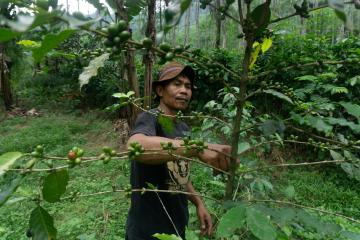
RS data may be particularly useful when outcomes are difficult to measure through standard survey-based techniques. For example, illegal activities, such as (in some settings) deforestation or crop residue burning, may be susceptible to substantial reporting error in surveys, but could be more accurately measured with RS data—providing adequate primary data can be collected, of course. Where primary data for training a model cannot be obtained from ground-based methods such as surveys or spot checks (for example, in a conflict zone), a small sample of very high-resolution satellite imagery may provide an alternative approach to constructing a dataset for training or calibrating the RS model.
Extending measurement to locations or time periods outside of the main study sample
Researchers may also want to use RS data to examine the impacts of an intervention outside of the original time period or sample of the evaluation, but as with any statistical analysis, care must be taken when conducting out-of-sample analysis.
First, out-of-sample extrapolation requires an assumption that the relationship between primary (training) data and RS data is the same between the original sample and the extended sample. For example, a land use model trained on data from a set of villages in the original evaluation may or may not perform well for a larger sample of villages that may have been affected by spillovers.
Similarly, the same land use model trained at a single point in time may be poorly suited to predicting the evolution of land use into the future as a result of the treatment. There will almost always be some differences in background characteristics—weather patterns, economic conditions, landscape, etc.—between the main study sample or time period and the extended sample which may cause a model from the original sample to interpret new RS data inaccurately (referred to as “model drift”).
Collecting new primary data for the extended sample and recalibrating the RS model can help with both accuracy and interpretation. If researchers can identify potential opportunities to use RS data to measure spillovers or long-run effects early on, they can design the initial evaluation to make measuring these outcomes easier down the line.
Takeaways
Incorporating remote sensing data into randomized evaluations has tremendous potential to measure outcomes that would otherwise be difficult or expensive to study with traditional surveys and may be especially useful for evaluating environmental interventions that require physical measurements like land cover. However, RS data are not a panacea and researchers need to take these considerations into account from the time they start designing their evaluations to determine whether and how to use RS data.
For more thorough guidance, additional practical considerations, and examples, check out the guidelines here.
J-PAL’s King Climate Action Initiative (K-CAI) supports pilot studies, randomized evaluations, and scaling projects at the nexus of climate change and poverty alleviation. Three years ago, the initiative concluded its first funding competition. Since then, K-CAI has generated evidence that has informed real-world policy design and implementation, including the ongoing scaling of five evidence-informed climate policies that cut greenhouse gas emissions and/or increase the resilience of communities severely affected by climate change.
J-PAL’s King Climate Action Initiative (K-CAI) supports pilot studies, randomized evaluations, and scaling projects at the nexus of climate change and poverty alleviation. Three years ago, the initiative concluded its first funding competition. Since then, K-CAI has generated evidence that has informed real-world policy design and implementation, including the ongoing scaling of five evidence-informed climate policies that cut emissions and/or increase the resilience of communities severely affected by climate change.
Climate impacts are worsening worldwide, as evidenced by extreme heat and weather this summer, and people living low- and middle-income countries are disproportionately affected. Climate change threatens the lives and livelihoods of communities who have contributed least to the climate crisis, and has the potential to reverse decades of progress in global poverty alleviation.
K-CAI, in partnership with King Philanthropies, is dedicated to addressing this challenge by innovating, testing, and scaling high-impact solutions to combat climate change and poverty.
K-CAI’s growth over three years
K-CAI has supported and launched 13 scaling projects and 32 randomized evaluations across 35 countries—increasing researchers in the J-PAL network evaluating policies at the nexus of climate change and poverty alleviation by 195 percent.
In the three years since K-CAI’s first funding competition, K-CAI-funded researchers have collaborated with 26 government partners, 22 NGOs, and 22 private sector businesses, including the Gujarat Pollution Control Board, the City of Cape Town, BRAC, and Centre for Net Zero founded by Octopus Energy. Below are five examples of how evidence generated through K-CAI is informing policies or being applied directly at scale by decision-makers.
Stories of informing climate policy with evidence
K-CAI-funded research is beginning to yield actionable insights that are increasingly being used by policymakers to mitigate and adapt to climate change.
Reducing air pollution and greenhouse gas emissions
The Government of Gujarat is working with a K-CAI-funded research team, J-PAL South Asia, and EPIC India to scale an emissions trading scheme (ETS) for particulate matter to address severe air pollution in India. The ETS has been scaled in Surat, a city with 6 million people living in its airshed, and in Ahmedabad, home to 9.3 million people in its airshed. The research team, including J-PAL affiliated professors Michael Greenstone, Rohini Pande, Nick Ryan, and Anant Sudarshan, found that the emissions market reduced plant pollution by 20–30 percent on average, as well as industries’ average costs associated with pollution abatement. Several other states are also exploring plans to launch emissions markets informed by this work.
In the United States, the Colorado Department of Public Health is using a machine learning model, developed and field-tested by a K-CAI-funded research team, co-led by J-PAL affiliated professor Michael Greenstone, to target methane inspections more effectively. As part of their long-term partnership, they are now investigating if inspections triggered by real-time emissions data can further improve compliance and reduce emissions from oil and gas facilities.
In Bangladesh, a K-CAI-funded research team is working with government partners to reduce emissions from brick manufacturing. They are building on promising preliminary results from a K-CAI-funded randomized evaluation to scale a training on proper operation of zigzag kilns, which were found to significantly reduce carbon and particulate matter emissions and increase the value of inventory when used correctly. As brick manufacturing in South Asia is dominated by inefficient coal-burning kilns, the training could significantly reduce emissions in the industry. In collaboration with the government, brick manufacturers, and local research institutions, the K-CAI-funded team, including J-PAL affiliated professor Grant Miller, J-PAL invited researcher Stephen Luby, and Nina Brooks, is working to scale the training program to zigzag kilns across the Dhaka region through 2025.
Adapting to climate impacts: Extreme weather and erratic rainfall
A K-CAI-funded research team is studying a flood early warning system (EWS), aiding Google's Flood Forecasting Initiative in South Asia. This team, featuring J-PAL affiliated professor Rohini Pande and J-PAL invited researcher Maulik Jagnani, is working with Google and the local NGO Yuganter to perform the first randomized evaluation of a flood EWS. This system combines smartphone alerts and grassroots volunteers to alert people about upcoming floods. The initiative directly affects 160 communities (1.8 million people) in rural Bihar. Additionally, it informs the design and messaging of smartphone alerts as well as the integration of human intermediaries in similar systems used by groups like the Federation of Red Cross and Red Crescent Societies and the Indian Red Cross Society.
In Niger, a K-CAI-funded research team is working with local partners to scale a program training farmers to adopt rainwater harvesting techniques in a more accessible way, which aims to initially reach around 6,000 farmers. Earlier findings showed that the training increased adoption by 90 percentage points and increased agricultural output by around 12 percent. Simultaneously, the research team, including J-PAL affiliated professors Jenny Aker and Kelsey Jack with Maigari Malam Assane, is now testing ways to make the training cheaper and easier to implement to finalize a cost-effective and scalable program model.
Insights for future forest protection programs
Rigorous evaluations have shown that, when designed and implemented well, payment for ecosystem services (PES) programs can be a potentially promising and cost-effective climate mitigation solution. In Mexico, the National Forest Commission and K-CAI-funded researchers, including J-PAL affiliated professor Seema Jayachandran, J-PAL invited researcher Santiago Saavedra, and Santiago Izquierdo-Tort, found promising impacts on reducing deforestation from an innovative PES program that modified certain design features, such as using stricter contracts, to increase PES programs' effectiveness in reducing deforestation and thereby delaying carbon emissions.
Based on these results, there is high interest in PES programs from governments across Latin America who are working to combat tropical deforestation in vital biomes. Together with government partners, K-CAI is currently exploring how to potentially apply these policy lessons to inform the policy design of key existing deforestation programs using cash transfers.
Looking forward: Partnerships for effective and equitable climate policies
These case studies illustrate just a few examples of how rigorous evidence can inform policy and benefit the lives of people most impacted by climate change. But as climate impacts worsen, more evidence-informed policies are needed. K-CAI is continuing to fund new climate research and scaling projects to reach people experiencing poverty and will share more stories of evidence informing climate policy in 2024.
“These stories show that evidence of impact can be a powerful tool for decision-makers in scaling effective climate solutions. I want to commend the policymakers and implementers collaborating with J-PAL affiliated researchers for showing the world that it’s possible to learn at the same time as we take action to combat climate and poverty.” — Claire Walsh, Associate Director of Policy, K-CAI Project Director, J-PAL Global
K-CAI is actively seeking new partnerships with governments, NGOs, the private sector, and funders to innovate, evaluate, and scale high-impact climate solutions. If you are interested in partnering with us to support evidence generation and scaling high-impact policies at the nexus of climate change and poverty alleviation, or to learn more about existing evidence and how it can inform policy, please contact us at [email protected].
This piece was originally published on December 21, 2023 and has since been updated.
This Earth Day blog post discusses how we speed up the path from research to policy action at J-PAL through the King Climate Action Initiative (K-CAI), which prioritizes funding research and scaling that uses administrative and remote sensing data to generate results in a timely manner.
We find ourselves in a make-or-break decade if we are to meaningfully confront the impacts of climate change on societies and ecosystems. The recently published Sixth Assessment Report by the Intergovernmental Panel on Climate Change (IPCC) leaves no doubt that the impacts of climate change are already felt today and will intensify in the future, affecting low- and middle-income countries most severely. The IPCC highlights that climate change acutely affects development outcomes, suggesting a “rapidly closing window of opportunity to secure a livable and sustainable future for all.” Not only does the world need to hit fast-forward on climate change mitigation by reducing greenhouse gas emissions, it also needs to ensure that those who are (and those who will be) feeling the impacts of climate change can adapt accordingly and sustain their livelihoods.
With increasing urgency to adapt to and mitigate climate change, it may be tempting to deploy innovations before they are rigorously evaluated in the field, in the name of reacting quickly. But innovations do not always achieve their intended impacts in the field, and there are large gaps between the engineering estimates and real-world performance of new technologies. Governments as well as companies concerned by climate change have much to gain from measuring the impact of existing solutions. Ultimately, we can save time by spending funds on the solutions that have been demonstrated to be effective, rather than putting resources into measures that will not achieve their desired results. Given limited time and resources, it is imperative to direct investments toward climate adaptation measures that work outside the lab, in the real world.
We should seize rapid climate action as an opportunity to carry out impact evaluations of policies, technologies, and programs through robust data collection and monitoring. Fortunately, large-scale, accurate data collection approaches are here to help and have become increasingly accessible to researchers and implementers in recent years. From administrative data (collected by governments or organizations) to satellite imagery and remote-sensing technology to forecast extreme weather events, randomized evaluations are beginning to leverage non-traditional data sources to yield timely and accurate results that can facilitate adaptation. To speed up the path from research to policy action, J-PAL’s King Climate Action Initiative (K-CAI) prioritizes funding research and scaling that uses administrative and remote sensing data to generate results in a timely manner.
The new kid on the block: Real-time data collection and non-traditional data sources
Traditionally, randomized evaluations have heavily relied on data sources like census and household survey data. Data collection can thus be costly and time-consuming. However, new approaches, like collecting data in real-time and in larger volumes, can unlock new kinds of interventions and generate results in a timely manner.
Data collected in real-time includes, for example, data from pollution sensors, air quality monitors, and satellite data. The ability to collect data in real-time unlocks insights into the short-, medium-, and long-run impacts of climate innovations, and allows for speedy optimization of interventions. This stands in contrast to surveys conducted after an intervention that captures effects, self-reported or otherwise, retrospectively rather than simultaneously—which delays informed climate action. In addition, real-time data can inform predictions about the future, such as accurate weather forecasts and early-warning systems, that can help communities adapt by preparing for impending weather shocks.
Randomized evaluations are already using properties of real-time data collection to unlock, for instance, new kinds of information interventions. In a study funded by K-CAI, researchers Douglas Almond (Columbia University) and Shuang Zhang (Imperial College London) are currently conducting an intervention across thirteen Chinese provinces, obtaining firms’ emissions data on a real-time basis. The real-time database started in January 2019 and continued to update on an hourly basis until 2022. Researchers collected hourly concentration data for three different air pollutants and three different water pollutants for every firm. Using this granular data, researchers identified firms with emissions above the regulatory limit, or suspicious data patterns that may point to intentional data manipulation. Leveraging this data is increasingly feasible in real-time and could provide objective information and thereby increase the effectiveness of environmental inspections.
Data collected in real-time, rather than after the fact, may also provide a unique opportunity for immediate feedback and incentives for changes in environmentally damaging behavior. In another ongoing K-CAI-funded study, J-PAL affiliated professor Robert Metcalfe (University of Southern California) is piloting techniques to reduce greenhouse gas emissions in the shipping industry by providing captains of cargo vessels with daily vessel data—offering personalized feedback, targets, and fuel-saving incentives via a software system. Feedback focuses on discrete captain behaviors, such as power management of engines, speed reduction, and route optimization.
These insights into the effectiveness of programs and policies are needed to combat climate change, as with every increment of global warming, climate impacts become more pronounced and challenging to adapt to.
Providing support where it is needed the most
Non-traditional data sources can help identify communities that are particularly vulnerable to the impacts of climate change. This information can help policymakers target adaptation interventions to these communities and ensure that they receive the support they need. Effective data processing approaches, such as classification through machine learning algorithms, can improve targeting adaptation support for the most vulnerable households and communities. For example, a study led by J-PAL affiliated professor and K-CAI co-chair Kelsey Jack (University of California Santa Barbara) on effective targeting of electricity subsidies in Cape Town is exploring whether administrative data can be used to better target subsidies to households with the greatest need for support. Better targeting of these subsidies could help the City of Cape Town achieve both its climate and its poverty alleviation goals.
In another study in Bangladesh, researchers Munshi Sulaiman (BRAC University), Ashley Pople (Oxford), J-PAL affiliate Stefan Dercon (Oxford), Rohini Kamal (BRAC University), and Rocco Zizzamia (Oxford) are evaluating an early action program to protect low-income communities from floods. The team is testing the efficacy of early flood alerts and adaptation assistance, and using satellite data to target these interventions to the most vulnerable households.
In identifying areas vulnerable to climate change, combining household surveys and satellite data may also provide insights into both climate phenomena, like changing weather patterns, as well as on-the-ground adaptation responses. This can allow us to identify informational and behavioral constraints to effective climate change adaptation. For example, J-PAL affiliated researcher Rohini Pande (Yale University) and Maulik Jagnani (University of Colorado Denver), utilize satellite data in an evaluation of an early warning flood forecasting system in Bihar, India. The study pairs cutting-edge forecasting and an Android-based flood alert system with grassroots volunteers trained in community outreach. Researchers subsequently employ household surveys to assess the system’s effectiveness in helping households adapt to flooding events. Early warning systems are one way in which satellite data can be leveraged to evaluate adaptation mechanisms as ex-ante information may facilitate precautionary measures.
The way forward: Setting up robust data collection systems
In the quest for timely climate mitigation and adaptation, rigorous evaluation may ultimately help us move faster by ensuring the real-world efficacy of public and private sector innovations. Using tools from computer science, data science, and engineering can unlock new opportunities for real-world evaluation of climate innovations and, potentially, protect livelihoods around the world. It is tempting to rely on intuition and good intentions to guide our actions, but there is no substitute for high-quality data. We need randomized evaluations and robust data collection and monitoring systems when rolling out new climate policies and programs to improve programs over time, across changing contexts, and ensure their effectiveness. Through rigorous evaluation, we can learn as we take action. Real-time data collection and monitoring, coupled with innovative approaches to data analysis, can help us identify vulnerable communities, target interventions effectively, and optimize our efforts to mitigate and adapt to a changing climate. Rigorous monitoring and evaluation, in turn, allow for more informed policy and private sector decisions during the current “window of opportunity” to drive a positive impact on the planet and the people who will most be affected by climate change.
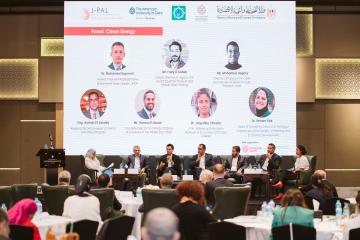
In the context of leveraging randomized evaluations for climate action, developing partnerships between various stakeholders is a necessary first step. From that premise, J-PAL MENA at the American University in Cairo co-hosted with the Ministry of Planning and Economic Development in Egypt, the National Institute of Governance and Sustainable Development, and the Arab Water Council the “Partnership Development for Climate Adaptation in Arab States” (PDCA) conference, that was held on September 26 and 27, 2023 in Cairo.
In 2022, the United Nations drew attention to the disproportionate allocation of climate finance funds, with a staggering 90 percent directed towards climate mitigation and only 10 percent towards climate adaptation. This imbalance resulted in a growing call to address this issue. Dr. Mahmoud Mohieldin, UN climate change high-level champion for Egypt, underscored the importance of prioritizing funding adaptation measures alongside curbing activities that contribute to rising greenhouse gasses. In response to these calls for action, the 28th Conference of Parties (COP28), happening in the United Arab Emirates soon, will recognize adaptation as a key theme thus highlighting the urgent need to address climate change's immediate effects on local communities and equip them with necessary tools to adapt.
The urgency of this matter is compounded by the fact that climate change will have a disproportionate impact on low- and middle-income communities and countries, which have limited resources to adapt. Meanwhile, high-income countries bear a significant responsibility for greenhouse gas emissions.
Evidence generation for climate action
The Middle East and North Africa (MENA) region is particularly vulnerable to the challenges posed by climate change, dealing with high water scarcity, air pollution, and extreme heat. These trends have had a direct impact on agriculture, leading the region to experience the largest food deficit across the globe. In response to these challenges, Arab states, such as Egypt, Morocco, Saudi Arabia, and the UAE, have made efforts to commit to adaptation goals. Their Nationally Determined Contributions (NDCs), reflect these efforts, allocating money to clean energy infrastructure, national water management plans, and sustainable agriculture transformation initiatives.
Scientific research and evidence generation are required to understand which interventions are effective in contributing to reaching the NDCs. Unfortunately, the MENA region has one of the lowest budget allocations to environmental research worldwide, estimated at 1.7 percent. This lack of funding hinders the development of effective climate policies and strategies.
To create adaptation strategies tailored for the MENA region, it is necessary to conduct further research to generate rigorous evidence on the effectiveness of climate adaptation and mitigation strategies. Randomized impact evaluations play a key role here. By utilizing randomized evaluations, policymakers and stakeholders can make data-driven decisions and allocate resources to interventions with the greatest impact on society and the environment. This approach ensures that limited funds are used effectively and efficiently, thus maximizing the benefits of adaptation policies.
Partnership Development for Climate Adaptation in Arab States
In the context of leveraging randomized evaluations for climate action, developing partnerships between various stakeholders is a necessary first step. From that premise, J-PAL MENA at the American University in Cairo co-hosted with the Ministry of Planning and Economic Development in Egypt, the National Institute of Governance and Sustainable Development, and the Arab Water Council the “Partnership Development for Climate Adaptation in Arab States” (PDCA) conference, that was held on September 26 and 27, 2023 in Cairo.
PDCA began with keynote addresses provided by H.E. Dr. Hani Sewillam, the Egyptian minister of irrigation and water resources, and H.E. Dr. Hala ElSaid, minister of planning and economic development in Egypt. Both speakers emphasized the government’s commitment to tackling environmental issues by relying on accurate scientific evidence that enhances national development efforts.
Subsequently, four key thematic areas were discussed at PDCA in relation to climate adaptation. These areas were derived from the Glasgow-Sharm El-Sheikh work program and included:
- Water quality and management,
- Education and green skills,
- Clean energy, and
- Agriculture and food security.
Panel sessions involved knowledge-sharing presentations by J-PAL affiliated researchers Kyle Emerick, Raymond Guiteras, Menno Pradhan, and Jaqueline Oliveira. In addition, thematic roundtable discussions were conducted to initiate partnerships and align climate action towards innovative policies and programs in the region.
Throughout the PDCA conference, there was a call to action for partnerships between environmental stakeholders to encourage evidence-based policymaking in shaping the Arab region’s climate agenda. Margaret Sancho, deputy mission director at USAID Egypt, emphasized during her panel discussion that all climate actors should be involved in tackling climate change and generating innovative solutions, whether they be in the private sector, public sector, civil society, or academia. Along these lines, PDCA brought together climate negotiators from Egypt, Palestine, Iraq, Lebanon, Somalia, and Sudan to exchange views on how to establish a unified regional climate adaptation strategy and mobilize efforts to serve the Global Goal on Adaptation.
Looking ahead: The Air and Water Lab in Egypt
The PDCA conference showcased the potential of randomized evaluations and J-PAL's global research in informing evidence-based solutions for climate action. The conference also marked the soft launch of the Air and Water Lab (AWL) in Egypt, which responds to air and water challenges through the co-generation of evidence between researchers and government partners.
As George Richards, Director of Community Jameel, emphasized in his opening remarks at PDCA: “Air pollution does have a cure, it lies in science and evidence…We need to think of segments in society that are most affected by air pollution. For the sake of our children, let us come together to write the next chapter."
Looking ahead, the discussions held at the conference shed light on research opportunities that are to be further explored under the AWL in Egypt and the possibilities to use evidence in climate negotiations such as the upcoming COP28 in Dubai. By continuing to bridge research and policy work and anchoring activities within local contexts, responsive climate action will accelerate in MENA.