

An interactive classroom program encouraging students to consider one another’s perspectives in Turkey lowered peer violence, improved relationships between refugee and Turkish students, and increased prosocial behaviors like trust, cooperation, and altruism.
Using research to combat internalized bias
Combating internalized biases is an important step in building equitable, fair societies. Sometimes internalized biases are implicit, meaning individuals may unknowingly associate stereotypes with certain social groups or have certain beliefs that they are not aware of. In other instances, they may be conscious of their biases but have difficulty overcoming them. Identifying strategies to combat this type of bias is critical for fighting prejudice and discrimination.
Despite growing support for policies and programs aimed at tackling discrimination, more research is needed to identify which strategies are effective and in which contexts. Research in social psychology, for instance, has developed several techniques to help individuals overcome their biases. While these have been shown to be effective in lab settings, there has been little work to study such strategies in real-world contexts. This research is essential for incorporating effective approaches into everyday programs.
With these considerations in mind, J-PAL hosted a webinar on April 11, 2022 focused on combating discrimination. We were joined by Sule Alan (European University Institute), Diag Davenport (University of Chicago), and Jenan Mohajir, Senior Director of Special Projects at Interfaith Youth Core, for a conversation moderated by Marianne Bertrand (University of Chicago; Co-Chair, J-PAL Labor Sector). The speakers shared their work and discussed the need for more evidence around effective programs to combat discriminatory practices. Read on for a recap of key insights from the panelists.
The state of the field
During the session, the panelists discussed their priorities related to combating bias and highlighted how research can help further our understanding of effective strategies.
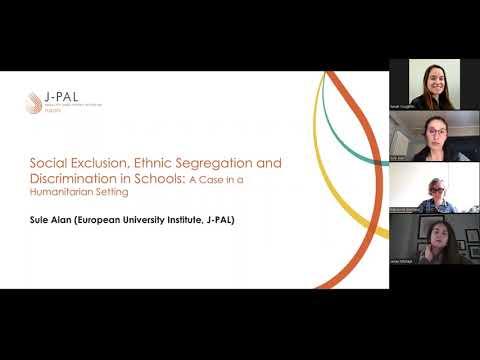
Sule Alan, a professor of economics, presented findings from a randomized evaluation in Turkey that found promising impacts of using an approach from social psychology known as perspective-taking to reduce bias against Syrian refugee students. This approach, which involves helping individuals learn to understand the point of view of someone they are biased against, has often been tested in lab settings with promising results. Professor Alan and her collaborators drew from those learnings to design a curriculum for Turkish classrooms and found that the intervention reduced violence and victimization and reduced social isolation. Increased friendships between Turkish and Syrian refugee children also persisted 2.5 years later, despite school closures that occurred as a result of the Covid-19 pandemic.
Diag Davenport, a PhD student in behavioral science, discussed preliminary evidence and open questions on the intersection of algorithmic decision-making and human bias. He highlighted the need for research around methods to reduce the “double penalty” that occurs when humans make biased choices on top of a set of biased options presented by algorithms. Algorithms and machine learning present potentially valuable opportunities to mitigate the effects of internalized biases—for example, they can be trained to detect and demote bias-inducing situations and actions, but they present many challenges as they are currently designed and used.
Jenan Mohajir, Senior Director of Leadership, shared insights from Interfaith Youth Core’s IDEALS research project that examines how college students engage with religious and worldview diversity. Results from longitudinal surveys show that the environment and setting in which relationship building takes place are important factors in how students overcome biases to form meaningful relationships across differences in religion, ideology, and other elements of identity.
Together, these panelists highlighted the importance of combating bias in both in-person and online spaces, providing suggestions for approaches that may be particularly effective.
Looking forward
Overcoming internalized bias is a critical step towards fighting discrimination and building equitable societies. Fortunately, tools and strategies that can help individuals recognize and overcome biases they may not be aware of have been developed and tested for decades in laboratory settings by researchers from different fields. Adapting these tools to real-world settings and testing their ability to prevent discriminatory behavior and practices can help practitioners understand what policies and interventions are particularly effective in changing mindsets and beliefs.
This work is important not just for in-person interactions but also online. As people around the world are increasingly interconnected via social media, better understanding the impact of algorithms on decision-making and the ways in which algorithms themselves may also be biased is a prerequisite for combating bias and discrimination in online platforms.
An important next step is to combine the expertise of practitioners in this space, who have spent decades developing and implementing context-specific programs, and of researchers, who bring experience in conducting real-world evaluations that can elucidate how and why such programs are effective. Doing so in a systematic way will shed light on what types of interventions are particularly impactful at changing mindsets and worldviews, reducing bias in decision-making, and–ultimately–combating discrimination.
Missed the webinar? You can watch it here.
2020 marked a global shift in the public discourse around bias and discrimination. As support for anti-discrimination policies and programs continues to grow worldwide, researchers can play an instrumental role in helping us to understand what policies to combat bias and discrimination are the most effective, and how best to tailor them to individual contexts.
2020 marked a global shift in the public discourse around bias and discrimination. While the Covid-19 pandemic led to greater disparities in healthcare access and financial instability, protests erupted around the world to denounce police brutality. Momentum from these events and decades of work by grassroots and social movements has motivated governments, NGOs, donors, and members of the private sector to redouble efforts to fight discrimination.
What is the role of research in helping to address this persistent challenge? Across disciplines such as psychology, sociology, economics, and more, researchers have been documenting the nature and consequences of discrimination around the world. As support for anti-discrimination policies and programs continues to grow worldwide, another area in which researchers could play an instrumental role is in helping us to understand what policies to combat bias and discrimination are the most effective, and how best to tailor them to individual contexts.
With these questions in mind, J-PAL hosted a webinar on October 25, 2021, on the need for more rigorous, interdisciplinary research in this space. In particular, randomized evaluations can help fill this gap by assessing the impact of different interventions in real-world settings. Because effective strategies should account for human psychology, as well as historical and sociological context, interdisciplinary research is another critical piece towards countering discrimination.
We were joined by Betsy Levy Paluck (Princeton University), Salma Mousa (Yale University), Sendhil Mullainathan (University of Chicago; J-PAL affiliate), and Mario Small (Harvard University) for a conversation moderated by Marianne Bertrand (University of Chicago; Co-Chair, J-PAL’s Labor sector). Read on for a recap of key insights from the researchers.
The state of the field
Over the course of the session, the panelists highlighted the ways in which rigorous interdisciplinary research could help identify promising anti-discrimination strategies. Salma Mousa, an assistant professor of political science, presented findings from a randomized evaluation that tested whether positive and cooperative interactions through mixed religion soccer leagues can improve relations across groups in post-conflict communities. The positive results of this study highlight how randomized evaluations can be leveraged to combine methods from economics and theory from psychology to measure the impact of anti-bias interventions in real-world settings.
Betsy Levy Paluck, a professor of psychology and public affairs, summarized findings from a meta-analysis of prejudice reduction interventions. She shared that despite a big uptick in prejudice reduction research, many studies still face methodological challenges, such as small sample sizes and reliance on light-touch interventions, leading to modest overall impacts.
Mario Small, a professor of sociology, shared insights from his study around sociological perspectives on discrimination. He argued that discrimination models in economics are valuable but insufficient to account for the role organizational and institutional practices play in reinforcing discrimination.
Sendhil Mullainathan, a professor of computation and behavioral science, discussed the importance of algorithms in shaping beliefs and interactions on social media, and in decision-making in health care and labor markets. He argued that if deployed correctly, algorithms could be powerful tools for curbing individual and institutional-level discrimination, and randomized evaluations could help us to understand the impacts of different algorithms.
Looking forward
These varying fields bring their own unique perspective and valuable insights on potential means of combating discrimination. Combining insights from across disciplines can help policymakers develop effective solutions that consider historical context, local norms, human psychology, and more. It could also enable the development of programs that counter discrimination in both formal institutions and social settings, where norms often develop.
However, there is not yet enough rigorous, field-based research in real-world settings on the effectiveness of interventions to combat discrimination. Developing this evidence base is crucial for scaling and implementing effective anti-discrimination policies and programs.
In addition to reducing bias and discrimination in workplaces and other organizations, other themes requiring more real-world research include identifying what tools effectively counter innate bias and prejudice, addressing hate speech and discrimination in online platforms (including via algorithms), and reducing discrimination in services such as healthcare, criminal justice, and more.
Programs may also have varying impacts across different contexts. Implementing similar programs in different regions around the world could help shed light on what contextual factors are critical for impact. For example, based on the findings of the Iraq evaluation, Salma Mousa and co-authors are currently replicating the soccer leagues in Lebanon with native Lebanese youth, Syrian refugees, and those descended of Palestinian refugees.
Despite widespread support for anti-discrimination policies and programs, the impact of many common interventions is not clear. Combining interdisciplinary insights on ways to counter discrimination with rigorous, real-world impact evaluation are critical steps towards a better future.
Missed the webinar? You can watch a recording of it here:
Gender inequality is an issue across all societies and it is particularly challenging in many low-income countries. In India, researchers evaluated the impact of interactive classroom discussions about gender roles and gender discrimination on adolescents’ gender attitudes, aspirations, and behaviors. The program impacted participants’ attitudes and made them more supportive of gender equality. In addition, the program led students, particularly boys, to enact more gender-equitable behavior. These short-run effects were still present two years after the program had ended.
Policy issue
Gender inequality is an issue across all societies and it is particularly challenging in low-income countries. Economic development alone seems unlikely to achieve gender equality, as many gender gaps persist despite economic progress. Increasingly, researchers are considering the role of cultural norms in perpetuating gender inequality as research shows that even long-held norms can be changed. Addressing gender norms at an early age may have an impact not only on adolescents throughout their life but also on their parents and future generations. Can interactive classroom discussions about gender roles and gender discrimination change adolescents’ gender attitudes, aspirations, and behaviors?
Context of the evaluation
According to the last government census in 2011, the state of Haryana had the most male-skewed sex ratio among all Indian states, with 861 girls for every 1,000 boys. Sparked by the Government of Haryana’s interest in evaluating policies to reduce gender inequality, researchers partnered with Breakthrough, a human rights organization based in India that works to promote social change. Breakthrough designed and implemented a curriculum around promoting gender equality among adolescents.
Breakthrough’s program, titled Taaron ki Toli (Gang of Stars), was centered around classroom discussions about gender equality in secondary schools, with a 45-minute session held every three weeks for two and a half school years. Sessions included interactive classroom discussions on household chores and learning skills like communication. Outside of the classroom, students completed homework assignments, such as writing stories or discussing gender with family members, in addition to activities like optional Breakthrough clubs.
Details of the intervention
In partnership with Breakthrough and the Government of Haryana, researchers evaluated a school-based program to test if adolescents’ gender attitudes, aspirations, and behaviors can change through discussion and persuasion. From a sample of 314 government schools, researchers randomly selected 150 in which to implement the program, while the remaining 164 served as a comparison group. The program began in the 2014-2015 academic year and targeted secondary school students between 11–15 years old, as adolescence is believed to be a critical time for development when students are still forming their own attitudes and are mature enough to reflect on complex issues. Over two and a half years, Breakthrough facilitators conducted 27 45-minute long sessions during the school day.
Researchers surveyed students four to nine months before the program began and one to six months after the program ended. They aggregated survey responses into indices that captured students' gender attitudes, aspirations, and behaviors.
To measure the program’s medium-term impacts, researchers surveyed the students again two years after the program ended, when the students were, on average, 17 years old. In addition, they distributed application forms for a college scholarship program to female participants to determine whether the program increased girls’ aspirations and thus made them more likely to apply for a scholarship. Finally, researchers also informed participants about a petition to end the dowry system, with the names of signatories to be published in the local newspaper, to evaluate whether participants would be willing to publicly support a gender-progressive position.
Researchers are measuring long-term impacts of the program into adulthood. They are surveying the students and their parents five years after the program ended to gather information on participants' education, employment, and marriage status.
See author Seema Jayachandran explain the intervention and results:
Results and policy lessons
The Breakthrough program made students’ gender attitudes more progressive, or aligned with more gender-equal views. Both boys and girls changed their behavior to be more gender equitable, but girls may have faced greater external constraints to enacting change. These effects persisted two years after the program had ended.
Gender attitudes: A few months after the program ended, students expressed more progressive gender attitudes and continued doing so two years later. In the short term, the program led to a 0.18 standard deviation increase on the gender attitude index, with equal impacts for boys and girls. To put this in context, students who initially held gender discriminatory attitudes changed their views to be more gender-equal in 16 percent of cases. The largest impacts were on attitudes towards employment, gender roles, and education. Two years after the program, there continued to be an increase in the gender attitudes index of 0.16 standard deviations, indicating that the short-term effects had persisted two years after the program ended.
The program also changed students’ perceptions of social norms about women’s employment. Students’ perception that others in the community held gender-progressive views related to women’s employment increased by 5.2 percentage points from 34 percent. In the medium term, participants continued to view the community as more supportive of female employment, but there was no longer an effect on perceived norms about female education.
Despite these impacts on attitudes, boys and girls were no more likely to sign a public petition to end the dowry system two years after the program ended.
Aspirations: The program had no impact on girls’ reported educational and professional aspirations in the short term or medium term. This may have been because girls’ aspirations, as measured in the surveys, were already high and comparable to boys before the program. However, in the medium term, girls were 3.1 percentage points (or 8 percent) more likely to apply to the college scholarship, indicating a change in their educational intentions.
Gender-equitable behaviors: As a result of the program, participants’ behavior became more aligned with gender-progressive norms by 0.20 standard deviations in the short term. This effect was greater for boys than girls: a 0.26 standard deviation increase for boys compared to 0.14 for girls. In practice, this meant that boys reported doing more household chores, while girls did not reduce their number of chores, for example. These results suggest that although both boys and girls changed their behavior, girls may have faced greater external constraints to enacting change. Participants continued to exhibit more gender-equitable behaviors two years after the program ended, with a 0.23 standard deviation increase on the gender-equitable behaviors index. Even in the medium term, the impact on behavior was more pronounced for boys than girls.
These results suggest that programs that attempt to directly shape individuals’ gender attitudes can make adolescents’ attitudes and, in turn their behavior, more gender-progressive. They also highlight the importance of including boys and men in programs aimed at altering gender norms, given that boys and men might have more freedom to act on their gender-progressive views.