Image
For governments, evidence-informed policymaking does not always start with the results of an impact evaluation. Sometimes it starts with a more immediate question: what can we learn from the information and experience we already have?
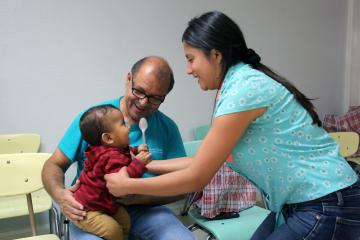
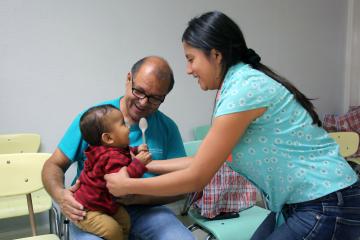
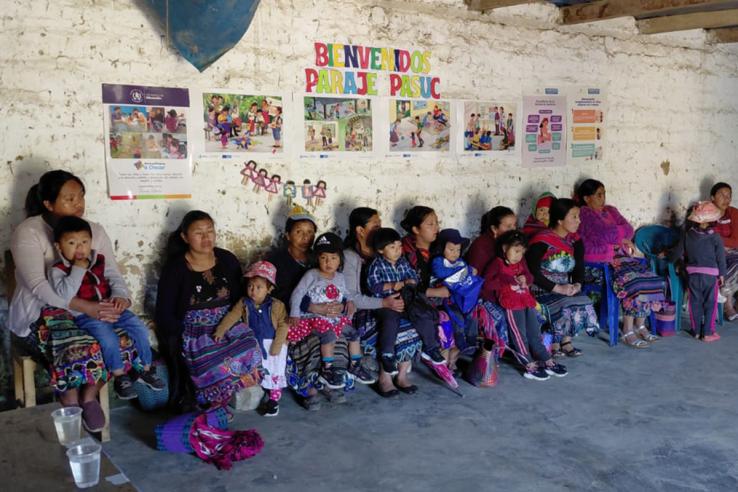
In Guatemala, the Ministry of Education (MINEDUC) is asking that question through Acompáñame a Crecer, a public early childhood education program that has been operating since 2020. Through a community-based model, the program seeks to promote children’s physical, cognitive, and socioemotional development while supporting parents and caregivers. MINEDUC leads the program, working with partners including UNICEF and other organizations involved in its implementation.
As MINEDUC considers the program’s next phase, it is working to understand more clearly how Acompáñame a Crecer operates in practice, which components could be strengthened, and what results should ultimately be measured. Through our broader work on early childhood development in Guatemala, we at J-PAL LAC have collaborated with MINEDUC and other partners to strengthen the use and generation of evidence. For Acompáñame a Crecer, that process began with a practical step: looking more closely at the data and information MINEDUC was already collecting.
We approached this work through three connected steps, each helping us move from what was already known about the program toward clearer questions for its next phase.
Rather than launching a new study, we began by looking more closely at administrative and monitoring data MINEDUC routinely collects on Acompáñame a Crecer. The ministry uses supervision forms as part of its routine program management to document different aspects of implementation. Working with MINEDUC, J-PAL LAC systematized and analyzed information from 67 available forms, including observations on the spaces where activities took place and the training received by community educators.
The forms had important limitations. They were not a representative sample of the program, so they could not provide a national diagnosis or tell us whether Acompáñame a Crecer was improving child development. Still, systematizing and analyzing the forms made implementation patterns and questions easier to see. For example, the forms showed differences in the conditions of program spaces and in the levels of training received by community educators.
This is one practical way administrative data can contribute to evidence-informed decision-making. Information collected for day-to-day program management does not need to answer every question to be useful. Used carefully, it can help governments identify where to look more closely, what might need strengthening, and what they still need to learn.
The supervision forms were only one piece of the picture. Understanding how a program is being implemented is different from understanding why particular components might improve child development or whether they actually do.
Alongside this analysis, we reviewed existing research on early childhood programs, building on J-PAL LAC’s broader work on early childhood development in Guatemala. Evidence from other contexts can highlight promising mechanisms and design choices, but it is not a blueprint. Whether and how those lessons apply depends on local institutions, implementation, and the communities a program serves.
Therefore, the experience of MINEDUC, UNICEF, and other implementation partners was equally important. Their knowledge of how Acompáñame a Crecer operates on the ground helped identify questions that the data alone could not answer.
In June, MINEDUC and J-PAL LAC convened a learning session with the implementation partners to discuss the supervision data, share their experience implementing the program, and identify opportunities to strengthen it. Bringing these perspectives together helped us make Acompáñame a Crecer’s theory of change more explicit.
Through this work, we came to see more clearly that Acompáñame a Crecer already had a community-based model for reaching children and families, but the pathways linking its different components to child development outcomes were not yet fully explicit. Working with MINEDUC and its partners, we therefore focused on clarifying which components were expected to drive change, through which mechanisms, and which outcomes would be most important to measure. Clarifying this logic would help strengthen the program’s next phase and ensure that a future evaluation focuses on questions that matter for MINEDUC’s decisions.
Each partner contributed a different kind of expertise. MINEDUC offered leadership, institutional knowledge, and insights into pressing policy questions. UNICEF and implementation partners contributed operational and territorial experience. J-PAL LAC helped systematize existing information and bring relevant research into the discussion, while research partners helped translate MINEDUC’s emerging policy questions into questions that could be rigorously tested.
Taken together, this work gave us a clearer picture of how Acompáñame a Crecer is intended to work and what still needs to be learned. MINEDUC and its partners are now using that logic to develop a pilot that translates the theory of change into a more clearly specified and evaluable version of the program.
Importantly, none of the work so far tells us about the impact of Acompáñame a Crecer. Monitoring data helped us identify implementation patterns. Research from other settings helped inform possible mechanisms and program choices. Implementation experience revealed how those ideas interact with local realities. Together, these different sources of information helped identify the questions that now require rigorous evaluation.
MINEDUC and its partners plan to test this pilot through a randomized evaluation. The pilot is planned for 2027, with the research design still under development. The evaluation will aim to answer causal questions that existing data, previous research, and implementation knowledge cannot resolve on their own.
For us, this process has reinforced several lessons about evidence use. Existing administrative data can be valuable even when it was not originally collected for research. International evidence can inform program design without replacing the need to understand local context. Long-term collaboration can bring institutional, operational, and research expertise together around a government’s policy priorities. And considering how a program can be rigorously evaluated while designing its next phase can help clarify what should be measured, how the program should be tested, and which questions matter most for decision-making.
In Guatemala, evidence use therefore did not begin with a randomized evaluation, and it will not end with one. The goal is a continuous learning process in which MINEDUC can draw on different forms of evidence to strengthen Acompáñame a Crecer today, generate better evidence tomorrow, and ultimately make more informed decisions about how the program should evolve.