

Conducting a Social Marketing Campaign to Increase the Uptake of Mental Health Care by Ukrainian Refugees in Germany
- Refugees
- Migrants
- Mental health
- Information
- Media
- Psychosocial support

Displaced populations face substantial mental health needs but often encounter significant barriers to seeking care. Researchers evaluated the impact of a social media messaging campaign on mental health help-seeking behavior among Ukrainian refugees in Germany. Social media was an effective means to reach refugees with mental health needs, and videos featuring a relatable patient led to more hotline calls than videos featuring a celebrity. Refugees were reluctant to share information on mental health services with their peers, however, leading to limited dissemination.
Policy issue
As of the end of 2024, approximately 123.2 million people worldwide had been forcibly displaced due to persecution, conflict, violence, human rights abuses, and events that disrupted public safety.1 Refugees and migrants are at risk for poor mental health, encountering both structural barriers—such as limited choices of providers, administrative hurdles, and long wait times—and sociocultural obstacles, including language barriers, stigma, lack of information, and distrust of mental health services.2,3 Ensuring access to mental health care for vulnerable and displaced populations is a major public health challenge worldwide.
Prior interventions have sought to reduce stigma and improve awareness of mental health through peer influence—in the form of in-person contact, virtual interactions, or stories and media—which has been shown to help spread information and shift attitudes.4 However, causal evidence on their effectiveness at scale is limited, especially in contexts of large-scale displacement where awareness of and trust in available services are often low. Decision-makers are sometimes reluctant to fund these campaigns out of concern that they will fail or backfire due to the stigma surrounding mental health issues. Can videos that provide information and reduce stigma make vulnerable populations more likely to seek mental health? Moreover, do celebrities or regular, relatable people make more effective messengers?
Context of the evaluation
This study was conducted in Germany, home to roughly 1.2 million Ukrainian refugees.5 Ukrainian refugees face various barriers related to mental health and access to services. They experience a significant mental health burden, with rates of likely anxiety or depression more than three times higher than the general German population. To address this need, the Central Institute of Mental Health (ZI) in Mannheim offers a national mental health hotline operated in Ukrainian and Russian.
Unlike many other refugee groups, Ukrainians arriving in Germany since March 2022 have full access to the public health care system, including Russian- and Ukrainian-speaking professionals, without out-of-pocket costs, giving them greater access to services than refugees from the Middle East or Africa. However, the use of mental health care services remains low, with 73 percent of study participants reporting a language barrier, 72 percent reporting high treatment costs, and 48 percent reporting a lack of knowledge about the availability of mental health support within the country. Moreover, refugees also face socio-cultural barriers, including low mental health literacy, self-stigma, negative attitudes toward mental health institutions rooted in the Soviet-era context, and limited proficiency in German or English.6
Women make up 81 percent of this study sample, with only 34 percent of them having a partner in the country, likely due to travel restrictions for Ukrainian men under military obligations due to the war.

Details of the intervention
To fill this gap, researchers partnered with the Central Institute of Mental Health (ZI) to evaluate which strategies best capture attention, increase awareness, reduce stigma, and promote help-seeking among Ukrainian refugees living in Germany. The intervention aimed to connect participants to a free and confidential mental health hotline. The hotline was staffed by Ukrainian- and Russian-speaking mental health professionals and provided information on local services, guidance in navigating the system, and direct support in booking appointments.
To encourage uptake of the mental health services, researchers conducted a randomized evaluation in the Telegram social media app. Telegram, which allows users to send messages, photos, videos and files to their contacts for free, was used by approximately 80 percent of Ukrainian refugees in Germany at the time of the study.7 The Telegram bot (Depsy) recruited users through community channels, partner chatbots, posters, and targeted ads. A parallel website evaluation mirrored the same recruitment strategies and content, but without the bot interface.
Participants were randomly assigned to receive either 1) a video featuring a relatable Ukrainian woman in Germany who sought mental health care and experienced improvement (710 participants) or 2) a video of a Ukrainian public figure highlighting the importance of mental health care in the context of war (710 participants). The comparison group received a text message about the hotline (573 participants).
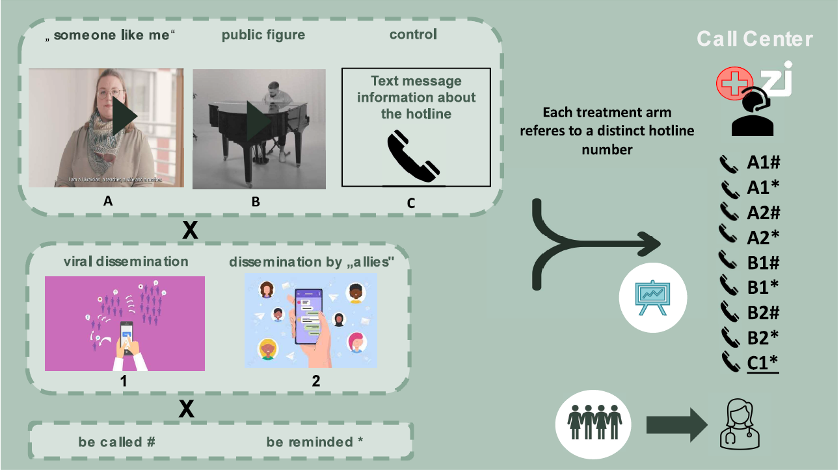
Researchers also tested additional delivery channels and engagement features within Telegram to further increase hotline uptake. A randomly selected subset of users was designated as “Allies” and encouraged to share with their peers. Separately, researchers tested alternative call-to-action buttons in the bot, offering either a “Call me back” option (allowing users to schedule a return call from the hotline) or a “Remind me later” option.
Researchers conducted a second, related evaluation within a national online panel survey (referred to as the within-survey evaluation). Participants were randomly assigned to receive one of the same two interventions: either 1) a video featuring a relatable patient (907 participants) or 2) a video featuring a celebrity (937 participants). A comparison group saw no video (975 participants).
Throughout the evaluation, researchers drew on a range of data sources to measure the impact of the intervention across the three settings. Tracking data in Telegram and on the parallel website captured user interactions with the video and action buttons. Researchers measured hotline calls using hospital data; different hotline numbers were given to each intervention group in order to attribute calls from each group. Survey data captured changes in perceptions: bot users received a survey the day after they first visited the bot, and online panel survey participants completed a follow-up survey three months later. Hotline callers also received a survey at the end of their calls.
Ethical considerations
The mental health support service (hotline) is a service based on the provision of mental health support for refugees as part of the normal functioning of a hospital, and the study did not collect any medical data from this service. Through the experimental intervention, participants are encouraged to find support and access to care. To minimize the risk that messages activate painful feelings or memories, the patient video was co-created through participatory methods involving the featured patients and other refugees with mental health symptoms.
Results and policy lessons
Results forthcoming.
United Nations High Commissioner for Refugees, Global Trends, https://www.unhcr.org/global-trends
Satinsky, Emily, Daniela C. Fuhr, Aniek Woodward, Egbert Sondorp, and Bayard Roberts, “Mental health care utilisation and access among refugees and asylum seekers in Europe: A systematic review,” Health Policy, 2019, 123 (9), 851–863
Quirke, Eleanor, Vitalii Klymchuk, Orest Suvalo, Ioannis Bakolis, and Graham Thornicroft, “Mental health stigma in Ukraine: cross-sectional survey,” Global Mental Health, March 2021, 8.
Thornicroft, Graham, Charlene Sunkel, Akmal Aliev, Sue Baker, Elaine Brohan, Rabih Chammay, Kelly Davies, Mekdes Demissie, Joshua Duncan, Wubalem Fekadu, Petra Gronholm, Zoe Guerrero, Dristy Gurung, Kassahun Mekonnen, Charlotte Hanlon, Eva Heim, Claire Henderson, Zeinab Hijazi, Claire Hoffman, and Petr Winkler, “The Lancet Commission on ending stigma and discrimination in mental health,” The Lancet, 2022, 400, 1438–1480.
Federal Ministry of the Interior and Community (Germany), [Three years of Russia’s war of aggression: 1.25 million refugees from Ukraine in Germany], press release, February 2025 https://www.bmi.bund.de/SharedDocs/pressemitteilungen/EN/2025/02/ukraine.html
Quirke, Eleanor, Vitalii Klymchuk, Orest Suvalo, Ioannis Bakolis, and Graham Thornicroft, “Mental health stigma in Ukraine: cross-sectional survey,” Global Mental Health, March 2021, 8.
National Sample. “Social Media in Eastern Europe: How Digital Habits Are Changing in Ukraine, Bulgaria, and Romania.” National Sample, April 4, 2025. https://nationalsample.com/social-media-in-eastern-europe-how-digital-habits-are-changing-in-ukraine-bulgaria-and-romania/