

The Impact of Cash Incentives and Health Messaging on Covid-19 Vaccination Rates in Ghana
- Rural population
- Adults
- Take-up of program/social service/healthy behavior
- Information
- COVID-19 response
- Monetary incentives





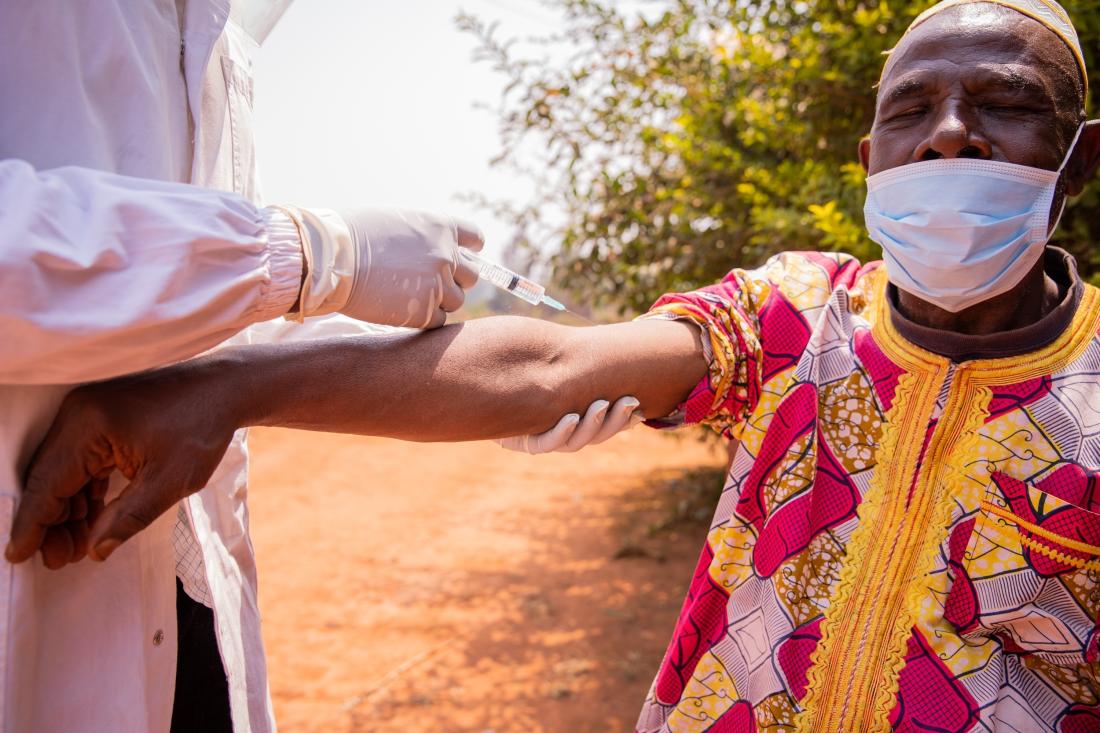
Despite an adequate vaccine supply, Covid-19 vaccination rates in Africa remain low. Researchers conducted a randomized evaluation to test whether health messaging or cash incentives of different amounts encouraged adults to get a Covid-19 vaccine in rural Ghana. When offered cash, adults were more willing to get vaccinated, but only the smaller cash amounts spurred adults to actually get vaccinated. At the same time, a standard health message alone did not lead to more people getting vaccinated.
Policy issue
Even in places where Covid-19 vaccines were free and available, some adults in Africa did not get vaccinated.1 Incentives can encourage people to get vaccinated, but there is little evidence on how well cash specifically works as an incentive, especially in low- and middle-income countries (LMICs). Moreover, though a larger cash incentive may seem more persuasive, it may be perceived as a sign that the vaccine is not safe. On the other hand, simple health messaging, without incentives, avoids this challenge but may not address an individual’s economic constraints to getting vaccinated. In higher-income countries (HICs), cash has had a mixed impact on Covid-19 vaccine take-up. At the same time, simple health messaging had little to no impact on encouraging vaccination in HICs. Can financial incentives encourage more people to get vaccinated against Covid-19 in rural Ghana, especially compared to standard messaging about the vaccine? And does the size of the incentive matter?
Context of the evaluation
The evaluation began in February 2022, across six rural districts in Ghana's Central Region. The District Health Offices made Covid-19 vaccines available in the relevant districts at roughly the same time, but vaccination rates lagged. By May 2022, 30 percent of people in Ghana had received a Covid-19 vaccination.
Within the selected districts, the researchers selected a random sample of adults who had not yet received a Covid-19 vaccine. Within this group, the average age was 37.4 years, 57.1 percent were women, 59 percent worked full-time, and 18.1 percent had never attended school. On average, respondents spent 161.6 Ghana cedis (US$20 at the time of evaluation) on food per week. Households were located, on average, 5.6 kilometers (3.5 miles) from the nearest health clinic. People may incur costs traveling this distance that a cash incentive could ameliorate.
Details of the intervention
Researchers partnered with District Health Offices in six Ghanaian districts to conduct a randomized evaluation testing the impact of cash incentives of varying amounts and health messaging on adults’ Covid-19 vaccination intentions and status.
The researchers and District Health Offices combined villages in each district into clusters of four based on each village’s population size. The researchers randomly selected thirteen clusters from each district, yielding 310 total villages in the study. Within each cluster, each village was randomly assigned to one of three intervention groups and one comparison group:
- Health Message (75 villages, 1,063 individuals): Participants watched a 45-second video promoting and providing information about the Covid-19 vaccine. The video was modeled on videos produced by the US Centers for Disease Control and Prevention.
- Low Cash Health Message (79 villages, 1,079 individuals): Participants watched a 45-second video. The first 30 seconds were identical to the Health Message video, and the last 15 seconds informed participants they would earn 24 cedis (US$3 at the time of evaluation)if they received the Covid-19 vaccine in the next six weeks.
- High Cash Health Message (83 villages, 1,089 individuals): Participants watched a video similar to that in the Low Cash Health Message group, except that they were informed they could earn 80 cedis (US$10)—about half a week’s food budget—if they received the Covid-19 vaccine in the next six weeks.
- Comparison (73 villages, 2,669 individuals): Participants watched a 45-second placebo video about the benefits of using solar power to charge household appliances.
Within each intervention village, a quarter of participants were shown the placebo video instead of the health video. This design makes it possible to measure spillover effects: whether the health information or cash incentives influenced people who never watched the video or received an incentive themselves, but may have heard about the health information or incentive from their neighbors.
Immediately after watching the video, researchers asked each participant about their intentions to get vaccinated in the next six weeks. Then, between April and June 2022, enumerators conducted phone and in person interviews to ask individuals whether they had been vaccinated. Finally, in October and November 2022, the District Health Offices shared verified administrative data on whether and when each participant received a dose of the Covid-19 vaccine.
In addition to receiving ethical review and approvals from an institutional review board, researchers made efforts to address and account for ethical questions by putting measures in place to protect enumerators and study participants during the Covid-19 pandemic. For more on the researchers’ discussion of ethical considerations, see page 3,206 here.
Results and policy lessons
Cash incentives increased Covid-19 vaccination intentions, but only small cash payments increased vaccination rates among unvaccinated adults in rural Ghana. In contrast, a standard health message alone reduced actual vaccination rates.
Vaccination intentions: Cash, especially the lower amount, changed adults’ vaccination plans, while the health information did not. After watching the high and low cash videos, participants were more likely to intend to get vaccinated, especially in the low cash group: intentions increased by 7.2 and 10.7 percentage points, respectively (increases of 10.1 and 15.1 percent, off a base of 71 percent). After watching the health information video, participants were no more likely to intend to get vaccinated than the comparison group.
Self-reported vaccination status: Although stated intentions did not always translate to action, small cash incentives were still the most effective intervention. A few months later, only the small-cash group stood out: they were 5.4 percentage points more likely to report getting vaccinated than their comparison peers (a 14.9 percent increase from a base of 36.3 percent). Despite being offered more money, adults who were offered the larger cash incentives were no more likely to report vaccinations than the placebo group, suggesting that the large payments may have led to vaccine skepticism. The health information group was similarly ineffective.
Verified vaccination status: Official vaccination records confirmed this pattern of small cash standing out. By the end of April 2022, 28.4 percent of individuals in the comparison group had been vaccinated against Covid-19. People in the low cash group were 12.3 percentage points more likely to be vaccinated than their peers (a 43.3 percent increase). There was no change in vaccination rates in the high cash group. People in the health message group were 6.8 percentage points less likely to be vaccinated than the comparison group (a 24 percent decrease).
Spillover effects: Neighbors got vaccinated too, even if they did not directly receive any small cash incentive. In villages where most residents were offered the smaller incentive, the few who saw the placebo video were still 11.5 percentage points more likely to get vaccinated than the comparison group (a 42.9 percent increase from a base of 26.8 percent) – suggesting that the decision to vaccinate spread person to person. However, neighbors of people offered the larger incentive or the health message were no more likely to get vaccinated.
Cost considerations: The lower cash incentive was approximately 30 percent of the cost of the higher cash incentive, and was more effective at encouraging people to get vaccinated. Consequently, the smaller payment was more cost-effective.
Overall, modest financial incentives encouraged more people to get vaccinated in rural settings, while health messaging alone did not. However, more money did not translate to more vaccinations. The lesson, the researchers suggest, is to match the payment to what vaccination costs people in time and travel. If policymakers offer too much cash, the offer may raise suspicion instead of uptake.
Duch, Raymond, Edward Asiedu, Ryota Nakamura, et al. “Financial Incentives for COVID-19 Vaccines in a Rural Low-Resource Setting: A Cluster-Randomized Trial.” Nature Medicine 29, no. 12 (2023): 3193–202. https://doi.org/10.1038/s41591-023-02670-4.
Ackah, Betty B. B., Michael Woo, Lisa Stallwood, et al. “COVID-19 Vaccine Hesitancy in Africa: A Scoping Review.” Global Health Research and Policy 7, no. 1 (2022): 21. https://doi.org/10.1186/s41256-022-00255-1.