

The Impact of Temporary Subsidies and Financial Education on Demand for Weather Insurance in China
- Farmers
- Rural population
- Technology adoption
- Information
- Insurance


Previous efforts by governments to increase the demand for formal insurance, through information provision, subsidies, and increasing trust in institutions, have not worked as well as expected, possibly leaving households exposed to risk. To better understand why people do or do not buy insurance, researchers partnered with the People’s Insurance Company of China (PICC) to conduct a randomized evaluation of an insurance subsidy and financial education program in Jiangxi province, China. Providing free insurance for one year increased adoption in the short term, but over time, buying insurance was driven by farmers’ experiences with the product.
Policy issue
Many rural, low-income households in low- to middle-income countries face risks, like extreme weather shocks, that can negatively impact their income and consumption. Insurance is one method to shield farmers from these risks, but previous efforts by governments to increase demand for formal insurance, such as through information, subsidies, or improving trust in institutions, have not worked as well as expected. The decision to buy insurance could be influenced by a variety of factors, such as the price, prior experience, anecdotes from one’s social network, and knowledge of how insurance works. What are the best ways to improve demand for weather insurance to protect farmers against risk?
Context of the evaluation
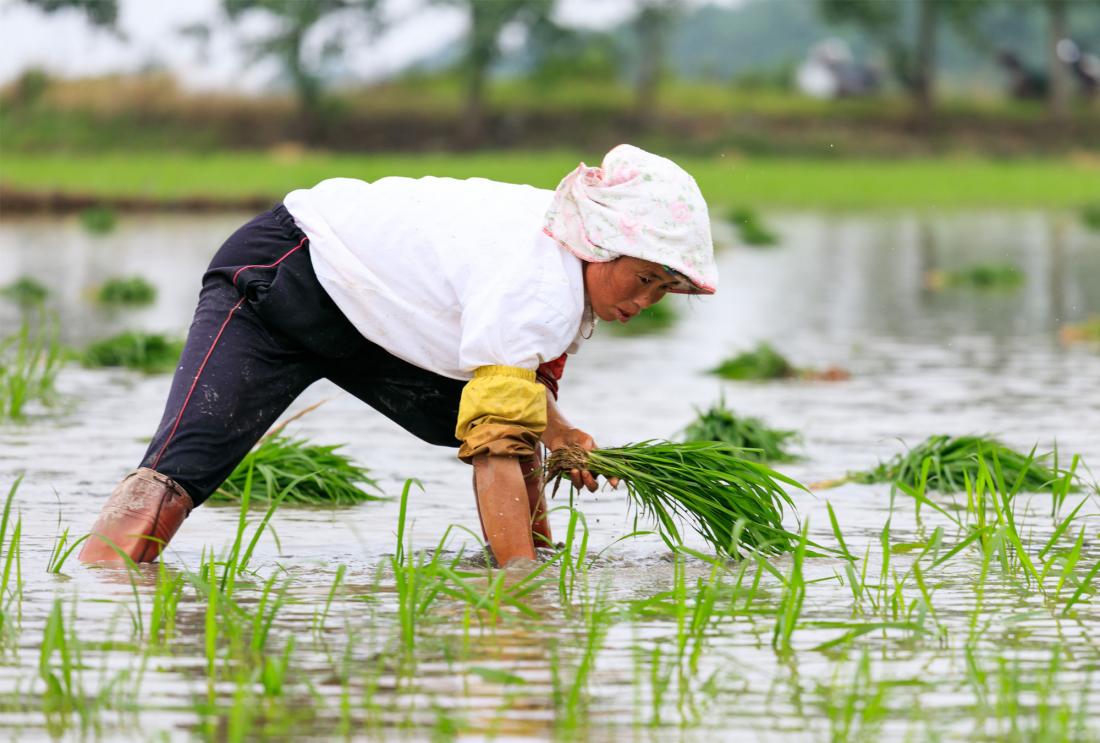
In China, nearly fifty percent of farmers are engaged in producing rice—the country’s most important food crop. To maintain food security and protect farmers from extreme weather, the People’s Insurance Company of China (PICC) designed a rice production insurance policy, and began piloting it in 2009 in rural villages in Jiangxi.
A farmer insured with the rice production insurance policy could receive a payout if they experienced an extreme weather event, such as heavy rain, flooding, windstorms, extreme temperatures, or drought, and the average yield in their area fell by at least 30 percent. The amount paid to the farmer depends on how many crops were lost; for instance, if the loss was 30 percent of the usual yield, each farmer would receive 60 RMB per mu (US$54.55 per acre). Each farmer could receive a maximum payout of 200 RMB per mu (US$181.82 per acre).
The PICC advertises their product every February, just before the first season of rice production. If a farmer purchases insurance coverage, the price is deducted from an annual rice production subsidy that is automatically deposited in each farmer’s bank account. Insurance payouts are made in the same way.
In the villages where the insurance product was piloted, almost all households were rice farmers. On average, farmers produce 12 mu (0.80 hectares) of rice per year, and rice production makes up seventy percent of household income. Households tend to be fairly risk-averse.
Details of the intervention
In partnership with the PICC, researchers evaluated the impact of subsidies and financial education on farmers’ demand for rice weather insurance from 2010 to 2011 in Jiangxi province, China. Researchers randomized access to variations of the PICC’s weather insurance product over the two years. In the first year, researchers randomly assigned 134 villages to two groups:
- Subsidized insurance (72 villages): Farmers were offered the insurance product with a seventy percent subsidy, or 3.6 RMB per mu (US$3.27 per acre).
- Free insurance (62 villages): Farmers were first offered the 70 percent subsidy and told two days later that the product would instead be provided for free.
Each year, researchers held information sessions about the insurance product, and households decided whether to buy insurance after. Researchers then randomized two additional interventions across the above groups:
- Financial education (86 out of 134 villages): Within these villages, half of all households were offered a group financial education class. The class explained how insurance differs from subsidies, explained historical average yield losses, and taught farmers how to estimate their average net gain or loss from purchasing insurance.
- Opt-out design (54 out of 134 villages): In selected villages, farmers had to opt out of purchasing the insurance (in the remaining 80 villages, farmers had to opt in).
In the second year, researchers randomly assigned households across all 134 villages to eight different subsidy amounts between 40 and 90 percent. During the information sessions, farmers found out—before they made a decision about whether to purchase insurance—about who in their village was insured and what payouts had been disbursed.
Researchers also used administrative data from the PICC on insurance purchases and payouts. Due to several extreme weather events in 2010, 59 percent of insured households received a payout.
Results and policy lessons
Farmers were more likely to buy insurance when it was free for one year, but in the long term, they were more likely to buy insurance if they received a payout previously. Farmers were influenced by payouts more if they purchased insurance—compared to receiving free insurance. If they did not have insurance, they learned from the payouts their friends received.
Demand for insurance: Farmers who received insurance for free in the first year were 5.68 percentage points (an 11.4 percent increase from a baseline of 49.92 percent) more likely to buy insurance in the second year compared to farmers who received a partial subsidy in the first year. When prices increased in the second year, farmers were less likely to purchase insurance.
Learning from experience: Farmers who got payouts in the first year were more likely to buy insurance in the second year. Farmers who paid for insurance in the first year and received a payout were 36.8 percentage points (a 73.7 percent increase from a baseline of 49.9 percent) more likely to buy insurance again than farmers who bought insurance but did not receive a payout. Meanwhile, farmers who received insurance for free and received a payout were 16.8 percentage points (a 29.8 percent increase from a baseline of 56.3 percent) more likely to buy insurance than farmers with free insurance and no payout, suggesting that farmers may place more weight on whether they received a payout if they paid for their insurance previously.
Farmers also learned from their friends’ experience with insurance. Farmers who paid for their insurance were 23.71 percentage points (a 44.9 percent increase from a baseline of 52.8 percent) more likely to buy it again if over half of their social network received a payout. For farmers with free insurance, having at least half of their social network receive payouts increased take-up by 13.51 percentage points (a 20.5 percent increase from a baseline of 65.8 percent). These impacts were driven by farmers who were not interested in buying insurance at a seventy percent subsidy, in both the free and subsidized groups. That is, farmers who chose not to buy subsidized insurance were more likely to adopt in the second year if most of their social network received payouts. But for farmers who did buy insurance, their social network did not affect their decision to buy again. Farmers who got free insurance but would not have bought it at a seventy percent subsidy were moved to buy it by their social network; this was not so for farmers who were already willing to buy it.
Farmers who received financial education were more likely to buy insurance in the fourth year if they received a payout in any of the three previous years, whereas farmers who did not receive financial education were more influenced by more recent payouts. Researchers suggest that financial education led farmers to permanently increase their take up of insurance.
Other mechanisms: Receiving payouts did not alter farmers’ risk aversion, perception of future disasters, or trust in the PICC. Farmers with greater rice production were no more likely to buy insurance. Farmers did not base their future decision to buy insurance only on whether the price was lower than the initial price. And farmers who bought insurance in the past do not continue buying insurance purely out of habit.
Cost-analysis: Combining the seventy percent subsidy and financial education was more cost-effective at increasing insurance adoption than the full subsidy, as it was both cheaper and more effective.
Taken together, researchers suggest that for a temporary insurance subsidy policy to effectively increase long-run take up, it should be paired with other offerings—like financial education—that increase farmers’ understanding of the insurance product.
After seeing the researchers’ findings, the PICC encouraged the government to provide financial education on insurance widely.