

Targeting Foundational Skills to Improve Learning at Scale in Zambia

Many children in low- and middle-income countries (LMICs) leave primary school without acquiring basic math and reading skills. Some education programs assume that once children master basic skills, they will unlock broader learning, but evidence on this kind of skill transfer is limited. Researchers studied Zambia's Teaching at the Right Level program, delivered by government teachers nationwide, using a pre-registered cluster-randomized trial and an event study covering 4.4 million exam scores. After two years, the program improved children’s foundational literacy and numeracy. Gains in mathematics were concentrated in the procedural skills the program targets, with near-zero improvement in other competencies. Yet by the end of primary school, cohorts exposed to the program scored higher on comprehensive leaving exams in both subjects. This contrast suggests that the broader returns to targeting foundational skills can operate over longer horizons.
Policy issue
Despite high enrollment, millions of children in low- and middle-income countries progress through school without learning basic literacy and numeracy skills.
Governments and NGOs have responded by investing in remedial programs that focus on specific foundational skills. However, there is limited evidence on whether children in these targeted programs learn skills beyond the ones directly taught. Prior research has also highlighted the potential of continuous professional development for teachers as a means to change instructional practices and improve student learning outcomes.
Can a government-led remedial education program that targets a narrow set of foundational skills produce broader learning gains for students? And does additional continuous professional development for teachers further strengthen the program?
Context of the evaluation
Zambia’s public education system is free and serves the vast majority of students. Despite a high enrollment rate of 85.6 percent, only 12.7 percent1 of Grade 4 students met the minimum global learning standards2,3 in 2023. To address low learning levels, Zambia's Ministry of Education began rolling out the Teaching at the Right Level (TaRL) program in 2016. The program, locally known as Catch Up, focuses on grades 3 through 5 and, as of 2026, covers all provinces, reaching more than one million students per year. Government teachers implement the program in schools without additional staff or infrastructure upgrades4.
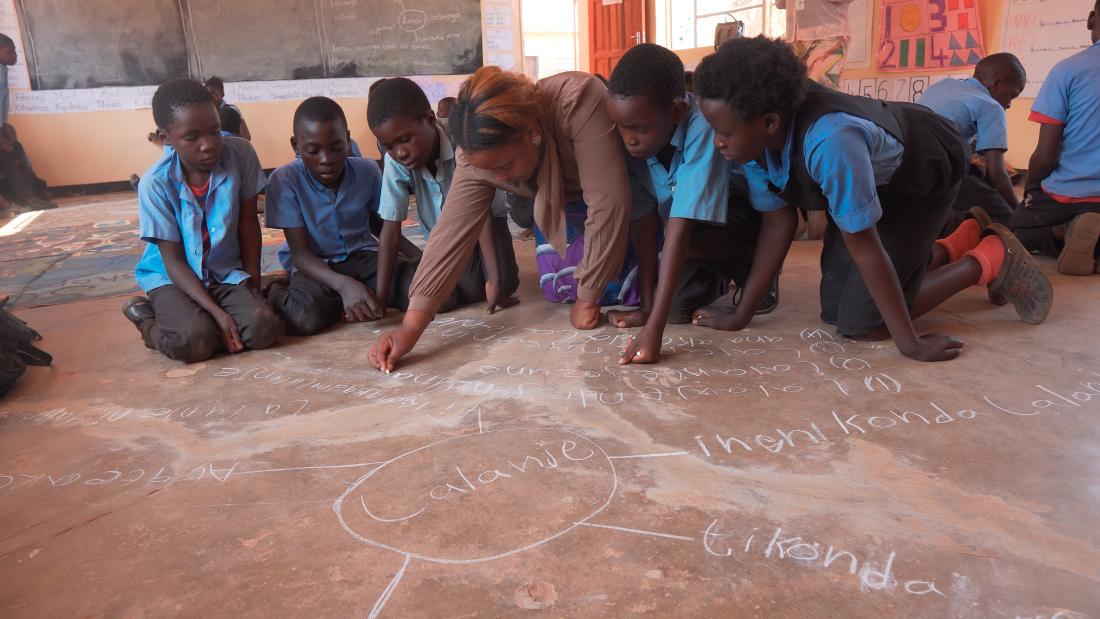
In Catch Up’s daily remedial classes, teachers assess children’s foundational skills using a simple, one-on-one assessment, group students based on learning level, and use a sequenced set of activities designed to accelerate foundational learning. Teachers are trained in the new structured instructional approach and receive mentorship from educators who have conducted practice classes themselves.
Students are meant to attend one remedial class each day, either in literacy or numeracy. In Catch Up math classes, students focus specifically on a subset of foundational mathematics skills5: number recognition and procedural arithmetic. In Catch Up literacy classes, students cover foundational reading and writing skills more broadly.
Details of the intervention
Researchers partnered with Zambia’s Ministry of Education, Teaching at the Right Level Africa, and VVOB-education for development to conduct a randomized evaluation to test the impact of the standard Catch Up program on students' foundational literacy and numeracy (FLN) skills. They also investigated the impact of adding additional continuous professional development for teachers to the program.
Researchers randomly assigned 182 administrative zones, and the 1,115 government-run primary schools within them, to either receive the Catch Up program or continue with regular instruction. Within zones assigned to the program, one school per zone was further randomly assigned to receive an enhanced version with an additional continuous professional development (CPD) component for teachers. This created three groups of schools:
- Comparison group (560 schools across 91 zones): Teachers continued with regular instruction until 2025 or later.
- Catch Up (560 schools across 91 zones): Teachers in these schools implemented the standard Catch Up program, which is being scaled nationally.
- Catch Up with additional CPD (91 schools across 91 zones): In addition to the Catch Up program, teachers were invited to participate in communities of practice, received additional guidance documents and videos, and were invited to collaborate with colleagues on “mastery challenges.” The Ministry also recognized participating teachers through formal letters.
For data collection, researchers randomly sampled 91 schools from each of the three groups, for a total of 273 schools. From each school, up to 40 students were randomly selected, yielding a sample of 8,025 Grade 3 students. These students were followed over two years (2022-24), with one-on-one assessments of foundational literacy and mathematics conducted at both the start and end of the evaluation. These assessments covered the specific skills targeted by the program, as well as a comprehensive set of foundational skills aligned with international frameworks and Zambia’s national curriculum. Researchers also measured students’ working memory, creativity, and socioemotional skills, along with study habits and teacher collaboration.
Separately, researchers analyzed approximately 4.4 million exam scores from all public Grade 7 primary school leaving exams between 2014 and 2025, using the program’s staggered national rollout to study its longer-term effects. These exams capture a broader range of competencies than the foundational assessments used in the two-year evaluation and are taken approximately two years after students leave the program in Grade 5.
Results and policy lessons
After two years, students in both Catch Up groups improved their foundational literacy and numeracy skills relative to the comparison group. Most of their math gains came from the program’s targeted skills rather than broader foundational math skills. By the end of Grade 7, two years after the end of the Catch Up program, however, students showed broader improvements across literacy and numeracy, as measured by a long-term analysis using administrative exam data. Catch Up students saw no additional program impacts when their teachers received additional continuous professional development.
Program impacts after two years: Only one-third of students attended a remedial class on any given school day. This low attendance rate was driven largely by overall student absenteeism: approximately 50 percent of students in the study’s sample were either absent from school on any given day, had dropped out, or switched to another school. Among students who did attend school, they attended the remedial classes on about two-thirds of the days they were scheduled to receive one.
Despite this, students in Catch Up schools improved their foundational literacy scores by 0.10 standard deviations (SD) and their foundational numeracy scores by 0.15 SD relative to the comparison group. This represents roughly 2.2 months of additional learning in literacy and 2.8 months in math over the two-year period. These learning gains place the program within the top 20–30 percent of large randomized evaluations6.
Lack of short-run transfer from targeted to comprehensive math skills: In the short run, targeted numeracy skills did not transfer to other foundational math skills. Students’ improvements in foundational math skills were almost exclusively driven by impacts on the narrowly targeted subset of skills (0.40 SD), such as number recognition and subtraction. In turn, their gains in closely related skills, such as number sense and applied arithmetic, and in other non-targeted domains of foundational math skills, were close to zero.
Additional outcomes: The two-year trial also found small impacts on Catch Up students’ working memory (0.07 SD) and homework completion (3.9 percentage-point increase). Catch Up teachers were also more accurate in predicting their students’ learning levels, at least for the targeted math skills. However, they continued to overestimate students’ abilities in non-targeted skills and in reading. Researchers did not detect meaningful impacts on Catch Up students’ attitudes toward school, creativity, or socioemotional skills.
Teacher professional development: Despite high engagement, teachers in the enhanced CPD group generated no additional learning gains for their students, compared to the standard Catch Up group. Impacts on foundational literacy and numeracy were nearly identical across the standard Catch Up and Catch Up with additional CPD programs. In fact, teachers in schools with additional CPD collaborated slightly less with colleagues than those in standard Catch Up schools, despite the aim to further strengthen collaboration. These findings are broadly consistent with evidence from LMICs7: in scaled public systems with constrained instructional capacity, level-based learning and explicit instructional routines appear to matter more for learning outcomes than additional investments in professional learning communities.
Cost-effectiveness: The standard Catch Up program cost US$9.63 per student over the two-year trial (average of US$4.82 per student/year). Adding additional CPD increased per-student cost to US$19.97 over two years (average of ~US$10 per student/year). These figures include both implementation costs and NGO costs. In the short-run, the standard program cost US$6.38 for every 0.1 SD impact on math and $9.53 for every 0.1 SD impact on literacy. For the specific math skill the program targeted, the cost was much lower at US$2.43 per 0.1 SD gain. In mathematics, the choice of outcome measure changed the estimated cost-effectiveness of the same program by a factor of 2.6.
Long-term impacts on broader skills: In a separate long-term analysis using administrative Grade 7 exam data, students who can be expected to have been fully exposed to the program scored higher on the comprehensive Grade 7 exams by 0.14 SD in language and 0.11 SD in mathematics. These effects were largely uniform across girls and boys.
Policy lessons: Recent evidence syntheses8,9 highlight that while TaRL has been highly effective in NGO-led programs, in summer camps, or when implemented with dedicated volunteers, large-scale rollouts delivered by government teachers in schools often show weaker or inconsistent impacts. This study demonstrates that TaRL can be effective when implemented at a large scale through existing public systems: Zambia’s Catch Up program, run entirely by the government, shows that strong results are achievable with limited reliance on external support. Because few such nationwide, government-led programs have been rigorously evaluated, Zambia’s experience offers an important example for policymakers considering large-scale adoption. More broadly, the study’s findings carry three implications for policymakers designing foundational skills programs.
First, a narrowly targeted focus on foundational skills can generate broad academic gains over time, even when delivered by government teachers through existing systems and with limited per-student exposure. Short-run assessments of non-targeted skills may understate a program’s long-run value.
Second, how programs are evaluated matters: in mathematics, the choice of outcome measure changed the estimated cost-effectiveness of the same program by a factor of 2.6. Policymakers comparing programs across studies should consider whether evaluations measure only the skills a program directly targets or a broader set of competencies.
Third, in settings where teaching capacity is constrained, investing in explicit instructional routines and level-based instruction may yield higher returns than investing in additional professional learning communities.
de Barros, Andreas, and Theresa Lubozha. Targeting Foundational Skills at Scale: Skill Specificity and Transfer.
CEGA Working Paper No. 259. Berkeley, CA: Center for Effective Global Action, 2026.
https://doi.org/10.26085/C3WG6F.
UNESCO Institute for Statistics (UIS) and Australian Council for Educational Research (ACER), Assessments for Minimum Proficiency Levels a and b (AMPL-ab) Zambia, 2024 (Montreal: UIS, 2024), https://unesdoc.unesco.org/ark:/48223/pf0000389094.
UNESCO Institute for Statistics (UIS), US Agency for International Development (USAID), UK Department for International Development (DFID), and Australian Council for Educational Research (ACER), Global Proficiency Framework for Reading and Mathematics: Grades 2–6 (Montreal: UIS, 2019), 8, https://www.uis.unesco.org/sites/default/files/medias/fichiers/2025/08/Global-Proficiency-Framework-18Oct2019_KD%20(1).pdf.
According to UNESCO, “‘meets’ global minimum proficiency levels” is defined as, “Learners have developed sufficient knowledge and skills. As a result, they can successfully complete the most basic grade-level tasks.”
Varja Lipovsek, Laura Poswell, Ashleigh Morrell, Devyani Pershad, Nico Vromant, and Abe Grindle, “Reflections on Systems Practice: Implementing Teaching at the Right Level in Zambia,” in Systems Thinking in International Education and Development, ed. Moira Faul and Laura Savage (Cheltenham, UK: Edward Elgar Publishing, 2023), 27–46, https://doi.org/10.4337/9781802205930.00012.
UNESCO Institute for Statistics et al., Global Proficiency Framework, 10–18.
David K. Evans and Fei Yuan, "How Big Are Effect Sizes in International Education Studies?,” Educational Evaluation and Policy Analysis 44, no. 3 (2022): 532–40, https://doi.org/10.3102/01623737221079646.
Anna Popova, David K. Evans, Mary E. Breeding, and Violeta Arancibia, “Teacher Professional Development around the World: The Gap between Evidence and Practice,” World Bank Research Observer 37, no. 1 (2022): 107–136, https://doi.org/10.1093/wbro/lkab006.
Cally Ardington, Alicia Menendez, and Jack Thunde, The Limits of a "Great Buy": What Rigorous Evidence Reveals about Teaching at the Right Level (Cape Town: AFLEARN, University of Cape Town, 2026), https://www.datafirst.uct.ac.za/sites/default/files/media/documents/dfru_uct_ac_za/2872/aflearn-report-tarl.pdf.
Global Education Evidence Advisory Panel, 2023 Cost-Effective Approaches to Improve Global Learning: What Does Recent Evidence Tell Us Are "Smart Buys" for Improving Learning in Low- and Middle-Income Countries (Washington, DC: World Bank; London: FCDO; New York: UNICEF and USAID, 2023), https://thedocs.worldbank.org/en/doc/231d98251cf326922518be0cbe306fdc-0200022023/related/GEEAP-Report-Smart-Buys-2023-final.pdf.