A new diverse cohort joins the vibrant graduate network of the J-PAL/UC Diploma in Impact Evaluation
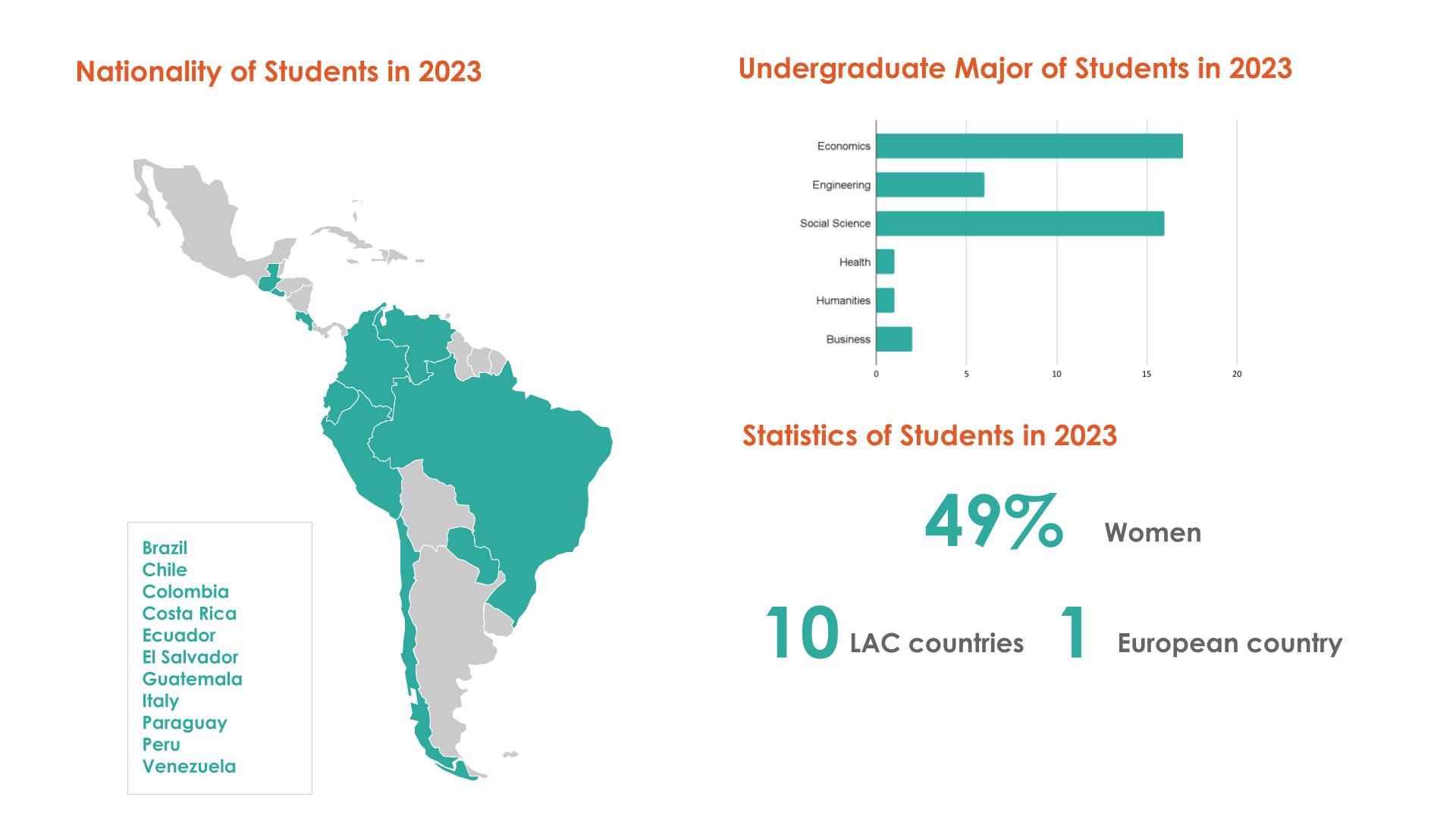
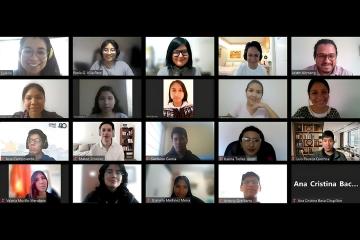
In January, a new diverse class graduated from the Diploma in Impact Evaluation of Public Policies and Social Programs organized by the Instituto de Economía (IE) of the Pontificia Universidad Católica de Chile (UC Chile) and J-PAL Latin America and the Caribbean (J-PAL LAC). Forty-one students from ten Latin American countries and one European country are now part of a vibrant network of professionals with the tools to design and understand the results of rigorous program evaluations.
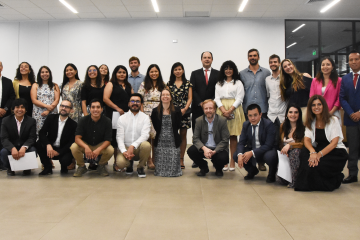
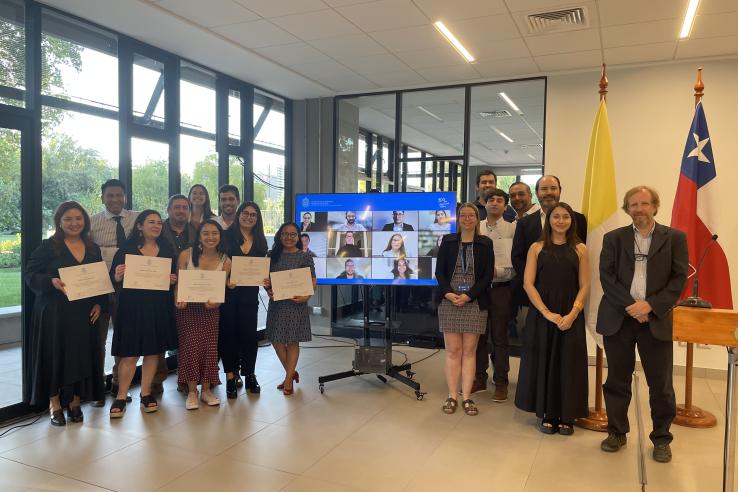
In a hybrid ceremony, IE director Tomás Rau, who also lectures for the Diploma, welcomed the new graduates. J-PAL affiliate, UC Chile Professor, and the Diploma’s Director Jeanne Lafortune highlighted the international diversity of the group, which enables them to create an impact that goes beyond borders. During the event, two students shared their thoughts on the impact of the Diploma in their professional lives.
Discover the class of 2023
Illustration: J-PAL
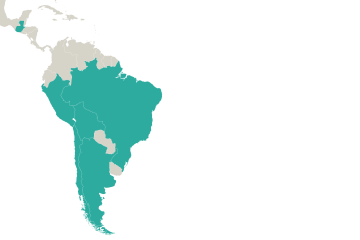
The Diploma students of 2023 are from seven countries in South America, three in Central America, and one in Europe. Their undergraduate studies range from economics to social sciences, business, health, humanities, and engineering, and more than half have completed or are pursuing postgraduate degrees. Most work in government, foundations, and the education sector. Women make up 49 percent of students.
This year, the generous support of Fundación Colunga, Fundación Olivo, and Fundación Mustakis, covered a portion of the tuition for six incoming students. Additionally, the Ministry of Finance of Paraguay covered the tuition of a group of civil servants. Receiving this kind of institutional support allowed for more students to join and benefit their organizations with their learnings.
Characteristics of the Diploma
The Diploma in Impact Evaluation of Public Policy and Social Programs is a highly regarded program among its students. It is taught in Spanish by UC Chile academics, J-PAL affiliates, and J-PAL LAC staff. Since 2021, classes have been synchronous, meaning that learners attend class sessions virtually at the same time as their instructor and classmates. This has allowed participants around LAC to be part of and engage in this training more easily.
The program provides students with a deep dive into the theory and practice of impact evaluations, equipping them to design and apply impact evaluations and become advocates of evidence-informed policy. It consists of three courses: Impact Evaluation Methods, Evidence and Policy, and Implementation of an Impact Evaluation. Students also develop an impact evaluation proposal for one of their organization’s programs. This year, the cohort presented eight evaluation projects, in which they worked on an experimental impact evaluation proposal for real social programs in sectors such as education, labor markets, health, and family.
Since its beginning in 2016, the Diploma has reached more than two hundred students across seventeen countries worldwide, most of them in LAC.
Beyond the Diploma
The vibrant network of the Diploma program expands its reach every day. Alejandro Carlos Sierra Campodónico, a Chilean engineer and graduate of the 2017 Diploma class, recently finished his PhD: “The Diploma sparked my interest in economics and, ultimately, was decisive in my decision to enter a doctorate program in economics.”
Similarly, Yadiraah Iparraguirre, a Peruvian economist and graduate from the 2022 Diploma class, will start a Master's program in economics this year: “After completing the Diploma program, I was encouraged to apply for the Master of Economics program at UC Chile. I was admitted to the program and have received a discount for academic excellence. With great satisfaction, I also received a Peruvian National Scholarship (Pronabec). My classes start in March 2024 and I am excited to start this new stage of my career.”
The Diploma can be a stepping stone to an impactful career in shaping social policies. We are grateful to know that our alumni network continues to grow the Diploma's impact by advocating for the generation and use of evidence across LAC.
Join the Diploma
Interested in enrolling in the Diploma in Impact Evaluation of Public Policy and Social Programs this year? You can fill out a form here. You can also email [email protected].
If you are a former student, join our network of graduates on LinkedIn.
Since 2016, the Diploma in Impact Evaluation of Public Policy and Social Programs, offered jointly by J‑PAL Latin America and the Caribbean and Pontificia Universidad Católica de Chile, has provided students with the tools to design and understand the results of rigorous program evaluations. Alumni of the last cohort of the Diploma highlighted what makes this program unique.
For many years, J-PAL LAC has been working on expanding access to our training programs and increasing the diversity of participants. The Diploma in Impact Evaluation of Public Policy and Social Programs—offered jointly by J-PAL Latin America and the Caribbean (LAC) and Pontificia Universidad Católica de Chile (UC)— changed from in-person to virtual instruction in 2021, and provided new scholarship opportunities. This allowed producers and users of evidence from all over LAC to join the Diploma; as a result, the 2022 cohort is an especially diverse class, bringing together students from different fields, countries, and backgrounds to learn from J-PAL affiliated professors (Francisco Gallego, Jeanne Lafortune, and Claudia Martínez), UC Chile professors (Tomás Rau), and J-PAL LAC staff, and engage with members of their cohort.
Some learners shared why they chose this Diploma, which takes place synchronously (learners virtually attend class sessions at the same time as their instructor and classmates—in other words, not self-paced) and is taught entirely in Spanish. The program consists of three courses: Impact Evaluation Methods, Evidence and Policy, and Implementation of an Impact Evaluation. These testimonials include learners’ perspectives on what they consider the most important advantages of this online program and how they will apply what they learned in their own work and institutions.
The Diploma in first person
Juan Carlos Atoche, a Diploma student from the World Bank Group, decided to enroll in the Diploma for the academic prestige of J-PAL LAC and Pontificia Universidad Católica de Chile, and the benefits of a synchronous online program: "I needed to learn from the best and J-PAL and the UC School of Economics have international prestige. Also, I needed to access a program that operates remotely."
Yadiraah Estefany Iparraguirre Cieza from Innovations for Poverty Action (IPA) highlighted the technical inputs the Diploma has given her: “The Diploma has helped me to consolidate technical knowledge specific on impact evaluations. I feel that I have a better understanding of the good practices and protocols that I must follow in studies with people.”
Valentina Reyes Fáez from Fundación Volando en V, which works to reduce and prevent bullying in Chilean schools, stated the importance of this training for its projects in 2023: the organization will design its first impact evaluation. She added that the courses “shed light on how to put into practice an impact evaluation of a social program. Professors are excellent educators. They transmitted their knowledge in a pedagogic and understandable way. In addition, the classes have a real balance between theory and practice. They integrate the knowledge into real projects, which I think is a great plus of the diploma.”
Increased diversity in our Diploma program

The 2022 Diploma has students from different backgrounds and nationalities.
Since 2016, the Diploma has provided students with the necessary tools to design and understand the results of rigorous program evaluations.
“Exclusively online classes and scholarship opportunities have allowed for greater diversity in the classroom, one of J-PAL's core values. This year, the generous support of Fundación Colunga, Fundación Olivo, and Fundación San Carlos de Maipo, together with discounts from UC, covered 85% of the tuition for twelve incoming students. This allowed more candidates to join and benefit their organizations with what they learn,” says María Paz Monge, J-PAL LAC Senior Policy and Communications Manager.
The 2022 Diploma cohort has 42 students from six countries in Latin America and the Caribbean, and one European country, with undergraduate studies ranging from Economics to Social Sciences and Engineering, and 62 per cent of students are women.
“We expect that our students will benefit from the Diploma’s diversity, the tools, and local cases presented in classes. Also, their experience is enriched by the continuous interactions with J-PAL affiliated professors and the staff, so they gain knowledge from a theoretical, but also a practical and applied perspective,” added Diana Suárez, J-PAL LAC Research and Training Manager.
As a result of increased diversity, we see the program gets stronger and offers a variety of perspectives to students.
Jeanne Lafortune, J-PAL affiliate and director of the Diploma in Impact Evaluation of Public Policies and Social Programs, invites professionals interested in sharpening their social impact skills to join this group: “Be part of a large community of international students interested in social impact programs.”
Join the Diploma program
For those interested in joining the Diploma, the next application cycle will open in June 2023. In the meantime, interested applicants can start their journey by following our communications through our newsletters and social media channels (Twitter or LinkedIn) to learn about upcoming webinars and blog posts. Complete this form to get the latest Diploma news in your email!
In this post, we speak with the co-founders of EconThaki, an organization created to improve diversity and inclusion in economics through information, training and mentoring in South America. Econthaki was launched by young Peruvian researchers, including Jostin Kitmang, J-PAL LAC Research Manager, and Selene Cueva Madrid, J-PAL LAC alumna.
This is the second post of J-PAL’s 20 for 20: Partner Voices blog series, where we showcase stories of results and impact with our partners to celebrate our twentieth anniversary. Read on to learn more about how J-PAL Latin America and the Caribbean (LAC) staff and a J-PAL LAC alumna have contributed to promoting diversity in economics.
In this post, we speak with the co-founders of EconThaki, an organization created to improve diversity and inclusion in economics through information, training and mentoring in South America. Econthaki was launched by young Peruvian researchers, including Jostin Kitmang, J-PAL LAC Research Manager, and Selene Cueva Madrid, J-PAL LAC alumna.
Education opportunities tend to exhibit an unequal distribution in Latin America and the Caribbean. On average, access to higher education is four times more inequitable than access to secondary education. Despite Indigenous and Afro-descendant people accounting for approximately 30 percent of the population in the region, these groups still face significant barriers when attempting to access higher education institutions. For instance, in some Latin American countries, disadvantaged ethnic communities are 15 percent less likely to pursue tertiary education, and those residing far from educational institutions also encounter disparities in access.
In light of these and other challenges, calls to increase access to higher education have been growing. At J-PAL, we are committed to helping make the field of economics more diverse, equitable, and inclusive. J-PAL has taken action to help build a more diverse economics profession, including the creation of resources for people around the world to gain experience and funding to run randomized evaluations—like through the Africa, MENA, and India Scholars’ Programs, North America’s Economic Transformation Project, the online MicroMasters in Data, Economics, and Design of Policy (DEDP) and the accompanying Master’s program at MIT. Moreover, we are actively working to make training resources available in multiple languages, including self-paced online courses available in Spanish and Portuguese. However, there is still ample room to improve in this work. Consequently, when we encounter organizations dedicated to fostering greater diversity in economics, we strive to provide enhanced support.
Econthaki is an organization in Peru created to address some of these challenges through mentorship, founded by Jostin Kitmang, J-PAL LAC research manager, and Selene Cueva Madrid, J-PAL LAC alumna. We spoke with Jostin and Selene to learn more about Econthaki and their own journeys in the field of development economics.
How was Econthaki born?
In Peru, as in many other LAC countries, opportunities to do research are highly concentrated in a few universities and research centers, while talent can be found everywhere. If we don’t address ways to use that talent, we are losing human capital and potential contributions of those voices. Diversity is important for equity reasons, but also to have more perspectives and to improve science.
In this context, Econthaki emerged as a collaborative effort involving eight young Peruvian researchers (get to know us here) two years ago, and this year a team from Ecuador joined us. Each of our members has different paths and backgrounds but we are all committed to building an academia that is more diverse and inclusive for future generations.
What does Econthaki do to promote diversity?
We decided to start promoting equity in the access to information, training, and mentoring in economics, recognizing also that there exists an important intersectionality between gender, race, socioeconomic status, and other characteristics.
To promote access to information, we created a guide for undergraduates in economics to apply to PhD programs from Peru, adding to other guides to apply from Argentina, Mexico, and Brazil. We also started to highlight LAC researchers who are in a PhD program or completed one and represent the diversity of our region. For training and mentoring in economics, we launched the Ecomienza program.
Can you tell us about the Ecomienza program—a project supported by J-PAL LAC since its origin?
Ecomienza was born to alleviate the barriers faced by students from underrepresented backgrounds in starting a research career. This training and mentoring program offers econometric and programming tools, as well as personalized mentoring supported by PhD students, to undergraduate students or recent graduates interested in research.
We designed this program to provide early-stage training and guidance to students with a passion for research but limited previous training and networks. Since its launch in 2022, Ecomienza has trained students who have started their academic journey in the public sector or academia. This year, in partnership with BOWEN (an organization that promotes gender equality in economics in Bolivia) we trained thirty students from Peru, Ecuador, and Bolivia to promote diversity and inclusivity in the field of economics across the region. We are also proud to partner with J-PAL and IPA for the training and with several early-career researchers who have been mentors.
How do you envision the effects of EconThaki and other diversity initiatives on the LAC region in the following years?
Our vision is to continue creating a diverse and supportive network of researchers who are eager to contribute to the field with their ideas and improve diversity and inclusion in academia. We are convinced that our voice matters and that we can have an impact on people’s lives. To that end, we are convinced that we need more collaborative action to fight toward transformative changes in academia. Several diversity organizations, such as Bowen in Bolivia and ECONecta - EconomistAs and REPP in Brazil are doing incredible work along these lines.
How has J-PAL contributed to the development of your projects?
J-PAL LAC is a place where we have grown exponentially as researchers, but also have the opportunity to connect with people who have become great allies to EconThaki. With their support, we have provided training in impact evaluation and the use of gender lens in research to our mentees and we will continue working together to make LAC academia more diverse and inclusive for young researchers.
Do you have any suggestions for researchers and research centers in LAC who would like to work on expanding diversity in the field?
To make academia fairer and more inclusive for diverse individuals, we must redouble our individual and collective efforts. Here are our three recommendations:
- Broaden the screening candidates pool when hiring and be transparent with affirmative action. There is no trade-off between quality and diversity if selection processes are well-designed and implemented.
- Be the mentor that you would like to have. The power of words and motivating your teams can make a difference and empower underrepresented students to pursue their paths and realize their full potential.
- Support initiatives like EconThaki, BOWEN, or REPP in Brazil, and many others that are working to open academia for people from non-traditional backgrounds.
Building a more representative field of economics continues to be a priority for J-PAL; Econthaki is the perfect example of how our staff and alumni are a crucial part of that effort. Learn more about our work in DEI.
J-PAL LAC is glad to welcome its fifth and most diverse Diploma cohort. Over six months, 32 students from six countries from LAC and 28 organizations will engage in over 100 hours of classes and conversations with J-PAL affiliates, UC Chile professors, and staff.
A core focus at J-PAL is building the capacity of researchers to produce evidence and practitioners, policymakers and donors to use it. Launched in 2016, the Spanish-language Diploma in Impact Evaluation of Public Policy and Social Programs is a collaborative effort between the Pontificia Universidad Católica de Chile (UC Chile) and J-PAL Latin America and the Caribbean (J-PAL LAC) to provide students with a deep dive into the theory and practice of impact evaluations and equip them to design and apply them, and become advocates of evidence-informed policy.
J-PAL LAC is glad to welcome its fifth and most diverse Diploma cohort. Over six months, 32 students from six countries from LAC and 28 organizations will engage in over 100 hours of classes and conversations with J-PAL affiliates (Francisco Gallego, Jeanne Lafortune, and Claudia Martínez), UC Chile professors (Tomás Rau), J-PAL LAC staff, and J-PAL LAC’s former executive director and current leader of the Experimental Policy Initiative within Chile's Budget Office, Ryan Cooper. By the end of the course, participants will know how to understand, design, and implement impact evaluations. The training includes three courses and a project where students develop a real-life impact evaluation strategy, often connected to their work.
Greater diversity in the classroom
The fifth edition of the Diploma brings two new innovations. First, although the Covid-19 crisis has presented many personal and professional challenges, it encouraged us to re-think the format of the Diploma. For the first time, classes are being implemented exclusively online. In contrast to previous in-person editions, the online modality allowed participants outside of Santiago of Chile to be part of and engage in this training more easily.
Second, generous support from Fundación Colunga, Fundación Olivo, Fundación Mustakis, and Fundación San Carlos de Maipo allowed J-PAL LAC and UC Chile to provide scholarships for more than one-third of the cohort. Together, these two factors allow for greater diversity in the classroom, one of J-PAL LAC's core values.
The scholarships also enabled professionals from grassroots organizations, working to solve the most pressing socioeconomic challenges in the region, to enroll. Foundation sponsors approached the organizations with which they work and offered partial scholarships to staff whose work would directly benefit from participation in the Diploma, and who met the academic requirements. Students who made the cut work at Padre Semería, Simón de Cirene, Súmate, Trabün, Comunidad Mujer, Corporación Formando Chile, Comunidad de Organizaciones Solidarias, Recrea, Fundación Mujer Levántate, Fundación Infancia Primero, and Fundación 99, on topics such as increasing social integration, education, early childhood development, gender, and entrepreneurship.
This is critical, since, as Arturo Celedón, the Executive Director of Fundación Colunga mentions, it is hard for professionals from civil society organizations to access first-level training. Patricia Matte, Founder and President of Fundación Olivo, explains:
“The programs implemented by NGOs have a big challenge related to responding effectively to the problems for which they were designed. In Olivo we believe it is essential to strengthen the abilities of organizations to generate evidence on the effectiveness of their programs and highlight the relevance of evidence-based approaches, as part of the intervention and advocacy processes. Considering this, we got together a group of philanthropic foundations with the objective of enhancing the capabilities of civil society, by giving grants for the Diploma. The highly positive reaction from the beneficiaries confirms the hypothesis of the importance of evaluation in the chain to transform reality.”
The 2021 cohort is 50 percent female and is also balanced between participants with and without graduate degrees (59 percent have a graduate degree). Most students (44 percent) work for NGOs, followed by government representatives (22 percent). Most students are aged 24-35.
Compared to previous editions of the Diploma, students come from more diverse backgrounds and locations. About one-third of the students are based outside Chile, coming from Peru, Bolivia, Brazil, Argentina, and Guatemala. Additionally, one-quarter of Chilean participants come from outside of the capital, Santiago.
We are proud to offer such in-depth and high-quality training in Spanish to increase access to relevant information for Spanish-speaking policy practitioners across the continent, who may be otherwise excluded.
What's next?
We believe these changes in the Diploma can help J-PAL LAC engage with a broader audience and achieve our mission of providing quality training for all. In particular, we see value in collaborations between the public sector, private sector, and academia, as they allow us to identify talented practitioners who would otherwise not be able to enroll. In the end, as Patricio Mayr from Fundación Mustakis points out, forming professionals to conduct impact evaluations in the public and private sector is a contribution to civil society. Over the next couple of years, we hope to increase our scholarship fund so that more professionals from diverse backgrounds can learn how to design and implement rigorous evaluations.