

J-PAL expands efforts to promote corporate sustainability and social impact partnerships
After 20 years of evidence generation and synthesis delivered in partnership with cross-sector stakeholders, in the next decade, J-PAL is accelerating our work to bring evidence-based strategies to drive corporate sustainability and social impact.
The private sector is a significant global employer, producer, and emitter, as well as a source of vast resources and knowledge. Nearly 90 percent of jobs created in developing countries are in the private sector. Global investment in sustainable investing assets ($30 T) outstrips net official development assistance ($202 B) by 150 times. The scale and consequence of this reach, together with the speed and flexibility of corporate action, make corporate actors a key partner in addressing the greatest environmental and social challenges of our time. It is therefore critical that its efforts and resources bear the maximum possible impact.
J-PAL’s network of researchers from over 270 universities worldwide has conducted rigorous randomized evaluations to produce keen insights into tried and tested interventions in the fight against poverty. These 2,200+ evaluations have been undertaken in partnership with governments, non-profits, private companies, multilaterals, and foundations.
But J-PAL does not stop at just measuring the impact of programs. We create policy insights that outline our policy-relevant recommendations from multiple studies, partner with organizations to scale programs found to be effective, and build the capacity of our partner organizations to increase their use of evidence in decision making.
J-PAL has already worked with many corporate sector partners, including banks, multinational companies, and domestic firms. As we mark our twentieth anniversary, one of our strategic priorities for the next decade is to greatly increase our engagement with the corporate sector for impact and sustainability, in partnership with Community Jameel.
The rise of sustainable business
In recent years, there has been an enormous increase in the number of companies and investors publicly committing to creating positive social and environmental impact. These efforts, driven by a combination of moral imperative; changing consumer, employee, and investor preferences; and regulations; present both opportunities and risks to businesses. In this changing business environment, companies may face uncertainty as to which approaches are most effective, which are counter-productive, and which might appear positive but may leave businesses open to questions regarding their reported impacts. Common sustainable business challenges include managing the energy transition, ensuring worker well-being and engagement, and increasing the resilience of supply chains.
Grounding decisions in rigorous scientific evidence is essential to overcoming these challenges and helping companies make decisions on which approaches they should invest in. Meeting ambitious corporate sustainability goals will also require innovation and a willingness to take risks. At J-PAL, we are already engaging with companies, often impact leaders in their industries, to test new and innovative social and environmental efforts, in a way that generates meaningful and credible evidence of impact.
Rigorous evidence and corporate sustainability
Our emerging corporate partnerships are taking a number of exciting forms. J-PAL’s extensive database of evidence, including insights from completed randomized evaluations in finance, climate change, education, health, and other sectors, can provide useful guidance to companies seeking to deliver social and business impact. We can work with our partners to map this evidence to their priorities and context so that companies can invest in programs with proven impact. (Read more about J-PAL’s generalizability framework.) When existing evidence does not neatly help answer questions that companies face, J-PAL can also “matchmake” companies with world-leading researchers to collaboratively design, pilot, evaluate, and scale new and innovative ideas.
For example, last year J-PAL launched UJALA, an agricultural research lab with OCP Africa, a subsidiary of OCP Group and a leading global provider of phosphate, as a key partner to increase small-scale farmers’ food security, productivity, and profitability. A collaboration between University Mohammed VI Polytechnic and J-PAL, and funded by the OCP Foundation, this partnership will share findings from hundreds of randomized evaluations conducted by researchers in the J-PAL network on how to improve agricultural outcomes.
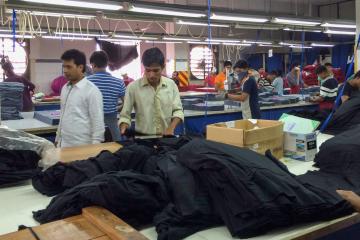
Randomized evaluations can also help companies establish links between sustainability and the resulting business impacts of these programs, such as productivity increases and reduced costs. For example, researchers partnered with Shahi Exports in India to conduct a randomized evaluation of a leading garment industry skilling program. The results showed that soft skills training for female workers dramatically improved productivity and returns to the firm, but also that alternative designs would be necessary to ensure that workers share these benefits.
Evaluations can also help private sector companies determine the most effective approaches to reducing their climate impacts. For example, J-PAL affiliates have collaborated with Virgin Atlantic to evaluate the effectiveness of management practices in encouraging commercial airline captains to implement more fuel-efficient behaviors, delivering both significant emissions reductions and cost savings.
The road ahead
In the past few months we have embarked on a listening tour, engaging with dozens of stakeholders in the corporate sector to understand their priorities for sustainable business. We look forward to building on this foundation and taking action this year and beyond.
First, we will share best practices companies can use to leverage existing rigorous evidence to achieve sustainability goals. Second, we will work with companies seeking to incorporate evidence into the design of inclusive products and services to maximize the impact of their investments. Finally, we plan to help foster powerful coalitions between corporate actors, researchers, and governments to use evidence to accelerate impact at scale.
We are seeking purpose-driven corporate partners committed to sustainable impact. Please reach out to [email protected] to get in touch with our team or join our mailing list.
Learn more about J-PAL's Corporate Impact and Sustainability Partnerships.
On October 10, J-PAL in partnership with University Mohammed VI Polytechnic launched the UM6P-J-PAL Agricultural Lab for Africa. Chaired by Tavneet Suri (MIT, J-PAL Agriculture sector Co-Chair), the lab will be hosted at University Mohammed VI Polytechnic (UM6P) in Rabat, Morocco, with the goal of designing and funding rigorous impact evaluations of private sector programs that improve small-scale farmers’ food security, productivity, and profitability in sub-Saharan Africa.
The lab was announced during this year’s Spring Annual Meetings of the World Bank Group and International Monetary Fund in Marrakech, Morocco, as part of UM6P’s “the Voice of Africa” side event panel discussions on food security and sustainability. Participants heard from Tavneet Suri on her vision for the lab as academic chair, Iqbal Dhaliwal (MIT; J-PAL Executive Director) on expanding J-PAL’s portfolio of work in agriculture with the private sector, and Hicham El Habti (UM6P President) on the importance of partnership to achieve broad development of the agriculture sector in sub-Saharan Africa.
Tackling food insecurity through agricultural value chains
Small-scale farmers face numerous decision points throughout the production cycle, such as how much fertilizer to apply, what mixture of fertilizer is best for their soil and crop, where to sell their output for the highest possible price, among many others.
In recent years, the factors that affect small-scale agriculture in sub-Saharan Africa have become more complicated. Specifically, the world has experienced a rise in global food insecurity, resulting from changes in international market structures and regulation, trade disruptions under Covid-19 protocols and geo-political conflict, climate change, and other political and economic dynamics. Understanding how to improve food systems is, therefore, an essential step along the path to reducing poverty and securing livelihoods for rural communities across sub-Saharan Africa.
In response to this growing uncertainty, clear policies and programs that support farmers to invest in higher-yielding, more profitable, tailored, and innovative technologies are essential. However, there are still a number of policy questions yet to be answered to inform large-scale improvements in agricultural systems. As many agricultural supply chains and systems work across countries, markets, and stakeholders, it is imperative to build this evidence base to inform decision-making with NGOs and governments as well as the private sector, which has an outsized opportunity to affect change in agricultural markets and value chains.
Conducting research on scalable programs with the private sector
With an initial grant from OCP Foundation, UJALA will fund innovative research over the course of three years and six RFPs that rigorously evaluate these critical questions and challenges. UJALA will generate research and actionable policy lessons in five key areas:
- Designing and delivering effective food and agricultural subsidies
- Assessing the value of fertilizer customization to crop needs and soil nutrients
- Reducing low-income households’ reliance on imported food
- Alleviating farmers’ constraints to adopting and maintaining new agricultural technologies and practices
- Connecting farmers to markets that sell at competitive prices.
As a lab, UJALA will work in close collaboration with private sector partners in sub-Saharan Africa to conduct randomized evaluations of their services for small-scale farmers. The partners UJALA works with will be selected based on scale of operations, relevance to the research agenda, and interest in learning about their business models and impacts from rigorous, quantitative research. UJALA will have the express goal to disseminate research results to relevant public and private sector actors and support the scale up of effective programs and services with partners.
To achieve these goals, UJALA will work along the research life-cycle from conceptualizing evaluations to disseminating results and facilitating discussions on how to scale effective programs and services. Specifically, UJALA aims to:
- Identify programs delivered by our private sector partners with the potential to answer open questions related to agricultural technology adoption in Africa
- Connect partners with researchers in the J-PAL network to facilitate multi-stakeholder research partnerships
- Fund randomized evaluations to build an evidence base on increasing small-scale farmers’ productivity and profitability through the uptake of improved and accessible agricultural technologies
- Summarize and synthesize available results to address and answer outstanding questions relevant to policy and practice
- Disseminate the evidence to inform relevant agricultural development strategies across the African continent.
Looking ahead
Through strong partnerships with the private sector and researchers in the J-PAL network, UJALA will support the generation of new evidence and evidence-based decision-making among private sector partners. As a result of their operational scale and incentives to quickly respond to market changes, the private sector is uniquely positioned to tackle the looming challenges of climate change, market instability, and food insecurity and to improve the lives of thousands of small-scale farmers across sub-Saharan Africa.
If you are a researcher interested in learning more and getting involved, please reach out to [email protected].
Can more firms learn from randomized evaluations to improve business operations in developing economies? How can development institutions better support clients to achieve sustainable growth and key performance improvements in terms of productivity, gender, work-related practices, skills, and other relevant issues?
Private-sector firms in low- and middle-income countries (LMICs) continue to face low levels of productivity. The question of what drives enterprise growth in LMICs has long confounded managers and investors alike. Policymakers and business leaders can benefit from rigorous evidence on effective ways to support private sector development. Using insights from rigorous research in business-related decision-making can allow more firms to meet both financial goals and social goals, like greater sustainability, employment, and worker welfare.
Meanwhile, a growing body of research by J-PAL affiliated researchers using randomized evaluations suggests that supply chains can play a critical role in global poverty reduction. Large firms connected to export markets in sectors such as manufacturing and agriculture can affect a variety of outcomes related to poverty alleviation, from productivity to job quality to technology adoption.
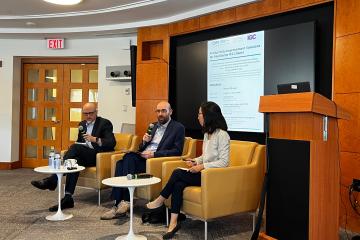
Can more firms learn from randomized evaluations to improve business operations in developing economies? How can development institutions better support clients to achieve sustainable growth and key performance improvements in terms of productivity, gender, work-related practices, skills, and other relevant issues? To explore these questions, J-PAL recently partnered with the International Finance Corporation (IFC) and the International Growth Centre (IGC) to host a workshop titled “Productivity Improvement Solutions for Real Sector IFC Clients'' in Washington, DC. The workshop, the first of its kind, facilitated evidence-sharing and research brainstorming sessions between academic researchers, social enterprise leaders, and staff from the IFC and World Bank Group with a focus on manufacturing, agriculture, and services sectors. The discussions shed light on the rising concern and need for rigorous impact assessments of firms’ sustainability performance, among other issues.
The value of rigorous evidence and data for private sector development
The first half of the event saw two panels where leading organizations and affiliated researchers shared their thoughts on the value of research as it applies to decision-making in investment and operational situations. Pablo Fajnzylber, Director of Development Impact Measurement at the IFC, opened the day by outlining the workshop’s objective of fostering collaborations with researchers to help achieve the IFC’s ambitious goal of strengthening impact evaluations. David Atkin, Firms sector co-chair at J-PAL and Research Program Director for the Firms program at the IGC, provided opening remarks highlighting the successes of evidence use in government contexts and made a call to action for private sector actors to engage with rigorous evaluations.
J-PAL and IGC affiliated professor Rocco Machiavello moderated the first panel focused on the use of evidence in agriculture supply chain contexts. Tomoko Harigaya, Chief Economist and Director of Research at Precision Development (PxD) and Colin Christensen, Global Policy Director at One Acre Fund, shared firsthand experiences on the use of data and scientific research in driving operational improvements and organizational learning. PxD and One Acre Fund are development organizations serving millions of smallholder farmers in Africa and South Asia. Tomoko described how rigorous evaluation methods improved PxD’s programs, including the use of evidence from existing evaluations to help identify effective service types, the use of A/B testing to improve design features of digital extension services, and the use of rigorous evaluations to assess the impact of its services. Colin spoke on the importance of a culture of evidence use, and the need to balance an organization’s priorities with the focus of research. In addition, both Tomoko and Colin agreed that research collaborations can bring in innovative products to contexts where resources for testing new ideas may be limited.
In the next panel, Eric Verhoogen, a Research Program Director for the IGC Firms program and a J-PAL affiliate, and Laura Boudreau, also a J-PAL affiliate, provided insights from randomized evaluations of interventions in the global manufacturing sector. Many of these studies found key social and economic mechanisms which enabled the firms that hosted the research to achieve higher productivity and greater worker welfare. In a garment manufacturer in India, for example, a soft skills worker training program led to an increased likelihood for worker promotions as well as productivity gains that resulted in returns of 256 percent to the firm. In an auto manufacturer in China, allowing workers to participate in their managers’ evaluation led to better manager behavior, gains in team productivity, and a reduction in employee turnover.
Sometimes, these interventions can yield unexpected results. In a soccer ball manufacturing cluster in Pakistan, for example, the introduction of a more efficient production technology was met with low take-up by firms as workers initially resisted adoption. Through qualitative surveys, the research team discovered that the gains from the technology came from reduced waste materials, which led to increased profits for firm owners. However, because workers were paid per piece of work they completed and learning the new technology slowed them down at first, their income fell. Finally, when workers were paid a bonus for learning how to use the technology, incentives between firm owners and workers aligned and more firms adopted the technology. Such scenarios illustrate the value that researchers can provide by deciphering complicated barriers to productivity.
The second part of the workshop centered on a research brainstorming session. “Today, technology and data are everywhere. Now, let’s use this to see not only what we are doing, but how we can do it better,” noted Wagner de Almeida, Director of the IFC Manufacturing, Agribusiness, and Services Department. In this session, IFC investment team managers, leads, and specialists met with J-PAL and IGC affiliated researchers to share experiences and discuss the needs of IFC projects in terms of key issues for businesses in the manufacturing, agribusiness, and services industries.
One of the most frequently discussed themes was the pressing need for investments aimed at decarbonization and other climate goals, around which affiliated researchers and IFC teams discussed how the impacts of sustainability-focused projects could be evaluated. Other points of discussion included the value and challenges of conducting randomized evaluations, how researchers could work with the IFC’s organizational structure, and the need to continue building the case to large organizations in the private sector on the value of scientific research.
Supporting development finance institutions to generate new evidence
This workshop was intended as the first in a series of matchmaking events between researchers and practitioners in private sector development topics. Going forward, J-PAL, IGC, and IFC will continue to engage affiliated researchers in evidence sharing, and identify the scope for innovative and policy-relevant evidence generation in the context of the IFC’s operations across diverse regions and industries.
We encourage partners who are interested in research matchmaking to contact us at [email protected]. Read more about exciting developments from past and ongoing research on our website.
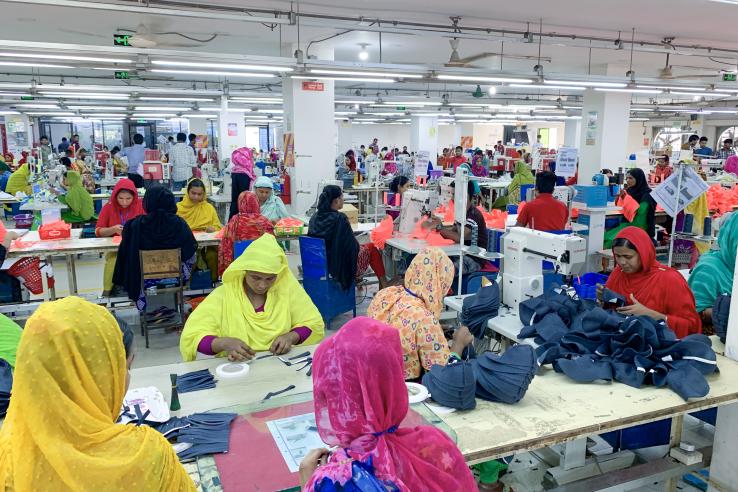
In countries with poorly-enforced labor laws, workers in factories that supply goods to foreign firms often face hazardous workplace conditions and limited labor rights. A researcher partnered with the Alliance for Bangladesh Worker Safety, a consortium formed by US multinational companies, to evaluate the impact of privately enforcing local labor laws on garment factories in Bangladesh. Enforcing the legally-required creation and operation of workplace safety committees increased factories’ compliance with the labor law and some measures of factory safety, without reducing factory efficiency. These effects persisted in the long run and were stronger among factories with good managerial practices.
Policy issue
In low and middle-income countries, workers in domestic firms that supply goods to foreign multinationals often face poor workplace conditions and limited labor rights. Specifically, worker welfare and safety is a challenge: in 2019, work-related mortality accounted for 5 to 7 percent of all global deaths annually1 and at least one in nine workers experienced non-fatal occupational accidents2—a majority of these deaths and accidents took place in low- and middle-income countries. Even when workplace regulations do exist, governments may lack the capacity or the political will to enforce them.2 A 2018 global ranking of labor laws and enforcement found that 65 percent of developing countries systematically violate or provide no guarantee of rights to workers.3 Furthermore, firms may also lack the capacity to comply, perhaps due to poor management, like an inability to build relationships with workers, or prioritization of business considerations instead of safety concerns.4
In response to the poor workplace conditions and weak regulations in some domestic industries, many foreign multinational companies (MNCs) who source from LMICs choose to enforce local labor laws and increase compliance capacity by working with labor unions, supporting the ability for workers to voice safety concerns, and coordinating with local government. However, little is known about whether local suppliers comply with MNC-enforced labor regulations, if the enforcement of these regulations actually improves labor standards for local workers, and what effect enforcement has on wages, employment, and productivity.
Context of the evaluation
In Bangladesh, domestic firms in supplier industries are tightly connected to foreign MNCs, which rely on the country’s low prices and large production capacity. This is particularly true for the apparel sector; Bangladesh is the second largest exporter of clothing in the world behind China, and the apparel sector has been a major driver of the country’s economic growth.
In the apparel sector, Bangladesh has been perceived as having weak legal protections for workers and poor, unsafe working conditions. A series of high-fatality industrial accidents in 2012-2013 —which observers connected to workers’ inability to form labor unions and advocate for safer conditions—led the government and multinational firms to take steps to improve workers’ safety and labor rights. In 2013, the Government of Bangladesh amended its labor law to improve workplace safety. A key provision of the amendment is the requirement that factories with at least fifty workers must create worker-manager safety committees of 6-12 members. These committees are meant to conduct activities that improve factory safety and worker well-being, including factory risk assessments, worker trainings, and regular disaster management drills.
Also in 2013, a group of 29 US-based multinational retailers (including Gap and Wal-Mart) formed the Alliance for Bangladesh Worker Safety (hereafter, the Alliance). Member companies required all factories in their supplier base to participate in workplace safety measures, such as building safety audits and worker training and empowerment programs. Overall, the Alliance covered between 600-700 garment factories and 1.21 million workers in the country.4 The Alliance formed a key part of the Government’s 2013 action plan to improve safety conditions, with MNC groups sharing the responsibility of overseeing safety in the factories they covered.
However, enforcement of and compliance with workplace safety regulations was low in factories under the government’s purview: as of mid-2017, only 210 of these 1,549 factories had formed safety committees (which were required by law). In addition, only 20 percent of the factories in the sample had complied with the legal requirement to create a safety committee as of mid-2016.
Details of the intervention
In partnership with the Alliance for Bangladesh Worker Safety, the researcher conducted a randomized evaluation to test the impact of enforcing the 2013 amended labor regulations on domestic supplier firms in Bangladesh. Eighty-four domestic supplier factories under the purview of the Alliance were randomly assigned to either receive a safety committee enforcement program in 2017 (41 factories) or to serve as a comparison group (43 factories, all of which would receive the program after the conclusion of the evaluation).
The Alliance’s safety committee enforcement program focused on existing laws that required domestic factories to have safety committees. The program was designed to help factories establish their committees and ensured that existing committees were running correctly. The committees were to meet regularly and were responsible for arranging worker trainings and safety drills, conducting factory risk assessments, investigating accidents and occupational illness, and making recommendations on safety improvements to the employer, among other related responsibilities. The Alliance also trained committee members and monitored committees’ performance. Overall, the enforcement program involved 2.5 months of support to establish the committee and train workers on its roles and responsibilities, followed by an additional six months of monitoring to track committee activities.
The researcher measured the impact of the safety committee enforcement program on local factories’ compliance with safety committee laws and on committee effectiveness; worker safety, well-being, and satisfaction; firm productivity; employee retention and wages. The researcher collected data through factory visits, surveys on business performance, administrative data from the Alliance, and international export records from Bangladesh. Additionally, to measure management strength, the researcher counted the frequency of production-related meetings that managers held with workers. Data was collected five months after an initial visit established baseline data, which demonstrate the short-run effects. This second visit typically took place after three to four months of factories in the group which received the enforcement program being exposed to the program. The researcher also returned ten months after the initial visit to establish longer-run effects. This third visit took place when the enforcement program factories were no longer being monitored closely.
Results and policy lessons
The safety committee enforcement program increased factories’ compliance with the labor law and improved factory safety conditions. These effects were stronger in factories with better managerial practices. In factories with poorer managerial practices, the program decreased workers’ job satisfaction, possibly because it raised workers’ expectations beyond what the factory was able to achieve.
Compliance with safety committee laws: The safety committee enforcement program increased compliance with Bangladeshi labor law in factories that were offered the program. Factories that were offered the program outperformed factories in the comparison group by over 0.2 standard deviations on an index measuring adherence to the legal requirements for safety committees, an effect which persisted 3-4 months after the end of the program. In particular, safety committees in factories that received the enforcement program were more likely to fulfill their responsibilities: 56 percent of factories that received the program had conducted at least one risk assessment toward the end of the program, compared with 15 percent of factories in the comparison group. These effects on compliance were stronger for factories that had better managerial practices. However, despite improvements in compliance, it is important to note that the program did not result in full compliance of Bangladeshi law. The researcher suggests that this could be explained by imperfect monitoring by the Alliance—for example, some factories had not conducted a risk assessment at the time of factory visits.
Committee effectiveness: In the longer-run, the program led to a 0.14 standard deviation increase over a comparison group score of 0.11 standard deviations on an index measuring the effectiveness of the committees at improving worker safety, increasing safety awareness, and engendering a culture of safety. These effects were strongest in terms of increasing the amount of factory safety spot checks. The researcher suggests that the overall improvements in worker health and safety may have been driven partly by increased information sharing between workers and managers, primarily via meetings with the safety committees. Committees in participating factories met more often and had longer and more substantive meetings than comparison group factories, as measured by an analysis of the content of the meeting notes. Furthermore, factories with better management practices saw the greatest improvements in committee effectiveness: compliance increased by 0.42 standard deviations in better-managed factories, compared to 0.12 in poorly-managed factories. This indicates that the quality of management in a given factory can have a substantial impact on improving the effectiveness of safety committees.
However, the program did not significantly affect factories’ safety culture or workers’ awareness of the safety committees. Some program and comparison factories already had high levels of committee awareness, perhaps due to their participation in a separate Alliance fire safety and worker training program. In addition, program factories did not outperform comparison factories in terms of committee effectiveness 3-4 months after the program. This was likely due to comparison factories improving the effectiveness of their own committees in an effort to prepare for future enforcement by the Alliance.
Worker wellbeing and satisfaction: After around five months, the program decreased worker-reported job satisfaction and did not affect worker-reported mental health and well-being. The program reduced an index of worker-reported job satisfaction by 0.15 standard deviations relative to workers in the comparison group. This decrease in job satisfaction was concentrated in factories with poor managerial practices where the program did not improve compliance or safety.
Productivity, employment, and wages: The program did not meaningfully affect factories’ productivity, levels of employment, or wages relative to factories in the comparison group, suggesting that improved working conditions do not necessarily come at the expense of factory productivity.
These findings demonstrate that private enforcement of labor laws can improve compliance and contribute to achieving the law’s objectives, especially in well-managed domestic factories and when there are low levels of government enforcement. However, the different findings for factories with better versus poorer managerial practices highlight the importance for MNCs of taking into account suppliers’ ability and capacity to meet higher labor standards. Further research could provide clarity on how to lower the risk of highly dangerous workplaces, the impact of MNC enforcement on state capacity, and how to improve worker safety in other settings.
Informed by the results of this study, the Alliance incorporated learnings into the design of its safety committee enforcement program. Following direct dissemination of the results by the researcher to the Alliance and member companies, several firms mentioned that these findings influenced their policies and programming with suppliers. In addition, in part in response to the findings that the program effects were concentrated in better-managed factories, the Alliance launched a training program for mid-level managers on improving managerial capabilities for safety. The post-Alliance organization, Nirapon, has maintained these practices.
ILO. 2019, “Safety and Health at the Heart of the Future of Work.” International Labor Organization.
ILO, 2019, “World Employment Social Outlook Trends 2019.” International Labor Organization.
International Trade Union Confederation. 2018. “2018 ITUC Global Rights Index: The World’s Worst Countries for Workers.” International Trade Union Confederation, Brussels, Belgium.
Distelhort, Greg, Jens Hainmueller, and Richard M. Locke. 2017. “Does Lean Improve Labor Standards? Management and Social Performance in the Nike Supply Chain.” Management Science, 63(3): 707-728.