

How does receiving a digital ID change lives in Kaduna State, Nigeria? A discussion with J-PAL affiliates and KADRIMA
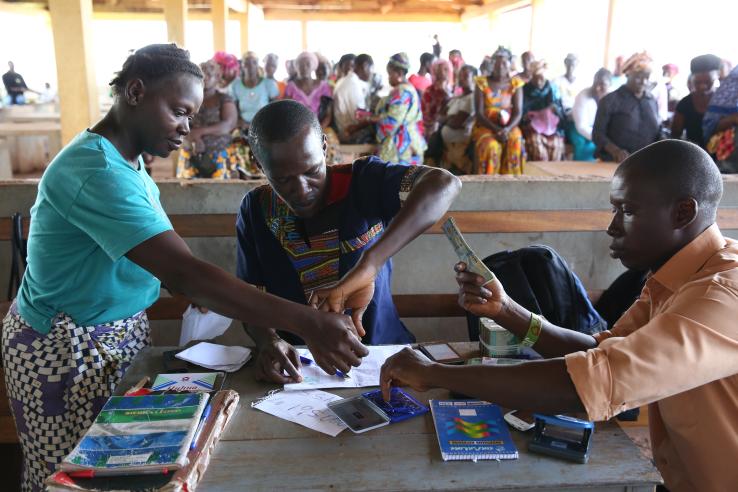
As many as 500 million people in sub-Saharan Africa lack any form of formal identification (ID). For the most at-risk individuals, not having an ID often means exclusion from the formal economy and from the government programs designed to support them. In northern Nigeria, the Kaduna State government has built a comprehensive social registry of at-risk households, yet many remain outside the formal financial and social protection systems because they have no recognized proof of identity.
The Kaduna State Residents’ Identity Management Agency (KADRIMA) is tackling this head on is tackling this head-on with a digital ID card that comes with its own bank account, so residents gain a recognized identity and access to the financial system in one step.The card is meant to become residents’ primary ID and the channel through which they receive social protection payments, financial services, and other public services.
While digital ID can open the door to financial inclusion and government services, that impact depends on two things: people being able to get the card, and people actually using it. Delivery involves real trade-offs: bringing cards to people’s doorsteps reaches more residents but costs more, while a central pickup point is cheaper but risks leaving some behind. And once the card is in hand, new accounts can still sit dormant unless people use them to receive support, save, or reach other services. With eleven million residents to reach, Kaduna State’s KADRIMA teamed up with J-PAL-affiliated researchers to test these questions through a randomized evaluation before scaling up.
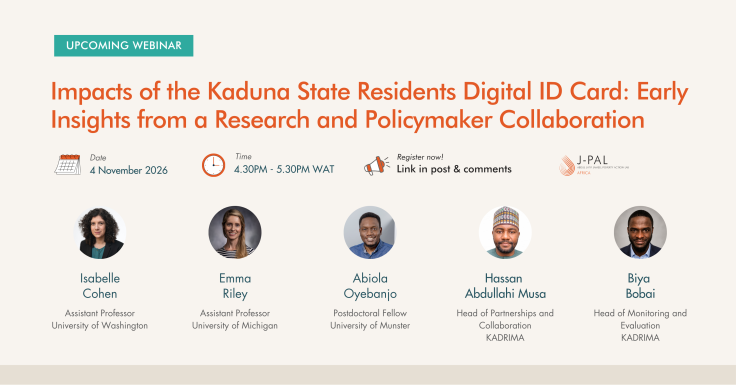
Join our Digital Identification and Finance Initiative (DigiFI) team, J-PAL affiliated researchers Isabelle Cohen and Emma Riley, Abiola Oyebanjo, and Hassan Abdullahi Musa and Bobai Biya from KADRIMA for a discussion on this topic. The conversation will follow the journey from receiving a Residents’ Card to using it to access financial services and social-protection programmes. Speakers will discuss what the early evidence reveals about card distribution and take-up, the trade-offs between expanding access and managing costs, and how collaboration between researchers and government agencies can help translate evidence into better programme design and scale-up.
Join our Digital Identification and Finance Initiative (DigiFI) team, J-PAL affiliated researchers Isabelle Cohen and Emma Riley, Abiola Oyebanjo, and Hassan Abdullahi Musa and Bobai Biya from KADRIMA for a discussion on this topic. The conversation will follow the journey from receiving a Residents’ Card to using it to access financial services and social-protection programmes. Speakers will discuss what the early evidence reveals about card distribution and take-up, the trade-offs between expanding access and managing costs, and how collaboration between researchers and government agencies can help translate evidence into better programme design and scale-up.