Image

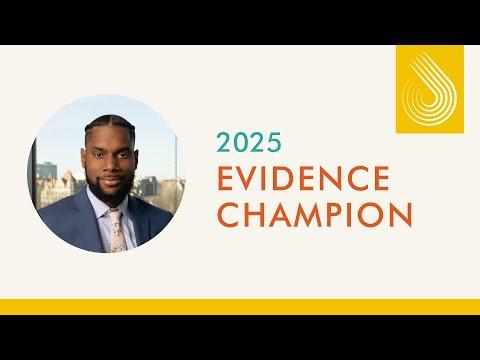
In this Evidence Champion series, J-PAL North America is recognizing individuals in our network who have made extraordinary contributions to the field of evidence-informed policymaking. This year’s researcher recipient is Damon Jones, an associate professor at the Harris School of Public Policy at the University of Chicago, the associate director of the Stone Center for Research on Wealth, Inequality, and Mobility at the University of Chicago, and a scientific advisor on J-PAL North America’s racial equity work. In this post, we highlight Damon’s contributions to both making the research around racial equity more rigorous and making the space for doing this type of research more welcoming and inclusive.
Damon Jones’ interest in racial equity grew out of his work in inequality that began before he started his graduate studies. “I've always been interested in inequality, and I think I saw social sciences as a way to learn more about inequality or ways to address inequality in society,” Damon shared. Through an early volunteer position with a nonprofit organization in Washington DC, Damon worked on an income tax assistant program for low-income individuals. Damon noted that through this experience, “I learned about the income tax refunds that people were getting, and it just kind of sparked a lot of interest for me—it raised a lot of questions.” This was a launching point for his decision to pursue a career in economics to study social and economic inequality, including racial disparities. He has since made this a focal point of his research throughout his career.
Damon recognizes that the field of labor economics has been historically influenced by randomized evaluations, especially through audit and correspondence studies. “Randomized controlled trials have played a significant role in the field of labor economics, looking at labor market discrimination, and trying to detect certain types of discrimination,” said Damon. “The classic example is the correspondence study, where people take resumes and alter things randomly on the resumes and see how many callbacks each resume gets and try to learn about what attributes are favored or not. In particular, if you could make people look very similar in all other dimensions, but signal that they are of different racial groups, what happens, and what implications does that have?”
Randomized evaluations, Damon believes, have the potential to help us understand the systemic forces behind racial inequality, and he is actively working to improve the quality of research in this field. Gerald Daniels, an associate professor of Economics at Howard University, noted, “Damon has been a thoughtful and consistent voice pushing our field to think more critically about how researchers can use evidence to address racial inequities.”
Economics can also be a powerful tool in grounding personal experience and theory with evidence, which is central to Damon’s research approach. Dania Francis, an associate professor at the University of Massachusetts Boston, explained, “As researchers, it’s important to acknowledge and recognize our own positionalities and be aware of when they might be influencing the questions we ask and the decisions we make as investigators. Damon is one of the best at recognizing this. In my work with him, it has not been uncommon for him to press pause and ask, what does the evidence say?”

Until recently, racial equity has been most often discussed as part of the subgroup analyses in larger randomized evaluations, meaning race is considered only after the intervention has concluded, rather than explicitly designing the study to understand the impact of the intervention on specific racial groups. Damon has emphasized that this is not enough to rigorously answer the pressing questions surrounding racial equity. He encourages researchers to learn from other disciplines and be familiar with the predominant theories to understand how these theories can be tested to find causal results by considering racial equity from the design phase to the publication of results.
To this end, Damon Jones has worked to expand who is involved in research. Dr. Daniels mentioned, “He is a great mentor to emerging and young researchers, always generous with his time and expertise. Through mentorship, collaboration, and openness in sharing methods and insights, he has helped expand who participates in and shapes the work of evidence-informed policymaking.”
This interdisciplinary approach to research allows it to be put into a broader context and implemented in practice. Dr. Francis observed, “Some people are big picture people, others are detail people, Damon is both. This quality is especially important in evidence-informed policymaking because it is easy to get caught up in details, especially as economists who are seeking very specific causal evidence. But being hyperfocused on details can be to the detriment of larger policy implications.” Dr. Daniels added, “Damon is especially effective at connecting the technical aspects of research to the broader institutional and historical context, ensuring that our work speaks to real policy challenges that families face.”
Damon has served as the Chair on J-PAL’s Racial Equity Advisory Committee (REAC) for the past three years. In this role, he and the REAC have supported and amplified the work of researchers dedicated to advancing racial equity through funding, resources, and collaboration. Damon shared, “The REAC is kind of a brain trust of different scholars who have experience studying race who have helped us think about what types of research we want to look for, what advice to give, what type of strategies are there to create opportunities for researchers in this area that may not have necessarily broken into certain spaces within the field of economics.”
Damon and the REAC have focused on intentionally bringing in researchers who may have felt excluded from the economics field in the past. He has also overseen the creation and dissemination of high-quality resources on conducting randomized evaluations focused on racial equity to researchers with experience in this type of evaluation, but are newer to the racial equity space.
In reflecting on Damon’s role in the REAC, Dr. Daniels explained, “Damon played a key role in grounding our conversations in both data and lived experience. He often reminded the group that research on racial equity must be intentional when studying underrepresented communities and that evidence should inform, not dictate, policy design. His approach exemplifies what it means to be an Evidence Champion. He is committed to using research not only to evaluate programs but also to rethink how evidence can advance fairness and opportunity. His leadership has had a lasting influence on both the research process and the policy community around it.”
Damon’s influence has been felt here at J-PAL, in the broader economics community, and beyond.
Damon would like to thank the broad team of researchers, policymakers, and practitioners who are partnering with him to make this work possible: past and present members of the REAC, Randal Akee, Courtney Bonam, Gerald Daniels, Dania Francis, Robert Gillezeau, Corinne Low, Sylvia Robles, and Angelino Viceisza; J-PAL collaborators, Michaela Chua, Laura Feeney, Noreen Giga, Sarah Margolis, Matt Notowidigdo, Laura Ruiz-Gaona, Fatima Vakil, and the entire J-PAL North America team.