Imagen
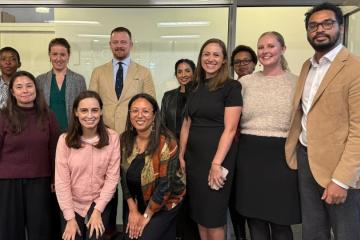
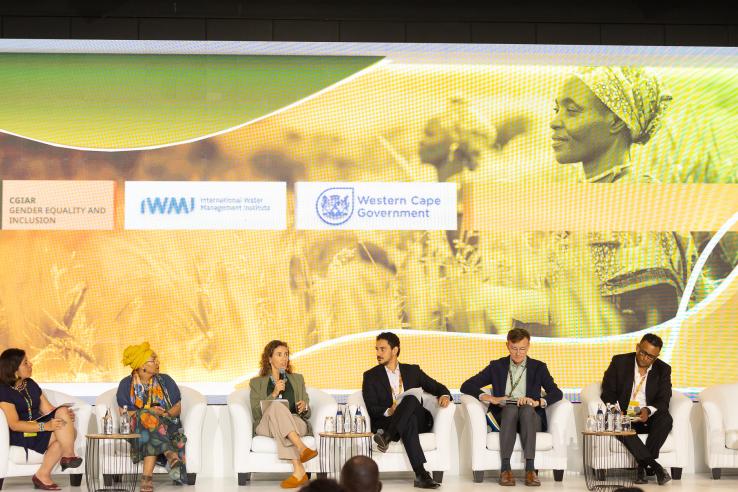
In October 2025, Cape Town hosted the CGIAR Gender in Food, Land, and Water Systems Conference, bringing together researchers, policymakers, and donors to chart actions for closing gender gaps in agriculture. J-PAL staff attended and presented in one of the key plenaries over the three days. Among the presenters was Jamal Mohammed, Associate Professor of Economics at Koforidua Technical University in Ghana and a J-PAL/CEGA DAISI Scholar, who shared insights from his DAISI-funded project on personalized digital solutions for smallholder farmers.
Malik Abaddi, Policy Manager and Delivery Lead at the UM6P-J-PAL Applied Lab for Agriculture (UJALA), participated in a plenary session which examined how to generate and measure impact on gender equality in agri-food systems, from the perspectives of UJALA, International Water Management Institute (IWMI), the Gates Foundation, the World Bank’s Africa Gender Innovation Lab, and the University of Cape Town.
Rethinking impact on gender equality
The plenary framed impact around: who has access to and control over resources such as inputs, information, credit, and land; who participates in and shapes decisions in the household and on the farm; and who ultimately sees improvements in income and economic security.
Design and delivery that shape gender outcomes
Program and evaluation design can either obscure or surface gender gaps. When services and surveys focus on a single household head, women are often invisible in both delivery and data. Designs that deliberately engage more than one decision-maker in the household, and that analyze outcomes separately by gender, reveal different constraints and preferences and make it possible to respond to them.
Evidence also points to stronger gains in empowerment when technical support is combined with elements that address norms, information gaps, and control over resources, rather than offered as isolated activities.
Evidence that matches real decisions
Impact evaluations are most useful when they are built around concrete choices that policymakers and funders already face—for example, around which bundles of services to offer at scale, or how intensively to invest in soil testing in a given region. Treatment arms, outcomes, and timelines can then be designed to mirror those options and align with budget and planning cycles. Results arrive in a form that speaks directly to scale and targeting decisions, rather than as findings that are interesting on paper but hard to use in practice.
Ongoing evaluations supported by UJALA illustrate this approach. In Tanzania, a soil testing study ties directly to a question of policy: Is increasing plot-level testing a good use of public funds, or does village-level aggregation provide sufficient value?
In Ghana, an evaluation of OCP’s Agribooster compares two bundles that donors actively debate: soil-test-based fertilizer recommendations paired with credit and training versus the same credit and training but with farmer-selected fertilizer and without soil testing, with results stratified by gender and youth to inform resource allocation.
At the CGIAR conference, Jamal Mohammed, Associate Professor at Koforidua Technical University, presented on his J-PAL Digital Agricultural Innovations and Services Initiative (DAISI)-funded project exploring how to improve digital solutions to support farmers in Ghana. The study engaged farmers across four regions to understand how they perceive digital farming services, while also exploring a partnership with Farmerline—a Ghanaian agri-tech company offering an advisory app with weather forecasts, market prices, financial tools, and access to farm inputs.
The study is motivated by the large gaps in market access, limited finance, and increasing climate shocks that farmers, especially women, face. Digital tools could help bridge these gaps, but adoption remains low.
Focus group discussions revealed that about half of the farmers—mainly in urban areas—were already familiar with bundled services and saw them as useful for tracking markets, weather, and farming practices. Yet, many voiced the need for apps that are more inclusive, with local-language content and gender-sensitive features. They found the key barriers to be limited access to smartphones and the high cost of mobile data.
Building on these insights, researchers are planning to potentially run A/B testing with Farmerline and government partners to test usability and adoption.
The CGIAR gender conferences provided an excellent opportunity for researchers with preliminary research and/or researchers early on in their careers to present on research and gain feedback. Professor Mohammed found the conference to be a great opportunity to showcase his team’s research, and he noted that the diverse backgrounds of the participants created a space for stimulating and inspiring discussions. He found the feedback he received on the project to be constructive and valuable for the project going forward. Lastly, he found the conference to be a valuable networking opportunity, which could potentially result in future collaborations.
The conference created a space where conversations could be honest and, at times, uncomfortable—pushing all of us to think differently. What emerged was a shared recognition that agricultural systems must work better for women, who play such a central role yet face disproportionate barriers.
Again and again, participants pointed to the same challenges: women’s limited access to land, information, and financial resources. In conclusion, we need stronger partnerships and collective action to move research into action to dismantle the barriers that women farmers face.