

Eliminating Behavioral Barriers to Saving through Savings Goal Setting and SMS Reminders in Paraguay
- Urban population
- Household finance
- Behavioral economics
- Digital and mobile
- Information
- Nudges and reminders
- Savings
Despite the benefits of accumulating savings, low-income individuals face financial, psychological, and behavioral barriers that limit their ability to save. Researchers evaluated the impact of a range of tablet-based savings activities—designed to remind users to save and support goal-setting—on savings behavior of low- and middle- income individuals in Paraguay. Combining savings goal setting and text reminders is effective at increasing savings behavior, but each tactic individually is not. Individuals who were offered the savings goal and text reminders intervention set greater savings goals and saved during more months of the year relative to a comparison group, but effects faded after reminders ended.
الموضوع الأساسي
Savings can provide a safety net for low-income individuals by enabling them to mitigate potential risks, build assets for their future, and smooth their consumption during periods of low income. However, despite these potential benefits many individuals still do not save. While income can limit the amount individuals can save, other psychological or behavioral barriers could also play a role in low savings levels. One potential strategy to overcome these barriers and help individuals save is to provide frequent reminders or assistance with setting financial goals. Can these solutions help individuals save?
سياق التقييم
This study took place among low- and middle- income individuals in Paraguay. Designed originally to be conducted with clients of Banco Familiar (a private financial institution with locations throughout Paraguay), the final group of participants were selected to look similar to clients of Banco Familiar while only a small fraction of participants actually were. The average participant in the evaluation was thirty years old and earned approximately US$15 per day. Prior to the intervention, one-third of individuals saved; they reported average savings of US$20 per month.
معلومات تفصيلية عن التدخل
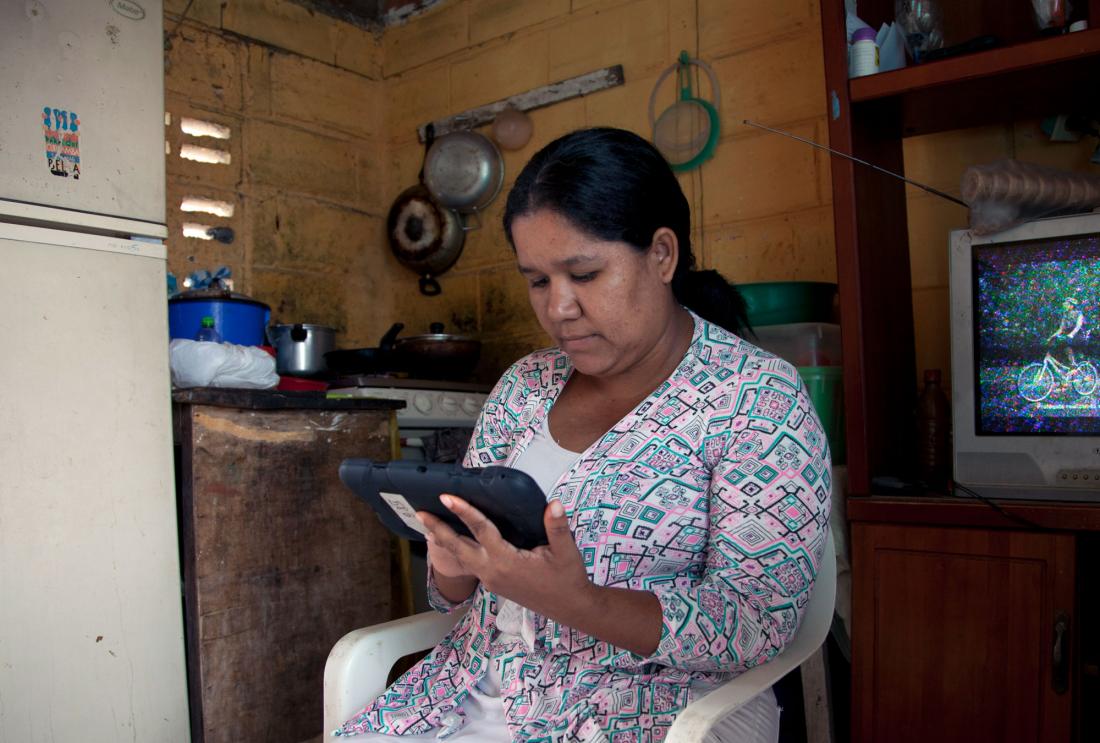
Researchers evaluated the impact of various tablet-based interventions which reminded low- and middle- income individuals to save and helped them set savings goals, on their savings behavior. Starting in April 2017, researchers randomly assigned participants to one of five app-based intervention groups or to a comparison group:
- Message only (comparison group; 712 participants): The tablet displayed one short message reminding individuals of the importance of saving.
- Message and text reminders (671 participants): The tablet displayed the same message as the comparison group, plus participants could opt in to receive monthly text message reminders on the importance of saving for up to six months.
- Savings goal only (639 participants): The tablet calculated and shared how much money the individual was currently saving based on income and spending data, and prompted individuals to use this information to define a monthly savings goal.
- Savings goal and text reminders (675 participants): The app led participants through the same savings goal-setting exercise as the savings goal group, plus participants could opt in to monthly personalized text reminders for up to six months to encourage them to save for their monthly goal.
- Purchasing savings goal and text reminders (644 participants): The app encouraged participants to pick a good or service they would be interested in saving money towards, and define a savings goal for how much they would be willing to save monthly to buy it in the future. The app also showed how much more participants would end up paying if they purchased the item on credit instead of the lower cost if purchased with savings. Individuals could opt in to receive personalized monthly text reminders of their goal.
- Emergency savings goal and text reminders (587 participants): The app showed how much financial cushion individuals should have to cover unexpected emergencies without needing credit, based on fluctuations in their income and expenses. Individuals defined a savings goal to cover emergencies and could opt in to personalized monthly text reminders.
Before any intervention, participants completed a survey that asked for information on their typical income, expenses, unforeseen expenses they had experienced in the previous year, labor supply, credit market use, psychological well-being, and current relationship with Banco Familiar. Researchers also completed a follow-up survey one year later that, in addition to previous topics, asked participants about their savings habits and what they remembered from the baseline survey and the intervention.
النتائج والدروس المستفادة بشأن السياسات
Combining savings goals (either generic or emergency savings themed) with text reminders increased savings behavior, while either tactic alone did not. However, changes in savings habits faded away after the reminder messages stopped.
Savings Outcomes: Both the savings goal and text reminders and emergency savings and text reminders interventions increased individuals’ likelihood to save and their amount saved during the period they received reminder messages. On average, combining personalized goal setting with reminders increased the likelihood that individuals set a savings goal, increased the amount of their savings goal by 145 percent, and led them to save for an additional .32 months of the year (a 29 percent increase), all relative to the comparison group. Financially literate individuals saw similar but stronger trends: their savings target was 582 percent greater than similarly financially literate individuals in the comparison group.
However, goal-setting around a specific purchase, the message and text reminders, and the savings goal only interventions did not increase savings. In fact, the savings goal only intervention decreased savings on average. Individuals in the savings goal only group were less likely to have a savings goal and set 72 percent lower savings targets relative to the comparison group. This was especially pronounced among individuals who had a larger discrepancy between the amount they currently saved and their budget balance; the savings exercise may have discouraged them by highlighting their past difficulty with saving.
Further, the message and text reminder intervention also led to negative outcomes among the most financially literate individuals. These reminders led financially literate people to be less likely to have a savings target, and to lower their savings targets by 69 percent compared to similarly financially literate individuals in the comparison group. Financially literate people likely already understood the value of saving; being reminded of this may have caused them to feel like their right to choose to save was being restricted or to feel like most people don’t save, changing their view on social norms. Personalizing the text reminders with details on their own goal setting in the combined interventions offset this somewhat.
Credit Outcomes: Individuals in the groups with personalized savings goals and text reminders were approved for PYG896,000 more credit (a 36 percent increase) relative to the comparison group. The authors suggest that this increase in credit, despite increases in savings behavior among the same groups on average, may be due to individuals using credit as a commitment device to save. In contrast, the savings-only and message and text reminder interventions reduced individuals use and requests for credit respectively.
Perception of Intervention: Researchers also tested what individuals remember about the interventions they received in order to understand how each intervention was perceived by participants. Including personalized reminders of individual saving goals in the text reminders did not make the message more memorable than generic reminders. However, this personalization did help participants remember receiving a message urging saving. This suggests personalized savings reminders helped increase savings by reminding individuals of their own specific savings goal, and not by making the message on the importance of saving more memorable.
Overall, researchers suggest that future savings products targeted at low-income individuals may be more effective if they combine both reminders and personalized budget and savings information. Receiving generic reminders or savings goal-setting alone may negatively impact some individuals' savings behavior. Indicating that expensive interventions previously evaluated cannot be replaced by cheaper alternatives.
Azevedo, Viviane, Jeanne Lafortune, Liliana Olarte, and José Tessada. 2024. “Personalizing or Reminding? How to Better Incentivize Savings among Underbanked Individuals.” Journal of Economic Behavior & Organization 222: 25–63. https://doi.org/10.1016/j.jebo.2024.04.005