

Empowering women through mobile money in Tanzania
- Women and girls
- Household finance
- Credit balance/repayment
- Digital and mobile




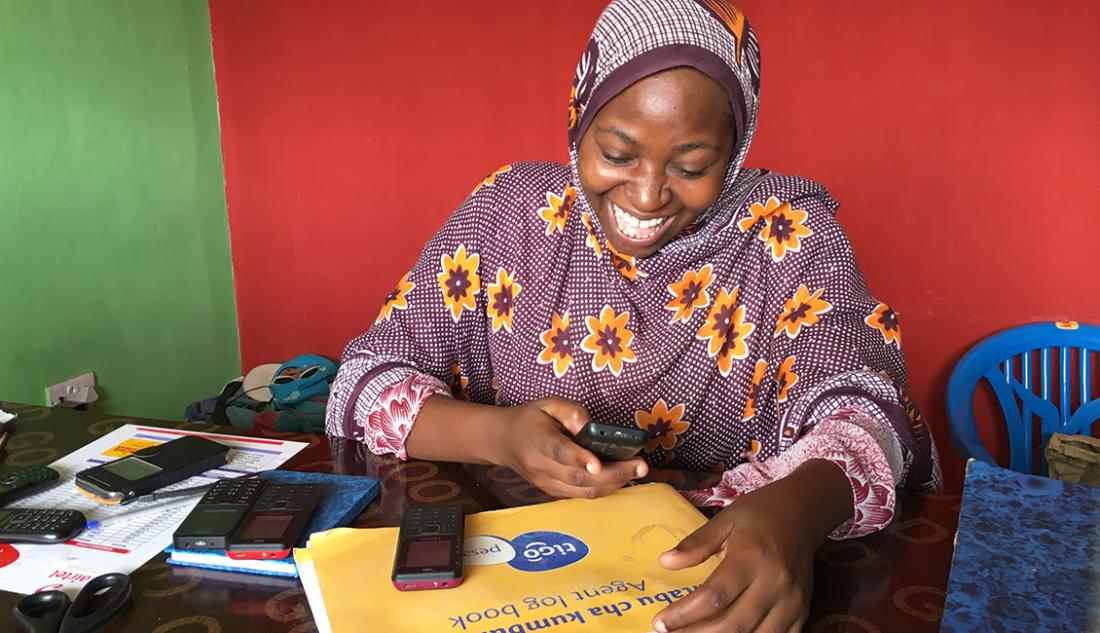
Empowering women not only has the potential to improve their lives, but also their children's health and education. In partnership with Innovations for Poverty Action (IPA) and BRAC, researchers conducted a randomized evaluation to test whether encouraging women to make weekly loan repayments through mobile money, instead of cash, helps them take control of their finances. The program increased mobile money use for loan repayment, savings, and other transactions and boosted women’s decision-making power at home.
الموضوع الأساسي
Women’s empowerment, including the ability for women to control their earnings and household resources and make their own choices, is an important goal in its own right and has the potential to benefit their families and local economies. Many programs aim to empower women by helping them boost their income or save more. However, women may not have control over how these funds are used in the household.
Mobile money can help women gain control over their income and finances by keeping income private, limiting their spouses’ access, and allowing money to be set aside for savings. Mobile money offers a secure platform that requires only a basic mobile phone, making it accessible to most people. However, women use mobile money less often than men in low- and middle-income countries.1 Could encouraging women to repay loans through mobile money increase their use of and comfort with the technology, and in turn, boost their financial control and empowerment?
سياق التقييم
Around half of adults in Tanzania have mobile money accounts, a rate similar to other sub-Saharan African countries. However, opening an account has not led to widespread use of mobile money for savings or business transactions, especially among women. In 2021, 36 percent of all mobile account holders in Tanzania used their accounts for savings, but women were half as likely as men to do so.
Many women access business loans through BRAC, the largest microfinance institution in Tanzania, by forming community groups of around eight to thirty women. Before the study began, women repaid loans through weekly cash payments to a credit officer.
Ninety-six percent of surveyed women had used mobile money for remittances and other basic transactions, but many did not use it for payments or savings, citing high fees. Seventy percent of participating women were married, and almost all completed primary school while 24 percent went on to secondary school. They earned an average of US$340 in profits per month from running small retail businesses.
معلومات تفصيلية عن التدخل
In partnership with IPA and BRAC, researchers evaluated how encouraging women in Tanzania to make loan repayments with mobile money—instead of cash—affected their empowerment and control in household financial decisions. Researchers randomly assigned 152 microfinance groups within seven BRAC loan branches in Mwanza, Tanzania, to one of two groups:
- Mobile money group (101 microfinance groups, or 501 women): Women were offered information on how to use mobile money to repay their loan by their credit officer during weekly in-person group meetings. They were encouraged to make the remainder of their weekly payments via mobile money, and informed that a standard 1 percent transaction fee would apply. They were still required to attend weekly in-person group meetings.
- Comparison group (51 microfinance groups, or 249 women): Women were not offered information about using mobile money for loan repayment. They continued to repay their loan in cash and attend weekly in-person group meetings.
Between 2022 and 2025, researchers surveyed women both before and after the intervention on their use, comfort, and trust of mobile money, their sales and profits, and their empowerment. To measure empowerment, researchers also conducted a scenario-based game before and after the intervention to assess how strongly women felt about whether they or their husband should have control over household resources.
النتائج والدروس المستفادة بشأن السياسات
Encouraging women to use mobile money for loan repayment increased their mobile money use, savings, and spending on school fees. It also gave women more control over their finances and helped them feel more empowered, though their business sales and profits did not change.
Use of mobile money: 64 percent of women in the mobile money group made at least one mobile repayment, and they made roughly one-third of their loan repayments digitally compared to almost zero in the comparison group. Women’s wider use of mobile money services for other types of transactions also increased relative to the comparison group. They were 7 percentage points (50 percent) more likely to allow mobile money payments in their businesses and 6 percentage points more likely to have mobile money savings relative to the comparison group. Women felt more comfortable with mobile money services after using them to repay their loan. Despite using the service more, women in the mobile money group expressed less interest in making digital loan payments relative to the comparison group, citing the 1 percent fee as a barrier. They were no more likely to default on their loans.
Savings: Women offered mobile money saved US$28 in their digital wallet compared to US$12 in the comparison group (a 130 percent increase).
Education spending: With more savings in their wallets, women paid US$9.70 in school fees using mobile money relative to US$0.70 in the comparison group (a 1,286 percent increase), suggesting they often used the savings to invest in their children’s education.
Business sales and profits: Women encouraged to use mobile money did not have higher business sales or profits, potentially because only 7 percent of their suppliers accepted mobile payments, they were not able to save a sum worth investing during the study, and they chose to spend the savings on their children’s school fees.
Women’s empowerment: Women encouraged to make mobile loan repayments demonstrated more control over their financial resources and gained greater decision-making power. For instance, scoring 3.29 out of four, women in the mobile money group were more likely to talk about their earnings with their spouse relative to women in the comparison group who scored 3.04 (an 8 percent increase), showing women felt less of a need to hide their income from their spouses.
Taken together, mobile money helped women have better control over their finances to boost their empowerment, though transaction fees might keep women from using the service more widely. Informed by the results of this study, BRAC has rolled out opt-in mobile money repayment to all women from the study and is scaling the program to all branches nationwide in 2025.
Klapper, Leora, Dorothe Singer, and Saniya Ansar. 2021. “Women and Financial Inclusion.”
The Global Findex Database 2021. doi: https://www.worldbank.org/en/publication/globalfindex/Report.