

Protecting Agricultural Households Against Floods Through Flexible Microfinance in Bangladesh

Floods are an extremely destructive and increasingly common threat to rural agricultural households in countries without strong social safety nets. Researchers conducted a randomized evaluation to study the welfare impacts of a new microcredit product which guarantees credit access to agricultural households after a flood. Households eligible for the Emergency Loan increased their profitable investments prior to a flood event and stabilized their consumption after a flood occurred. The emergency loans were also profitable for the private organization giving out the loan.
الموضوع الأساسي
Extreme weather events, such as floods, are common and growing threats that can destroy agriculture, assets, and homes. Households in low-income countries without strong social safety net programs may respond to the threat of floods by reducing their potentially profitable investments, lowering their food consumption, selling assets, or taking their children out of school to save money. All of these adaptation strategies lower household incomes and can contribute to a cycle of agricultural production that focuses on protecting themselves from shocks rather than increasing profits. Other protections, like standard credit or insurance products, have had limited success in these circumstances because financial institutions do not want to lend to vulnerable households, and farmers do not want to pay up-front premiums. Can a novel Emergency Loan product that guarantees credit access after a flood improve farmers’ welfare by increasing pre-flood investments and post-flood stability?
سياق التقييم
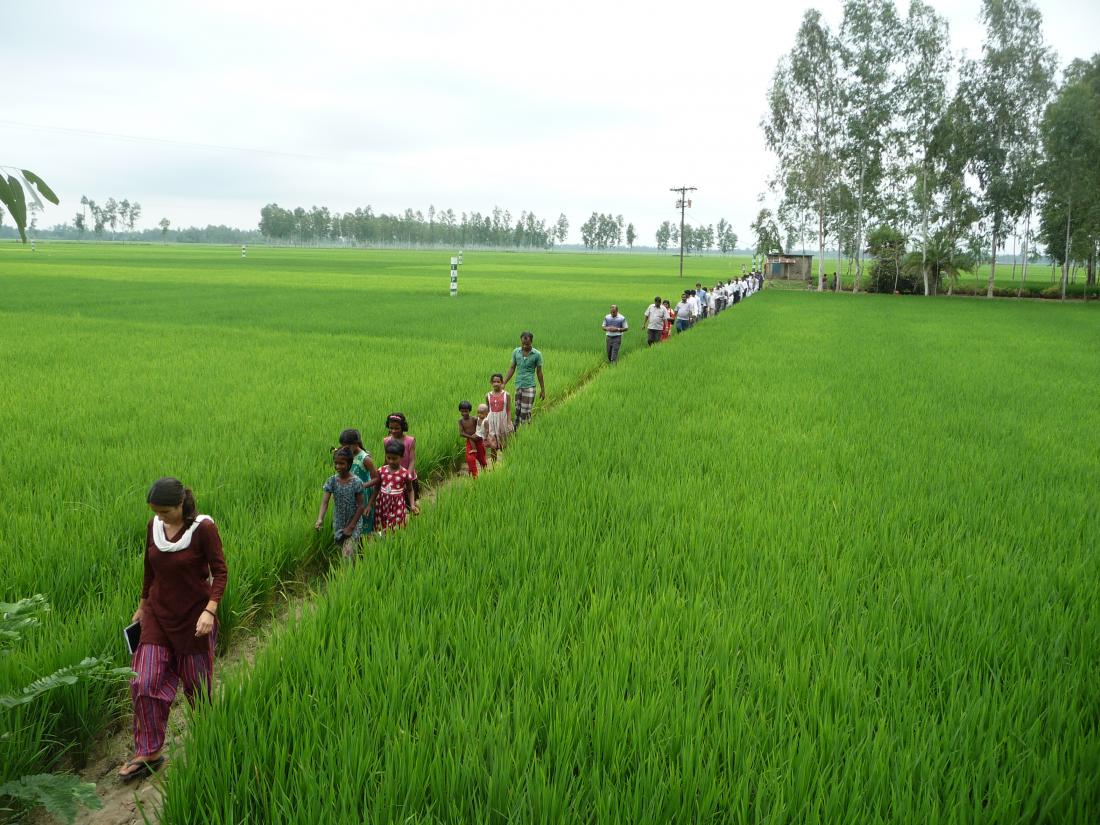
Floods are yearly occurrences in Bangladesh; about 80 percent of the country is located on floodplains and between 20 to 60 percent of the country can be submerged by flood water in any given year 1. More than 80 percent of rural households depend on agriculture for their livelihoods, and floods are very destructive toward crops, livestock, and other assets, but Bangladesh’s government does not have the resources to provide large-scale flood protection and relief. While some climate resistant agricultural technologies exist, like flood and drought tolerant seeds, take up by farmers in Bangladesh remains low because they may cost more than traditional varieties and have uncertain benefits in non-flood years. Financial institutions are often wary to lend to households with limited resources after weather events have occurred, and at the time of the study no microfinance organizations in Bangladesh were offering to do so.
BRAC has over two thousand branches that each provide microfinance services for between twenty to sixty village organizations. The most common loan BRAC offers is called the Dabi loan, which is a small loan that households repay within one year. BRAC loan officers visit village organizations on a regular basis, so households are familiar with how credit products work and tend to have high repayment rates.
معلومات تفصيلية عن التدخل
Researchers conducted a randomized evaluation to test the impact of a new microcredit product on agricultural households’ flood protection and coping strategies.
In partnership with BRAC, researchers designed a new financial product that guarantees access to credit in the event of a flood for existing BRAC clients with a credit score above a certain threshold, for which approximately forty percent of borrowers were eligible. The Emergency Loan product guaranteed that eligible households could borrow up to fifty percent of the total amount of their last approved BRAC loan, regardless of the balance of any existing loans.
Researchers randomly assigned 200 BRAC branches to either offer the new Emergency Loan or continue to be offered standard services. Eligible branches were randomly selected from areas the government’s forecasting center considered flood-prone, and researchers authorized eligible branches to extend loan offers to eligible borrowers if more than twenty percent of a branch’s area became flooded.
Credit access treatment group (150,000 clients of 100 BRAC branches): All eligible BRAC members at these branches were notified that they were pre-approved for an Emergency Loan in the event of a flood during the agricultural season. Information was provided in advance of the agricultural season, when households typically make decisions about agricultural investments, and households were informed that they could choose to take out a loan if a flood occurred, without having to make any upfront payments. They received regular reminders throughout the rice-growing season of the availability of Emergency Loans.
Comparison group ( 150,000 members at 100 BRAC branches): Members in comparison group branches were offered standard BRAC microfinance services, and they were not notified about Emergency Loans.
Researchers used BRAC’s administrative data to access loan records and repayment rates for all clients in the study. Researchers also surveyed a sample of the 4,000 BRAC clients from all 200 branches in the study. Researchers surveyed BRAC clients and staff prior to the intervention in April 2016, as well as in December 2016 and 2017.
النتائج والدروس المستفادة بشأن السياسات
The Emergency Loan increased agricultural investments for eligible households prior to flooding, as well as led to increased consumption after a flood occurred. Although take up of the loan was low, they were still a profitable investment for the lender.
Loan take-up: Household take-up of loans was higher when more flooding occurred. In 2016, there were few floods in most locations, and 2.9 percent of eligible households chose to purchase the emergency loan. There was more severe flooding in 2017, and 5.4 percent of eligible households purchased loans. Higher take-up rates were concentrated in households that were not as prepared for a flood, and households that were hit especially hard by a flood.
Pre-flood behavior: Households that knew they were eligible for the loan increased the amount of land they dedicated to farming by 18 percent. The number of eligible households that planted crops increased by approximately four percentage points (eight percent). Households also increased the amount of pesticides applied to these crops, indicating more intensive land usage. Investments in non-agricultural business for households who were given notice of the loan increased by 31 percent.
Post-flood consumption: In the event of a flood, households that received information about their eligibility for the Emergency Loan had an eight percent increase in food consumption per capita relative to households that did not receive information on eligibility. Researchers suggest that improved consumption after flooding may have resulted from increased investments that eligible households undertook after they were informed of the loan. Crop production for households that received approval information also increased by 19 percent. For households where flooding did not occur, there was a 35 percent increase in crop production for households that received notice of loan approval.
Effects on ineligible households: Households in treatment branches that were ineligible for the emergency loan may have been impacted by its availability since they are likely to have existing social ties and financial connections with eligible households in their same community. In branch areas that did not experience flooding, consumption increased by eleven percent for ineligible households. In these non-flooded areas, total crop production increased by 25 percent. Researchers suggest this these results may be because eligible households were able to hire laborers more frequently.
BRAC performance: Households with access to the Emergency Loan repaid these loans at a higher rate after the flood shock, and also had higher repayment rates overall. BRAC branches increased their profits, and clients who marginally qualified for an emergency loan had the largest impact on this increase. Overall, the total number of loans does not increase, as the number of other types of loans taken out decreases while Emergency Loans increase.
Taken together, these results indicate that providing guaranteed credit after weather shocks may be an effective and scalable policy tool for low-income countries, particularly as these shocks increase in frequency and severity due to climate change. These results also show how the private sector can be involved in giving loans without losing money.
Lane, Gregory. “Adapting to Climate Risk with Guaranteed Credit: Evidence from Bangladesh,” Econometrica, 92, no 2. (March, 2024): 355-386 https://doi.org/10.3982/ECTA19127
Brammer, H. 1990. “Floods in Bangladesh: Geographical Background to the 1987 and 1988 Floods.” The Geographical Journal 156 (1):12–22.