

Separating Diagnosis and Treatment: Using Incentives to Improve Malaria Care in Kenya
- Health care providers
- Adults
- Malaria
- Health outcomes
- Information
- Health care delivery
- Monetary incentives

Despite the availability of effective and affordable treatments, malaria remains a significant health problem in Africa.1 Researchers conducted a randomized evaluation to test the impact of incentives for both malaria testing and treatment on appropriate care in Kenya. Both patient subsidies and health provider incentives increased the use of malaria tests. The incentives also improved targeting of antimalarial drugs to patients who actually had malaria, while reducing unnecessary treatment of malaria-negative patients. The incentive structure was highly cost-effective, lowering costs by reducing the number of malaria-negative patients taking unnecessary medications.
Policy issue
Malaria is a substantial public health problem in Kenya despite the availability of effective drugs and diagnostic tests.2 Approximately 3.5 million cases are reported each year in Kenya, and an estimated 10,700 deaths were attributed to malaria in 2021.3
Rapid diagnostic tests (RDTs) for malaria are widely available and affordable in Kenya. However, less than ten percent of patients with malaria symptoms are correctly diagnosed before receiving treatment. This low rate of diagnostic testing leads to a mismatch between treatment and need. Some malaria-positive patients go untreated, resulting in severe illness. At the same time, some malaria-negative patients unnecessarily receive medication, fostering increased drug-resistance in the population. One possible solution is the use of incentives for both patients and providers to more frequently use diagnostic tests.
Context of the evaluation
The evaluation took place in thirteen malaria-endemic counties near Lake Victoria and on the coast, areas of Kenya with the highest risk of malaria transmission.
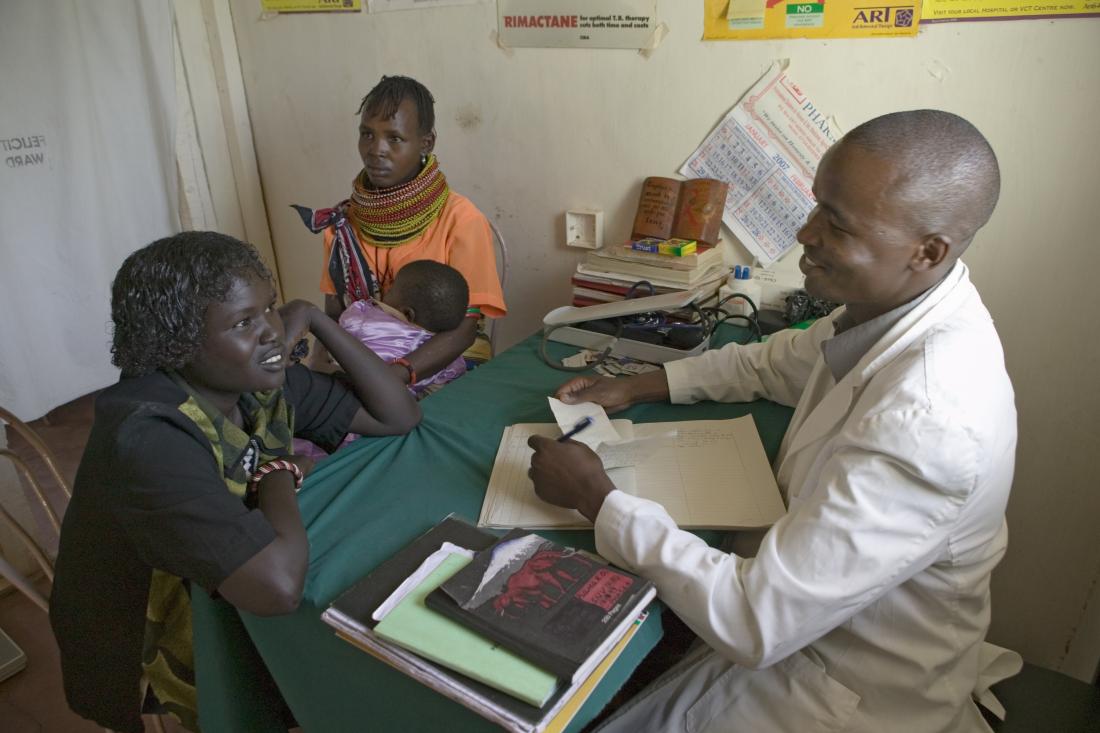
In East Africa, pharmacies are often the first place people go when seeking treatment for malaria; more than half of patients begin their care there. Because pharmacies are widely available across Kenya and the region, they play an essential role in providing primary care where clinics and hospitals are scarce.
All pharmacies that took part in the evaluation were users of Maisha Meds, a Kenyan healthcare social enterprise that provides a digital sales and inventory management platform for small, private pharmacies and clinics. Key evaluation outcomes were monitored using the Maisha Meds platform, which captures all pharmacy transactions and inventory data.
Details of the intervention
Researchers conducted a randomized evaluation to examine the effect of incentives on malaria testing and treatment decisions. They randomized 140 pharmacies into one of four groups:
Patient subsidy group (T1): Patients who visited these pharmacies for suspected malaria paid a 90% subsidized price for the diagnostic test and a subsidized price for artemisinin combination therapies (ACTs, the recommended antimalarial drugs). Their subsidized price was conditional on a confirmed positive malaria diagnosis. To ensure patients were aware of the subsidy, large posters showing the prices were displayed throughout the pharmacy.
- Pharmacy incentive group (T2): Pharmacy owners were given incentives for each malaria test sold and for dispensing ACTs to patients who tested positive. In addition, pharmacy attendants received a subsidy for recording transaction details in the malaria case management platform (Maisha Meds) and finalizing the sale of the incentivized products. Pharmacies retained the freedom to set their own prices charged to patients.
- Combined group (T3): Patients were eligible for subsidized RDTs, as well as discounted ACTs if they tested positive. Pharmacy owners earned a monetary incentive for each rapid test sold and an additional incentive for dispensing ACTs to malaria-positive patients. Pharmacy attendants received a monetary incentive for the same tasks in T2—recording transactions into the Maisha Meds platform and completing the sale of incentivized products. Once again, pharmacies were free to choose the prices charged to patients.
- Comparison group: These pharmacies continued with business as usual, with no incentives or subsidies.
The total value of the incentives was kept constant at KES 200 (approximately US$2.00 in 2021 exchange rates) across all intervention groups.
In the three intervention groups, supplies of the malaria tests and medicines were provided to the pharmacies by Maisha Meds. Comparison group pharmacies managed their own stock of tests and medicines.
To evaluate the impact of these incentives, researchers collected data from multiple sources, including administrative sales data, malaria case management data, patient surveys, and pharmacy owner and staff surveys.
Results and policy lessons
Both patient subsidies and provider incentives increased use of diagnostic tests and improved targeting of antimalarial drugs to patients who actually had malaria. The incentives offered a high return on investment, primarily due to reductions in malaria-negative patients inappropriately being given ACTs.
Use of rapid diagnostic tests (RDTs): In the comparison group, eight percent of patients seeking care for malaria bought a test prior to receiving treatment. In the intervention groups, the incentives meaningfully increased the use of RDTs. Across all three intervention groups, patients were 25 percentage points more likely to purchase a test (a 309 percent increase).
Use of ACTs (malaria treatment): In the comparison group, 87 percent of suspected malaria patients purchased ACTs, despite the low testing rate and only 34 percent truly having malaria. These numbers suggest that 66 percent of patients were purchasing ACTs when they did not need to, resulting in wasted medication. In the intervention groups, the incentives led to a decrease of 14 percentage points in purchasing ACTs (a 16 percent decrease).
Impacts on prices and pharmacy behavior: In the group that received patient subsidies, patients paid 43 percent lower prices for the rapid diagnostic tests. However, in the groups that received pharmacy incentives, the lower prices were not passed down to clients. Instead, the pharmacy incentives led pharmacists to give more detailed treatment recommendations to patients, leading to more accurate diagnosis and treatment.
The results of the evaluation suggest that patient and pharmacy incentives for malaria treatment and testing can be an effective tool for policymakers. The incentives can increase the affordability of malaria treatments and avoid unnecessary medical costs at the same time.
Cost-analysis: The incentives were highly cost-effective; they lowered the cost per malaria-positive patient and reduced unnecessary treatment of malaria-negative patients. Compared to the comparison group, the patient subsidy group correctly treated an additional 180 patients and saved US$57.60 per patient due to reducing the amount of unnecessary treatment. The pharmacy incentives saved even more money; US$142.14 was saved per patient, and 258 additional patients were treated appropriately with ACTs. Finally, while the combined interventions resulted in an additional 165 patients being treated correctly, they were not cost saving.
“Malaria Factsheet.” World Health Organization (WHO), 11 December, 2024. https://www.who.int/news-room/fact-sheets/detail/malaria.
Amboko Beatrice, Kasia Stepniewska, Peter M Macharia, Beatrice Machini, Philip Bejon, Robert W Snow, and Dejan Zurovac. 2020. “Trends in Health Workers' Compliance with Outpatient Malaria Case-Management Guidelines Across Malaria Epidemiological Zones in Kenya, 2010–2016.” Malaria Journal. 19, 406 (November). doi: 10.1186/s12936-020-03479-z.
World Health Organization. August 2023. “Country Disease Outlook: Kenya.” https://www.afro.who.int/sites/default/files/2023-08/Kenya.pdf