Image

Governments play a key role in providing the services and institutions that low-income citizens need to escape poverty–and that all citizens need to realize their aspirations. But many low- and middle-income countries struggle with state capacity: Overstretched public servants are tasked with performing these key functions on a limited budget.
These public servants face a number of challenges. One is a lack of information on citizens and taxpayers. Many LMICs don’t have formal property addressing, for instance, so tax collectors must venture out on foot to identify and value properties and then deliver tax bills. Another is a lack of personnel: governments may not have enough workers to meet citizens’ needs for services like health care and education.
Artificial intelligence promises to help governments meet these challenges and deliver better for citizens. AI tools could be leveraged at multiple points in the public financial management cycle—from collecting revenue through taxation, to spending those revenues on public services. They could also make government operations more efficient by automating processes—and, by reducing human involvement, could reduce opportunities for corruption.
In fact, AI is already widely used by high-income country governments: According to the OECD’s Digital Government Index, 70 percent of member countries report that they have used AI to improve internal government processes.
But there is a risk that governments can get ahead of themselves in applying AI tools without sufficient evaluation, oversight, or customization. AI tools can inadvertently introduce bias or exclusion, or simply be ineffective and waste taxpayer dollars. Rigorous evaluation of new AI-powered tools in real-world settings is needed to ensure not just that they work on a technical level, but that they are actually leading to desired outcomes, like fairer tax systems and better citizen satisfaction.
Below, we explore what we are learning from rigorous evaluation of AI for raising taxes and delivering public services.
AI could help solve multiple challenges that LMIC governments face in raising tax revenue.
The first challenge governments face is limited information on the people, properties, and firms that governments want to tax. Several evaluations have explored the use of AI to fill these information gaps.
In Senegal, government workers typically go into communities to see properties in person and assign values—a common approach in low-resource settings, but one that can introduce potential for bias and corruption. Researchers partnered with the national tax administration to test a new approach: a machine learning algorithm that generated a predicted property value based on characteristics input by government workers.
The algorithm served to increase the tax base and raise revenue, all while making taxation more fair, since government workers had tended to undervalue more expensive properties. But there’s an important caveat: The algorithm tended to overvalue the cheapest properties. This points to the importance of creating a grievance and redressal mechanism for citizens who may be taxed unfairly as a result of the algorithm.
Along similar lines, with funding from J-PAL’s Governance Initiative, researchers are using hundreds of thousands of property images from Punjab, Pakistan to define a computer vision algorithm to predict property assessments. In the DRC, researchers have used drone imagery, processed by a machine learning model that was trained on expert property value assessments, to generate an updated property tax roll.
But using AI is not an end in itself: To make a difference, these tools must be integrated into broader reforms. In this latter case, this updated tax roll formed the basis of a new progressive property tax system that researchers are currently evaluating.
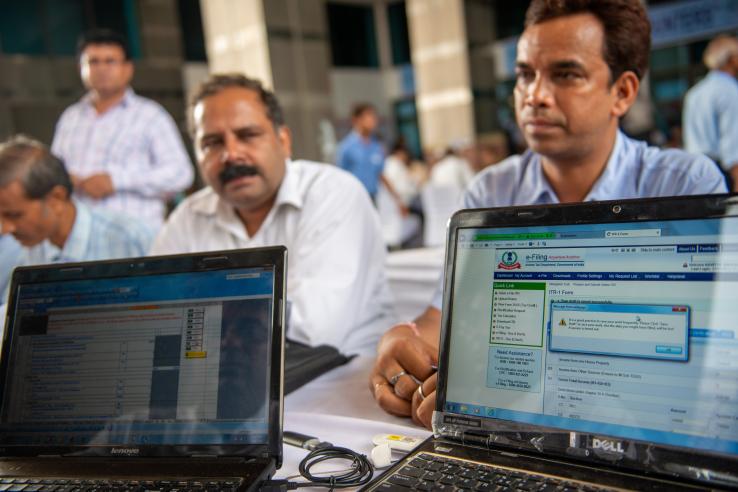
The second challenge is collecting taxes. While evidence on the impacts of deploying AI for these purposes is still nascent, there are multiple pathways for AI use. For example, tax reminder messages have been extensively evaluated and found to boost tax compliance. AI could make this intervention more efficient by generating individually-tailored tax reminder messages. AI could also improve the taxpayer experience: AI chatbots could help taxpayers file and pay taxes, building on evidence that e-filing can save taxpayers’ time and reduce opportunities for bribery. For example, Singapore’s tax authority built a chatbot to allow citizens to check their tax balance, make payments, and ask questions. There is a need for more research on the effectiveness of these approaches.
The third challenge is increasing compliance—reducing tax evasion and other forms of corruption. Through analyzing patterns, machine learning can identify likely fraud. In a study in Brazil, researchers trained a machine learning model to analyze municipal budget records and accurately rank municipalities according to the risk of corruption–local officials diverting funds meant for local development.
There are important caveats, however. When it comes to improving compliance, AI doesn’t always perform better than civil servants, who are often highly skilled and whose jobs are complex. In another study in Senegal, researchers designed an algorithm to identify firms that were likely to evade taxes, which would be audited by the national tax office. Algorithm-selected audits underperformed tax collector-selected audits in predicting fraud—and were less cost-effective. This was partly due to limitations in the data that was used to build it—pointing to the challenge of using AI in data-poor environments.
To take another example, in India, many firms evade the Goods and Services Tax (a value added tax) by claiming fraudulent input tax credits against “ghost” purchases from fake firms. Tax officials spend a lot of time sorting through data to uncover these fake firms. Using tax returns and inspection records, researchers trained a machine learning tool to generate a list of likely fake firms.
The ML tool worked pretty well: physical inspections in the field found that 53 percent of the firms it identified were indeed fake, compared to 38 percent in the status quo. But despite the model’s accuracy, using it did not result in more or faster cancellation of fake firms—partly due to a lack of capacity for enforcement—and tax collection did not improve.
Once taxes have been collected, governments spend revenues to deliver policies and programs spanning health, education, infrastructure, social protection; providing security and enforcing property rights; and delivering justice. There are many promising applications of AI across these government functions, many of which were outlined in our first blog in this series.
AI could help governments identify citizens in need of social services. In Togo, researchers used machine learning algorithms and data from satellites and mobile phone networks to target households in need of assistance during the Covid-19 pandemic. With support from PAIE, researchers are using AI to analyze administrative records to identify low-income tenants who have a high likelihood of facing eviction proceedings, in order to provide housing supports.
AI could help frontline workers deliver better public services to more people. It can save time with repetitive tasks, freeing up public servants’ time for more complex and interesting tasks and leading to more efficient public service delivery. To take one example, agricultural extension agents in many countries are charged with visiting farmers across far distances to provide advice on agricultural practices. Agents often struggle to meet the demand for advice: in India, for instance, there is only one agent for every 1,000 farming families.
Organizations like Precision Development and Digital Green have developed digital and video-based tools to reach more farmers with more customized advice. AI has the potential to enhance these innovations. Digital Green has now rolled out Farmer.Chat, an AI chatbot that enables farmers to ask conversational questions in their own languages, and is currently working with IFPRI to study its impact. Chatbots could also be used to extend the research of frontline workers, such as teachers and health care workers.
AI could also help bureaucracies manage their frontline workers. Many governments are using smartphones and e-governance tools to generate more data on the delivery of public services, from agricultural extension in Paraguay to primary health care in Pakistan and payment monitoring in India. AI could be used to analyze the vast amounts of data these programs generate and, potentially, create predictive models that would enable faster service delivery.
Finally, AI could help improve citizens’ ability to access their government and hold it accountable for providing services. With funding from the Governance Initiative, researchers in India are using machine learning to improve the process by which citizen complaints are matched to relevant departments and officials within departments.
Governments have a visible and direct impact on people’s lives, along with a duty to uphold the public good, so caution on AI applications is warranted. As the examples above illustrate, AI models are only as good as the data used to train them, and many LMIC governments may not have good data at their disposal.
Importantly, AI is not a replacement for the important and often incremental work of strengthening state capacity. Tools must not only be technically valid, but well-integrated into broader government practice– governments must be able to act on the information that AI generates.
Transparency and accountability are paramount—especially since AI systems often act as “black boxes,” the outputs of which civil servants and bureaucrats may not fully understand and struggle to explain. Governments must explain to citizens how AI is being used and create opportunities for redress in case of errors.
Aggregating citizens’ data from multiple data sources can also raise concerns about data privacy and surveillance. Some evidence suggests that autocratic governments can leverage AI, such as facial-recognition technology, to quell political unrest. Governments must build and comply with appropriate safeguards.
Finally, citizens without access to digital tools or skills will be less able to engage with AI-driven public services, potentially exacerbating digital divides. Care must be taken to ensure that citizens are not left behind.
While we’re starting to see promising evidence on AI use cases, policymakers still need more rigorous research on what these tools actually mean for governance. It’s not just a question of whether AI helps boost revenue or speed up service delivery. Researchers also need to dig into equity and distributional impacts, and evaluate how these systems play out in real-world settings where humans make human mistakes. Ultimately, governments should view AI as one tool in a broader toolkit for strengthening their ability to tax and spend.
There are many open questions regarding the use of AI and machine learning in governance:
In addition to being effective and efficient, governments must also be representative of their citizens’ needs and preferences. There is another emerging research agenda around AI for political participation, including the use of AI chatbots as a source of political information and civic education for voters, candidates, and journalists.
Researchers funded by J-PAL’s Governance Initiative are asking these and more questions as they explore applications of AI to strengthening state capacity and broadening political participation. Answering these questions will be key to helping low- and middle-income governments use AI effectively and responsibly to tax and spend, deliver services, provide security and justice, and represent the voices of citizens in the 21st century.
We’ll continue to share new research results as more findings emerge, including in our AI Evidence Playbook. The playbook summarizes what we know and don’t know about AI’s role across sectors and shares perspectives on building on these lessons.
Read other posts in this series.