Image

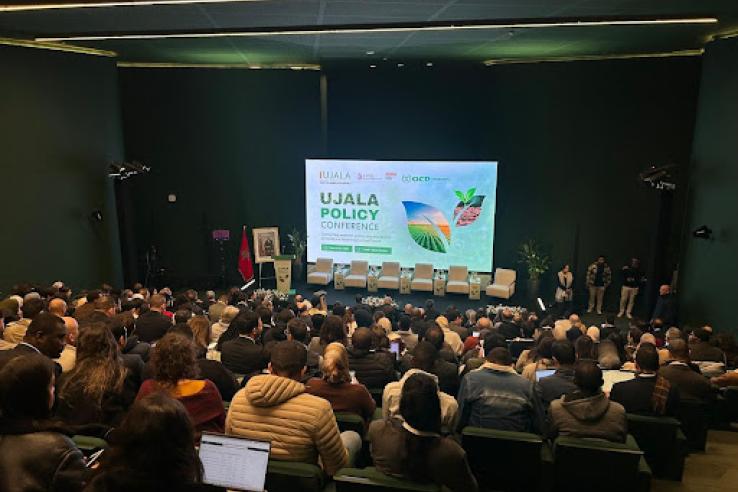
In 2023, we launched a new J-PAL policy lab: The UM6P-J-PAL Applied Lab for Agriculture (UJALA), which generates rigorous, policy-relevant evidence to answer critical questions around small-scale agriculture and food security worldwide. The lab, launched in collaboration with OCP Africa and led by J-PAL staff, is based at University Mohammed VI Polytechnic (UM6P) in Rabat, Morocco.
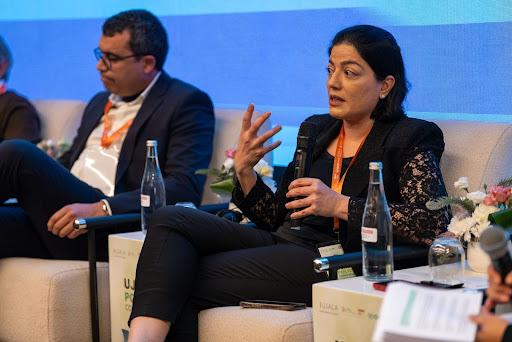
On January 12, 2026, UM6P Rabat hosted the UM6P-J-PAL Applied Lab for Agriculture Policy Conference, bringing together J-PAL affiliated researchers and UM6P academics, OCP executives, and policymakers to contribute to the future of evidence-informed agricultural policymaking.
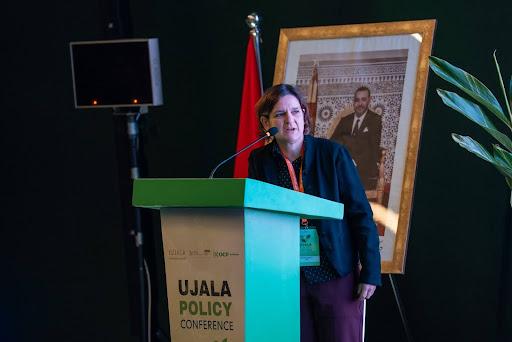
The conference featured opening remarks from key institutional and research leaders, who emphasized that rigorous evidence must be embedded in real delivery systems and inform public policy decisions. Speakers also affirmed how scaling agricultural solutions must begin with farmers’ realities, ensuring that innovation responds to conditions on the ground.
The panels that followed examined agricultural transformation through three complementary lenses: multi-dimensional constraints to smallholder productivity, the design and use of digital solutions, and the role of soil health in sustaining long-term gains.
“J-PAL was created to translate rigorous experimentation into real-world policies and practices, ultimately scaling impact.”
Esther Duflo, Co-founder and Director, J-PAL
“UJALA is the first major partnership of J-PAL working with a private entity, and when we think about scaling out interventions from evidence to policy, this is a great opportunity to reach that goal.”
- Alison Fahey, Global Director of Partnerships and Strategic Initiatives, J-PAL
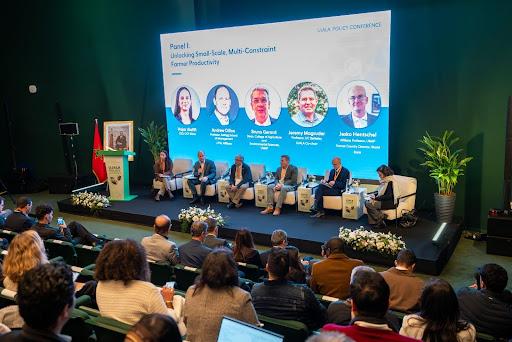
Speakers: Hajar Alafifi, CEO of OCP Africa; Andrew Dillon, J-PAL affiliate and Professor at Kellogg School of Management; Bruno Gérard, Dean of College of Agriculture and Environmental Sciences, UM6P; Jesko Hentschel, Affiliate Professor at the UM6P Faculty of Governance, Economics, and Social Sciences, Former World Bank Country Director in Africa; Jeremy Magruder, J-PAL affiliate, UJALA Co-Chair, and Professor at UC Berkeley.
The panel discussed research findings that suggest multiple factors jointly shape adoption, rather than a single binding constraint. Credit and liquidity, savings and insurance, information, infrastructure, transaction costs, and access to labor and land all influence farmers’ adoption of inputs and reduce incentives to invest in productivity-enhancing practices.
Affiliate Andrew Dillon, furthering the discussion, showed that timing matters as much as agricultural components. Interventions that address only one constraint, such as lowering input prices, may be insufficient to generate sustained improvements. Even when inputs and markets are available, agronomic conditions can block gains, as depleted soils often respond weakly to fertilizer.
Behavioral constraints further slow adoption. Jeremy Magruder underscored that agriculture is a noisy environment. Therefore, trust—in advisors, input quality, and delivery systems—is central to reducing uncertainty and enabling learning.
From OCP Africa’s perspective, recognizing this multi-constraint reality has transformed its role. As Hajar Alafifi, CEO of OCP Africa, explained, productivity gains must happen on the field, but they depend on broader systems that include finance, insurance, mechanization, markets, and policy.
The concept of bundling emerged as a critical point of convergence between research and policy that might enhance impact. Hajar stressed that “impact means partnerships,” noting that delivering such bundles at scale requires strong institutional alignment and long-term commitment. She also emphasized that productivity gains alone do not guarantee durable welfare improvements: stability, inclusive institutions, functioning markets, and public investment are essential to sustain gains and ensure that productivity growth translates into lasting poverty reduction.
Speakers: Jenny Aker, J-PAL affiliate, DigiFI Africa Co-Chair, and Professor at Tufts University; Waseem Rashid, Executive Vice President of Digital Solutions at OCP Nutricrops; Faissal Sehbaoui, CEO of AgriEdge; Tavneet Suri, J-PAL affiliate, UJALA Co-Chair, and Professor at MIT; and Philipp Zimmer, Consultant, Data Scientist, Development Impact Group at the World Bank.
Digital solutions are often promoted as scalable alternatives to traditional extension programs. As Tavneet Suri noted at the event, “Digital tools help farmers better access information, but the information needs to be actionable for the farmer to increase productivity and improve their livelihoods.” Their value depends on integration with extension, input access, and financing. Ultimately, it is not the digital nature of these tools that drives change, but their ability to address farmers’ real constraints.
One key insight shared by J-PAL affiliate Jenny Aker was that connectivity gains often masked deep inequalities through the variability of infrastructure quality. She emphasized that weak or unreliable connectivity determines both digital services function and who benefits from them. Designing digital tools, therefore, involves a trade-off between precision and inclusion: systems that rely on constant connectivity risk reinforcing disparities, while successful ecosystems often prioritize robustness and accessibility for the median farmer.
Participants also discussed how digital tools could inform both higher-level and farmer-level decision-making. World Bank panelist Philipp Zimmer stressed that despite a growing body of evidence and the availability of AI-based digital tools, governments and financial institutions often inform food security policies through high-stakes or large-scale decisions, based on limited information. He highlighted how these AI-based digital tools can serve as early warning systems to key policy issues when embedded in clear decision protocols that translate information into action.
At the farm level, digital tools matter only when they deliver practical, actionable guidance. Speakers from OCP Nutricrops and AgriEdge affirmed how farmers think in terms of decisions that affect yields, rather than in terms of digital platforms. AI-driven tools were most effective at the last mile when they support specific decisions at the right moment, reduce cognitive load, and build trust through simplicity, local relevance, and explainability. Hence, there is a need to design digital systems that absorb agronomic complexity and align recommendations with input availability, timing, and field realities.
Speakers: Hope Michelson, J-PAL affiliate and Professor at University of Illinois at Urbana-Champaign; Robert Darko Osei, J-PAL affiliate, DAISI Co-Chair, and Professor at the University of Ghana; David Spielman, Director, Innovation, Policy and Scaling Unit at IFPRI; Nawfel Roudies, J-PAL affiliate, UJALA Co-Chair and Professor at MIT; and Leonardus Vergutz, Chief Scientific Officer at OCP Nutricrops.
Soil health offers a third lens through which to examine agricultural productivity. From an agronomic perspective, soil sustains productivity only when its essential functions—soil’s organic matter, balanced nutrition, and good structure—work together to allow roots to develop, water to be retained, and nutrients to be absorbed.
This insight suggests that sustainable soil management requires shifting the farmer’s question from “what should I apply?” to “what does my soil need?”, building these properties gradually through practices such as conservation agriculture combined with appropriate fertilizer use. However, adoption and learning are cumulative, and system-level impact often takes 15 to 25 years to materialize.
At the event, David Spielman stressed that “Policymakers operate within annual budget cycles and limited implementation capacity, and evidence needs to speak directly to those constraints if it is to inform real policy choices,” which affirms the need for long-term program design, policy engagement, and realistic evaluation timelines.
From the farmer’s perspective, soil health is both an agronomic and economic decision. J-PAL affiliated professor and DAISI Co-Chair Robert Darko Osei explained that soil-improving practices involve upfront costs and delayed, uncertain returns, and that liquidity constraints, competing household needs, and risk tend to limit farmers’ ability to act—even when recommendations are understood. Trust and learning are therefore essential.
Affiliate Hope Michelson's research shows that farmers are more likely to persist with soil practices when they receive repeated feedback, observe visible yield improvements, and rely on credible messengers. Hope emphasized that “information only works when farmers trust the messenger and the system delivering it. Even accurate recommendations can fail to generate impact when distrust in input quality or advisory services remains unresolved.”
Aligning rigorous research with policy realities and implementation constraints is essential to move from isolated successes to sustainable, scalable impact. Bringing research, policy, and practice together offers a rare opportunity to examine agricultural transformation from complementary perspectives, and affirms how it is advanced not from isolated innovations, but from sustained alignment across evidence generation, policy design, and field implementation.
Building on these multi-lens insights, UJALA looks forward to supporting researchers ready to take on exciting, policy-relevant projects in collaboration with practitioners and implementing partners of their choice. Opening the door to fresh ideas, innovative pilots, and real-world impact, and fostering collaborations that translate rigorous evidence into actionable impact.