

To Ease the Climate Crisis, First Figure Out What Works
The New York Times summarized Nobel Laureate and J-PAL co-founder Esther Duflo's interview about climate change and inequality at The New York Times Climate Forward event.
We find ourselves in a make-or-break decade if we are to meaningfully confront the impacts of climate change on societies and ecosystems. The recently published Sixth Assessment Report by the Intergovernmental Panel on Climate Change (IPCC) leaves no doubt that the impacts of climate change are already felt today and will intensify in the future, affecting low- and middle-income countries most severely. The IPCC highlights that climate change acutely affects development outcomes, suggesting a “rapidly closing window of opportunity to secure a livable and sustainable future for all.” Not only does the world need to hit fast-forward on climate change mitigation by reducing greenhouse gas emissions, it also needs to ensure that those who are (and those who will be) feeling the impacts of climate change can adapt accordingly and sustain their livelihoods.
With increasing urgency to adapt to and mitigate climate change, it may be tempting to deploy innovations before they are rigorously evaluated in the field, in the name of reacting quickly. But innovations do not always achieve their intended impacts in the field, and there are large gaps between the engineering estimates and real-world performance of new technologies. Governments as well as companies concerned by climate change have much to gain from measuring the impact of existing solutions. Ultimately, we can save time by spending funds on the solutions that have been demonstrated to be effective, rather than putting resources into measures that will not achieve their desired results. Given limited time and resources, it is imperative to direct investments toward climate adaptation measures that work outside the lab, in the real world.
We should seize rapid climate action as an opportunity to carry out impact evaluations of policies, technologies, and programs through robust data collection and monitoring. Fortunately, large-scale, accurate data collection approaches are here to help and have become increasingly accessible to researchers and implementers in recent years. From administrative data (collected by governments or organizations) to satellite imagery and remote-sensing technology to forecast extreme weather events, randomized evaluations are beginning to leverage non-traditional data sources to yield timely and accurate results that can facilitate adaptation. To speed up the path from research to policy action, J-PAL’s King Climate Action Initiative (K-CAI) prioritizes funding research and scaling that uses administrative and remote sensing data to generate results in a timely manner.
Traditionally, randomized evaluations have heavily relied on data sources like census and household survey data. Data collection can thus be costly and time-consuming. However, new approaches, like collecting data in real-time and in larger volumes, can unlock new kinds of interventions and generate results in a timely manner.
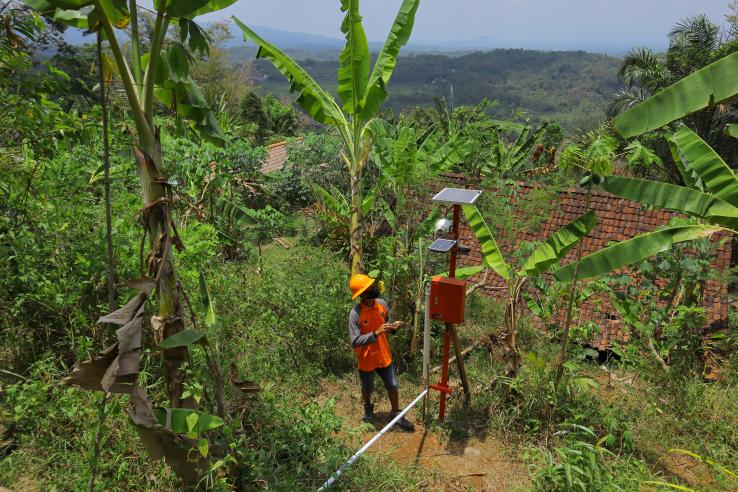
Data collected in real-time includes, for example, data from pollution sensors, air quality monitors, and satellite data. The ability to collect data in real-time unlocks insights into the short-, medium-, and long-run impacts of climate innovations, and allows for speedy optimization of interventions. This stands in contrast to surveys conducted after an intervention that captures effects, self-reported or otherwise, retrospectively rather than simultaneously—which delays informed climate action. In addition, real-time data can inform predictions about the future, such as accurate weather forecasts and early-warning systems, that can help communities adapt by preparing for impending weather shocks.
Randomized evaluations are already using properties of real-time data collection to unlock, for instance, new kinds of information interventions. In a study funded by K-CAI, researchers Douglas Almond (Columbia University) and Shuang Zhang (Imperial College London) are currently conducting an intervention across thirteen Chinese provinces, obtaining firms’ emissions data on a real-time basis. The real-time database started in January 2019 and continued to update on an hourly basis until 2022. Researchers collected hourly concentration data for three different air pollutants and three different water pollutants for every firm. Using this granular data, researchers identified firms with emissions above the regulatory limit, or suspicious data patterns that may point to intentional data manipulation. Leveraging this data is increasingly feasible in real-time and could provide objective information and thereby increase the effectiveness of environmental inspections.
Data collected in real-time, rather than after the fact, may also provide a unique opportunity for immediate feedback and incentives for changes in environmentally damaging behavior. In another ongoing K-CAI-funded study, J-PAL affiliated professor Robert Metcalfe (University of Southern California) is piloting techniques to reduce greenhouse gas emissions in the shipping industry by providing captains of cargo vessels with daily vessel data—offering personalized feedback, targets, and fuel-saving incentives via a software system. Feedback focuses on discrete captain behaviors, such as power management of engines, speed reduction, and route optimization.
These insights into the effectiveness of programs and policies are needed to combat climate change, as with every increment of global warming, climate impacts become more pronounced and challenging to adapt to.
Non-traditional data sources can help identify communities that are particularly vulnerable to the impacts of climate change. This information can help policymakers target adaptation interventions to these communities and ensure that they receive the support they need. Effective data processing approaches, such as classification through machine learning algorithms, can improve targeting adaptation support for the most vulnerable households and communities. For example, a study led by J-PAL affiliated professor and K-CAI co-chair Kelsey Jack (University of California Santa Barbara) on effective targeting of electricity subsidies in Cape Town is exploring whether administrative data can be used to better target subsidies to households with the greatest need for support. Better targeting of these subsidies could help the City of Cape Town achieve both its climate and its poverty alleviation goals.
In another study in Bangladesh, researchers Munshi Sulaiman (BRAC University), Ashley Pople (Oxford), J-PAL affiliate Stefan Dercon (Oxford), Rohini Kamal (BRAC University), and Rocco Zizzamia (Oxford) are evaluating an early action program to protect low-income communities from floods. The team is testing the efficacy of early flood alerts and adaptation assistance, and using satellite data to target these interventions to the most vulnerable households.
In identifying areas vulnerable to climate change, combining household surveys and satellite data may also provide insights into both climate phenomena, like changing weather patterns, as well as on-the-ground adaptation responses. This can allow us to identify informational and behavioral constraints to effective climate change adaptation. For example, J-PAL affiliated researcher Rohini Pande (Yale University) and Maulik Jagnani (University of Colorado Denver), utilize satellite data in an evaluation of an early warning flood forecasting system in Bihar, India. The study pairs cutting-edge forecasting and an Android-based flood alert system with grassroots volunteers trained in community outreach. Researchers subsequently employ household surveys to assess the system’s effectiveness in helping households adapt to flooding events. Early warning systems are one way in which satellite data can be leveraged to evaluate adaptation mechanisms as ex-ante information may facilitate precautionary measures.
In the quest for timely climate mitigation and adaptation, rigorous evaluation may ultimately help us move faster by ensuring the real-world efficacy of public and private sector innovations. Using tools from computer science, data science, and engineering can unlock new opportunities for real-world evaluation of climate innovations and, potentially, protect livelihoods around the world. It is tempting to rely on intuition and good intentions to guide our actions, but there is no substitute for high-quality data. We need randomized evaluations and robust data collection and monitoring systems when rolling out new climate policies and programs to improve programs over time, across changing contexts, and ensure their effectiveness. Through rigorous evaluation, we can learn as we take action. Real-time data collection and monitoring, coupled with innovative approaches to data analysis, can help us identify vulnerable communities, target interventions effectively, and optimize our efforts to mitigate and adapt to a changing climate. Rigorous monitoring and evaluation, in turn, allow for more informed policy and private sector decisions during the current “window of opportunity” to drive a positive impact on the planet and the people who will most be affected by climate change.
The New York Times summarized Nobel Laureate and J-PAL co-founder Esther Duflo's interview about climate change and inequality at The New York Times Climate Forward event.
Climate change has the potential to undo decades of progress in poverty alleviation and improvements in well-being among the most vulnerable. Recognizing this challenge, J-PAL’s work in the Environment, Energy, and Climate Change sector seeks to measure the real-world impacts of energy and environmental policies, particularly on climate change mitigation, pollution reduction, climate change adaptation, and energy access, and disseminate these findings to advance evidence-informed decision-making and scale-ups of effective approaches.
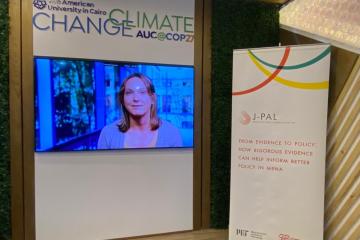
This year’s UN Climate Conference, COP27, focused on efforts to anticipate and adapt to the climate crisis, especially in low and middle income countries. J-PAL staff participated in COP27 to raise awareness of the need to generate more rigorous evidence on climate adaptation programs, identify potential research opportunities, and discuss the importance of rapid evidence adoption at scale.
Participating in panels alongside leaders in government, multilateral development banks, and civil society, we shared some of the successes generated so far by J-PAL’s King Climate Action Initiative (K-CAI), as well as the locally-grounded work of regional offices such as J-PAL MENA and South Asia. As participating countries ramp up their commitments to fund adaptation, evidence of effective policies that can help create more resilient societies is useful for policymakers to ensure investments will go to programs and populations where they can have a significant impact.
Among the most remarkable things to witness at COP27 were the myriad conversations taking place by a range of climate stakeholders that go beyond the small group of diplomats tasked with determining national ambitions.
While the formal discussion this year focused in creating an international fund for loss and damage due to climate catastrophes—ever more relevant with historic flooding in Pakistan and a four-year drought in the Sahel—the conference’s side events hosted conversations on questions that are central to practical-minded actors: What ideas, frameworks, and policies do we know work to ensure that vulnerable populations can anticipate and act to protect themselves from the worst consequences of climate change? How do you measure successful adaptation?
This occasion brought together people across disparate geographies, backgrounds, and institutions. Oumou Hawa Diallo, a young activist from Guinea, was one of them. Speaking to a group of UN officials, she emphasized the needs of grassroots movements for high-quality data, advice, and financial support to help drive adaptation projects on the ground.
Echoing this, Heli Uusikyla of the UN Office for the Coordination of Humanitarian Affairs spoke about the promise of anticipatory actions—like cash transfers and other kinds of support to areas that will be hardest hit by a weather event—before it happens. Ms. Uusikyla also confirmed that more knowledge on how to conduct anticipatory action, such that is being generated by current J-PAL studies in this space, is needed to improve policies and, crucially, unlock financing to scale up these activities.
The announcement of a loss and damage fund at the conclusion of COP27 signaled that more funding may become available for LMICs to compensate for the damage suffered by climate change, making the need for evidence on policies that improve resilience ever more relevant.
Out of this backdrop of diverse voices speaking on a range of urgent needs, a common thread emerged on achieving food security as a priority to protect the well-being and livelihoods of the world’s most vulnerable populations. According to the UN’s Intergovernmental Panel on Climate Change, climate change is projected to exacerbate food insecurity, with projected declines in yields and crop suitability under higher temperatures.
For example, the BBC reported last month that a 1°C rise in temperatures could cause a 6.4 percent drop in the amount of wheat grown around the world. Universities and institutions worldwide have been engineering more resilient and nutritious foods as droughts and other climate risks threaten agriculture and food security.
Advances in science and technology to alleviate these impacts must be paired with evidence-based policymaking in order to ensure their promise is translated into impact. In a recent op-ed for the Egyptian newspaper Ahram, J-PAL affiliate Kyle Emerick wrote that researchers need to focus on developing more evidence at the nexus of climate change, food security, and nutrition—particularly on adapting food systems to extreme weather, finding sustainable and local sources of nutritious food, and bundling services to help farmers overcome their productivity constraints.
In Egypt, J-PAL MENA is actively working on these issues. One current study explores the use of small-scale biogas digesters, fuelled by agricultural waste, as a possible solution for both the provision of clean cooking fuel as well as an environment-friendly way of waste disposal. Locally-grounded studies like these will be critical to informing local policy solutions; for example, World Bank data showed that in 2020, MENA’s share of the world’s acutely food-insecure people was 20 percent, disproportionately high compared to its 6 percent share of the global population.
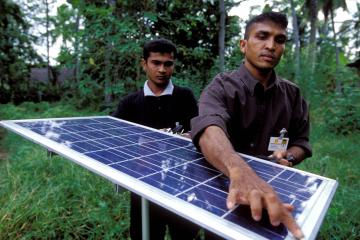
Globally, climate adaptation can benefit from rigorous knowledge generated by interconnected areas such as agricultural resilience, early warning response systems, and energy access. J-PAL researchers’ studies on increasing takeup of flood-tolerant seeds, citizen response to forecasting systems, and increasing household takeup of solar panels, as well as health care use cases, are just a few examples of the solutions that can be replicated, tested, and scaled in many contexts around the world.
By continuing to produce and disseminate evidence to inform effective climate adaptation, J-PAL, K-CAI, and our partners are developing a library of best practices that can inform policymakers and grassroots communities alike.
Earth Day presents an opportunity for citizens, policymakers, and the private sector alike to take stock of the state of our planet and our progress in fighting climate change. This Earth Day, we must also acknowledge climate change's disproportionate impact on people experiencing poverty. To address this effective, evidence-informed policy solutions are needed.
Earth Day presents an opportunity for citizens, policymakers, and the private sector alike to take stock of the state of our planet and our progress in fighting climate change. However, we cannot evaluate the impact of climate change without also acknowledging its disproportionate impact on vulnerable populations, particularly people experiencing poverty.
Since last Earth Day, the Covid-19 pandemic has underscored the inequality of existential threats. Many in low- and middle-income communities are already feeling the harmful effects of climate change. As we assess our ability to combat climate change and the solutions we’ve developed thus far, we must bear this in mind and prioritize solutions that effectively reduce emissions while addressing disproportionate impacts for people living in or at risk of falling into poverty.
The year 2020 corresponded with an unprecedented decline in CO2 emissions, in part as a result of global lockdowns. However, as economies begin to reopen, this drop is already proving to be temporary, with emissions two percent higher in December 2020 than they were in December 2019.
Although greenhouse gas emissions are predominantly emitted by high-income countries, the impacts will be felt most strongly by people in low- and middle-income countries. Fortunately, there has been a significant increase in recent commitments to reach net-zero emissions from both corporations and governments. While these commitments are essential, they must translate to meaningful climate action.
In order to address climate change and help governments and corporations achieve their commitments to net-zero emissions, corresponding and effective policy solutions are needed.
Although it’s easy to feel daunted by the manifestations of climate change since last Earth Day, we need to keep an eye on the future and focus on evidence-informed policy solutions. For innovations to effectively combat climate change and address poverty and disproportionate impacts of climate change, they need to be tested in real-world settings.
While there is much research that still needs to be conducted in this space, there are also existing evidence-informed solutions that can or already have helped inform policy decisions.
In order to mitigate climate change, we must urgently reduce greenhouse gas emissions, and solutions that reduce emissions at the lowest cost per ton are needed for the greatest impact. Reducing and avoiding deforestation presents one opportunity to abate emissions. A randomized evaluation in Uganda, for example, examined the effectiveness of a Payments for Ecosystem Services program, which paid landowners not to cut down trees. The evaluation found that deforestation declined, and CO2 emissions were abated at less than US$1 per ton delayed from entering the atmosphere. While this evaluation examines the impacts of just one small-scale program, it has great potential to scale in other settings given the demonstrated cost-effectiveness.
Activities that produce greenhouse gas emissions also produce local pollutants which have harmful impacts on human health and the environment. Local pollutants often disproportionately impact low-income communities, who are more likely to live near sources of pollution. Balancing this inequality by lowering air pollution and improving respiratory health is even more important in the face of respiratory viruses, like Covid-19. This was of particular concern in India, which struggles with some of the worst air pollution globally. One solution that has already been scaled in Gujarat, India is improving third-party audits by changing incentives for industrial pollution auditors.
Many are already experiencing the effects of climate change—spotlighting the need for strategies to improve resilience to climate change for vulnerable populations. In low- and middle-income countries, the income and agriculture outputs of smallholder farmers are particularly vulnerable to extreme weather events. The adoption of new technologies can be a helpful solution. One example of this occurred in India, where researchers evaluated the impact of flood-tolerant rice. Adoption of the new rice variety reduced risk and encouraged additional investment in smallholder farms, resulting in increased yields and resilience to climate shocks.
These results offer promising guidance for similar programs in other rice-growing countries.
Ensuring that energy use is efficient is essential to a low-carbon future. To promote energy conservation in the United States, researchers evaluated the impact of home energy reports on energy conservation. The evaluation found that receiving reports led to reduced household energy consumption. Initially, energy savings were driven by immediate response to the report, but eventually, households made long-term changes to energy consumption habits even after they were dropped from the program after two years. Based on these findings, home energy reports may have the potential to scale in similar contexts and further contribute to increasing energy efficiency.
These demonstrated solutions are significant steps for evidence-informed policy addressing the global climate challenge, and more research is underway. J-PAL affiliated researchers are evaluating an array of interventions to address climate challenges and its effects on vulnerable populations, from reducing emissions through increased ride-sharing, to the adoption of off-grid solar power among small retailers, to rainwater harvesting techniques for small scale farmers.
However, many popular climate technology and policy solutions have not been evaluated in the real world to measure their impacts on emissions and people's lives. Although there is much evidence on the impacts of climate change and abundant promise in technological innovations, more research is needed for decision-makers to scale solutions that are effective in real-world settings.
To address this, the King Climate Action Initiative (K-CAI) at J-PAL is dedicated to designing, piloting, evaluating, and scaling innovations that not only tackle climate change but benefit people living in poverty. Through K-CAI, our focus will remain on developing climate solutions with demonstrated effectiveness that address both the urgent need to reduce global emissions and protect low- and middle-income communities.
To stay up to date on environment, energy, and climate change policy solutions and research, subscribe to our mailing list and mark “Environment & Energy” as a sector interest area.