
April 2026 LAC Quarterly Newsletter
Strengthening the link between research and public policy
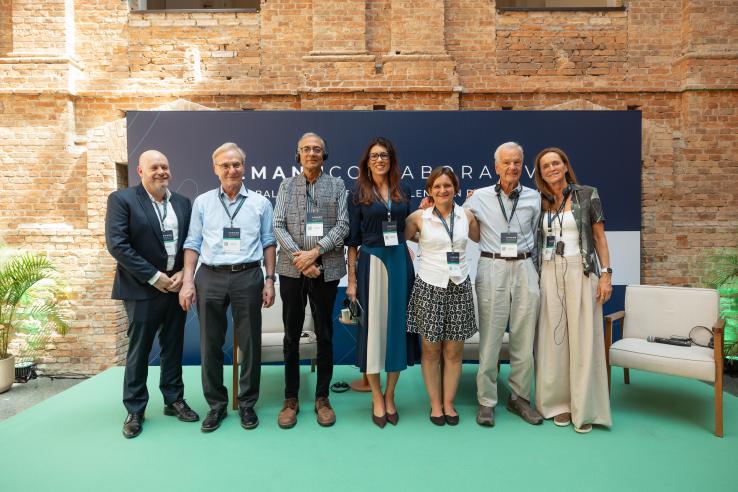
Esther Duflo and Abhijit Banerjee, J-PAL co-founders and Nobel laureates in economics, headlined three events in Brazil during March to mark the launch of the Lemann Collaborative. This new, long-term collaboration between J-PAL, the University of Zurich, and Fundação Lemann aims to strengthen applied research, support the development of public policy leaders, and help connect both to scalable decision-making.
These convenings brought together public sector leaders, researchers, and institutional partners from different regions of the country, ensuring that the content could reach diverse audiences. The discussions focused on how rigorous evidence can be produced, interpreted, and used within policy processes around the world in general and in Brazil specifically.
In Brasília, Professor Duflo led a masterclass at the Brazilian National School of Public Education (ENAP) for civil servants on how randomized evaluations can help inform policy design. In Belém, Professor Banerjee delivered the inaugural lecture for the 2026 school year of masters and PhD degrees in economics at the Federal University of Pará. In São Paulo, both participated in a panel to celebrate the official launch of the Lemann Collaborative.
J-PAL LAC is grateful to all the individuals and institutions who made these exchanges possible, particularly ENAP, the Federal University of Pará, Fundação Lemann, the University of Zurich, and Vale.
Córdoba and the path toward a culture of evidence use
In February 2026, we published a new blog post on our partnership with the Government of Córdoba, Argentina, and the practical work involved in strengthening evidence use in public decision-making. The blog shows how this collaboration has evolved over more than a year into a more operational phase focused on building capabilities, organizing programs and data, and supporting day-to-day management with evidence. It also highlights early lessons from this process, including the importance of cross-government coordination, realistic prioritization, and applied partnerships that help turn evidence into better policy management. Read the blog post »
Expanding diversity in impact evaluation: Fellows Program Brasil 2026
In March 2026, J-PAL LAC launched the Fellows Program Brasil during the inaugural lecture event at the Federal University of Pará (UFPA) in Belém, to strengthen the pipeline of researchers in impact evaluation across Brazil. The one-year program is targeted to early-career researchers from the North and Northeast regions of Brazil and offers structured training in randomized evaluations (RCTs), opportunities for hands-on research experience, and mentorship. With a strong focus on equity, the program aims to expand diversity in the production of evidence for public policy by prioritizing applications from Black and Indigenous researchers, especially women. The initiative is co-funded by Vale and is part of a broader strategy to build local research capacity. Learn more about the program »
IMPACTA: J-PAL LAC's new platform to assist government social programs
IMPACTA (Instrument for Measurement, Piloting, and Learning in Social Programs) is a digital platform developed by J-PAL LAC to assist governments in designing, piloting, and evaluating social programs based on evidence and a clear theory of change. Originally co-created with the government of the State of Querétaro (SPPC), the platform is now being adopted by governments across Argentina, Brazil, Chile, Guatemala, and Mexico. IMPACTA seeks to transform how social programs are designed and managed, moving from compliance-focused approaches to strategic, evidence-informed policymaking, while identifying opportunities to test and expand innovations. Join us for the official launch of IMPACTA on May 6 as we expand access to more governments across the region »
New partnership with Fundación Aprender a Quererte to strengthen evidence use in education in Colombia
In February 2026, J-PAL LAC and Fundación Aprender a Quererte (AAQ), a Colombian organization that incubates and implements evidence-based education programs, formalized a new partnership to strengthen the use of rigorous evidence in education in Colombia. Through this collaboration, the two organizations will promote evidence-informed decision-making, share research and policy lessons with education stakeholders, and explore how proven education programs can be adapted to the Colombian context. The partnership brings together J-PAL LAC’s experience translating research into actionable insights and AAQ’s work advancing evidence-based education initiatives in Colombia, including Teaching at the Right Level (TaRL). Read the partnership announcement »
JOI Brasil celebrates 5th anniversary
As JOI Brasil marks its fifth anniversary, it continues to deepen its work at the intersection of research, policy outreach, and evidence use. This includes its engagement with SuperAção SP, the São Paulo State Government’s poverty-reduction and productive-inclusion program, which is expected to reach up to 105,000 families. Alongside J-PAL LAC’s Government Partnerships team, JOI Brasil contributed evidence on labor market policies to the program’s design and is now participating in training field agents, who will play a central role in accompanying families and collecting data to inform the program’s evaluation. A few hundred agents have already been trained, and training efforts are expected to reach around 2,000 agents as implementation expands across the state. To know more about JOI Brasil access the website »
EVIDENCE IN LAC
Can legal aid improve outcomes for children in foster care?
A study by Ryan Cooper (University of Chicago), J-PAL affiliated professor Joseph J. Doyle (MIT), and J-PAL invited researcher Andrés P. Hojman (Pontificia Universidad Católica de Chile) evaluated Mi Abogado (“My Lawyer”), a program in Chile that provides legal aid and social services to children living in foster care institutions. The program was capacity constrained, so admission was randomly assigned as a way to equitably distribute the resource and with an explicit aim to evaluate its effectiveness. Using linked administrative data, the researchers found that the program reduced the length of time children spent in foster care without increasing later placements. It also decreased involvement with the criminal justice system and improved school attendance, while generating savings that substantially exceeded the program’s costs. Read the study »
Does a student’s rank in the classroom affect how much they learn?
A study by J-PAL affiliated professor Pedro Carneiro (University College London), Yyannu Cruz-Aguayo (Inter-American Development Bank), Francesca Salvati (University of Essex), and Norbert Schady (World Bank) examined how a child’s relative position in the classroom influences learning in Ecuador. With students randomly assigned to classrooms from kindergarten through sixth grade, the researchers found that children with higher classroom rank at the start of the school year achieved significantly higher test scores by the end of the year. The effects were stronger for younger children and grew over time, also improving executive function, student happiness, and the teachers’ perceptions of student ability. Read the study »
MEDIA HIGHLIGHTS
Insper
Uma trajetória guiada por propósito e evidências
Folha de S.Paulo
Ganhadores do Nobel dizem que IA pode aumentar desigualdade e prejudicar emprego no Brasil
O Globo
“A tecnologia ameaça o emprego na classe média, será uma grande crise”, dizem vencedores do Nobel
Valor Econômico
Pobres pagam a conta em guerras, afirmam vencedores do Nobel