

August 2026 North America Newsletter
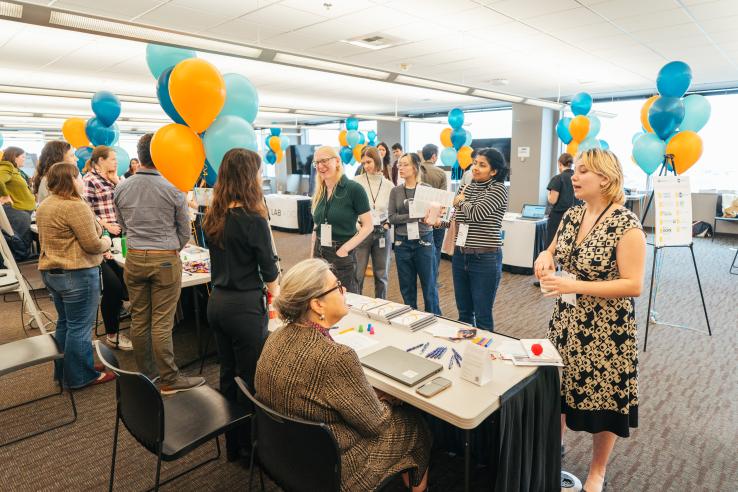
Every policy or budget decision that changes communities for the better depends on years of groundwork—local governments innovating and continually adjusting their practice and researchers building and sharing knowledge. We built Evidence Matters, a public learning series hosted by the Wilson Sheehan Lab for Economic Opportunities (LEO), J-PAL North America, and Carrie S. Cihak, to bring researchers and government leaders into sustained and intentional practice.
Through webinars and in-person convenings, Evidence Matters showcases successful collaborations and practical strategies for creating and using rigorous evidence to advance equitable, evidence-informed economic mobility. We start from a simple premise: government staff, researchers, and community practitioners each hold real expertise, and creating evidence that matters requires that we incorporate each of these perspectives into the research generation process. In our Evidence Matters conversations, we spend as much time exploring the messy "in-between" work, the trusting partnerships, commitment to learning, and day-to-day practice that make evidence actionable, as we do on the results of studies themselves. And we don't treat a single randomized evaluation result as the finish line; rather, we focus on how governments and researchers together can contribute to a culture of continual and deep learning that leads to real community change.
Our most recent webinar, held in June, explored the practical challenges of, and opportunities for, aligning local government spending with evidence. You can read the recap and watch the recording on the J-PAL blog. Our fall webinar will feature staff from two programs alongside their research partners who are using evidence to scale up and replicate nationally. Sign up now and read more about the upcoming webinar below. And, if you’ll be attending the 2026 Association for Public Policy Analysis and Management (APPAM) conference in Boston this November, we hope to see you at one of our sessions. We’ll be discussing how to continue momentum for evidence-informed policies and how researcher-practitioner partnerships can drive the scale up and replication of evidence-based interventions.
If any of this work resonates with you, sign up for the Evidence Matters mailing list to keep the ideas and invitations coming!
Sincerely,
Carrie S. Cihak, Beyond Measure
Rachel Fulcher-Dawson, Wilson Sheehan Lab for Economic Opportunities
Vincent Quan, J-PAL North America
Featured Webinar
The path to greater impact: Evidence partnerships for replication & scale
Evidence is the key to achieve greater impact through replication and scale in government agencies. Strong partnerships are needed to build strong evidence—and both are needed to carry programs from pilot to scale, and from one place to many. Join our next Evidence Matters webinar to hear from J-PAL affiliated professors Alicia Sasser-Modestino (Northeastern) and Patrick Turner (Notre Dame), research partners Allison Vernerey (City of Boston) and Betsy Delgado (The Excel Center), and J-PAL North America’s own Kalila Jackson-Spieker to learn about how these partnerships are turning evidence into action. Register here »
Coming soon: Homelessness Evaluation Resource Hub
This fall, J-PAL North America is launching a new Resource Hub to increase access to evidence-informed housing stability by providing essential tools for policymakers and practitioners to evaluate the impact of their programs, expand the body of evidence on effective programs and policies that reduce homelessness, and leverage existing evidence to inform programs and decision-making. The Hub will feature newly developed resources—like these briefs on case management, emergency financial assistance, and Housing First—and introductory training content. Interested in learning more? Come to the launch event on October 27! Register here »
Opinion: As Medicaid renewals get more frequent, states have a proven tool to reduce unnecessary coverage loss
As states brace for new redetermination shifts introduced through H.R. 1, many eligible Americans risk losing their Medicaid coverage—not because they no longer qualify, but because of administrative red tape. In a new opinion piece in STAT News, J-PAL affiliated researchers Rebecca Myerson (Emory University & UW-Madison) and Laura Dague (Texas A&M), along with Allison Espeseth (Covering Wisconsin and UW Extension), share insights from their research on scalable and cost-effective strategies to prevent avoidable coverage loss for Medicaid beneficiaries. Read the op-ed »
New Research Results
The impact of nudges to increase primary care engagement among Medicaid beneficiaries in Maine
How can states encourage people who have recently enrolled in Medicaid to take up primary care? A new study from J-PAL affiliated professors Sarah Gordon (BU) and Jacob Wallace (Yale), alongside coauthors Kevin Nguyen, Breanne Biondi-Bonetti, Benjamin Sommers, and Anna Goldman, evaluated if simple mailers could impact primary care engagement among Medicaid enrollees in Maine. Individuals who received a simplified mailer along with the standard outreach packet were no more or less likely to engage with primary care compared to those who just received the standard packet. Read more »
Featured Research Resource
Data security procedures for researchers
Data security is critical to protecting confidential data, respecting the privacy of research participants, and complying with applicable protocols and requirements. Even seemingly de-identified data may be re-identified if enough unique characteristics are included. A J-PAL research resource provides guidance on basic data security themes, context on elements of data security that are particularly relevant for randomized evaluations, and offers suggestions for describing data security procedures to an Institutional Review Board (IRB) or in an application for data use. Read the resource »