

What the field taught us about measuring sexual harassment in public spaces in India
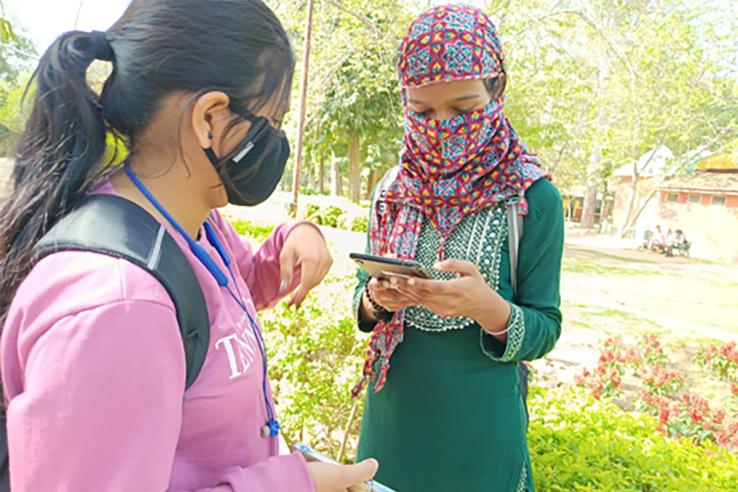
Between 2024 and 2025, field teams from J-PAL South Asia surveyed more than 6,000 women in public places across Delhi, Jaipur and Bengaluru to understand the prevalence of sexual harassment in public spaces in these three cities. Surveying in public places has its own rhythm: surveyors approach strangers who are commuting, running errands, or waiting for transport, and have only seconds to introduce themselves. Most people refuse before they even know what the survey is about, so a single completed survey can take many attempts. Furthermore, a topic like sexual harassment adds a second layer of challenges and sensitivities. Respondents may feel stigma about discussing their experiences, and finding a private spot to talk is difficult in an open, crowded setting.
To mark the United Nation's 16 Days of Activism against Gender-Based Violence, we spoke with members of the field and research teams about how they managed the public and the sensitive side of the survey; how their approach evolved through training and piloting; the risks they encountered in the field; and what they would do differently next time.
Recruiting surveyors was the first challenge, as the sensitivity of the topic and the demands of the fieldwork limited who was willing to take on the role. One surveyor candidate withdrew over concerns about the social acceptability of the work. As a team member recalled, the concern was that "it's not done for women from good families to be working at bus stops and then on top of that to be asking such sensitive questions." In other words, the work was seen as improper. Social stigma around discussing sexual harassment, therefore, shaped who was willing to take on the role—an important consideration during recruitment. Practical constraints of the fieldwork played a part too. One team member struggled to recruit more than a couple of surveyors. Climate conditions made this exercise harder, as Jaipur’s data collection ran through the peak heat of April to June. Some candidates withdrew once these conditions were explained. This suggests that the social and environmental conditions of fieldwork can limit who is able or willing to collect data on sensitive topics, and should be anticipated in the planning stage. Being upfront with candidates about the challenges and about the support they can count on is a good place to start.
Surveyors also had to be trained for the sensitive conversations that might result from the questionnaire. Most respondents were expected to answer questions on a tablet themselves, but some could not or preferred not to, so surveyors needed to know every question well enough to read it aloud. Across all three cities, surveyors were instructed not to advise respondents on their experiences of sexual harassment, as they were not trained to offer guidance. When a respondent asked for guidance, the surveyors directed them to hotline numbers the team had compiled. According to one team member, quite a few respondents asked for these numbers. Fieldwork on topics such as these, therefore, requires clear protocols defining the limits of the surveyor’s role, along with referral pathways for respondents who need support beyond the survey.
Once in the field, the team found that several sampling assumptions needed revisiting. Since the survey took place in public spaces, many logistical constraints had to be addressed. For instance, in Delhi a list of bus stops was not widely available online, so the team compiled one from government websites. "Even that data wasn’t formatted well," a team member said, noting that it needed a lot of processing. Piloting also showed that students were overrepresented among survey respondents, which the team addressed by surveying every other student in person and giving the remaining students a QR code to complete the form later. Both cases suggest that sampling for public spaces may need to be built and monitored from the start, rather than developed retrospectively.
The survey wording needed similar care. The way the survey initially translated the phrase "sexual harassment" made both enumerators uncomfortable in training and respondents uncomfortable in the field. The teams also found that opening the survey with questions about "sexual harassment" prompted quick refusals, and one noticed "a sort of restraint from the respondents' side." Moving the explicit mention to the consent stage and opening the survey with questions about "women's safety" led to fewer refusals. Testing wording and sequencing with real respondents, therefore, matters as much as the questions themselves.
Beyond the wording, how surveyors approached the respondents mattered. Communication skills became crucial not only to introduce the survey but also to request privacy since respondents were often accompanied by their friends and family. One team member said that whether a woman agreed to take part was influenced by "the company the respondent was keeping at that particular point in time." Companions could shape answers too. During piloting, the team saw a female friend peep at a respondent’s screen and try to influence their answers. Another team member said that if a companion was watching, a respondent was more likely to answer "no, nothing like that has happened to us" across the board. This underscored the importance of ensuring privacy during data collection, since the presence of others can affect both response rates and reporting.
Finally, safety was a concern for the surveyors and for the teams supervising them throughout fieldwork, and risks often depended on the conditions at particular sites, such as the hour and who tended to gather nearby. The team adjusted its protocols as it learned what each site needed. In the evenings, a few sites were judged unsafe for female surveyors, and getting home safely was also a worry. To manage these risks, surveyors worked in pairs. Male supervisors also stayed close by, and one surveyor highlighted how bystanders behaved better in their presence: "the way [men] look at us changes." But these measures had limits. Where a site still felt unsafe, and the risk seemed likely to recur, teams chose to drop it from the sample altogether. This suggests that safety planning for a survey in public places is largely about sites, hours, and who goes where; so researchers should plan for ongoing adjustments, including the possibility of leaving out high-risk sites.
In this survey, the pairing of surveyors, the rewording of the recruitment script, and the decision to drop unsafe sites all came from what the field showed, and from team members who reported it. Adaptability, safeguarding, and field-team feedback were integral to how the research was done. For surveyors who started conversations with women in busy public spaces, and listened closely to those who chose to take part, those safeguards and the chance to be heard were part of what made the work possible.
Reliable data on sexual harassment in public spaces is essential. It makes an often invisible problem visible, informs responses that reflect women's lived realities, and helps build safer, more inclusive public spaces. Getting this data right, for respondents and for the people who collect it, matters as much as getting it at all.
Akanksha Sharma is a policy consultant at J-PAL South Asia.
The writers would like to thank the field team members for taking the time to share their experiences. For more information about this survey, read the full paper.