
Image


Hosted by the Wilson Sheehan Lab for Economic Opportunities (LEO) at Notre Dame, J-PAL North America, and Carrie S. Cihak, Evidence Matters is a collaborative learning series bringing together government, researcher, and community perspectives to advance evidence-informed solutions that increase economic mobility and equity. In March 2026, Evidence Matters held “Ten Lessons for Building Government & Research Partnerships That Matter,” featuring a candid conversation with Carrie S. Cihak (Public Sector Evidence Leader), Louise Geraghty (J-PAL North America), Patrick Turner (LEO), and Vincent Quan (J-PAL North America) on the practical lessons, unexpected challenges, and long-term rewards of investing in these sustained evidence-building partnerships. This blog highlights select takeaways from the webinar, which can be viewed in full here.
Evidence from rigorous impact evaluations provides key information for solving social problems, shedding light on the most effective ways to allocate resources, design policy, and improve lives. In short, evidence matters.
Public sector leaders, community members, and researchers all have a stake in generating good evidence. Government leaders have a wide mandate: they must identify and respond to constituents’ needs and efficiently allocate taxpayer dollars to address those needs. Governments can also serve as connectors to their communities—including service providers and clients—who are closest to the issues at hand and critical to identifying and understanding effective solutions. Academic researchers answer novel questions and share generalizable lessons to strengthen our collective knowledge base.
While leaders in each of these sectors may independently use or develop evidence, the most valuable learnings result from when these stakeholders work together to understand how a program or policy can create the greatest impact.
However, from finding the right partners to navigating administrative hurdles, cross-sector partnerships can be challenging to build and maintain. To address these challenges, Evidence Matters—a collaborative learning series on advancing equitable, evidence-informed economic mobility—held a webinar on “Ten Lessons for Building Government & Research Partnerships That Matter.”
In the webinar, Carrie S. Cihak, long-time public sector evidence leader and founder of Beyond Measure, introduced the lessons she learned from her experience building strong partnerships:
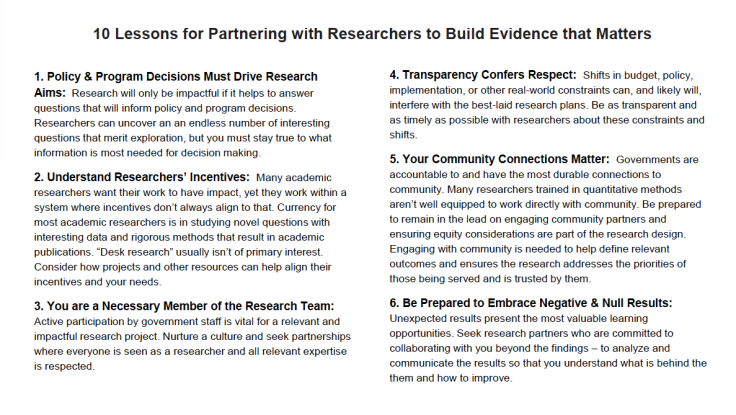
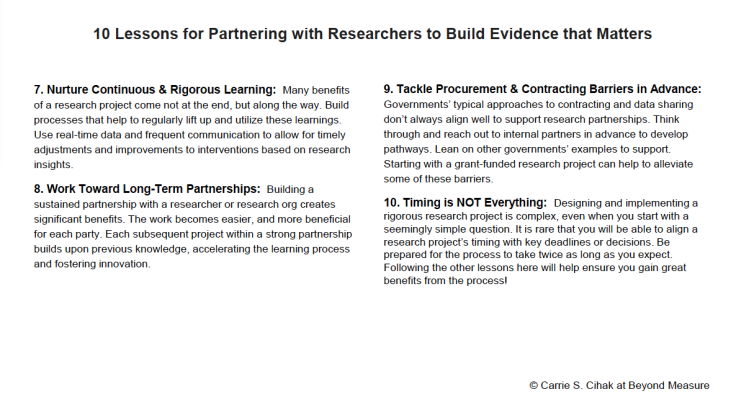
Across the discussion of these lessons, a central throughline emerged: successful cross-sector research partnerships honor the expertise of each stakeholder at every stage of the policy cycle.
At its core, the policy cycle involves identifying a potential solution to a community need, implementing that intervention, evaluating its effects, and learning from the evaluation to modify and improve the solution, thus continuing the cycle.
Understanding Needs and Developing Potential Solutions
To develop potential solutions that are likely to succeed, it is crucial to understand a community’s needs and geopolitical context. Public sector leaders have the expertise to engage their constituencies and an understanding of the ecosystems in which they operate. They are able to tap into on-the-ground providers to ensure any solution is informed by those who would carry it out (i.e., service providers) and the community that stands to benefit. It can be valuable to bring in an academic researcher even at this early stage, as they may be able to provide insights into what existing literature says about promising solutions to the issues at hand. However, as Louise noted, a successful research partnership should always “start with the government partner’s priorities and build from there.”
Implementing the Intervention
Once a solution has been identified, enacting and implementing the intervention, too, relies upon the expertise of all of these partners. This is where cross-sector teams really benefit from the expertise of government partners and service providers who understand the intricacies of funding and implementing programs. On the webinar, Carrie noted that government staff understand how decisions get made and how information gets used. Governments know what is politically, financially, and practically feasible; what data can be collected and how; how to communicate with and enroll constituents; and the various barriers that need to be overcome. Researchers may be able to help with additional program monitoring and data collection, and each sector can learn from one another to ensure the policy is being implemented as intended.
Evaluating the Intervention
Evaluating the intervention is where an academic researcher’s expertise may be most prominent. Academics have precise training in rigorous research methods, data analysis, and results interpretation. At the same time, during the webinar Carrie advised, “Everyone in this [zoom] room should consider themselves a researcher.” Government leaders, too, bring critical insights into what research designs are feasible in their contexts, including ethical and logistical hurdles the researcher may not be familiar with. They know what program implementation looks like on the ground, and what data they collect. Public sector partners can elevate the voices of their communities and explain how participants will experience the research process, which then influences key aspects of how the study is designed—including how consent forms are written and what questions are asked.
In this vein, Patrick implored the government leaders in the audience to not be afraid to “ask questions” of their academic partners. Governments may have a tendency to defer entirely to an academic researcher during an evaluation, or they may be wary of a research design because there isn’t a clear vision of how it would work. A good partnership, and a good evaluation, requires a dialogue where everyone can understand each others’ concerns and contributions, and where everyone is clear on and supportive of the research aims and design.
Using Results to Continue Learning and Improving
A good partnership also continues even after the formal evaluation concludes. All parties can work together to understand not only what the results show, but how to use them. Public sector leaders and other community members can contextualize findings, while academic researchers can help explain what the data does and does not say about a program’s effectiveness. Together they can use the results to modify or scale a program as needed, while contributing broader lessons learned to build a wider evidence base. Moreover, findings may inform new solutions—and new questions—thus continuing the cycle.
The strongest evidence-building partnerships are not one-offs, but rather long-term relationships committed to continuous learning. When everyone’s expertise is respected and utilized across the whole policy cycle, cross-sector research partnerships can generate evidence that truly matters.
For more information on Evidence Matters, visit our website and subscribe to our newsletter. Read this blog and watch this video for a summary of the in-person convening we held in fall 2025.