Alumni Voices: A new era of humanitarian action
The Alumni Voices series is a platform for J-PAL alumni to share their work as it relates to major events, in their own words.
In this inaugural post, Bhavya Srinivasan (former Senior Finance and Operations Manager, J-PAL South Asia ’14) discusses her work at Start Network to build a stronger humanitarian system for COVID-19 response.
Start Network is a systems change organisation who currently works through a membership of over 50 humanitarian organisations, ranging from large international organisations to national NGOs. The vision of the network is for a new era of humanitarian aid which will ultimately save more lives; and our mission is to drive and catalyse the change that is urgently needed in three ways:
- Shifting humanitarian financing from a reactive to a proactive model
- Creating a more balanced system that shifts power and decision-making to those closest to the frontline
- Facilitating collective innovation to solve humanitarian problems locally and globally
A key feature of this vision is to have a distributed network of networks. This infrastructure is fundamental in achieving our ambitions of a proactive, innovative and localised humanitarian system that can better meet the needs of people affected by crises across the world.
My work has focused on building this infrastructure of national and regional networks, who we refer to as hubs. To define it simply, a hub is a collective of humanitarian organisations that collaborates on programmes, policy and decision making. In order to answer some fundamental design questions for this network model, we launched an 18 month ‘Proof of Concept’ in November 2019 with a portfolio of five “founding hubs” - that represent a diversity of contexts, operating models and constituencies. The five hub locations include Pakistan, Democratic Republic of Congo, Guatemala, India and the Pacific Islands.
The COVID 19 pandemic has exemplified the need for building this new enabling culture and infrastructure to help make humanitarian response more local, more responsive, more effective. The five hubs launched a paper that reflects the undeniable need for reform in our response to COVID-19 and beyond, that should fundamentally re-shape humanitarian action of the future, and centres around seven calls-to-action for the Start Network and the wider humanitarian sector.
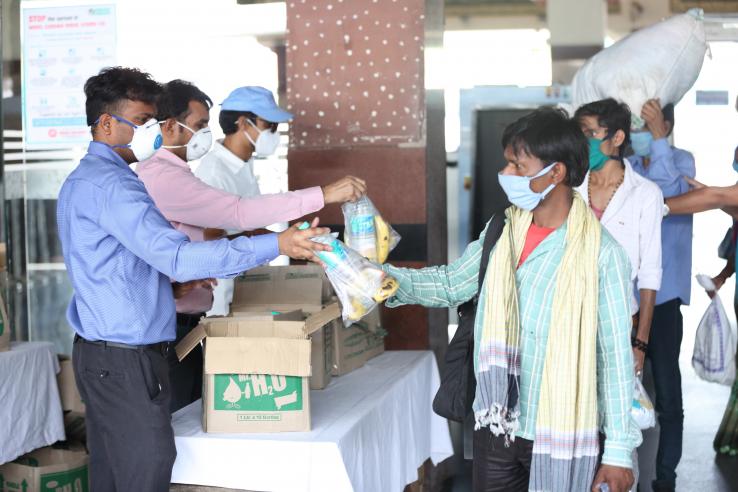
Start Network has also responded to COVID 19 through its existing financing mechanisms—Start Fund (Global and Bangladesh) and the Migratory Emergency Response Funds (MERF). Building on our experience running pooled fund mechanisms, a COVID-19 Fund was launched to anticipate and respond to critical virus related humanitarian needs in low-income countries.
However, while the world is focused on COVID-19 other humanitarian crises and natural disasters have not stopped. We will continue to advocate for the systems change that is urgently needed to ensure the humanitarian system is able to meet the needs of people affected by crises and reduce needless suffering.

Adrien Bouguen joined J-PAL Europe as a research assistant in 2009, where he played a central role in establishing our then-fledgling European office. Now an assistant professor of economics at Santa Clara University, his research focuses on the economics of education and child development.
The Alumni Spotlight series highlights J-PAL alumni who are making an impact across industries and around the world. To nominate a J-PAL alum to be featured in a future Alumni Spotlight, please fill out this form.
Adrien Bouguen joined J-PAL Europe as a research assistant in 2009, where he played a central role in establishing our then-fledgling European office. Now an assistant professor of economics at Santa Clara University, his research focuses on the economics of education and child development. He joined us to talk about his time at J-PAL and his growth as a researcher.
Could you tell us a bit about what led you to J-PAL?
Back in 2008, when I was getting my Master’s in education, I had a couple of great professors who were focused on studying the role of non-cognitive skills on life outcomes. I became really excited about this topic and knew I wanted to get serious about it.
As I was applying for my PhD to continue working on education, I saw an ad for a job in Paris to assist in an exciting new form of education policy research. I thought, great, this is exactly what I want to do. So I decided to delay my PhD for this opportunity. I moved back to France and I started working with J-PAL affiliates Marc Gurgand, Luc Behaghel, and Clément de Chaisemartin.
I really loved being a research assistant. During my first year, I worked on data collection for an evaluation of France’s “Boarding Schools of Excellence,” which was a very well-funded national program that places disadvantaged students in boarding schools to provide them with better learning environments.
I was able to constantly interact with researchers while working in the field, and found that I came to better understand my own education system as well. The first year was a lot of hard work, but very worthwhile. I ended up staying for two or three years before moving on to the Paris School of Economics to get my PhD.
Could you expand on what it was like to be at J-PAL Europe when it was just getting off the ground?
We were practically sleeping there! There were around eight of us or so, we were all around 25 years old, and we were so excited to be building an entire office from scratch. Randomized evaluations were almost unheard of in France at the time, so collecting data was new and asking for access to administrative data was not something that people were used to, so we had to do a lot of convincing. The structure for J-PAL Europe was gradually built up and it became more professional, but at the time it really felt like a startup.
Sounds like you were incredibly busy all day long—can you tell us a bit more about what your day to day was like as a research assistant? How has that changed now that you are a Primary Investigator (PI)?
There were a lot of things that I had to learn on the job. Back then we didn’t have tablets for surveys and the Internet wasn’t used as much, so we had to print questionnaires. We had walls of questionnaire packets—one per student— that we sent to schools, and then over the summer we had around twenty people inputting data all day long. At the beginning I wasn’t doing much analysis, but as I built up my skills, the PIs began to trust me more and I began to help out on other things. Some research assistants only stay at J-PAL for a year, but I appreciated spending more time there to really build skills I needed later on.
As a research assistant, a large part of the job is managing data: collecting the data, making sure that it was done correctly, inputting the data, putting the database together on Stata, coding, cleaning, etc.
Now, as a PI, it’s more about supervising. I have weekly calls with my research assistants and research managers where I give them directions on what to do or what to look into. I do a bit of analysis in Stata to help them out, but really, what I do now is look at result tables and say, okay, you need to go there. You need to check that.
As a PI, you have both decision-making power and greater responsibility. You are the one taking responsibility for where you send your research team, so you need to think constantly about security.
A good example is when COVID-19 hit, because my co-PI and I had people in the field in Burkina Faso at the time and there was a very weak signal on what we should be doing. We had to find ways to continue to do our work. And it took time to balance things, because at the same time we were working, Burkina Faso was confronted with an outburst of terrorist attacks. Even in simpler situations, with limited information it’s hard to know if you are taking a lot of risk or no risk at all. You have to assess the situation and make a decision at the end, and you don't really know at the time if you're making the right one.
Could you tell us about a current or a recent project of yours that you're working on that you find particularly interesting?
One has to do with non cognitive skills, which are in essence skills like perseverance and confidence that are not captured by IQ tests. Along with some French colleagues (including J-PAL affiliate Elise Huillery), I’m in the final stages of analysis for a randomized evaluation in France on how to stimulate non cognitive skills at a later stage in life—adolescence. We find some very interesting results that indicate that for a very small price, you can actually stimulate the perception people have about themselves and that the perception people have about themselves matters for their personal success.
When thinking about education, people most often think about resources, how much money you should invest in infrastructure, in professors, in training, etc. What we are realizing now is that the perception people have about themselves actually makes a difference in their performance. Our research suggests that at the same level of cognition, or the same level of knowledge, the perception that you have of yourself really changes your success in life through your belief in what you are able to achieve.
The main skills that we are interested in right now are grit and growth mindsets, which relate very much to belief in oneself. The mere fact that telling students that what matters is not their intelligence, but rather what they are doing right now to make progress in their lives, can actually change their GPAs is astonishing to me. I think this transforms to an extent our vision of what should be part of an education policy.
As we wrap up, could you tell us briefly about what you enjoy the most about being a PI and an assistant professor?
Being a PI has been a dream. I’m in the position now to actually conduct my own project and I have some experience that I can transmit to the RAs in the field. I do miss being able to go to the field as much as I’d like, but being able to direct the agenda and guide the research is amazing.
For instance, I’m currently working with a research group at the University of California, Berkeley on the long-term impact of child nutrition, following the cognitive impact of a big randomized evaluation conducted ten years ago. Building a huge project like that is super exciting, but it’s a long path to get to this point—it took me twelve years! You have to constantly upgrade your skills and be ready to face disappointment. Most of the time, it’s 90 percent rejection and 10 percent positive feedback. It’s hard work, but at the same time, it's incredibly exciting.
We caught up with Nana Okozi, a former project officer at J-PAL Africa. Nana joined J-PAL Africa in 2015 and led training and data collection for many of its research projects. Now a project coordinator at the National Institute for Communicable Diseases (NICD), Nana is helping to coordinate research on drug resistance in South Africa.
The Alumni Spotlight series highlights J-PAL alumni who are making an impact across industries and around the world. To nominate a J-PAL alum to be featured in a future Alumni Spotlight, please fill out this form.
We caught up with Nana Okozi, a former project officer at J-PAL Africa. Nana joined J-PAL Africa in 2015 and led training and data collection for many of its research projects. Now a project coordinator at the National Institute for Communicable Diseases (NICD), Nana is helping to coordinate research on drug resistance in South Africa.
What drew you to the field of development? Tell us a bit about what you were looking for in a career and how you learned about J-PAL.
When I first started studying, I thought I was going to become a psychologist. During my third year of university, I grew more and more drawn to research and the ethics of research. I found the research side to be interesting and I thought this would be a space where I could personally make more of a difference.
Then I heard about J-PAL through a research assistant who was working there at the time. She explained what the organization does and I found it to be very interesting. I applied for an internship at J-PAL Africa to get a bit more work experience. I interned for two months and then was offered a full time position.
You worked at J-PAL Africa as a project officer in Johannesburg. Can you tell us about your role?
I didn’t focus on one particular sector or topic—I wanted to learn it all! I first started working on a transportation RCT, but I was always looking to learn more across different sectors. My day-to-day activities included assisting in training enumerators, making sure that field staff had the right equipment, ensuring that the data was verifiable, and doing quality checks.
I then moved to working with Harambee—an organization working to promote youth employment in South Africa—on their work-seeker program, mainly doing monitoring and evaluation. I assisted with training and helped to administer questions. My work with Harambee was particularly fulfilling because I got to work with psychometrists and interact directly with youth in the program.
Which skills or experiences that you picked up during your time at J-PAL Africa are most relevant to the work that you do today?
Working at J-PAL was very eye-opening for me and I learned a lot of fundamentals. At the beginning of every year, we had to complete a course showing that we understood good research practice: getting consent from survey participants, drafting questionnaires, writing proposals, understanding why you need demographic information, data analysis, and understanding how all these steps fit together. We used to do data checks almost every day and we used to report weekly. It really saved us a lot of time and the data was more valid and reliable. But with bigger organizations this can be quite difficult.
Through the training process, you learn to understand why and how the data that you collect from participants will influence analysis and policy at the end. You had to know how all the different components interact and how to continuously monitor how each piece (i.e training, analysis, data collection) affects the other. This was crucial to my work at the time, but it has also really helped me even beyond J-PAL. I also learned how to manage people, how to coordinate between members of a team, and how to be more understanding as a supervisor.
My sense is that some bigger companies don’t really concentrate as much on skills development or on how employees want to grow inside the company; like there is less of a focus on the individual. But at J-PAL everyone was very helpful, and I got the sense that many around me were invested in my growth.
You are now a project coordinator at the National Institute for Communicable Diseases (NICD) in South Africa. Could you tell us a little about your current role?
As a project coordinator I mainly assist one of the pathologists at the Institute with her research. We’re working on analyzing previous drug resistance surveys, along with data cleaning and quality checking the data from the surveillance reports. We transfer this data to an epidemiologist, who writes papers and gives presentations to the Department of Health.
I also worked on the country’s first tuberculosis prevalence survey—the report is still in the works and will probably be released at the beginning of next year. The Institute also conducts validations with companies. We have a couple of studies under way: one reporting on drug resistance which will then be forwarded to relevant stakeholders.
What do you look forward to doing in the future, and what advice would you give to those who are interested in exploring a career in research and data management?
I would love to continue to work in the field rather than just in the office dealing with data and reports. So I would like to be involved in training, managing data collectors and field workers, and monitoring—the whole process from beginning to end to ensure that there are no missing links.
My advice to others who are exploring a career in this field: Learn all that you can. Study and gain more knowledge. Learn from others as much as you can. Don’t choose money over happiness!
Amanda joined J-PAL LAC during its earliest years and led the development of many foundational research partnerships and projects. Now the head of the social policy division at the Ministry of Social Development in Chile, Amanda is leading an effort to rethink Chile’s social policy ecosystem and integrate evaluation into program design.
The Alumni Spotlight series highlights J-PAL alumni who are making an impact across industries and around the world. To nominate a J-PAL alum to be featured in a future Alumni Spotlight, please fill out this form.
In this installment of our Alumni Spotlight series, we caught up with Amanda Dawes Ibáñez, a former senior research manager at J-PAL Latin America & the Caribbean (LAC). Amanda joined J-PAL LAC during its earliest years and led the development of many foundational research partnerships and projects. Now the head of the social policy division at the Ministry of Social Development in Chile, Amanda is leading an effort to rethink Chile’s social policy ecosystem and integrate evaluation into program design.
Could you start by telling us about what drew you to J-PAL LAC, and what you worked on while there?
I first learned about J-PAL through my advisor at university, Pancho Gallego—the Scientific Director of J-PAL LAC—who invited me to participate in this work. I joined at an exciting time—the office was very, very new, having been founded less than two years prior.
My main job was to get new research projects started. This meant that I got to dive deep into research design: I loved becoming an expert in a topic, understanding what the questions were and developing new ones, considering possible interventions and whether they were feasible to evaluate, talking to lots of different partners, etc. It’s a very creative process!
It’s also a challenging process—take partnership development as an example. You need to understand your partner’s goals and find common points between the investigation’s objectives and the partner’s needs. It can be a bit frustrating to spend so much time designing ten projects only to have one ultimately work out, but the best part of the process to me was always this design phase.
You began as a research analyst at J-PAL LAC but achieved the position of senior research manager by the time you left. Can you tell us about how your role evolved over the years?
As an analyst I had a lot of fun diving deep into a variety of topics. As I became a manager, my role became more complicated—it was more about overseeing several projects at a time and making sure that they were progressing as they should, at a high level of quality. This meant having to manage teams, schedules, budgets, expectations, and stakeholders, to name a few.
When I became a senior research manager, I had to oversee all of the projects and make sure they were meeting J-PAL standards. Another significant part of my role was working with the primary investigators and J-PAL directors to make sure that all of our work across the research, policy, and training teams was linked; while at the same time making sure we were providing the highest-level support to affiliates.
I loved being in the position to really understand the projects and identify their challenges. But the best part of working at J-PAL LAC was the people. All of my colleagues on the Chile team are very passionate people and dedicated to doing the best possible work. I keep on running into them in different parts of the world, and even different ministries in Chile! I look back and think about what a privilege it was to work with such incredible people. My conversations with them were some of the most enriching that I’ve ever had.
Like many J-PAL alumni, you brought your research and policy talents to a government development agency. Could you tell us about your current role in Chile’s Ministry of Social Development? What are some projects you are working on now?
I find my role now to be absolutely fascinating. The Ministry plays a coordination role between all other social ministries to ensure that Chile’s social policies are coordinated, well designed and well evaluated, and make sense for our beneficiaries. There are two main functions within my division: monitoring and evaluation, and the design of social policy and targeting instruments.
For the former, I’m thinking about how we can map Chilean social policies to understand not only what each program is doing individually, but what the combination of programs is doing for one person or one issue.
We've started linking the ex-ante, monitoring, and ex-post stages of evaluation so that all the program information flows into the impact evaluation process. Ryan Cooper, the former executive director of J-PAL LAC, heads up program impact evaluation at the Ministry of Finance—it’s been great to work closely with him to build an evaluation component into programs as they are created, so that he can do an impact evaluation down the line.
Within Chile, we have one of the biggest linked databases of social information in existence, comparable to those of New Zealand, Australia, and some Nordic countries. We use this rich information to identify the people that we should be prioritizing for our programs, and help other ministries and counties use the database to identify beneficiaries for their own programs. The impact of a program depends a great deal on being able to reach the right individuals and families, so doing that efficiently has a huge impact.
The database is highly protected to ensure the privacy of our beneficiaries. Given the database’s potential to help us answer important social policy questions, we built a system that allows academics to use it safely, ethically, and with respect for individual privacy, in collaboration with the Ministry. Having a J-PAL background, I had a better idea of how academics work and how to find a way to bring researchers and the government together to generate evidence.
Finally, the other thing I do is design social policy. For example, last year the government drafted a law that gives a subsidy to low income workers. We had to figure out how much it should be, who it should reach, who will deliver it, etc. It's a very intellectual exercise, and it helps to have a very strong J-PAL training in understanding different settings and having a good awareness of the literature.
The Ministry of Social Development of Chile has partnered with J-PAL on several occasions. Since joining the Ministry, what have you learned about keys to successful government/researcher partnerships?
It’s crucial to understand what everyone is looking for in the project. Recognize upfront that both government and researchers want to contribute to finding the right answers, and that each has their own needs. For example, academics need freedom—for good reason—to publish results regardless of what an evaluation reveals, and they also often need more time so that their papers can go through the academic review process. At the same time, governments often need answers within a shorter timeframe and have more practical questions that may be less interesting to an academic. A successful research partnership takes into account the needs of both entities so that the project can be designed accordingly.