


Applying lessons from the MicroMasters—together—in Botswana
This is a guest post from Hannah Blair and Efua Bortsie at Young 1ove, a youth-focused NGO that scales evidence-based programming in health and education in Botswana.
Young 1ove was born out of evidence.
Our first program, “No Sugar,” was inspired by a 1-hour class that a randomized trial by a J-PAL affiliate showed could significantly reduce teenage pregnancy—also a proxy for unprotected sex and HIV—by 28 percent.
We keep testing our programs to ensure they work as we adapt and scale. From 2015 to 2016, we partnered with J-PAL, Baylor University, and the Ministry of Basic Education in Botswana to run a randomized trial to ensure the “No Sugar” program from Kenya still worked in our context. Now, we are using the lessons learned from this second RCT to implement an adapted version of the “No Sugar” program, in order to maximize its impact in Botswana. We take evidence seriously.
But the J-PAL/MITx MicroMasters in Data, Economics, and Development Policy (DEDP) has given us an opportunity to take this commitment to the next level—ensuring that all staff not only get an introduction to "good evidence" (which is part of our onboarding process), but also that everyone at Young 1ove, not just our research team, is connected to the evidence. This enables all decisions at Young 1ove, from public relations to nudges for office productivity, to have a link to evidence.
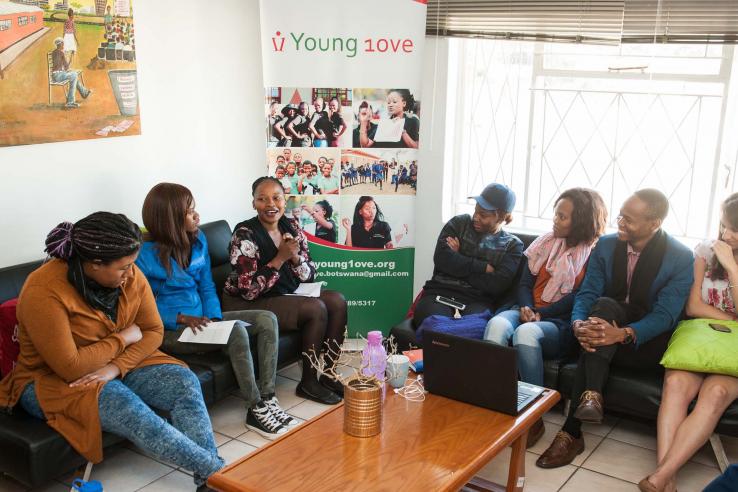
Thus, this past spring, a group of seven of us decided to take a DEDP online course on The Challenges of Global Poverty together, so that we could discuss the weekly lessons and brainstorm how to apply them in our context—and hold each other accountable for completing the assignments!
Out of the seven team members from Young 1ove who enrolled in the course, none work in our Research and Innovation Department. We come from diverse backgrounds: administration, social work, education, international relations, and communications. These are essential skills for our respective positions, but prior to this course we had little experience in understanding the complex issues that our beneficiaries face from an economist’s point of view.
Our individual reasons for persevering and completing the course were largely intrinsic; we approached it as an opportunity to develop ourselves and engage with familiar topics from a new perspective.
For example, I (Hannah), a Princeton in Africa Media Fellow at Young 1ove, spend much of my time writing about and explaining our research methods for various stakeholders, supporters, and collaborators. Taking the course makes my job easier because I have a deeper understanding of the history and importance of running RCTs.
Similarly, Dorothy Okatch, the Development Manager for Young 1ove, found the course helped her justify our work as part of a global movement.
“It has assisted me, when meeting with stakeholders, to reference other programs similar to ours, and validate that we are working as part of a greater movement towards evidence-based development interventions across the world.” -Dorothy Okatch, Young 1ove
Neo Molefe, the Senior Human Capital Officer, echoed this sentiment, finding that the MicroMasters courses not only helped her learn about new programs but also allowed her to better understand current programs being implemented by Young 1ove.
“The module on Teaching at the Right Level really helped me understand that program in a more in-depth fashion. It helped me understand the relevance of education in the real world in terms of economic empowerment, and showed how the program was developed by Pratham in more detail than I knew beforehand.” -Neo Molefe, Young 1ove
The experience was not without its challenges, however. We navigated low-quality Wi-Fi, international travel, and tight schedules.
At first, when the opportunity was presented to the Young 1ove team to enroll in the course, a number of our colleagues jumped at this opportunity to acquire new skills and knowledge. We did not anticipate the challenges that we would face in juggling our workload with course work.
Many of our peers snuck in lecture videos during lunch time or came to the office on weekends to access the internet. Those of us who traveled abroad for work had to find enough time and quality internet to complete the weekly assignments, which was not always possible. We initially had scheduled a weekly discussion session to discuss the course material together in more detail, but finding time when our schedules aligned was more difficult than we anticipated.
Despite tight schedules, we engaged in informal discussions around the weekly lessons. These discussions sparked interesting conversations and debates, which helped bring useful context to our answers to course exercises and homework.
Having a group of peers with whom to take the online courses was similarly encouraging—we helped each other stay on track and were motivated to keep up with the course so that we could fully engage in the group conversations. The MicroMasters website notes that each online course is equivalent to a full-semester course at MIT, requiring a commitment of about 12 hours per week, and we’ve found this to be true. The course certainly was not easy, but the skills we gained are already incredibly useful for both our day to day work and for developing a more long-term vision of Young 1ove and our impact.
As much as we learn on the job, it has been enormously helpful to take a course that details the evolution and use of RCTs across the world. Another program we work on, Teaching at the Right Level, was even referenced in the Education module of the MicroMasters course. We have a newfound appreciation for the decades of refining and testing that has gone into the programs Young 1ove has adapted from randomized trials.
“At the heart of all we do, every decision that we make, from the age of the facilitators implementing a program to the duration of a training, is evidence.”
This is a phrase every member of our team has repeated hundreds, if not thousands of times. Thanks to the MicroMasters in DEPD, this phrase now has an even deeper meaning, as we are able to place our work as part of a historical, international movement to learn, apply, and hone evidence into effective action.
The next MicroMasters semester begins September 11, 2018—sign up here. Applications for the new blended online and in-person Master’s program in Data, Economics, and Development Policy will open in December of this year.
This is a guest post authored by Norman Simon Rodriguez, a MicroMasters learner in Colombia.
I am a 26-year-old Colombian political scientist with a master’s degree in Economics. I first became interested in development in 2012 when, as part of my work as an advisor in the Colombian Senate, I came across the Spanish translation of Poor Economics.
The book was a revelation for me. It made me revise all my preconceptions about social policy and left me wondering how I could apply all the empirical results covered there to my own work.
I consequently turned to data science, and several of the bills I helped create in the Senate benefited from this—like a bill to make public utilities more affordable for the poorest, and a resolution to address a massive coffee growers strike that took place in 2013. I was still figuring out how to do empirical economics, but I was starting to have a sense of the potential for data to inform development policy.
In 2014 I discovered J-PAL’s online courses on edX and joined The Challenges of Global Poverty, and after that, Evaluating Social Programs and Foundations of Development Policy. The latter course helped me refine my R skills, which proved extremely valuable for several professional projects in which I had to analyze my country’s income distribution using census data to identify economic trends related to Gini indexes.
When MIT’s Department of Economics and J-PAL announced the MicroMasters in Data, Economics, and Development Policy, I saw an opportunity to further grow my economic analysis skills and boost my competitiveness on the job market.
I rushed to take the other MicroMasters courses and earned the full credential in February of this year. Because the MicroMasters is an online program, I was able to learn at my own pace, and the forums were a treasure trove of knowledge and interactions—I still keep in touch with friends I made there.
In 2016, armed with this knowledge and experience, I started working as a professor of Development Economics and Policy Evaluation at the National University of Colombia. My course plans are heavily inspired by the MicroMasters courses. My undergraduate and graduate students, many of whom are policymakers, love learning about and analyzing J-PAL and IPA’s randomized evaluations, and (hopefully!) come to understand the importance of running impact evaluations like these locally.
Thanks to the MicroMasters I also became interested in artificial intelligence (AI), and created an app in Python that used AI and big data to make this year's congressional elections in Colombia more transparent. The app used a deep neural network that read all the electoral cards published by the authorities and compared their results with the official election results. Our team plans to scale it for the 2019 electoral round.
The skills I gained from the MicroMasters program helped open doors for me to pursue new ventures and share knowledge with my colleagues and peers. I encourage those considering enrolling in the program to do so—it’s a lot of work, but well worth it. The program provides important access to cutting-edge knowledge at a low cost, which we can all use to improve our communities' quality of life.
The application for the new blended Master’s program in Data, Economics, and Development Policy will open in December of this year. Only those learners who have successfully completed the MicroMasters credential in DEDP will be eligible to apply—sign up here to enroll in the upcoming semester of courses beginning June 5.
The MicroMasters team at J-PAL recently announced a new collaboration with ReACT Hub, an MIT initiative that designs and deploys new learning opportunities for displaced populations.
Starting in the summer of 2018, ReACT will sponsor a cohort of refugees to join the MicroMasters in Data, Economics, and Development Policy, providing selected learners with access to scholarships for the five MicroMasters in DEDP courses, remote work with paid internships during the fall of 2018, and in-person skill-building workshops in January 2019. Learners with proof of refugee, asylee, or internally displaced status are encouraged to apply for this opportunity.
The partnership between J-PAL and ReACT provides a foundation upon which to rebuild the disrupted education and careers of refugees worldwide. Using a carefully crafted model of blended online and in-person learning, financial support, and community building, the new program is designed to address the unique educational and professional obstacles facing refugees. The goal is to make graduate-level education in data analysis and development economics accessible and affordable for all, especially those who face heightened barriers to accessing online and higher education.
ReACT Hub was founded by Admir Masic, a current MIT professor in civil engineering and a former refugee from Bosnia. Creating a blended learning program for refugees offers important educational and professional pathways for this specific learner population, whose lives and institutions have often been thrown into disarray by forced displacement, and who are often shut out of traditional learning structures in their asylum countries. While these are serious barriers that can inhibit refugees from continuing their education and growing their careers, they also underline the potent opportunity extended by collaborations around blended online learning. By partnering with ReACT to reach this vulnerable population, J-PAL has designed a bespoke model of remote and in-person learning that can help refugee learners catalyze a stalled education and career.
Of note, all refugees who enroll to audit The Challenges of Global Poverty and Data Analysis for Social Scientists for the upcoming summer semester, starting June 5, are eligible to apply for these scholarships, as well as refugee learners who have already taken these courses. Interested learners should visit the ReACT website for application instructions.
The internship component of the program will enable refugee learners to gain valuable hands-on work experience, build their professional credentials, and become better prepared for a career in development economics and public policy. Organizations hosting refugee learners will benefit from the knowledge and skills learned in the MicroMasters program, including a strong understanding of the insights from the last decade of economic research, and a mastery of the theory and techniques behind econometric data analysis and the statistical software R.
We are actively seeking partner organizations to host refugee learners for remote or in-person paid internships starting in September 2018; interested organizations should reach out to ReACT staff at [email protected].
This new pathway is designed to empower refugees with customized roadmaps to education and career opportunities, supporting J-PAL’s mission to reduce poverty by ensuring that policies and programs are informed by scientific evidence. Our hope is the refugee learners selected for ReACT scholarships will be able to gain strong technical skills and meaningful professional experiences in evidence-based policymaking that they can bring back to their communities and put into practice.
Those interested in learning more about this program or sharing this opportunity with refugee communities can visit the ReACT website or contact [email protected] for a more in-depth description of the program.
The next MicroMasters semester begins June 5. Enroll now and make sure to apply for this scholarship opportunity soon!
J-PAL and MIT recently announced the launch of a full master’s degree program in Data, Economics, and Development Policy. This blended program combines online learning and one semester of residential instruction at MIT, and is open to students of all educational backgrounds. To help meet growing demand in sub-Saharan Africa for training and capacity building, the William and Flora Hewlett Foundation will sponsor seven students from sub-Saharan Africa over the first three years of the blended master’s program. Sponsorship includes full coverage of tuition, housing, and healthcare costs, as well as a small living stipend.
To be eligible to apply for the blended master’s program and the Hewlett Foundation scholarship, students should successfully complete the online MITx MicroMasters in Data, Economics and Development Policy credential at their own pace. The credential requires students to pass five rigorous online courses, along with accompanying in-person proctored exams for each course. Once students receive their MicroMasters credential, they can apply to complete their full master’s degree in one semester at MIT. Applications for the blended master’s will open in 2018.
Since the launch of our MicroMasters in Data, Economics, and Development Policy in February 2017, more than 10,000 students from 187 countries have enrolled in the program’s courses. Nearly 70 percent come from low or middle-income countries—a positive trend towards a more diverse and inclusive kind of graduate education at MIT, and a promising indication of the growing global interest in evidence-based social policy.
The blended master’s program builds on this demand, offering opportunities for traditional and non-traditional students to access high-quality graduate education. This graduate program is the first at MIT to exist exclusively in the blended online/residential format.
We know that many who aspire to a post-graduate education face significant barriers to access. For applicants to top universities whose resumes don’t boast prestigious undergraduate degrees, signalling their aptitude among others with near-perfect credentials can be an insurmountable hurdle. Although universities strive in earnest for greater inclusiveness, admissions committees struggle to spot talent beyond the usual markers of success. Students lucky enough to gain admission face the reality that graduate school remains an expensive and time-intensive endeavor.
The blended master’s program, a collaborative effort between J-PAL and MIT’s Department of Economics, offers a potential solution to these challenges. No prior university-level education is required; any student who has successfully completed the online MicroMasters credential will be eligible to apply. The MIT admissions committee will base its decisions primarily on students’ performance in the MicroMasters program, allowing students to demonstrate their abilities regardless of background or origin.
Even with more feasible logistics, the financial cost of graduate education can be the most significant barrier to access. In our MicroMasters program, we offer students income-based pricing. This means students are charged based on their ability to pay (between US$100 and US$1,000 per course). The majority of our students study with us at the lowest course price.
For these reasons, the ultimate success of the blended online and in-person Master’s degree hinges on our ability to further extend financial support to deserving students who cannot afford MIT’s graduate tuition. Funding from the Hewlett Foundation, in addition to providing sponsorships for blended master’s students, will further subsidize the cost of online MicroMasters courses for learners from sub-Saharan Africa and support increased awareness of the program in the region.
Solving the world’s most difficult development challenges requires finding and developing global talent with a range of backgrounds and experiences. We hope that this effort to level the playing field in graduate education will not stop here. Encouragingly, J-PAL and MIT are in conversations with several universities exploring similar blended learning opportunities. It is our aim that this new endeavor can serve as an experimental model for rethinking higher education and expanding access to diverse learners worldwide.
For more information about the MicroMasters and blended master’s, including opportunities for foundations and individuals to support increased access for low-income learners, please contact [email protected].