
Lessons from gender-sensitive police reform in India: A Q&A with Sandip Sukhtankar on his new paper in Science
J-PAL affiliate Sandip Sukhtankar published a new study in Science in July 2022 on the impacts of gender-sensitive police reform in Madhya Pradesh, India, supported with funding from J-PAL's Crime and Violence Initiative and Innovation in Government Initiative.
In these short videos, Sandip shares with us how the initial partnership was developed, key results and policy implications, and plans for scale-up and further study.

Q: Why is gender-sensitive policing important in India?
Q: How did you come up with the idea to evaluate women's help desks in local police stations?
How did the partnership with the Madhya Pradesh Police come about?
What potential solutions was the study designed to test?
What did you and your coauthors learn about the effectiveness of these interventions?
From your perspective, what are the implications of these findings for policy makers seeking to improve women's access to justice in India?
How have these results informed decision-making within the Madhya Pradesh Police? Have you considered scaling up the intervention?
Many thanks to Sandip for taking the time to speak with us, and to his coauthors, Gabrielle Kruks-Wisner and Akshay Mangla.
For more information about the study, check out our evaluation summary and read the full paper over at Science.
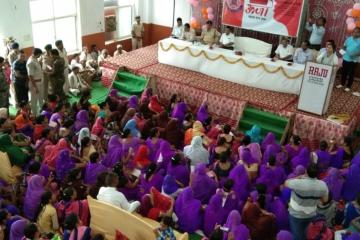
Gender-targeted police reforms, which seek to increase the accessibility and accountability of police to women, are commonly introduced to tackle rising levels of gender-based violence (GBV) globally. These interventions aim to reduce barriers to reporting, like stigma and low trust in police. In India, researchers, in partnership with the Madhya Pradesh Police department, evaluated the impact of a program that introduced designated women’s help desks (WHDs) in police stations throughout the state alongside training for officers. The study found that officers in stations with WHDs were more likely to register cases of GBV, particularly when female officers were assigned to run the help desks.
Policy issue
Globally, many countries face both rising levels of GBV and weak law enforcement, which often leads to underreporting of violence against women. In many settings, women may be hesitant to report crimes to the police due to stigma or low trust in policing, while the police themselves are often unresponsive to women’s concerns or are themselves perpetrators of violence against women.
Previous interventions have tried to introduce gender-based reforms to policing through two primary channels: increasing women’s representation within mixed-gender police forces and creating gender-segregated services like all-women police stations. However, evidence on increasing women’s representation in police forces is mixed, and some studies suggest that creating gender-segregated services may further isolate women and limit the reach of their cases in broader law enforcement structures. Can dedicated women’s help desks (WHDs) within mixed-gender stations, provided alongside training for officers, improve women’s comfort in reporting cases and officers’ interest and capacity in recording cases?
Context of the evaluation
India currently ranks 140 out of 156 countries on international measures of gender inequality.1 It also has high rates of GBV, with an estimated four in ten women reporting domestic violence over their lifetime.2 Researchers studied the women’s help desk program in Madhya Pradesh, an ethnically diverse Indian state with a population of 81 million.
Though police are the primary officials charged with registering crimes against women in India, law enforcement is often either dismissive of women’s concerns, lacks the capacity to effectively support women, or is itself a perpetrator of violence against women. As a result, women’s security concerns often go un-recorded. A study from the four largest cities in Madhya Pradesh, for example, found that only one percent of women experiencing violence had reported it to the police.3 Meanwhile, women make up a small share of the Indian police force, at seven percent.4
In India, police register incidents of GBV in two ways, depending on the nature of the complaint. Filing a First Information Report (FIR) at a police station opens a criminal investigation. A Domestic Incident Report (DIR) initiates civil proceedings and referrals to social services, and may eventually also lead to criminal proceedings. While FIRs are filed directly by the police, they require substantial investments of officer time and effort for case investigation. For the DIR, officers must bring the paperwork before a local magistrate, requiring inter-agency coordination. The DIR is also a relatively new procedure, initiated by a 2005 legal reform, and so is unfamiliar to many officers.
Prior to the intervention, officers registered very few cases related to crimes against women. At baseline, there were close to zero DIRs and fewer than four GBV-related FIRs per police station (which serve 130,000 people on average) per month. In qualitative research accompanying the randomized evaluation, the researchers found that officers often resisted recording cases, despite their legal obligation to do so, due to capacity constraints, lack of adequate training and legal knowledge, and political pressure to under-report crime prevalence. Officers are also constrained by patriarchal norms within the police, which emphasize the need to “protect families” by prioritizing reconciliation over the legal cases. They may additionally be inclined to doubt women: A recent report found that 39 percent of officers in India believe that GBV complaints are generally unfounded.5
Details of the intervention
Researchers collaborated with the Madhya Pradesh Police Research and Training Department to conduct a randomized evaluation to test the impact of gender-targeted police reforms, in the form of WHDs, on police accountability and accessibility to female complainants. The intervention began in full in May 2019; researchers collected endline data between February and October 2020.
The WHD intervention consisted of four primary components:
- Stations created private spaces, such as a dedicated room or cubicle, for women seeking assistance.
- Officers received training on how to properly register cases involving crimes against women. This training included information on filing FIRs and DIRs, as well as lessons on the proper channels of communication with other state and civil society agencies. The training also contained gender sensitization modules that urged officers to listen to women’s claims and not dismiss them out of hand.
- Police, local community groups, and an NGO (ActionAid) with expertise in supporting victims of GBV conducted outreach to local women’s and community safety networks.
- Female officers were assigned to run the WHDs.
The Madhya Pradesh Police selected 12 of the state’s 52 districts to take part in the intervention, choosing districts that were representative of Madhya Pradesh’s geography, demographics, and socioeconomic conditions. Within these districts, 180 police stations participated in the intervention, excluding fully rural stations that the Madhya Pradesh Police considered too remote to justify a new, continually staffed WHD.
Researchers randomly divided the 180 stations into three groups:
- Regular WHD group (61 police stations): These stations received the first three interventions listed above—the help desks, officer training, and community outreach. No gender was mandated to run the help desks, and men ultimately ran the desks in 72 percent of stations.
- Woman-run WHD group (59 police stations): These stations received all of the interventions described above, and female officers were assigned to run the help desks (with 90 percent compliance).
- Comparison group (60 police stations): Stations in this group did not receive help desks, trainings, community outreach, or the allocation of female officers, and continued to perform in the standard manner, without any intervention.
As of December 2019, all stations in the regular or the woman-run WHD groups had received at least some training (although just 67 percent had conducted full training at the station level), 94 percent had set aside space for the desks, and 87 percent had conducted a community outreach event (although such efforts were limited by the large size of station catchment areas).
Researchers collected administrative data on crime levels, including crimes against women, and recorded the rates at which women visited police stations through CCTV footage from cameras that the police routinely place at the entrance to the stations. In addition, researchers fielded surveys of police officers, of visitors to police stations, and of citizens residing in police station catchment areas. These surveys gauged officers’ attitudes on crimes against women, station visitors’ satisfaction levels, and residents’ perceptions of safety, opinions of and contact with the police, and experiences of crimes.
Ethical considerations
For this project, researchers recognized that extra care should be taken to conform to the highest ethical standards in research involving questions of GBV and violence more broadly. They were, moreover, guided by the context-specific insights of their local research partners, including those embedded within the Madhya Pradesh Police and in civil society organizations working with survivors of GBV in Madhya Pradesh, as well as legal consultants with expert knowledge of Indian criminal and civil procedures. These local partnerships enabled the researchers to ground global best practices on research ethics within a specific local context, with attention to on-the-ground realities and to local social, political, and economic constraints.
When designing the intervention, researchers worked to ensure that officers received gender sensitization training and established guidelines for how visitors to the help desks were treated, provisions for privacy, directions for the provision of first aid and trauma assistance when needed, and procedures for referrals to social service agencies with resources including legal assistance, housing, and economic and social support for victims of GBV. The study design also ensured that no resources were diverted away from stations that did not receive help desks.
Researchers recognized the risk involved in surveying women who may be victims of GBV. To mitigate this risk, and to minimize potential trauma or discomfort, researchers took a number of steps, including ensuring that only female enumerators interviewed women; warning that there were questions about GBV so women could opt out of an interview; and ensuring that there were no questions about women’s own personal experiences with GBV (focusing instead on the household level). Enumerators were trained on additional protocols to ensure privacy of responses to the citizen survey, for example by having other survey team members engage or divert family members who might otherwise be present during an interview. Enumerators also received training on when to stop an interview, when to call emergency services, and when to offer resource lists with referral to legal and social services.
Results and policy lessons
The impact of the intervention was observable in changes in police behavior, but not in broader attitudinal changes among the police or among citizens. Officers in stations that received WHDs were more likely to register cases of violence against women, particularly when help desks were run by female officers. Police in WHD stations also expressed greater awareness of general inadequacies of policing with regard to women’s cases, although their broader attitudes on gender did not appear to shift. Citizens’ attitudes towards the police, and the rates at which women approached the police also did not shift.
Registration of cases: Stations with WHDs registered 1.5 DIRs per month on average, compared to just 0.05 in stations without WHDs, where knowledge of DIRs was very low, resulting in a total of 1,905 additional DIRs filed over the course of the study. Officers in WHD stations also registered 14 percent more FIRs in cases of crimes against women, with an average of 4.4 per month, compared to 3.8 in stations without WHDs, accounting for 3,360 additional FIRs.
Notably, however, the increase in FIR registration was driven almost entirely by woman-run WHDs. The increase in DIRs, in contrast, occurred across both male- and female-led WHDs. Qualitative research suggests that the commitment of female officers was particularly important in filing FIRs, which—because they initiate criminal proceedings—require more time and effort from officers than DIRs to complete, and which also push against entrenched patriarchal norms related to “protecting families” that might be broken apart by criminal cases.
Importantly, both FIRs and DIRs initiate (criminal or civil) court proceedings, thus ensuring a critical first step in women’s access to the justice system. However, there were no significant changes in the number of arrests in cases of crimes against women within the timeframe of the study.
Police attitudes and beliefs: Overall, officers in stations with WHDs were no less likely to express the belief that women often file “false” complaints against men. However, female officers in WHD stations were less likely to express such beliefs than female officers in comparison stations. This suggests that the intervention may have been more effective at changing female officers’ beliefs, and that women may have been more sensitive to police training. Both male and female officers in WHD stations indicated greater awareness of the shortcomings of policing with regard to women’s cases; for instance, they were less likely to describe the police as helpful to victims of crimes against women. Male and female officers in WHD stations were also more likely to state that crimes against women were a top priority in their station.
Women’s engagement with the police: In citizen surveys, women were no more likely to report experiences of GBV following the intervention. Nor were women more likely to visit police stations with WHDs than those without help desks, according to CCTV footage. Citizens’ attitudes toward the police also did not shift, although this may reflect the relatively short duration of the intervention. It is likely, moreover, that the relatively weak implementation of community outreach limited women’s knowledge of WHDs; for instance, in the citizen survey, only 10 percent of women were aware of the existence of the help desks.
Female visitors to WHD stations: Women who did visit WHD stations reported being more comfortable during their visits (registering an average score of 3.39 on a four-point scale, relative to 3.27 in comparison stations). However, women visitors to WHD stations did not express any differences in their satisfaction with the visit or in whether they were treated with respect. Importantly, though, expressed levels of comfort, satisfaction, and respectful treatment all improved significantly among those WHD stations with greater training and implementation quality.
Based on these results, the researchers suggest that gender-targeted reforms that focus attention on women’s cases can—under certain conditions—make police more responsive to women’s security concerns. The presence of female officers may be key to such efforts, as visible by the increase in FIRs in woman-run WHDs. More research is needed to understand the commitment and agency of female officers. However, qualitative research suggests that investments in station-level capacity are required to support and empower female officers, who operate in highly masculine station settings. More research is also required to explore the effects of gender mainstreaming that integrates reforms such as the WHDs in regular (as opposed to gender-segregated, women-only) stations, and the impact of such efforts on both female and male officers.
Use of Results
Based partially on the results of this intervention, Madhya Pradesh Police has scaled up the WHD program all across the state, with 950 police stations (serving almost the entirety of the state) now designated to implement WHDs. Researchers are studying the scale-up process to understand the persistence, spread, and sustainability of the intervention. Future research will also explore whether similar interventions produce similar results in other Indian states. Read more about the scale up here.
The Global Gender Gap Report 2021. World Economic Forum. Geneva: 2021.
Kalokhe, A., et al. (2017). Domestic Violence against Women in India: A Systematic Review
of a Decade of Quantitative Studies. Global Public Health 12, no. 4 : 498-513.
Neville, S, et al. (2015). Evaluation of the Madhya Pradesh Safe Cities Initiative. Baseline
Report. London: DFID.
Common Cause et al. (2019). Status of Policing in India 2019: Police adequacy and working
conditions. New Delhi: Common Cause & Lokniti.
Common Cause et al. (2019). Status of Policing in India 2019: Police adequacy and working
conditions. New Delhi: Common Cause & Lokniti.
Today we are announcing J-PAL’s Innovation in Government Initiative (IGI). IGI’s mission is to work with governments to adapt, pilot, and scale evidence-informed innovations with the potential to improve the lives of millions of people living in poverty in developing countries.
For more than a decade, J-PAL has built long-term partnerships with governments around the world to increase the use of evidence from randomized evaluations in policy, and adapt and scale programs informed by evidence.
We work with government partners on policy priorities they have identified, helping them determine whether and how evidence is relevant to their context or not, supporting pilots of programs leveraging relevant evidence, and building systems for data-enabled program delivery and monitoring
We believe this middle phase is vital to bridging the gap between the generation of promising evidence and the scale-up of effective programs. IGI is designed to support this important work to help catalyze the transition from research to scale.
An example of evidence informing large-scale change: Teaching at the Right Level
In classrooms around the world, many students are not learning at grade level and struggle to catch up. To help address this learning crisis, Co-Impact recently announced support for Teaching at the Right Level (TaRL) Africa, an initiative led by J-PAL and the NGO Pratham, to work with governments across sub-Saharan Africa to adapt and scale up Pratham’s evidence-based Teaching at the Right Level approach to reach three million children in the next five years.
This is an exciting new chapter in a two-decade-long story that began and flourished in India, traveled to Zambia—where the Zambian Government, J-PAL Africa, and Pratham have worked together for more than three years to adapt, pilot, and monitor the program in public primary schools—and most recently, launched the new TaRL Africa initiative to support several more governments in adapting and scaling the approach.
This case is a testament to the broad coalition of partners and funders, as well as the large amount of research, capacity building, and policy work, that it takes for evidence to inform large-scale change in governments.
This change is well worth the time it takes to cultivate. As the primary providers of social services around the world, even small improvements in governments’ effectiveness can potentially benefit millions of people.
The Innovation in Government Initiative
While universities and research organizations are producing evidence and many governments are eager to use it, we know that good research and demand from governments is often not enough to change lives.
Using evidence to inform change at scale also requires a deep understanding of context and systems, political will, a policy window where evidence can make a difference, and institutional and implementation capacity. Identifying these opportunities and building strong partnerships to apply evidence takes time.
Starting in 2019, IGI will host scale-up innovation competitions to support this important work. The competition will be open to teams of governments, J-PAL regional offices, and J-PAL affiliated professors in low- or middle-income countries working on priority problems or opportunities government partners have identified.
IGI funding can be used to support a broad range of technical assistance to governments to adapt, pilot, monitor, evaluate, and scale evidence-informed innovations. By innovations, we don’t just mean new programs, but also changes to existing programs, processes, or delivery systems.
IGI will initially focus on innovations in three areas in which there are promising opportunities to take programs to scale given a large body of existing evidence and high government demand for collaboration: education, health, and social assistance.
We will also prioritize partnerships that explore technology- and data-enabled program delivery, implementation science, and cost analysis—crosscutting themes that we believe are key to implementing and learning from programs at scale. For more information on what IGI will fund, head here.
IGI’s first Request for Proposals will be issued in spring 2019. Stay tuned to our blog, newsletter, and Twitter account for more details on our first scale-up innovation competition.
For more information about IGI, including opportunities for foundations and individuals to support this important work, please contact [email protected].