Events

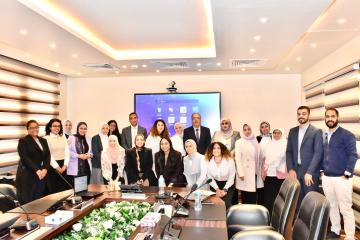
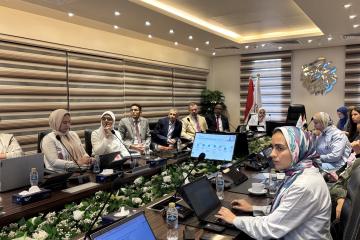
At EIL, our events are more than convenings. They are spaces where policymakers, researchers, practitioners, and development partners come together to exchange ideas, challenge assumptions, and co-create solutions rooted in evidence.

Across the EIL thematic areas, these engagements reflect EIL’s commitment to strengthening institutional capacity and advancing evidence-informed policymaking in Egypt.

Here is how that journey has unfolded.

Partnership Development for Climate Adaptation in Arab States (PDCA)

September 26–27, 2023

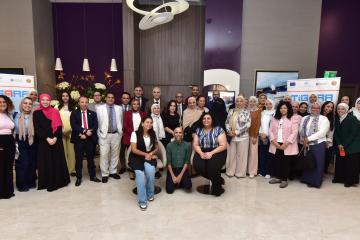
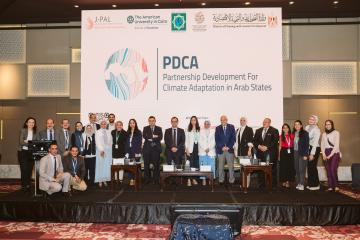
Institutionalizing evidence requires shared platforms. Together with the Ministry of Planning and Economic Development, the National Institute of Governance and Sustainable Development, and the Arab Water Council, J-PAL MENA at the American University in Cairo co-hosted the Partnership Development for Climate Adaptation in Arab States (PDCA) conference in Cairo.

The conference convened regional and international partners to explore collaborative models for climate adaptation. Discussions focused on integrating research into national systems, aligning financing with adaptation priorities, and strengthening regional cooperation.

PDCA marked a significant milestone in advancing evidence-informed dialogue on climate adaptation across the Arab region and served as the soft launch of the Hub for Advanced Policy Innovation for the Environment (HAPIE), signaling a strengthened commitment to data-driven environmental policymaking.

Explore the PDCA blog

Knowledge Exchange Webinar Series – Bridging Health Systems

April 23, 2024
 
Knowledge Exchange Webinar Series – Bridging Health Systems EIL event

Structured knowledge exchange can directly shape how policy is tested and improved. Through the Knowledge Exchange Webinar Series, EIL, alongside the Universal Health Insurance Authority and the World Health Organization in Egypt, built a platform for government-to-government learning that is now informing the design of an evaluation with UHIA. 

The series launched in April 2025 with a session on the foundations of universal health coverage featuring former Chilean Health Minister Emilio Santelices, followed by a July 2025 webinar on benefit package design and Health Technology Assessment drawing on Thailand’s experience. The third session in November 2025 focused on informal workers’ inclusion in health insurance in Indonesia, generating concrete lessons on subsidies, enrollment systems, and administrative design that are actively informing discussions on future evaluation strategies with UHIA. Together, the three sessions strengthened institutional partnerships, aligned research with implementation needs, and positioned the series as a practical bridge between international evidence and Egypt’s reform agenda.

Learn more on the event page

Rethinking Labor Market Policies in Low and Middle-Income Countries

June 26–27, 2024
 

When labor markets are under pressure, policy choices matter even more. At a two-day policy learning seminar organized by the European Training Foundation and Enabel, EIL joined employment experts and civil servants in public employment programs in EU partner countries to reflect on the Effectiveness of Active Labour Market Policies in Fragile Socio-economic and Post-conflict Contexts.

The discussion centered on what works, and what does not, when designing vocational and skills-training programs for youth. EIL shared best practices in designing and evaluating skills programs, emphasizing rigorous impact evaluation, adaptive implementation, and continuous learning. Beyond presentations, the seminar created space for collective reflection on how active labor market policies can be designed to generate measurable, scalable impact.

Collaborative Urban Futures at the 12th World Urban Forum

November 7, 2024

How can cities grow sustainably while ensuring services remain inclusive and efficient? In collaboration with GSMA, HAPIE hosted a panel at the World Urban Forum in Cairo titled “Collaborative Urban Futures: Innovative Partnership Models for Development.”

The conversation explored how partnerships among governments, private-sector actors, and research institutions can address the complex challenges facing fast-growing cities. Speakers reflected on how improved communication systems, data-driven planning, and coordinated resource management can maximize development impact.

The panel reinforced a core principle: urban transformation requires collaboration, and collaboration is strongest when grounded in evidence.

Learn more on the event page

Climate Action Through Evidence-Based Partnerships – COP29

November 18, 2024

Climate resilience demands partnerships that move beyond dialogue into action. In collaboration with Community Jameel, HAPIE convened a roundtable at COP29 as part of the Marrakech Partnership for Global Climate Action.

The session highlighted impact-driven partnerships advancing food and water resilience. Drawing on scalable solutions from Solutions and Advancements through Research for Water and Air (SARWA) and the UM6P-J-PAL Agricultural Lab for Africa (UJALA), the discussion showcased how evidence-based approaches can inform climate policy and accelerate implementation.
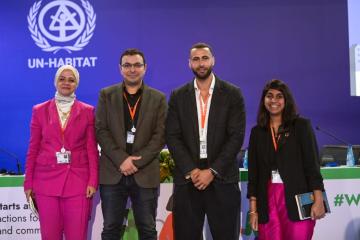
By bringing together diverse stakeholders, from researchers to policymakers, the roundtable underscored the power of collaboration in addressing climate challenges through measurable solutions.

Read more in the HAPIE COP29 blog

Advancing Green Transformation with MSMEDA

February 25, 2025
MSMEDA  Egypt Impact Lab event

Evidence is most powerful when it informs implementation. In response to interest from the Micro, Small, and Medium Enterprise Development Agency (MSMEDA) in advancing green transformation, HAPIE convened a closed session to share insights and international lessons on supporting MSMEs in transitioning to greener practices.

The discussion moved beyond theory. Insights generated during the session directly informed the development of a practical Green Transformation Handbook, offering actionable guidance for implementation.

Discover the Green Transformation Handbook

Building Evidence Ecosystems through Training: Education and Employment

April 8–10, 2025

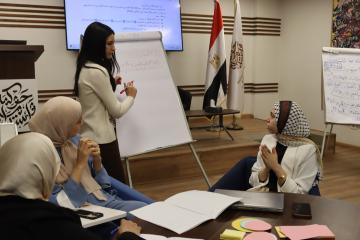
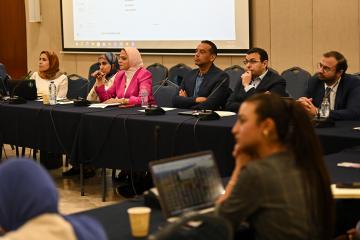
Building Evidence Ecosystems through Training (BEET) marked the launch of a new convening series by the EIL, designed to bring academics, practitioners, and policymakers into the same room to learn from one another. The series was created with a clear purpose: to bridge research and implementation, and to strengthen how labor market policies are designed, delivered, and evaluated.

Focusing on effective labor market interventions and the critical link between technical education and employment outcomes, this BEET fostered dialogue grounded in data, practical experience, and institutional realities. Through structured discussions and applied learning, participants explored how education systems and labor market policies can better align,  ensuring that skills development translates into meaningful employment opportunities.

In Cairo, in collaboration with the European Training Foundation, the program convened national policy leaders and technical experts from the Ministries of Labor, Education and Technical Education, and Planning and Economic Development, along with representatives from the German Agency for International Cooperation (GIZ), the International Labour Organization, the World Association of Public Employment Services (WAPES), and RAND Europe, with a focus on employment and education.

Visit the event page here 

Building Evidence Ecosystems through Training: Urban Planning

May 26-27, 2025

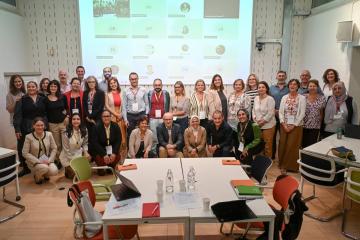
Following the first BEET convening on labor market policy, EIL expanded the series to another critical policy frontier: urban planning. In May, EIL, in collaboration with UN-Habitat, convened policymakers and urban planning experts in Alexandria to explore a central question: How can data-driven policies shape the future of our cities?

Held under the Urban Planning and Infrastructure in Migration Contexts (UPIMC) project funded by the Swiss State Secretariat for Economic Affairs (SECO), the training featured applied sessions on Geographic Information Systems (GIS) for urban planning, the UPIMC methodology, and integrating evidence into infrastructure and migration-responsive planning decisions.

Senior representatives from the Ministry of Local Development, the Ministry of Housing, the New Urban Communities Authority (NUCA), and three governorates, Cairo, Damietta, and Alexandria, participated in the workshop. Together, they examined how spatial data, planning tools, and evaluation frameworks can translate national urban strategies into measurable, local impact.

As the second convening in EIL’s BEET series, this workshop reinforced a defining feature of the initiative: bridging high-level policy dialogue with technical capacity-building, ensuring that evidence ecosystems are not only discussed but built.

Explore the training details

Building Evidence Ecosystems through Training: Industrial Policy and Market Access

August 20–21, 2025

Strong industrial systems require policies informed by data and continuous learning. In partnership with the Policy Support Unit under the European Union-funded TIGARA project implemented by the United Nations Industrial Development Organization, EIL convened policymakers and practitioners for a two-day Building Evidence Ecosystems through Training workshop focused on industrial policy and market access.

Through interactive sessions on impact evaluation, case studies, and applied exercises, participants explored how to design, test, and scale industrial and trade policies grounded in rigorous evidence.

Learn more about the event

Building Evidence Ecosystems through Training: Employability and Skills Development

September 9-10, 2025
Building Evidence Ecosystems through Training EIL event

National capacity-building efforts may contribute to policy learning beyond borders. The BEET series then extended its reach to Turin through a partnership with the European Training Foundation, one of the principal partners supporting Technical Education Reform in Egypt. The collaboration focused on strengthening evaluation frameworks to better understand how reforms in technical education translate into improved employability and skills outcomes.

From urban systems in Cairo to education reform dialogues in Turin, BEET’s expansion illustrates a broader evolution: evidence ecosystems are not confined by geography. They grow through partnership, shared learning, and institutional commitment.

Evidence to Policy Dialogue: Advancing Climate-Resilient Agriculture in Egypt

November 11, 2025

Resilience begins in the field, but it must be sustained in policy. Led by HAPIE, the first high-level dialogue in the Evidence to Policy series, a flagship initiative of EIL designed to bridge research and practice through actionable dialogue among policymakers, development partners, and sector leaders. The first dialogue of this series centered on climate-resilient agriculture, grounding national discussions in field-level evidence. The session drew on findings from HAPIE’s ongoing evaluation of the Farmers’ Adaptation to Climate Change project, demonstrating how rigorous impact evaluation can inform both effective policymaking and practical agricultural interventions.

By connecting real-world implementation data with institutional decision-making, the dialogue illustrated how evidence can move beyond reports and directly shape program design.

The session was delivered in close collaboration with the World Bank, whose team provided an overview of national programs supporting the Egyptian government at the intersection of agriculture and food systems. The discussion also highlighted priority areas where impact evaluations are most needed to strengthen program effectiveness and scalability.

The dialogue reflected a broader institutional shift: embedding evidence into climate resilience planning, strengthening partnerships, and building a shared vision for data-informed agricultural policy in Egypt.

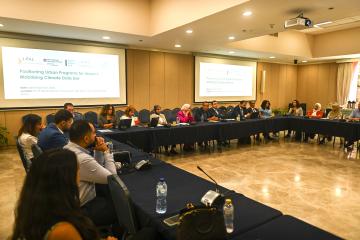
Positioning Urban Programs for Impact: Mobilizing Climate Data Use

September 21, 2025

Data is only powerful when it informs action. On September 21, 2025, HAPIE and UN-Habitat Egypt held a high-level roundtable focused on how to mobilize climate data to enhance urban programs. The meeting included government representatives, international organizations, philanthropists, and private sector partners, emphasizing practical pathways for turning data into policy decisions.

The discussions stressed aligning climate and development initiatives at the local level and called for a unified, accessible climate data ecosystem to support effective decision-making.

The roundtable also explored how data-driven insights can unlock climate finance, enabling urban programs to attract funding and direct resources effectively. Ultimately, it reinforced the importance of building government capacity and fostering partnerships to integrate data use into policy processes, reflecting a commitment to evidence-driven urban development.

Building Evidence Ecosystems through Training: Governmental Digital Inclusion Initiatives

November 24–26 & December 1–3, 2025

Digital transformation must be inclusive and measurable. In collaboration with the German Agency for International Cooperation and Egypt’s Ministry of Communications and Information Technology, EIL co-hosted two rounds of BEET training.

Held within the InnoPA framework, a policy innovation and capacity-building initiative that supports governments in designing and testing evidence-based public sector reforms, the sessions equipped government actors with practical tools to embed impact evaluation into digital inclusion initiatives. Participants engaged in applied workshops that connected policy design with measurable outcomes.

These trainings marked a significant step toward institutionalizing the use of evidence within Egypt’s digital governance ecosystem.

Formalizing the STAR Partnership: Evaluating Agricultural Resilience in Upper Egypt

December 7, 2025

Partnership turns ambition into measurable impact.

On December 7, 2025, Hub for Advanced Policy Innovation for the Environment (HAPIE) formalised a new partnership with the Ministry of Agriculture and Land Reclamation to evaluate the Sustainable Transformation for Agricultural Resilience (STAR) project.

Implemented by the Ministry with technical support from the International Fund for Agricultural Development (IFAD), STAR is a seven-year, EUR 246 million program designed to strengthen the incomes, productivity, and climate resilience of smallholder farmers across Menya, Assyut, and Sohag. The project will reach 160 villages in its calibration phase.

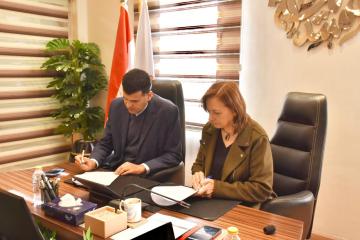
The contracting ceremony brought together key stakeholders, including Dr. Hany Abdelatty and Mr. Kareem Ismail from the Ministry, Mr. George Richards, Director of Community Jameel, representatives from IFAD, the Egypt Impact Lab team, and Dr. Sherifa Sherif, Executive Director of the NIGSD, reflecting a strong institutional commitment to evidence-based agricultural policy.

The agreement marks a milestone in Egypt’s evidence-informed policymaking journey: ensuring that a flagship resilience program is accompanied by a robust framework to measure, learn, and strengthen impact over time.

From Dialogue to Action

Across these convenings, one thread remains constant: partnerships grounded in rigorous evidence can strengthen public systems and improve development outcomes.

Whether through global forums, regional conferences, or targeted technical sessions, EIL continues to create spaces where research meets policy and where collaboration turns ideas into action.

Stay updated on the latest EIL events

Connect with us