

Image
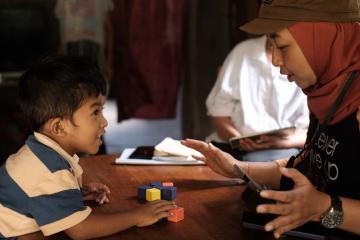
High-quality early childhood education is essential. Children from birth to age three are in a critical period of development, yet only 55 per cent of those from low-income households meet key developmental milestones, compared to 78 percent from wealthy households.
Randomized evaluations show that simple, low-cost activities, like reading, singing, and playing, can boost children’s cognitive, language, social, and motor skills. A landmark study in Jamaica found that early stimulation led to higher academic achievement and greater adult earnings decades later. And in Bangladesh, building early childhood services into existing government systems improved child development at a cost of less than US$10 per child, with results comparable to far more intensive programs.
Still, one big question remains: How can we deliver high-quality preschool education at scale?
Caminhos da Pré-escola, a partnership led by J-PAL Latin America and the Caribbean (J-PAL LAC), Fundação Bracell, and Itaú Social, aims to help answer that question. Working with municipalities in Bahia and São Paulo, the project identifies promising preschool programs, supports their implementation in school systems, and generates rigorous evidence to guide future scaling.
Through an open call, two out of ten promising programs were selected for evaluation: Curiosamente and Semente.
Curiosamente is a Brazilian adaptation of an evidence-based math program designed to strengthen both socioemotional skills and mathematical understanding among children in their final year of preschool. The program uses playful, structured activities that teachers can easily integrate into their daily classroom routines, blending cognitive development with emotional and social learning.
J-PAL invited researcher Luiz Scorzafave, along with other researchers, will evaluate the program’s impact on children's mathematical reasoning, problem-solving abilities, and socioemotional skills.
Semente is an adaptation of the methodology SEL Kernels (Social-Emotional Learning) developed by the Easel Lab (Ecological Approaches to Social Emotional Learning) from Harvard University, and focuses on children’s socioemotional development. It helps children identify, express, and manage their emotions, build interpersonal skills, develop a growth mindset, and make responsible decisions.
Like Curiosamente, Semente relies on brief, teacher-led activities embedded in existing classroom practice; in this pilot, principals and pedagogical coordinators are trained first and then work with teachers to deliver the content, supporting adaptation to preschool settings. J-PAL researcher Alejandro Ganimian and collaborators will lead an impact evaluation to assess improvements in children's emotional regulation, social interactions, overall socioemotional wellbeing and teaching practices.
Following the evaluation phase, implementation will be led by teams with technical expertise in the interventions.
In the Curiosamente program, the implementation will be carried out by Nara Andrade of the Federal University of Juiz de Fora (UFJF) and Chrissie Carvalho of the Federal University of Santa Catarina (UFSC), with institutional support from UFJF’s Regional Center for Innovation and Technology Transfer (Critt).
For Semente, the implementation will be led by Ana Luiza Colagrossi of Espaço ARA. Training will be provided to school principals and pedagogical coordinators, who will be prepared to work with in-service teachers on the content, facilitating adaptation to the new routines.
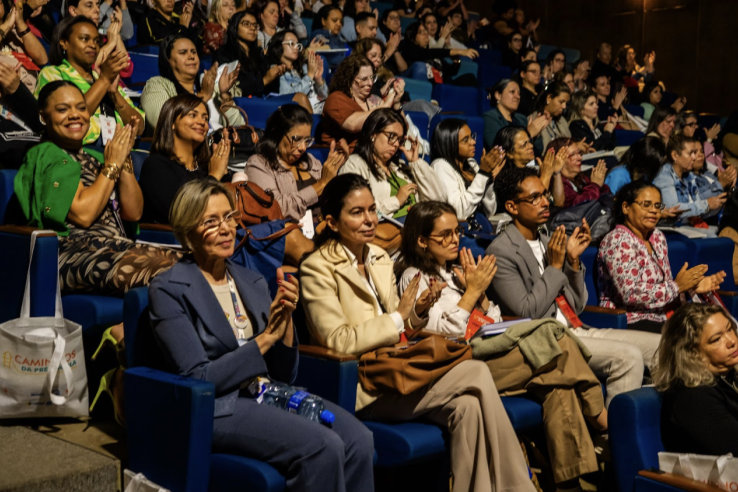
After selecting the programs, we hosted four regional seminars in Bahia (Feira de Santana and Camaçari) and São Paulo (Bauru and Guarulhos). These meetings underscored the importance of preschool education and set the groundwork for deeper collaboration with municipalities ahead of the pilot and evaluation phase. They also created space for managers, experts, and partners to discuss local challenges and align on shared priorities.
Studies will begin in 2026: Curiosamente in Camaçari and Feira de Santana, Bahia; and Semente in Bauru and Guarulhos, São Paulo. Ongoing learning from these RCTs—combined with close partnership with education authorities—will help refine the programs so that they are contextually appropriate and ready for scale within public education systems.
To follow this work as it unfolds, check the J-PAL blog and the Caminhos da Pré-escola project page for updates.