

Indonesians are turning to digital financial services during the COVID-19 pandemic
Social distancing guidelines in Indonesia and around the world have profoundly impacted many aspects of people’s lives, from the way we communicate to the ways we work, shop, and transact. These shifts have brought the potential of digital financial services (DFS) as a means of easing some of the economic consequences of the COVID-19 shock in Indonesia to the forefront.
While anecdotal evidence suggests DFS adoption is on the rise nationwide, policymakers lack concrete evidence on how widespread adoption is and what new users’ experiences look like. To examine whether the pandemic has increased the use of DFS in Indonesia, J-PAL Southeast Asia’s Inclusive Financial Innovation Initiative (IFII) team collaborated with an Indonesian government partner to conduct an online survey on DFS adoption.
The survey was conducted through Google Surveys, which uses convenience sampling to recruit people through mobile phone and computer-based Google platforms. Accordingly, the sample is skewed towards people who are digitally engaged, often considered as an important target group for DFS conversion.
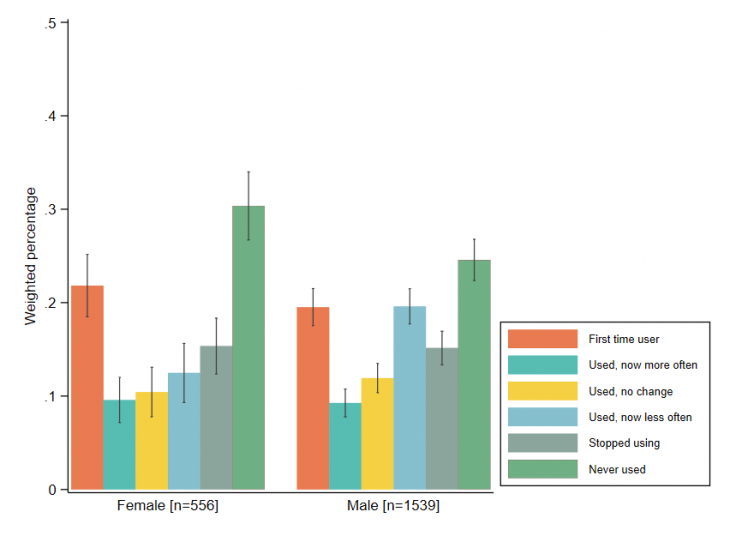
Increased DFS use during the pandemic
Notes: Results are weighted using SUSENAS 2019. The numbers in parentheses are sample sizes. Whiskers denote 95 percent confidence intervals.
Key findings
More people are using DFS during the pandemic. Twenty-one percent of men and 22 percent of women in the survey reported that they used DFS for the first time during COVID-19, while 15 percent of men and women reported that they stopped using DFS in this period.
As online platforms often offer discounts and shoppers can compare prices more easily than in physical stores, we found that the desire to find cheaper goods online is one of the biggest triggers of DFS adoption. Other drivers of use are the greater safety and convenience of online shopping, as well as the need to more easily transfer funds.
DFS users do not go fully digital. Sixty-two percent of DFS users use online platforms to buy primary goods like food and drinks, or secondary goods like clothing, books, stationary, and household utensils; however, 54 percent of online shoppers report cash is still their main payment instrument. The most common reported barriers for using electronic payment technologies like digital banking and e-money are a perceived lack of use cases, associated fees, and trust issues.
Promising signs of inclusion among harder-to-reach groups
J-PAL’s survey suggests that women and rural dwellers are actively adopting DFS during the pandemic; moreover, older Indonesians (45+) have a higher take-up than the younger population—at least within the highly-selected Google Survey sample.
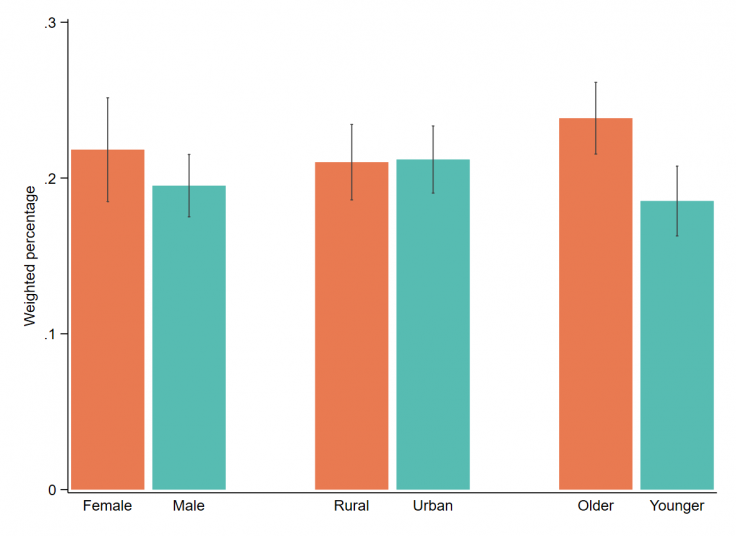
Notes: Results are weighted using SUSENAS 2019. Age category is split between the older group (45 and older) and the younger group (18 to 44 years old). Whiskers denote 95 percent confidence intervals.
Women and rural residents report being first-time DFS users at the same rate as men and urban dwellers, which is crucial to lift up who are more likely to be excluded from the financial system. Female DFS user are also more frequent online shoppers (84 percent of women versus 76 percent of men). Accordingly, online shopping could provide a compelling business case for women to adopt DFS after the pandemic abates.
Older individuals are more likely to convert to DFS. Twenty-four percent of people aged 45 and above are first time adopters, as compared to 19 percent of people aged 18 to 44. Part of this may reflect higher pre-pandemic use among younger individuals, who are often more digitally literate.
What can industry and policymakers do to support sustained DFS use among new adopters?
Pandemic-induced shifts in adoption are more likely to convert to meaningful longer-term engagement if new users have positive experiences early on.
Private sector players should pay attention to user onboarding and communication to ensure that getting started is easy. They could also ramp up promotion efforts by expanding incentives (discounts, cash-back, etc.) to create habitual DFS use. At the same time, government agencies could build on recent initiatives that leverage DFS for social protection payments.
Efforts now to help new users get comfortable and stay engaged may pay long-term dividends as Indonesians adjust to a “new normal” way of managing their finances and participating in the economy.
J-PAL Southeast Asia’s Inclusive Financial Innovation Initiative (IFII) is working alongside governments, private sector firms, and nonprofit organizations to understand how the COVID-19 pandemic has shaped the way people live and transact.
This blog post is based on effort funded by the Bill & Melinda Gates Foundation. The findings and conclusions contained within are those of the authors and do not necessarily reflect positions or policies of the Bill & Melinda Gates Foundation. The mission of IFII is to ensure that digital financial services can drive economic development while lifting up women, low-income groups, and marginalized communities.
You can review the detailed results of the online survey here. For more information about IFII, contact [email protected].
Perkembangan terbaru di Indonesia semakin memperbesar pentingnya layanan keuangan digital (LKD) terutama potensinya dalam meringankan beban ekonomi akibat pandemi COVID-19. Meskipun informasi anekdotal menunjukkan bahwa penggunaan LKD di tengah pandemi ini sedang meningkat, pembuat kebijakan di Indonesia belum memiliki bukti ilmiah atas seberapa luas penggunaan LKD saat ini, serta karakteristik dan pengalaman para pengguna baru LKD.
Untuk melihat apakah pandemi ini telah meningkatkan adopsi LKD, tim Inclusive Financial Innovation Initiative (IFII) J-PAL Asia Tenggara berkolaborasi dengan sebuah institusi pemerintah melakukan survei daring (online) terkait adopsi LKD dari 16 Juni sampai 13 Juli 2020. Survei ini dilakukan melalui platform Google Surveys. Convenience sampling digunakan untuk merekrut responden melalui telpon genggam dan platform-platform Google yang berbasis komputer. Sesuai dengan hal tersebut, sampel dalam survei ini cenderung diisi oleh individu-individu yang melek digital. Individu-individu ini juga merupakan kelompok target penting dalam usaha mendorong adopsi LKD.
Peningkatan penggunaan LKD di tengah pandemi
Catatan. Hasil dibobotkan sesuai SUSENAS 2019. Angka di dalam tanda kurung adalah ukuran sampel survey. Garis di setiap batang mencerminkan tingkat kepercayaan 95%.
Temuan 1: Basis pengguna LKD meningkat di tengah pandemi. Dua puluh satu persen (21 persen) laki-laki dan 22 persen perempuan yang menjadi responden dalam survei melaporkan bahwa mereka baru pertama kali menggunakan LKD pasca COVID-19. Sebaliknya, 15 persen laki-laki dan perempuan dalam survei melaporkan bahwa mereka berhenti menggunakan LKD pasca COVID-19. Faktor-faktor utama yang mendorong penggunaan LKD adalah harga murah dari platform niaga elektronik (e-commerce), keamanan, kenyamanan, serta kebutuhan untuk mentransfer dana.
Temuan 2: Pengguna LKD tidak sepenuhnya mengadopsi teknologi digital. 62 persen dari pengguna platform daring untuk membeli kebutuhan primer dan sekunder; namun demikian, tercatat bahwa 54 persen pengguna yang juga melakukan belanja daring masih memakai uang tunai sebagai instrumen pembayaran. Hambatan paling utama dalam menggunakan teknologi pembayaran elektronik seperti perbankan digital dan uang elektronik (e-money) adalah persepsi terkait rendahnya kegunaan untuk jenis pembayaran lain. Pengguna juga melaporkan faktor tidak adanya kegunaan (~16 persen), biaya administratif (16 persen untuk pengguna perbankan digital dan 13 persen untuk pengguna uang elektronik), dan masalah kepercayaan (15 persen untuk pengguna perbankan digital dan 12 persen untuk pengguna uang elektronik) sebagai hambatan-hambatan utama lainnya.
Peluang untuk inklusi kelompok-kelompok marjinal
Survei J-PAL juga menunjukkan bahwa perempuan dan penduduk pedesaan secara aktif mengadopsi LKD di tengah pandemi; selain itu, penduduk tua Indonesia (berumur 45+) memiliki adopsi yang lebih tinggi dibandingkan kalangan pemuda -- setidaknya untuk responden di dalam sampel survei.
Catatan. Hasil dibobotkan sesuai SUSENAS 2019. Kategori umur dipisahkan antara penduduk berumur lebih tua 45 tahun ke atas dan kalangan yang lebih muda 18-44 tahun. Garis di setiap batang mencerminkan tingkat kepercayaan 95%.
Terdapat lebih banyak perempuan dan penduduk pedesaan yang menjadi pengguna LKD untuk pertama kalinya: Sebagaimana disebutkan diatas, tingkat adopsi antara laki-laki dan perempuan relative sama. Perempuan pengguna LKD yang kami survey lebih sering berbelanja daring (84 persen dari perempuan dibandingkan 76 persen dari laki-laki) – hal ini bisa menjadi use-case yang menjanjikan untuk dieksplorasi setelah pandemic. Selain itu, kami juga melihat adanya penggunaan yang menjanjikan oleh penduduk pedesaan yang memiliki tingkat adopsi relatif sama dengan penduduk perkotaan selama pandemic COVID-19.
Penduduk yang lebih tua lebih mungkin mengadopsi. 24 persen dari orang yang berumur 45 tahun ke atas menggunakan LKD pertama kali, dibandingkan 19 persen orang yang berumur 18 hingga 44 tahun. Sebagian dari perkembangan ini mungkin disebabkan oleh penggunaan LKD yang lebih tinggi di kalangan masyarakat yang lebih muda dan memiliki literasi digital yang lebih baik
Apa yang dapat kalangan industri dan pemangku kebijakan lakukan untuk mendukung keberlanjutan penggunaan LKD diantara pengguna baru?
Peningkatan adopsi yang diakibatkan oleh pandemi ini akan menjadi lebih berarti secara jangka apabila pengguna baru memiliki pengalaman yang positif dalam menggunakan LKD. Para pelaku usaha perlu memperhatikan proses on-boarding dan komunikasi, sehingga pengguna dapat mulai menggunakan LKD dengan mudah. Pelaku usaha dapat lebih meningkatkan usaha promosi, sebagai contoh dengan memperluas insentif yang diberikan (diskon, cash-back, dsb). Pada saat yang sama lembaga pemerintah perlu membangun program dari inisiatif yang dilakukan baru-baru ini terkait penggunaan LKD dalam pembayaran perlindungan sosial. Usaha-usaha untuk membantu pengguna baru untuk dapat menggunakan LKD dengan nyaman dan berkelanjutan kiranya dapat memberikan dividen secara jangka panjang seiring dengan proses adaptasi penduduk Indonesia terkait pengelolaan keuangan dan partisipasi ekonomi dalam kondisi “new normal”.
Inclusive Financial Innovation Initiative (IFII) J-PAL Asia Tenggara saat ini sedang bekerja sama dengan pemerintah, perusahaan sektor swasta, dan organisasi nirlaba untuk memahami dampak COVID-19 terhadap kehidupan masyarakat termasuk dalam cara mereka melakukan transaksi. Dengan dukungan dari Bill & Melinda Gates Foundation, IFII mempunyai misi untuk memastikan layanan keuangan digital dapat mendorong pembangunan ekonomi sekaligus memberdayakan perempuan, kelompok berpendapatan rendah, serta komunitas-komunitas marjinal. Temuan dan kesimpulan yang diperoleh adalah opini penulis dan tidak mewakili pendapat atau kebijakan Bill & Melinda Gates Foundation.
Untuk rincian hasil survei online dapat diakses disini dan informasi lebih lanjut tentang IFII, hubungi [email protected]
The digital financial services (DFS) sector is among the fastest-growing: the number of financial technology (“fintech”) companies in Indonesia more than doubled from 130 in 2017 to more than 320 in 2019. In addition to this rapid growth in the private sector, the Indonesian government is increasingly moving towards digital delivery of social assistance programs in the public sector. J-PAL Southeast Asia, based at the Faculty of Business and Management at the University of Indonesia, is launching the Inclusive Financial Innovation Initiative to answer important policy questions now at the forefront of the region’s economic growth.
Indonesia’s digital economy has quadrupled since 2015—reaching an approximate value of USD$40 billion in 2019. Much of this growth is driven by the country’s e-commerce sector, which recorded 88 percent growth from $1.7 billion in 2015 to $21 billion in 2019.
The digital financial services (DFS) sector is among the fastest-growing: the number of financial technology (“fintech”) companies in Indonesia more than doubled from 130 in 2017 to more than 320 in 2019. In addition to this rapid growth in the private sector, the Indonesian government is increasingly moving towards digital delivery of social assistance programs in the public sector.
J-PAL Southeast Asia, based at the Faculty of Business and Management at the University of Indonesia, is launching the Inclusive Financial Innovation Initiative to answer important policy questions now at the forefront of the region’s economic growth. With the support of the Bill and Melinda Gates Foundation, the three-year initiative aims to ensure that digital financial services can drive economic development while lifting up women, low-income groups, and marginalized communities.
While growth in e-commerce and DFS represents a promising opportunity to advance financial inclusion, use of DFS is currently concentrated among young, urban, and higher-income populations. As digital technologies continue to improve and costs of service provision decline, there is a growing opportunity to expand the reach of DFS and leverage it as a tool for broad-based financial inclusion.
The Inclusive Financial Innovation Initiative will build on existing global evidence to understand how DFS can be used to accelerate financial inclusion and broad-based economic development within Indonesia and beyond.
The Initiative will include three intersecting workstreams to provide actionable evidence to members of Indonesia’s DFS ecosystem, including policymakers, practitioners, and non-profit organizations:
- Policy research and analysis: Under the Initiative, J-PAL staff and researchers will review the existing global evidence base to offer evidence-based policy recommendations for how to leverage DFS to improve government anti-poverty programs and benefit marginalized groups, and to identify knowledge gaps where new research is needed to answer important questions.
- Creation of a Learning Collaborative: To encourage collaboration, the Initiative will facilitate a learning and communication platform where relevant stakeholders in the financial inclusion and digital finance sector can connect, share knowledge and best practices, and formulate strategies to answer priority research and policy questions.
- Research collaboration: The Initiative will develop innovative pilot studies and randomized evaluations to answer policy-relevant questions. It will build partnerships to ensure that the evidence produced by these studies can directly contribute to policy decisions.
Why focus on financial inclusion?
Financial products and services are designed to help individuals build resilience to unexpected events and take advantage of opportunities, and are often viewed as key tools for improving families’ welfare and economic mobility.
Existing evidence suggests that improving access to savings accounts can have positive effects on household welfare, and that digital financial tools like mobile money may offer users significant benefits. For example, studies in Chile and Kenya have found that access to basic bank accounts allowed households to better manage fluctuations in income, increase business investment, and increase private expenditure levels. Meanwhile, offering mobile phone-based savings accounts to parents in Kenya whose children were about to enter high school increased enrollment by 5 to 6 percentage points.
Digital financial services can also be a tool for boosting women’s economic engagement and empowerment.
For example, a study in India found that linking earnings from a government workfare program to women’s bank accounts (rather than household-level accounts), coupled with a basic account training, led to increased female employment both within the workfare program and the private sector, especially for those women whose husbands expressed the most opposition to women working.
In Niger, disbursing cash transfers via mobile money improved diet diversity during the 2009-2010 food crisis relative to cash-in-hand transfers. Women who received mobile transfers were more likely to travel to weekly markets, be involved in selling household grains, and spend more on children’s clothing than those in the other groups.
Why focus on Indonesia?
Indonesia’s DFS providers are developing tech-based innovations to increase financial inclusion among households that are currently underbanked or unbanked altogether. For example, micro, small, and medium enterprises (MSME) now have access to digital payment services designed to boost transactions, improve bookkeeping, and build better credit scores.
Women’s savings collectives, called arisan, also have opportunities to go digital through MAPAN arisan. Digitized arisan groups can collectively purchase goods online without disrupting their household cash flow.
Finally, online peer-to-peer lending such as Amartha and TaniFund offer access to credit for farmers, fishermen, and micro-merchants who have been largely ignored by formal banking institutions. While these and other innovations are promising, we know little about their real causal impacts on the lives of the poor.
To push the frontier further, we need more evidence on what types of DFS work within the context of Indonesia’s regulatory and business environment, infrastructure, and demographics; why they work; and how they can be deployed to maximize impact.
Working alongside a diverse set of collaborators, the Inclusive Financial Innovation Initiative aims to contribute to an inclusive, impact-driven digital finance ecosystem in Indonesia.
For more information, contact Aliyyah Rusdinar.