Navigating Indonesia’s post-pandemic era: Addressing opportunity, inequality, and growth
In the one and a half years Indonesia has battled the Covid-19 pandemic, the past few weeks may have been the most challenging. The second wave is hitting the country hard, with the rapid spread of the virus threatening the country’s healthcare and financial system. As the government implements an emergency public activity restriction, there is an urgent need for strategic action to cushion the pandemic’s health and economic consequences, protect vulnerable populations, and set the stage for a lasting recovery.
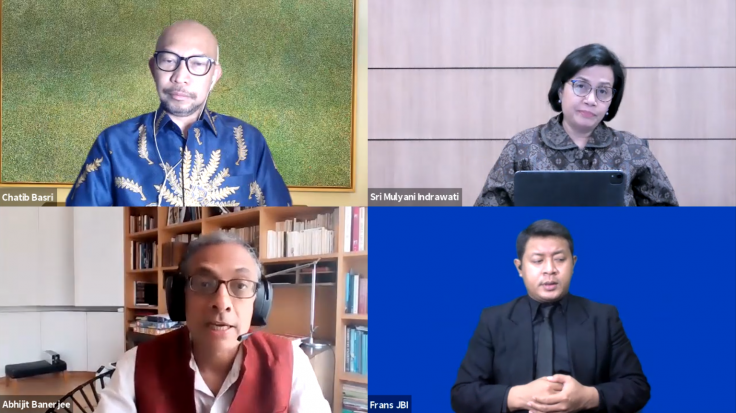
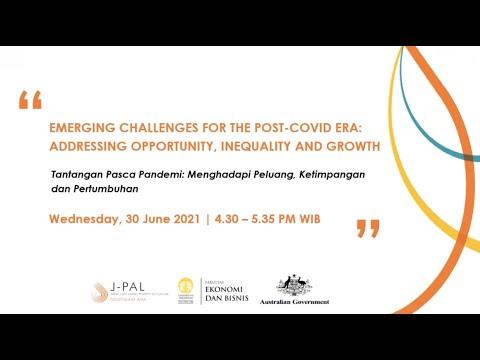
To support this effort, on June 30, J-PAL SEA organized a public webinar on the Emerging Challenges of the Post-Pandemic Era: Addressing Opportunity, Inequality, and Growth. The webinar aimed to provide insights into the Government of Indonesia’s policy directions and learnings from global evidence on challenges faced in health, inequality, and the environment. The webinar featured Sri Mulyani Indrawati (Minister of Finance, Government of Indonesia) in conversation with Abhijit Banerjee (MIT; Director, J-PAL), and was moderated by Chatib Basri (Co-founder and Senior Partner, CReco). More than 600 people attended, most of whom are representatives of governments and universities.
Key takeaways from Sri Mulyani and Abhijit Banerjee’s conversation are summarized below.
“Recovery is going to depend on how you address the necessary condition that is the Covid, and on how you design a policy in order for you to be able to: first, protect the people from the health threat...; second, from the economic catastrophe; third, to make sure that the financial system will continue to be stable; and fourth, the macroeconomic — the fiscal — will continue to be sustainable and healthy” - Sri Mulyani Indrawati
1. Vaccination will be the key to achieve national and global recovery
“The main instrument [for restoring the labor market] is still going to be the normal workings of the labor market. As long as people are not vaccinated, it is not clear how we could do that. It (vaccination) is completely central to the story.” - Abhijit Banerjee
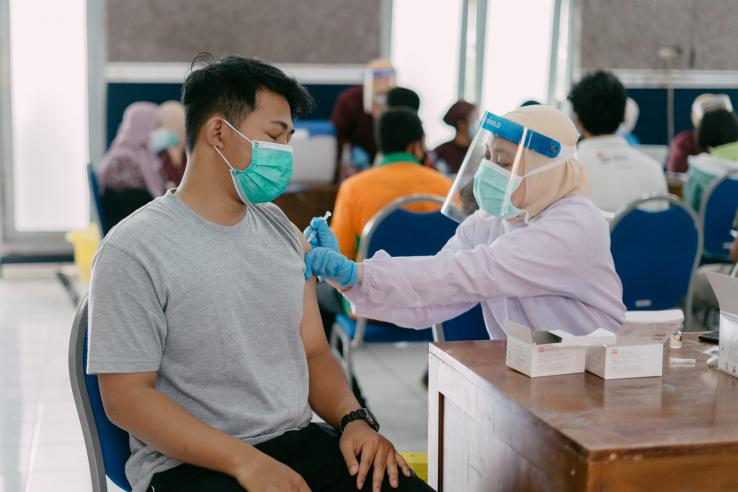
Many countries are torn between opening up the economy and controlling the spread of the virus, and vaccination is the only instrument capable of addressing both. However, not every country is able to secure enough doses for its citizens. This is true especially for low-income countries who either do not have enough financial resources to procure the vaccines, or are facing other political, social, or religious barriers.
The Government of Indonesia acknowledged the importance of international cooperation to make vaccines available and affordable for all. Indonesia’s Minister of Foreign Affairs Retno Marsudi is working to establish a global vaccine collaboration, with the goal to ensure equal access for everyone.
The next priority after ensuring equal vaccine access is restoring economic activity. The economy will not automatically stabilize once lockdowns are lifted, given that many of the actions taken to cushion the impact of the pandemic may have led to loans that cannot be repaid. If left unchecked, this may pose a serious threat to the financial sector, increasing the risk of debt for the government.
One of the possible solutions to addressing the economic crisis is by having adequate support from the international community. The IMF recently discussed the possibility of allocating a new Special Drawing Rights (SDR) of USD$650 billion, an international reserve currency to help countries cope with the fallout of a global crisis like the one caused by Covid-19. This new SDR would provide additional liquidity to the global economic system by supplementing the reserve assets of member countries like Indonesia. Although the proposal is yet to be approved, this arrangement could benefit IMF member states, especially if backed with a clear-cut strategy for allocating the funds.
2. Policies must address Covid-induced inequalities
Another challenge on the road to recovery is addressing the inequality exacerbated by Covid-19. Economists are now picturing a K-shaped economic recovery. Under this scenario, higher-income populations are more resilient and can recover quickly, but those who were in more precarious economic conditions beforehand may struggle to build back. As the impact of the pandemic is larger among poor and near-poor households, there are concerns over whether Indonesia will experience this type of recovery.
To prevent this, one of the strategies taken by the government is to expand the number of recipients in social safety net programs, from the initial bottom 20 percent to the bottom 45 percent of the population. This is applicable throughout various programs, ranging from cash transfers and food assistance to lower interest rate subsidies for small and medium enterprises and pre-employment cards for job seekers. Through these interventions, Indonesia was able to maintain the poverty rate at 10.19 percent, instead of 11.8 percent as predicted by the World Bank. Moreover, from September 2020 to February 2021, unemployment was reduced by 800,000, bringing the percentage back to 6.26 percent from the previous 7.07 percent.
Aside from ensuring the welfare of the people, another important aspect when addressing the issue of inequality is dealing with long-term learning loss. The pandemic has had a substantial effect on education, especially for the poor. The sudden transition from normal schooling to learning from home highlights the unpreparedness of the readiness of teachers, parents, and students in carrying out the teaching and learning process effectively.
Moreover, as explained by Abhijit Banerjee, research estimated that one year of missed education may reduce lifetime earnings by 7 percent in Indonesia. This is why it is crucial not to go back to the conventional method of learning once school reopens, but instead to be mindful of the student’s actual learning level and implement a targeted education method.
3. International cooperation is needed to ensure a green recovery
As human activities are reduced during the pandemic, negative externalities such as carbon emission, air, and water pollution also decreased. Many countries are now considering the possibility of pursuing a green recovery, transforming the threat of Covid-19 into an opportunity. Yet, the pressure of restoring the economy complicates this effort for low- and lower-middle-income countries like Indonesia.
Similar to dealing with the health and economic crisis, the key is to have equal commitments from both the international community and the country itself. From country-level perspectives, governments need to ensure that there is a legal ecosystem in place to support environmental protection. In the case of Indonesia, one of the efforts is through the creation of a Green National Medium-Term Development Plan, which outlines the strategy and indicators to achieve improved living conditions, low carbon emissions, and resilience towards disaster and climate change.
Still, this effort needs to be backed by adequate support from the international arena. With many emerging and developing countries now dealing with increased economic pressure, it now falls to the high-income countries to take the first step and provide financial assistance to aid the transition towards a green recovery. There are high expectations that the upcoming UN Climate Change Conference or COP26 will be able to deliver a series of much more specific commitments towards combating climate change, now that all the world has been given a unique opportunity to ‘reset’ the environment.
A global commitment for a resilient recovery
The Covid-19 pandemic has posed serious threats to multiple sectors, challenging governments to find a balance between protecting the people and stabilizing the economy. Nevertheless, although recovery from the pandemic is an uphill battle, recent developments from the international arena present us with a solid footing and a reason to be hopeful. For Indonesia, the experience in strengthening social protection in recent years and the knowledge generated from the evaluation of poverty alleviation policies from around the world can act as a foundation to better navigate these challenging times.
J-PAL Southeast Asia hosted a webinar to disseminate the preliminary findings from a study on the long-awaited transition from Beras Sejahtera or Rastra (previously known as Raskin), Indonesia’s largest food assistance program which covered 15.5 million beneficiaries, to non-cash food assistance or BPNT.
On March 31, J-PAL Southeast Asia hosted a webinar to disseminate the preliminary findings from a study on the long-awaited transition from Beras Sejahtera or Rastra (previously known as Raskin), Indonesia’s largest food assistance program which covered 15.5 million beneficiaries, to non-cash food assistance or BPNT. The event attracted almost 900 participants, the majority of whom were representatives from the government sector and research institutions.
The webinar featured J-PAL SEA Co-Scientific Directors Rema Hanna (Harvard) and Ben Olken (MIT; Co-Director, J-PAL), Elan Satriawan (UGM; Chief of Policy Working Group, TNP2K ), and Sudarno Sumarto (SMERU Research Institute; Policy Advisor, TNP2K) who were involved first-hand in the evaluation process, along with Maliki (Director for Alleviating Poverty and Development of Social Welfare, Bappenas) who shared his view on how these findings could be used to further informed policies. The session was moderated by Adelia Surya Pratiwi (Head of Public Communications Strategy and Management Subdivision, BKF).
The session was also attended by Tb. A. Choesni (Deputy Ministry for Social Welfare Improvement, Kemenko PMK), Asep Sasa Purnama (Director General for Poverty Handling, MoSA), Vivi Yulaswati (Senior Advisor to the Minister of Development Planning for Social Affairs and Poverty Reduction, Bappenas), Ryan Washburn (Mission Director for Indonesia, USAID) and Simon Ernst (Counsellor, Development Effectiveness, Australian Embassy Jakarta), who participated as keynote speakers in the webinar.
The challenges of the Rastra program and the solution
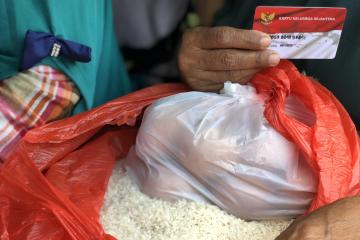
The transition from Rastra to BPNT may be Indonesia’s largest social assistance reform in twenty years. Before the reform took place, beneficiary households used to receive 10 kilograms of free rice per month under the Bansos Rastra program. However, there were several complications with the in-kind transfer process, especially in terms of the quality and quantity of rice. For example, beneficiary households tend to receive less rice than what was originally intended—and often of poor quality. This was also coupled with various logistical challenges, such as delay in the delivery process or loss of rice due to leakage (e.g., when sacks of rice fell off the truck).
Looking at this situation, the Government of Indonesia, in collaboration with various international organizations and universities, conducted numerous studies on the Rastra program, which in the end resulted in the recommendation to transform the program delivery into a non-cash method, or BPNT.
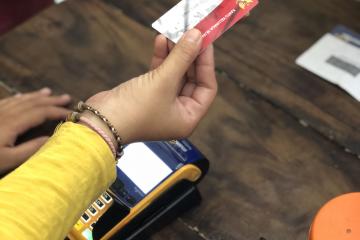
Through this mechanism, instead of receiving assistance in the form of rice, beneficiary households will receive e-vouchers transferred to an account in their name, amounting to IDR 110,000 (USD 7.60) per month. The e-voucher can be accessed using a debit card, and can be used to purchase rice and eggs at any registered retailers, also known as agents or e-warongs. The ultimate goal is to create a more effective social assistance program, by improving what the Indonesian government refer as the “6T”: tepat sasaran, tepat harga, tepat jumlah, tepat mutu, tepat waktu dan tepat administrasi (targeting, price, quantity, quality, time and administration).
The decision to transition from in-kind food assistance to electronic food vouchers was a direction from President Joko ‘Jokowi’ Widodo back in 2016, as explained by Tb. A. Choesni in his opening remarks. Following this mandate, in 2017 the government began to implement BPNT in stages. Nevertheless, the question remains on whether or not the BPNT program managed to overcome the challenges of Rastra. To answer this, the Government of Indonesia worked together with J-PAL affiliated researchers to conduct a randomized evaluation on both programs.
BPNT: A promising solution to Indonesia’s poverty challenges
In assessing the impact of the reform on individual welfare, researchers conducted an evaluation with the goal to compare the delivery of social assistance using BPNT and Rastra. The evaluation involved 105 districts, with 42 districts transitioning to BPNT in 2018 and 63 transitioning to BPNT in 2019.
Results show that not only was there better targeting in districts implementing BPNT, but the quality and amount of assistance received by beneficiaries also increased. This was possible because the vouchers managed to concentrate aid to truly eligible households, therefore decreasing the probability of non-poor households receiving the assistance.
On average, there was a 45 percent increase in the value of subsidies received by below-cutoff households in districts implementing BPNT. This increase in subsidy value also led to a decline in poverty—presumably because beneficiaries received a higher amount of assistance. For households that fall under the bottom 15th and 5th percentiles, poverty was 20 and 24 percent lower respectively.
The BPNT program also affected households’ consumption decisions. Under BPNT, each household can purchase eggs in addition to rice. However, as almost everyone in Indonesia consumed more than 10 kg of rice per month (the amount received under the Rastra program, and equivalent to the BPNT e-voucher), there was no mechanical reason to expect households to use the subsidy to purchase eggs.
And yet, the result shows that there was an increase in egg consumption, with no impact on overall rice consumption. This finding highlights a very important point, in line with the government’s efforts to further broaden the type of food under this program: having a wider range of food available can encourage beneficiaries to have a more diverse diet.
The last set of findings are related to the rice price and the administrative cost of the project. One of the key concerns of the government is whether there would be an increase in the price of rice in the districts implementing BPNT.
While economic theory predicts that this might happen (limited supply of rice in agents or e-warongs might drive the prices up), in reality, BPNT did not have a major impact on rice price. Although there was a slight increase in price in remote villages, it was not enough to negate the benefits of the program. Furthermore, the administrative cost of BPNT was even lower than the already low cost of Rastra: only 0.75 to 2 percent of benefits disbursed. BPNT was thus substantially less costly to administer, in addition to the fact that it was more effective in delivering assistance to targeted beneficiaries.
The continuous improvement of Indonesia’s social assistance program
Based on these the findings, the transition from Rastra to BPNT appears to be a one-way road, and the question now is how to optimize the program. According to Maliki, improving data quality is essential in ensuring a smooth program implementation, especially considering the government has a plan to further transform the social assistance program.
As of 2020, BPNT was upgraded into Program Sembako, which includes an e-voucher worth IDR 150,000 (USD 10.40) that can be used to purchase a wider range of food commodities, not only rice and eggs. In the future, the government is also planning to further transform this program into Program Sembako Plus, with the ‘Plus’ covering electricity and gas, aside from basic food needs.
To ensure the success of this long-term plan, having reliable beneficiary data is key. At the moment, there is still insufficient information especially on beneficiaries located in remote areas (i.e., missing ID card numbers, incomplete family names). This makes it harder to create a bank account, which is a fundamental part of the assistance. A continuous improvement of beneficiary data is thus highly recommended.
Moreover, a constant renewal of the socio-economic data of each beneficiary household is also crucial, especially to further increase the accuracy of the program targeting. By carrying out these two points, the ultimate goal is to digitize and integrate Program Sembako with other social assistance programs, in order to eradicate chronic poverty in 2024.
Read about a collaboration between the Government of Indonesia and researchers to use government administrative data to evaluate some of the largest social programs in the country.
Data collection is one of the most costly and time-consuming aspects of conducting impact evaluations. However, past research by J-PAL affiliated researchers has demonstrated that conducting a rigorous evaluation using preexisting administrative data is not only possible, but can potentially expedite and reduce the cost of the data collection process.
Governments collect rich data on program beneficiaries in the process of running their social assistance programs. When this administrative data is collected rigorously and made accessible, policymakers and researchers have the opportunity to evaluate social programs more effectively and strive for continuous improvement in their design and delivery.
To promote and guide the use of administrative data in impact evaluations, J-PAL’s Innovations in Data and Experiments for Action Initiative (IDEA) published a free, online handbook on Using Administrative Data for Research and Evidence-based Policy. The chapter on “Using Admin Data to Improve Social Protection in Indonesia” explores the collaboration between the Government of Indonesia and researchers to use government administrative data to evaluate some of the largest social programs in the country.
J-PAL SEA hosted a talk as part of the IDEA Handbook webinar series to dig deeper into this collaboration story. The event was moderated by Indonesian economic journalist Ade Safrina Nasution and featured chapter authors Vivi Alatas (CEO, Asakreativita), Sudarno Sumarto (SMERU Research Institute; Policy Advisor, TNP2K), Rema Hanna (Harvard; Co-Scientific Director, J-PAL SEA), and Ben Olken (MIT, Co-Director, J-PAL; Co-Scientific Director, J-PAL SEA).
The essential “dance” to improve access and availability of administrative data in Indonesia
As a prominent economic researcher, Vivi Alatas has extensive experience in evaluating social programs with the Government of Indonesia. The government has always been interested in understanding a program’s effectiveness in eradicating poverty, but leading up to this big question also lies the more preliminary program design concerns such as, “How do we define ‘poverty’? And how do we correctly identify beneficiaries who are eligible to receive social assistance?” Here, administrative data act as a powerful tool to address the question of who should receive a program.
Administrative data helps researchers and policymakers to design an impact evaluation. The essential component of impact evaluation is estimating what would have happened to beneficiaries had a program not been implemented, also called the counterfactual. Deciding how to replicate this counterfactual is a crucial step that affects the rigour of evaluation results.
This is where administrative data plays a part, as it allows researchers to better replicate the counterfactual by comparing characteristics of beneficiaries and program implementation across different areas without additional data collection effort. For example, when designing an evaluation for a nationwide policy, administrative data collected on a national scale helps shed light on whether beneficiaries are selected in a similar manner across provinces and program components are rolled out uniformly. With regularly updated high-quality administrative data, we can understand not only whether or not a program had an impact, but also whether there are remaining implementation challenges to address at a cheaper cost compared to conducting a nationwide survey.
Despite the important role administrative data can play, its use for program evaluation in Indonesia is still limited in part due to the mismatch of research interests and desired result timelines between researchers and policymakers. Closer collaboration between researchers and practitioners in program monitoring and evaluation planning is therefore instrumental in producing more usable evidence. This synchronization of steps between the two parties is the essential “dance” that can promote evidence-informed decision-making through improved administrative data collection.
A successful collaboration story: Long-term partnership to evaluate Indonesia’s social protection programs
In 2012, researchers worked with the Government of Indonesia to utilize administrative data in implementing the Raskin ID card program—a card that would state the eligibility of a beneficiary, and hence increase the transparency of the program. The card was found to reduce the program leakage by 33-58 percent.
When the Raskin program was reformed in 2017, it was Indonesia’s largest social assistance reform in twenty years. Researchers again worked together with the government to evaluate the impact of this reform by utilizing a set of administrative data called SUSENAS (the national socio-economic survey), a biannual national sample survey administered to over 250,000 households.
The collaboration to evaluate Raskin ID cards led to a long-term administrative data use partnership between researchers and the Government of Indonesia, including the updating of UDB (Unified Database), one of the largest social assistance databases in the world. Sudarno Sumarto, senior research fellow at SMERU and policy advisor at TNP2K, shared this success story.
The Raskin collaboration allowed researchers and the government to work together to explore other questions related to optimizing social assistance programs. For example, they wanted to understand the best way to update a program beneficiary list by looking into whether eligibility surveys would alter people’s behavior.
By randomizing additional questions in the targeting survey on asset ownership (e.g. of TVs, cell phones, motorcycles, and goose-neck toilets), researchers were able to identify whether or not respondents were more likely to alter their answer in order to be eligible for the program, such by not disclosing some of their assets, or even changing their purchasing decision entirely. The latter may have important welfare consequences if people choose a lower quality product or do not buy essentials. Results from the study suggest that households may have responded by hiding assets but not actually changing their consumption.
At the moment, the challenge is to ensure that the administrative data is used not only by the national government, but also by local governments. Some local governments worry that the national administrative data may not reflect the actual conditions in their regions. According to Sudarno, one step to solve this issue is to conduct a regular discussion between the national government and the relevant stakeholders. Furthermore, empowering the Regional Coordination Team for Poverty Reduction (TKPK) to work with their local government to update the social assistance database is also essential in promoting the use of administrative data in local government decision-making.
Significant improvement, but still a long way to go
The Government of Indonesia is a world leader in incorporating evidence into policymaking. The Covid-19 pandemic has shown how important social protection programs are to protect vulnerable groups from economic shocks. When the pandemic required the government to move quickly to alter available programs to new needs, they were able to rely on a past evaluation to inform this decision. Continuous investment in research will be helpful for future shocks as well.
Encouraging the use of administrative data in more research may be the key to unearthing more innovative solutions. One way to do this is by creating a forum where researchers and policymakers can meet to identify the important policy questions together, determine the data required to answer those questions, and set standards and criteria for how data is used and collected to provide protection and anonymity to each subject.
This article is based on the IDEA Handbook Webinar, “The use of admin data to improve social protection in Indonesia,” on January 26, 2021.
The past year has been filled with tragedy and sacrifice—but, critically, also innovation, as researchers and policymakers addressed new challenges with creative solutions. Existing and newly generated evidence has informed many policies over the past year, providing a roadmap for incorporating evidence into even the most timely responses.
It has now been more than a year since the Covid-19 pandemic began closing schools and businesses and filling hospitals. The past year has been filled with tragedy and sacrifice—but, critically, also innovation, as researchers and policymakers addressed new challenges with creative solutions. But just because this pandemic was unprecedented in scope doesn’t mean evidence can’t inform decision-making. Existing and newly generated evidence has informed many policies over the past year, providing a roadmap for incorporating evidence into even the most timely responses.
J-PAL’s affiliated researchers and staff have worked alongside policymakers around the world to support use of data in decision-making for pandemic response, at many points along the journey from research to policy.
Collecting data to provide real-time insights to inform emergency response
J-PAL researchers quickly adapted to focus on providing much-needed information about on-the-ground realities to help governments understand the full extent of the problem before rolling out responses.
For example, in Indonesia, J-PAL Southeast Asia (SEA) Scientific Directors Rema Hanna and Ben Olken worked with the National Development Planning Agency to conduct a nationwide online survey to learn how the lives of poor households were affected by Covid-19, to inform expansion of the government’s social protection policies addressing the pandemic. Similarly, in Togo, researchers used satellite imagery and phone data to assist the government in targeting cash transfers to the most vulnerable individuals impacted by Covid-19.
Working with policymakers to quickly fund and launch pandemic-related research
J-PAL has prioritized funding research to understand how to mitigate the effects of Covid-19. Seven J-PAL initiatives opened rounds for proposals dedicated to funding rapid, policy-relevant, and safe research relevant to mitigation and recovery. Over the spring and summer of 2020, J-PAL funded 34 research proposals for a total of more than $1.5 million. Many have already provided useful information on the design and effectiveness of response programs.
For example, in Italy, researchers evaluated the effectiveness of an online tutoring program designed to address inequalities in education exacerbated during the pandemic. After only three months, the program improved students’ academic performance and well-being.
And in West Bengal, India, researchers sent short videos shot by a celebrity with tips for Covid-19 prevention to 25 million people. The intervention increased preventative behaviors and symptom reporting. Researchers are now assisting with the scale-up across West Bengal. Other evaluations by J-PAL affiliated researchers have also already reported results that have fed back into the design and roll out of effective response programs.
Drawing from existing evidence to provide advice to governments
J-PAL and our affiliated researchers joined many conversations with governments interested in using existing evidence to inform their pandemic response.
Early in the pandemic, J-PAL’s Global Executive Director, Iqbal Dhaliwal, joined the Government of Punjab, India’s Group of Experts for Covid-19 Relief to co-develop policy measures on agriculture, education, digitization, and social protection. Many of the recommendations made by J-PAL were included in the final strategy report agreed to by the government.
In Chile, J-PAL Latin America and the Caribbean (LAC) has also worked closely with the government across many sectors. Scientific Director Francisco Gallego, affiliate Claudia Martinez, and J-PAL staff worked with the Ministry of Finance to provide recommendations based on a large body of research to inform the design of Chile’s cash transfer pandemic relief program, which has now reached more than three million workers who were not formally employed.
Also in Chile, J-PAL staff participated in a working group to advise the Ministry of Education on evidence-based interventions to prevent school dropout. Based on promising results, Francisco and J-PAL LAC are now working with the Ministry of Education to test and expand upon an SMS intervention aimed at promoting enrollment for the 2021 school year among students (grades 1-12) who had previously dropped out of school.
And in Morocco, the J-PAL/Evidence for Policy Design Morocco Employment Lab, created in partnership with the US Millennium Challenge Corporation and MCA-Morocco, worked with the Moroccan Ministry of Labor to examine the effects of Covid-19 on employment in Morocco, drawing on lessons from international evidence. These conversations paved the way for further research in public policy response to challenges identified.
Disseminating lessons on Covid-related topics to facilitate learning
J-PAL evidence has informed broader conversations about how to address challenges brought on by the pandemic. For example, in 2020, J-PAL North America (NA) released a meta-analysis with Education Sector co-Chair Phil Oreopoulos that found that tutoring was a consistently effective strategy to help students who have fallen behind to catch up.
To date, the report has been downloaded nearly 5,000 times and been cited in major federal and state policy proposals for how to bolster student learning in the face of the pandemic. As one recent example, leaders within the California Governor’s Office shared that J-PAL’s tutoring research was especially useful as they considered how best to deploy K-12 stimulus funding to combat learning loss.
Collaborating with researchers, policymakers, and implementers to identify key challenges emerging for which additional research is needed
The pandemic has highlighted many open questions. What are the best ways to address the intersection of poverty and climate change—a question becoming increasingly important as millions around the world are now more vulnerable to climate shocks after enduring the economic shocks of the pandemic? What are the best ways to target and deliver government relief programs? How can we prevent the spread of misinformation and restore trust in health systems and government institutions?
As we progress to the next phase of post-pandemic recovery, J-PAL’s research initiatives are already considering how to encourage research that tackles these and other questions. With an ambitious research agenda focused on the intersection of poverty and critical social issues, we hope to contribute to not only recovering from this pandemic but also building a stronger foundation from which to respond to future emergencies.
As always, visit J-PAL’s Covid-19 page for more information on our ongoing response to the pandemic.