

Low-income Americans are missing out on the public benefits they're eligible for. Simple interventions can help.
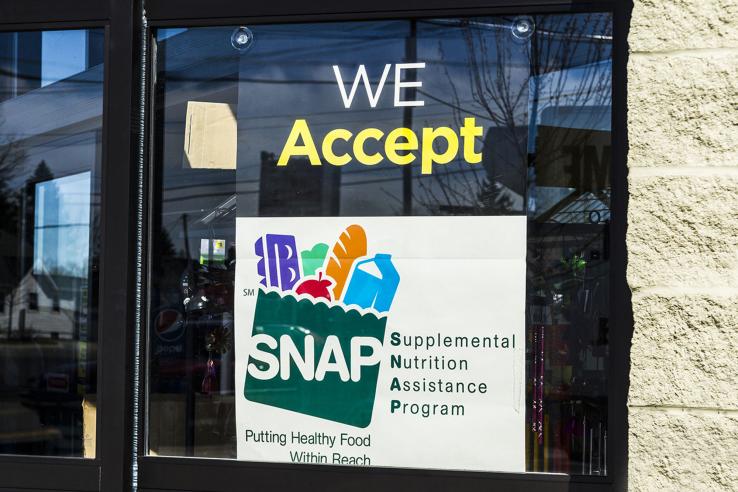
The Supplemental Nutrition Assistance Program (SNAP)—often referred to as food stamps—is one of the largest social safety net programs in the United States. But every year thousands of households eligible for SNAP benefits do not enroll, missing out on food assistance that could be critical. Enrollment among adults over the age of 60 is particularly low; in 2012, nearly half of older adults who qualified to receive SNAP benefits did not enroll.
Why don’t more older adults apply for SNAP benefits—are they not aware of their eligibility? Is the application process too confusing or time-consuming? Or are they simply not interested? And how can organizations help more older adults access the SNAP benefits they are eligible for?
To investigate these questions, Amy Finkelstein (Co-Scientific Director of J-PAL North America) and I partnered with Benefits Data Trust (BDT), a national nonprofit committed to transforming how individuals in need access public benefits, to conduct a randomized evaluation.
In our evaluation, we wanted to test how different strategies designed to reduce barriers to enrollment might impact the number of older adults who apply for SNAP.
We worked with BDT and the Pennsylvania state government to randomly select 30,000 study participants from administrative records of low-income individuals. These individuals were not enrolled in SNAP, but we knew they were likely eligible because they were already enrolled in Medicaid, which has similar eligibility requirements in Pennsylvania.
Individuals in our study were able to apply for SNAP benefits at any time. Our research design was different from many other randomized evaluations, where one group receives program services and another doesn’t. We would not want to—nor would we be able to—prevent individuals in the comparison group from enrolling in a program they are legally entitled to, such as SNAP.
Instead, we used an approach called an encouragement design. We randomly assigned participants into three equal groups; participants in two groups received additional encouragement and support to enroll in SNAP, while those in a comparison group still had access to SNAP but received no extra encouragement.
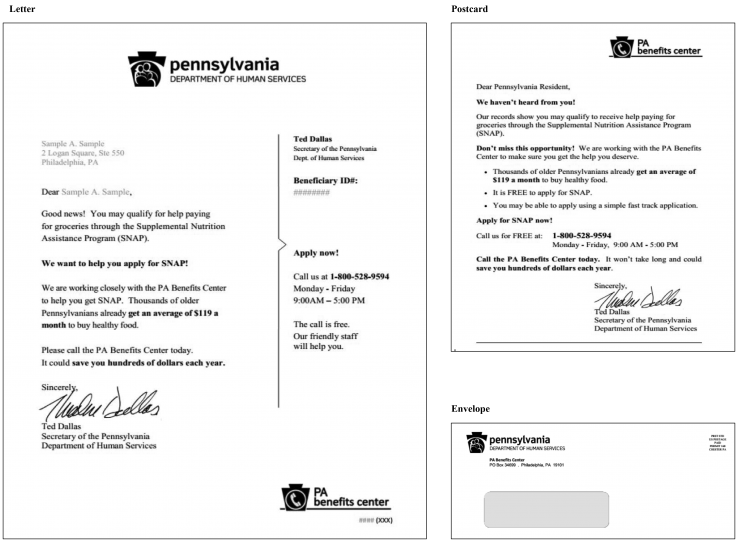
In our “Information only” group of eligible older adults, we mailed them a letter which informed them of their likely eligibility for SNAP benefits and provided a DHS (government) phone number to call to receive an application form. A randomly selected subgroup also received a follow-up reminder postcard eight weeks later if they hadn’t yet called.
In our “Information plus assistance” group, participants received the same outreach materials in the mail as the other group did. But their letter included a phone number that would connect them with our partner, BDT, instead of directly to DHS. If they called this number, they received extra assistance from a specialist who helped them submit an application and compile required documents, and answered any follow-up questions.
What did we find?
About 6 percent of study participants in the comparison group, who did not receive any additional encouragement, enrolled in SNAP over the nine-month study period. Participants who received the “information only” intervention (letters and a DHS phone number) were almost twice as likely to enroll. And among participants who received the “information plus assistance” intervention, enrollment rates tripled to 18 percent.
Just within our study sample, this intervention helped roughly 1,700 seniors access the food benefits that they need. If scaled up further, BDT’s intervention could help many more.
The findings suggest that lack of information about eligibility and challenges in navigating the application process prevent many older adults from successfully applying for and enrolling in SNAP benefits for which they are eligible. Our results also indicate that for some people, providing information about eligibility is enough to encourage them to enroll. But for many others, more intensive assistance is required to substantially increase enrollment. Overall, we think encouraging eligible people to enroll in SNAP seems like a relatively low-cost way to reach this low-income population.
To read about our study in greater detail, please see our recently released working paper (Take-up and targeting: Experimental evidence from SNAP), which provides more detailed results and includes a framework to analyze the overall cost and welfare implications of the interventions.
In the United States, enrollment in social safety programs is not automatic, and many social safety programs experience low take-up; many individuals who are eligible for certain programs fail to become enrolled. Researchers studied the impact of providing outreach and assistance to households that are likely eligible for the Supplemental Nutrition Assistance Program (SNAP), previously known as food stamps, on enrollment in the program. Researchers found that informational mailings nearly doubled SNAP enrollment while informational mailings plus application assistance tripled SNAP enrollment, suggesting that both the lack of information and the effort required to apply pose barriers to SNAP take-up.
Policy issue
The Supplemental Nutrition Assistance Program (SNAP)–previously known as food stamps–provides a benefit that can be spent on food to eligible, low-income households in the United States. In 2013, nearly one in seven households received SNAP.1 Enrollment in SNAP is not automatic: individuals must apply and demonstrate their eligibility in order to receive benefits.
There are a number of potential reasons why individuals who are eligible for SNAP or other social safety programs might not enroll. Individuals may not know that they are eligible to receive benefits. They may also be deterred by the time and effort required to apply for benefits, such as filling out application forms and providing documentation of their eligibility. Can informational mailings about SNAP eligibility and individualized application assistance increase SNAP enrollment? And which types of eligible individuals respond to these interventions?
Context of the evaluation
Many social programs in the United States feature incomplete take-up; for example, Currie (2006) documents take-up rates ranging from a low of 10 to 20 percent for the State Children’s Health Insurance Program in the late 1990s and 60 to 90 percent for cash welfare (TANF).2 There is also substantial variation in take-up rates across eligible populations, and take-up of SNAP benefits is disproportionately low among the elderly: in 2013, only 41 percent of those eligible enrolled in SNAP.3 Benefits Data Trust (BDT) is a national not-for-profit organization based in Philadelphia that designs innovative solutions to generate better economic, health and social outcomes for individuals and their larger communities. BDT’s direct service programs provide targeted outreach and person-centered application assistance to individuals who are likely eligible for benefits and services, including elderly households likely eligible for SNAP. Elderly households in Pennsylvania could qualify for SNAP in one of three ways:
- households may have gross income below 200 percent of the Federal Poverty Level;
- have gross income over 200 percent of the Federal Poverty Level but have net income below 100 percent of the Federal Poverty Level and resources below $3,250; or
- can be categorically eligible if all members of the household receive or are authorized to receive a qualifying benefit such as Temporary Assistance for Needy Families.
Details of the intervention
Researchers conducted a randomized evaluation to measure the impact of various interventions on take-up of SNAP. Using application and enrollment data for other public benefits, BDT identified households who were likely to meet the income requirements for SNAP. Researchers randomly assigned 31,188 likely eligible households to one of three groups:
- Information Only: One-third received a letter that informed them that they were potentially eligible for SNAP and provided them with contact information for the Pennsylvania Department of Human Services, the state agency that processes SNAP applications. This intervention group included four (randomly assigned) sub-interventions which altered the exact design of the letter, the wording of the letter, and whether or not a follow-up postcard was sent to households that did not call within eight weeks.
- Information Plus Assistance: One-third were mailed a similar letter, which informed them of their potential eligibility and provided contact information for BDT’s in-house call center. For those who called with an interest in applying for benefits, BDT helped screen the household for potential SNAP eligibility and level of benefits. If the caller wanted, BDT also helped them assemble the necessary documentation, submitted the application electronically on their behalf, and assisted with any follow-up questions from the state. Households that did not call within eight weeks received a postcard containing the same information as the letter. This group includes two (randomly assigned) sub-interventions with variations in the design and wording of the letter.
- Comparison group: One-third received no outreach or intervention from BDT.
Results and policy lessons
Researchers measured the impact of the Information Only and Information Plus Assistance interventions on the number of households that applied to and the number that ultimately enrolled in SNAP within nine months. The Information Only intervention increased enrollment by 5 percentage points from a baseline of 6 percent in the comparison group (an 83 percent increase). The Information Plus Assistance intervention increased enrollment by 12 percentage points (a 200 percent increase relative to the comparison group). These results suggest that both the lack of information and the time and effort required to complete and submit an application pose barriers to enrollment. Among the sub-intervention, the follow-up postcards had a significant impact whereas changing the exact design and wording of the letter did not. Sending a reminder postcard in the Information Only group increased SNAP enrollment by an additional 20 percent relative to those who were only sent the first letter. Both the Information Only and the Information Plus Assistance interventions increased applications proportionally to the increase in enrollment; success rates were similar (about 75 percent) across both intervention arms and the comparison arm.
Researchers also studied the characteristics of the individuals who enrolled in SNAP as a result of the interventions. These enrollee characteristics were similar in both intervention arms, but differed from those who enrolled in the status quo comparison group. Individuals who enrolled because of the intervention were—relative to eligible individuals who enrolled in the comparison arm—older, more likely to be white, and more likely to speak English as their primary language. On average, the entire studied population had a lower income than the general population and was more likely to have chronic diseases. Individuals who enrolled because of the interventions had fewer measured chronic diseases prior to the intervention, and they also received lower monthly benefits than enrollees in the comparison group. Since the monthly benefits are lower for individuals with more resources by design of the progressive SNAP benefits formula, this suggests that enrollees in the intervention groups had higher net resources prior to the intervention than individuals who enrolled under the status quo. Nonetheless, the $1,300 per year in SNAP benefits received (on average) by those newly enrolled outweighed the estimated cost of the intervention ($20-$60 per household enrolled) and the processing costs to the state (approximately $240 per application).4
Researchers developed a behavioral model allowing for misperceptions of the safety net program, and calibrated the model with the experimental results. The calibration results suggest that both interventions are a cost-effective way to redistribute to low-income households relative to other safety net programs.
Loveless, Tracy A. “Supplemental Nutrition Assistance Program (SNAP) Receipt for Households: 2000–2013 (American Community Survey Brief No. 13-08).” Washington, DC: US Census Bureau, 2015.
Currie, Janet. “The Take-up of Social Benefits,” in Public Policy and the Income Distribution, ed. Alan Auerbach, David Card, and John Quigley (New York: Russell Sage, 2006), 80-148.
Eslami, Esa. 2015. “Trends in Supplemental Nutrition Assistance Program Participation Rates: Fiscal Year 2010 to Fiscal Year 2013.” Washington, DC: U.S. Department of Agriculture, Food and Nutrition Service.
Isaacs, Julia. 2008. “The Costs of Benefit Delivery in the Food Stamp Program.” USDA Contractor and Cooperator Report No. 39.https://www.brookings.edu/wp-content/uploads/2016/06/03_food_stamp_isaacs.pdf Last accessed June 29, 2017.