

Using Technology to Improve Direct Benefit Transfer in India




Can using technological innovations for monitoring improve the administrative implementation of social protection programs? In partnership with the Ministry of Rural Development in two states in India, researchers conducted a randomized evaluation of a web and mobile-based management and monitoring platform, PayDash, to improve the administration of Mahatma Gandhi National Rural Employment Guarantee Scheme (MGNREGS), a large workfare program in India. PayDash access reduced wage payment delays and increased household participation in MGNREGS. Its impact primarily came from making real-time payment processing information more accessible to bureaucrats.
الموضوع الأساسي
Roughly one in four people worldwide receive government payments1. Yet, these payments are often delayed in the very places where they are most urgently needed, low-income countries where a large share of the people experiencing poverty live2. Such delays can have severe consequences, forcing households to choose between going hungry or taking on costly debt, deepening their poverty.
Digital payment systems are often hailed as a solution to payment delays, but they do not always resolve the issue, especially when manual approvals are still required3. Nonetheless, there is untapped potential in the data generated by digital payment systems. When used effectively, this data can enhance information flows within government agencies, enabling stronger oversight and more timely payments.
However, whether these improvements materialize depends on the underlying cause of the delays. Are bureaucrats simply overburdened and lacking timely access to information? Or are they using the system to extract personal benefits, rather than to improve program performance?
سياق التقييم
MGNREGS is one of India’s largest social protection programs, guaranteeing low-income, rural households up to 100 days of paid manual work each year. In 2024-25, over 70 million households participated in the program. 37 percent of workers belonged to scheduled castes and tribes, communities that have historically faced significant social and economic disadvantages, compared to 30 percent of the overall rural population. Women also played a key role, completing 55 percent of the total workdays, even as overall female labor force participation in India had declined to just 20 percent.
MGNREGS is implemented by tens of thousands of officials, across three levels of bureaucratic hierarchy: Frontline officials who verify the work and request wage payments; Sub-district level officials who manage frontline officials and release wage payments; District-level officials who have an overarching administrative role over sub-districts.
Persistent delays in wage payments undermine MGNREGS’ promise of providing timely income support4 5. The program mandates that initial wage processing be completed within 8 days of work. But prior to the study, the average processing time in the study’s states was 18 days. These delays matter: each extra day in initial wage processing was linked to nearly a full day’s delay in workers getting paid.
Weak infrastructure further complicates implementation. Subdistrict officials in the study identified poor internet connectivity and frequent power outages as one of their top operational challenges. These issues slow down access to program data and make monitoring more difficult. They also reported that tracking performance required navigating hundreds of web pages, and that reformatting the data for decision-making added significantly to their workloads.
معلومات تفصيلية عن التدخل
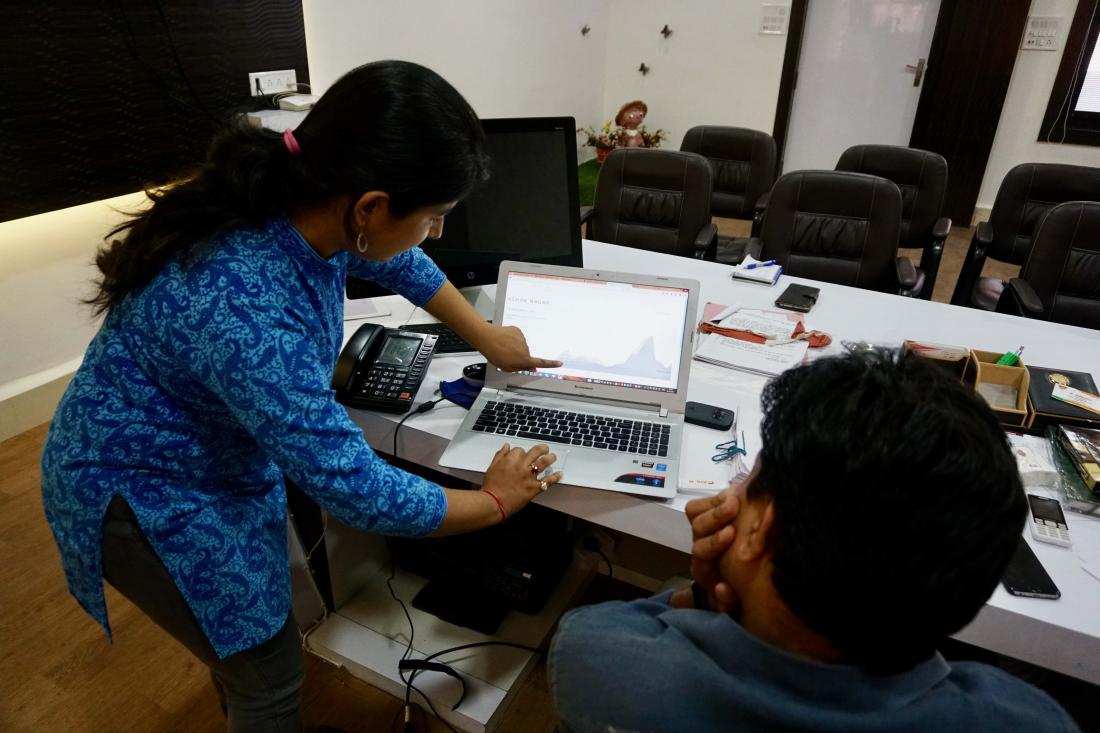
India’s Ministry of Rural Development and researchers conducted a randomized evaluation of PayDash, a web-and mobile-based platform designed to improve how wage payments are tracked under MGNREGS. PayDash uses automatic timestamps from the government’s information system to record when key steps like work verification and payment processing are completed. The platform allowed bureaucrats to view data on the number and length of payment delays, as well as the contact information of the specific official responsible for the delays.
While this information is accessible through the existing MGNREGS website, PayDash makes it much easier for bureaucrats to access real-time information about program implementation. Additionally, the PayDash mobile app is also built to work in areas with poor internet or mobile connectivity, allowing users to access the latest available data from their last online session.
The evaluation included over 1,200 bureaucrats and took place in 73 districts and 560 sub-districts in two states, Madhya Pradesh and Jharkhand. Each district was randomly assigned to be in one of four groups:
- Sub-district only (16 districts): Districts where only sub-district level officials received PayDash
- District only (17 districts): Districts where only district-level officials received PayDash
- Both sub-district and district (20 districts): Districts where both sub-district and district-level officials received PayDash
- Comparison (20 districts): Districts where no officials received PayDash
PayDash was launched in Madhya Pradesh in February and March 2017, and in Jharkhand in October 2017. The evaluation ended in August 2018. As part of the rollout, researchers organized half-day sessions to conduct baseline surveys and train officials. All officials, regardless of whether they were assigned to use PayDash, received a refresher training on how to access MGNREGS data through the existing government website. Officials who were assigned to use PayDash received an additional hour of training, during which they installed the mobile app and learned how to use its features.
Researchers drew on a range of data sources to measure the impact of PayDash. Usage was tracked using Google Analytics. Administrative data from over 17 million MGNREGS attendance registers were analyzed to assess wage payment processing times. Community demand for work and corruption was examined through government-led social audits. Additionally, data on the postings of district and sub-district officials were collected through phone-based tracking.
النتائج والدروس المستفادة بشأن السياسات
Overall, PayDash reduced wage payment delays, increased the number of active worksites, and increased household participation in MGNREGS. Its impact primarily came from making real-time payment processing information more accessible to bureaucrats.
PayDash usage: When only district officials had access to PayDash, they used the platform an average of 5.4 times per month. This was slightly higher than the 4.3 sessions per month observed when only sub-district officials had access. When both district and sub-district officials had access, usage by sub-district officials remained similar, regardless of whether district officials also had access.
Payment processing speed: In sub-districts with PayDash, officials processed wage payments 17 percent (1.4 days) faster than those in the comparison group. Faster processing also helped make payment timelines more consistent, reducing variation by 13 percent (0.6 days), relative to variation in the comparison group.
MGNREGS participation: In sub-districts where PayDash was provided, households worked 10 percent more days per month relative to the comparison group, adding up to 1,700 additional days of work per sub-district each month. This was driven by the fact that PayDash increased active worksites by 23 percent, especially during the agricultural lean season when job options were limited.
Mechanism of impacts: PayDash had similar effects whether provided to sub-district or district level officials. These results help distinguish between two ways PayDash could be used: to reduce wage payment delays or to extract rents. If officials struggled to obtain timely information, then providing PayDash to either sub-district or district level officials would lead to similar improvements. But if sub-district officials were misusing information by colluding with frontline officials to extract rents, then limiting PayDash access to district level officials would be more effective. The similar effects across both levels suggest that the main barrier to implementation was limited access to information, not rent-seeking behavior. Moreover, social audit data that tracked financial misappropriation showed no increase in corruption from PayDash access.
Bureaucratic transfers: District officials can manage sub-district officer performance by transferring them between posts. These transfers typically serve as a form of punishment for poor program outcomes, can be costly for sub-district officers, and are disruptive to program delivery. In districts where district officials had access to PayDash, transfers of sub-district officials dropped by 11 percentage points (a 24 percent reduction). This suggests that PayDash may have helped district officials gain stronger knowledge on sub-district officer actions and thereby condition transfers on their effort rather than program outcomes.
When compared to hiring additional staff, the main alternative for speeding up wage payments, PayDash delivered similar benefits at just 1 percent of the cost in its first year. Back-of-the-envelope calculations suggest that for every $1 invested in PayDash, households saved over $7 in interest payments and gained 63 additional days of paid work, resulting in more than $165 in extra wages per household.
Drawing on the results from the study and with support from J-PAL’s Innovation in Government Initiative, PayDash is now being integrated into central government systems to enable nationwide scale-up. Researchers are also exploring how the platform’s core features can be adapted to strengthen other areas of social safety net delivery.
Dodge, Eric, Yusuf Neggers, Rohini Pande, and Charity Troyer Moore. 2025. “From delay to payday: Easing bureaucrat access to implementation information strengthens social protection delivery.” NBER Working Paper No. 33756. https://doi.org/10.2139/ssrn.5257207.
World Bank (2022). Next Generation G2P Payments: Building Blocks of a Modern G2P Architecture. Report, World Bank.
Page, L. and R. Pande (2018). Ending Global Poverty: Why Money Isn’t Enough. Journal of Economic Perspectives 32 (4), 173–200.
Chopra, R., V. Sharma, K. Daga, N. Nayak, S. Singh, R. Singh, S. Abbi, and P. Mehta (2024). Smart Payments Playbook: A Guidebook to Implement Smart Payments in the Government Payments Ecosystem. Technical report, Microsave Consulting.
Muralidharan, K., P. Niehaus, and S. Sukhtankar (2016). Building State Capacity: Evidence from Biometric Smartcards in India. American Economic Review 106 (10), 28952929.
Basu, P., R. R. S. N, and K. Sen (2024). Payment Delay in Workfare Programmes and Household Welfare: Theory and Some Evidence from India. The Manchester School 92 (2), 93–121.