Providing large loans to small businesses in Egypt had no impact on profits for the average borrower, but entrepreneurs predicted in advance to be top performers saw much higher returns than their peers.
The private sector’s role in worker well-being, sustainability, and inclusive growth: Reflections from researchers and businesses
What is the role of the private sector in improving the lives and livelihood conditions of workers in lower- and middle-income countries (LMICs)? How can we empower LMIC-based entrepreneurs to develop successful and sustainable businesses? And what are the potential benefits for businesses from partnering with researchers to evaluate evidence-informed solutions for social impact? These were the key questions central to a recent gathering of academic researchers, business leaders, and development practitioners at MIT, co-hosted by the J-PAL’s Firms sector, the Good Business Lab, and University of California, San Diego’s 21st Century India Center.
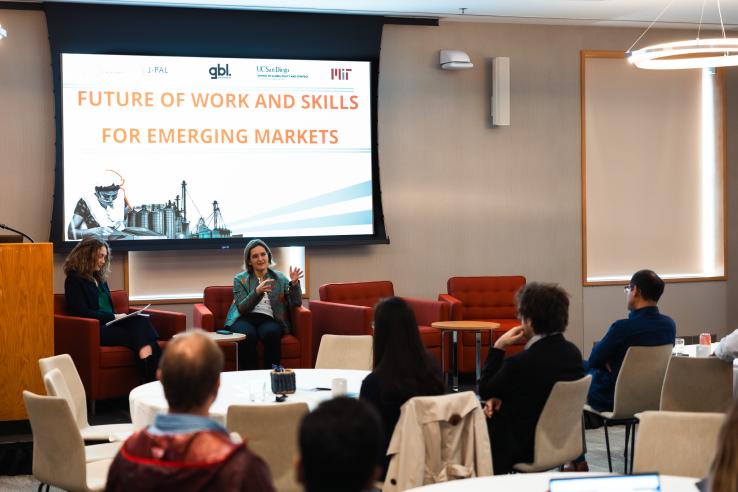
In recent years, there has been a growing focus on the role of businesses in achieving social objectives and offering higher-quality employment opportunities to workers in LMICs, with the ultimate goal of reducing poverty. Anchored by a keynote dialogue with J-PAL Co-Founder and Director Esther Duflo (MIT), the full-day event, Future of Work and Skills for Emerging Markets, aimed to boost evidence-use in the private sector for effective social impact programs.
The event centered on three key themes:
- enhancing workers’ skill sets, including soft skills,
- accelerating women's economic empowerment across employment and entrepreneurship settings, and
- promoting sustainability and entrepreneurship through supply chain relationships.
Across these themes, the event urged businesses and stakeholders to adopt evidence-based practices, fostering a future where informed decisions drive both social impact and business success.
What evidence can we share on how to unite worker welfare and business growth?
In her keynote dialogue, Esther Duflo noted that “the priority of the private sector is to run their business, like hiring people and producing goods that people want to buy…but there are so many opportunities to do things much better.” Indeed, business outcomes can often overshadow the needs of workers. Some firms might hold the view that practices that enhance worker well-being come at the cost of growth or profitability. Or, as Esther added, they might falsely believe that “if something should be done, then it would already have been done,” and miss out on opportunities to improve. However, work by J-PAL affiliated researchers and the Good Business Lab are illuminating how to potentially unite the two objectives of worker welfare and business health.
An early example comes from India, where researchers randomly offered a soft skills training program to female garment line workers. The workers who received the program demonstrated an increase in soft skills such as sociability and likelihood of requesting further skill development trainings, relative to those who did not. They were also more likely to earn a promotion. Meanwhile, the productivity of the lines they worked on increased such that the returns to the program for the manufacturer amounted to 258 percent nearly two years after its end. These results suggest that it can be worthwhile for firms to invest in the upskilling of their workers. Improvements in soft skills, which are basic human skills that can improve employment outcomes for job-seekers and, as J.D. Giri (vice president at Shahi Exports where the trainings took place) observed, can complement hard skills to make an employee successful once hired.
In addition to upskilling their workers, firms also have opportunities to empower the voice of workers. For example, letting automobile factory workers in China provide anonymous feedback on their managers led to lower turnover and higher morale, all while increasing team-level productivity. However, worker empowerment is especially salient for women. As Claudia Martínez A., lead economist at the Inter-American Development Bank, noted, women face unique challenges in the workplace, such as gender-based violence and the need to devote time to childcare in many contexts. J-PAL affiliated researchers have found that secure survey designs, which can help alleviate the fear of retaliation that many women face when choosing whether to report harassment or not, substantially increased the number of complaints filed within a Bangladeshi garment manufacturer. A recent review of several studies also revealed positive impacts of access to various types of childcare support for women, such as enabling them to be more productive by not having to bring their child to work anymore.
The role of firms however, is not limited to their own factory floors and workforce. Large firms also have an important role to play in improving environmental and social sustainability through their supply chain relationships. Chris Mejía Argueta and Josué C. Velázquez Martínez, research scientists at the MIT Center for Transportation Logistics, shared examples of how innovative sourcing practices by global food and beverage brands, new AI-assisted tools, and other interventions increased productivity among the popular retail microenterprises in Latin America and reduced their carbon footprint. In other sessions, speakers discussed the state of evidence and identified key areas for empowering women informal entrepreneurs and partnerships for evidence-based action in the private sector.
While these studies offer promising ways to unite social and business objectives, wider adoption is needed. Business practices can be improved by using scientific evidence on which ones work, are worth investing in, and should be scaled up. Large multinational companies and LMIC-based firms stand alike to gain from such informed decision-making. Evidence can also quantify the link between responsible and sustainable business practices and higher productivity, and thus bolster the business case for the adoption of these practices.
The need for evidence-informed decision-making in the private sector, and for future collaborations between researchers and businesses
At the close of the event, co-founder of the Good Business Lab and J-PAL affiliated professor Anant Nyshadham (University of Michigan) reflected that “we want to move firms away from viewing workers as balance sheet liabilities, and more toward human assets to invest in, who are truly part of the organization.”
The event presented attendees with several open questions to consider, many of which challenged attendees to think about how to take advantage of emerging technologies and greater capacities in data collection. For example, how can we leverage digital tools to engage workers? And how can these digital tools help firms and researchers quantify the impacts of new solutions? In his closing statements, J-PAL affiliate and Firms sector co-chair David Atkin (MIT) remarked, “It sounds like a no-brainer, that everyone should be doing evidence-based decision-making, but it’s really not how most decisions are made. With all this data that’s coming online…we should be doing a lot more evidence-based decision-making.”
He further captured the many low-hanging fruits that came up throughout the day, which firms could adopt to raise profits and productivity while also serving social goals:
- Upskilling and soft skills training
- Digital record keeping and tools to bring transparency to supply chains, strengthening worker voice, and inform decision making
- Boosting women’s health, empowerment, and entrepreneurship
- Improving energy efficiency in supply chains to lower costs
- Leveraging global value chains to raise labor standards and environmental sustainability
Through a commitment to evidence-based practices, coupled with the integration of emerging technologies, businesses can navigate a future where sustainable growth aligns with the well-being of workers.
We encourage businesses or partners interested in learning more about impact evaluations to reach out to Julie Cobill, environmental, social, and governance lead at J-PAL at [email protected] or GBL at [email protected].

IPA and JPAL have supported numerous rigorous research studies exploring diverse questions related to climate change and sustainable development. In particular, since 2020, the King Climate Action Initiative at J-PAL has funded several randomized evaluations addressing these questions as well as scaling projects aimed at amplifying the impact of research findings. This blog presents some of those findings and highlights some questions to guide future research on how firms in LMICs can respond to environmental challenges, and in some cases, how to limit the potential harms of their business operations on nearby communities.
This piece is also available on Innovation for Poverty Action (IPA)'s website.
“Most of the real costs of climate change are going to be experienced by people who live in poor countries,” expressed Esther Duflo, J-PAL co-founder, and affiliate, during the 2023 Spring Meetings of the World Bank Group. Research has shown that higher temperatures have been associated with lower productivity and economic growth rates for lower- and middle- income countries (LMICs). Given that today’s LMICs are poised to contribute 60 percent of world gross domestic product (GDP) by 2030, it is increasingly imperative to provide a persuasive business case for firms in LMICs to respond to environmental challenges and adapt to climate change. As LMICs work to reconcile growth and environmental needs, providing appropriate policy incentives that do not discourage growth can encourage LMIC-based firms, which may often act as passive entities affected by climate change or themselves engage in locally harmful practices like air and water pollution, to transform into proactive catalysts for environmental adaptation, progress, and innovation.
IPA and JPAL have supported numerous rigorous research studies exploring diverse questions related to climate change and sustainable development. In particular, since 2020 the King Climate Action Initiative (K-CAI) at J-PAL has funded several randomized evaluations addressing these questions as well as scaling projects aimed at amplifying the impact of research findings. The following existing randomized evaluations conducted by researchers affiliated with J-PAL and IPA suggest some ways that firms can overcome barriers to adaptation and improve environmental quality. This blog presents some of those findings and highlights some questions to guide future research on how firms in LMICs can respond to environmental challenges, and in some cases, how to limit the potential harms of their business operations on nearby communities.
Balancing financial and environmental goals
The provision of training and information when introducing new technology could align firm owners’ incentives with broader social concerns about reducing pollution and emissions. In a K-CAI funded project in Niger, a practical and interactive training on how to adopt an environmental technology, designed to encourage land restoration and climate change adaptation, led to a higher adoption of said technology, resulting in increased agricultural output and reduced land turnover. Similarly, in Bangladesh, another K-CAI study is assessing the role of information in the adoption of energy-efficient motors for stitching machines in the leather goods and footwear manufacturing sector.
On the other hand, information or technology alone may be insufficient to align the incentives of firms with social concerns. For instance, in Pakistan, researchers attempted to introduce a new production technology to soccer-ball manufacturers to help minimize waste and reduce costs. However, many firms did not take up the innovation. Their workers, who were paid per item produced, blocked adoption because the new technology slowed them down and they did not share in the benefits from reduced input costs. Only when workers were offered a bonus payment to demonstrate competence in the new technology to the firm’s owners did adoption rise.
Financial incentives could have an impact on technology adoption, but their design should consider timing of costs. A study in Zambia on agricultural technology subsidies revealed that while financial incentives increased technology adoption, they did not guarantee sustained usage. However, rewards for ongoing use did result in greater adoption after one year. The results from this study suggest that when there is uncertainty regarding the timing of costs and benefits, long-term incentives might promote sustained technology usage more effectively than incentives focused solely on initial adoption.
Governments often strive to address environmental concerns. However, their policies may not provide sufficient incentives for firms to comply. In India, the state of Gujarat’s third-party environmental audit system was found to produce unreliable information about industrial plant pollution, likely because auditors were paid by the company that was the subject of the audit. Researchers evaluated the impact of a reform to increase auditor independence, and found that they were more likely to report pollution levels truthfully and plant pollution decreased in response.
In the state of Punjab, the government paid cash transfers to farmers after agents verified that they stopped burning crop residue—a practice that degrades local air quality—for several months. But this policy was not enough to meaningfully change the behavior of the farmers, who may have been skeptical that they would ever receive payments or lacked the resources needed to finance alternative crop management equipment in the meantime. A study revealed that farmers were more likely to stop burning crop residue when they received payments upfront, rather than, after verification of compliance. Such cases demonstrate the need for policymakers to carefully consider the incentives of businesses when attempting to address environmental concerns.
Similarly, government regulation that enables firms to reduce their costs of compliance may also be more successful in achieving desired environmental outcomes. For example, a current K-CAI funded scaling project in India is based on a study that examined the impact of a particulate matter emissions market on air pollution, which allowed for the buying and selling of pollution permits among firms. Historically, the Indian government has used a command-and-control approach that mandates firms to reduce emissions by a prescribed amount, but these can impose a high cost of cutting emissions on businesses. In the study, firms randomly assigned to participate in the emissions market not only demonstrated perfect compliance with the program and lower abatement costs, but also reduced their pollution emissions by around 20 to 30 percent compared to those operating under the status quo system.
Research questions to move forward
Despite growing awareness and interest in environmental sustainability, there is still a gap in the evidence regarding the environmental practices of LMIC-based firms. Developing a business case for firms—particularly micro-, small-, and medium-sized enterprises (MSMEs), which are more vulnerable to environmental shifts—to respond to environmental challenges requires building a body of rigorous evidence to inform action. We propose a series of open research questions below for stakeholders to shape their research or policy agendas.
Building resilience and mitigating threats: What strategies can be used to build resilience among MSMEs in the face of environmental threats? What are the potential environmental risks that these businesses face, and how can these risks be mitigated? What can be done to increase MSME owners’ knowledge about the potential risks to their businesses caused by climate change, as well as ways to manage these risks?
Encouraging innovation among MSMEs: MSMEs can be highly agile and innovative compared to larger firms, and are often on the front line of confronting the impacts of climate change and environmental degradation. Can MSMEs play a role in creating innovative solutions to problems posed by climate change and other environmental threats? How can these innovative MSMEs be identified and supported?
The role of firms in adaptation: Much of the adaptation to climate change among LMICs in the coming years may be achieved by large migration of peoples from rural to urban environments, and building resilient infrastructure there. What role do firms have to play in this shift? What can be done to improve their employment capacity to absorb new labor from rural areas? How can firms be encouraged or supported to provide services like transportation, food delivery systems, and garbage collection, which enable high-density areas to thrive?
Addressing barriers to the adoption of sustainable practices and technologies: What specific barriers prevent firms from adopting sustainable practices and technologies? Though some research exists on the topic, there is a need for a deeper understanding of these barriers. Are these barriers primarily related to financial constraints, knowledge gaps, lack of awareness, misalignment of incentives within firms, or are there other factors at play? Similarly, what incentives have proven most successful in encouraging firms to do so? Do these incentives vary across different types of firms?
Understanding the benefits of renewable energy for economic activity: How does the adoption of climate-friendly technologies impact the profitability of firms? It is important to consider not only the immediate costs of adoption, but also the potential for long-term savings and profitability. Do firms gain reputational benefits by adopting climate-friendly goals? How do these benefits vary in local and global markets?
The identified promising areas for future research intersect with K-CAI at J-PAL, which is currently funding research into scalable solutions for climate change, and IPA’s Entrepreneurship and Private Sector Development program, which examines the effectiveness of innovative policies with potential to assist firms in adapting to new challenges brought by climate change and enables businesses to be drivers of green growth and innovation.
Can more firms learn from randomized evaluations to improve business operations in developing economies? How can development institutions better support clients to achieve sustainable growth and key performance improvements in terms of productivity, gender, work-related practices, skills, and other relevant issues?
Private-sector firms in low- and middle-income countries (LMICs) continue to face low levels of productivity. The question of what drives enterprise growth in LMICs has long confounded managers and investors alike. Policymakers and business leaders can benefit from rigorous evidence on effective ways to support private sector development. Using insights from rigorous research in business-related decision-making can allow more firms to meet both financial goals and social goals, like greater sustainability, employment, and worker welfare.
Meanwhile, a growing body of research by J-PAL affiliated researchers using randomized evaluations suggests that supply chains can play a critical role in global poverty reduction. Large firms connected to export markets in sectors such as manufacturing and agriculture can affect a variety of outcomes related to poverty alleviation, from productivity to job quality to technology adoption.
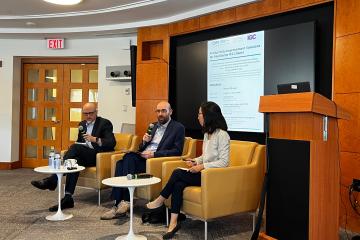
Can more firms learn from randomized evaluations to improve business operations in developing economies? How can development institutions better support clients to achieve sustainable growth and key performance improvements in terms of productivity, gender, work-related practices, skills, and other relevant issues? To explore these questions, J-PAL recently partnered with the International Finance Corporation (IFC) and the International Growth Centre (IGC) to host a workshop titled “Productivity Improvement Solutions for Real Sector IFC Clients'' in Washington, DC. The workshop, the first of its kind, facilitated evidence-sharing and research brainstorming sessions between academic researchers, social enterprise leaders, and staff from the IFC and World Bank Group with a focus on manufacturing, agriculture, and services sectors. The discussions shed light on the rising concern and need for rigorous impact assessments of firms’ sustainability performance, among other issues.
The value of rigorous evidence and data for private sector development
The first half of the event saw two panels where leading organizations and affiliated researchers shared their thoughts on the value of research as it applies to decision-making in investment and operational situations. Pablo Fajnzylber, Director of Development Impact Measurement at the IFC, opened the day by outlining the workshop’s objective of fostering collaborations with researchers to help achieve the IFC’s ambitious goal of strengthening impact evaluations. David Atkin, Firms sector co-chair at J-PAL and Research Program Director for the Firms program at the IGC, provided opening remarks highlighting the successes of evidence use in government contexts and made a call to action for private sector actors to engage with rigorous evaluations.
J-PAL and IGC affiliated professor Rocco Machiavello moderated the first panel focused on the use of evidence in agriculture supply chain contexts. Tomoko Harigaya, Chief Economist and Director of Research at Precision Development (PxD) and Colin Christensen, Global Policy Director at One Acre Fund, shared firsthand experiences on the use of data and scientific research in driving operational improvements and organizational learning. PxD and One Acre Fund are development organizations serving millions of smallholder farmers in Africa and South Asia. Tomoko described how rigorous evaluation methods improved PxD’s programs, including the use of evidence from existing evaluations to help identify effective service types, the use of A/B testing to improve design features of digital extension services, and the use of rigorous evaluations to assess the impact of its services. Colin spoke on the importance of a culture of evidence use, and the need to balance an organization’s priorities with the focus of research. In addition, both Tomoko and Colin agreed that research collaborations can bring in innovative products to contexts where resources for testing new ideas may be limited.
In the next panel, Eric Verhoogen, a Research Program Director for the IGC Firms program and a J-PAL affiliate, and Laura Boudreau, also a J-PAL affiliate, provided insights from randomized evaluations of interventions in the global manufacturing sector. Many of these studies found key social and economic mechanisms which enabled the firms that hosted the research to achieve higher productivity and greater worker welfare. In a garment manufacturer in India, for example, a soft skills worker training program led to an increased likelihood for worker promotions as well as productivity gains that resulted in returns of 256 percent to the firm. In an auto manufacturer in China, allowing workers to participate in their managers’ evaluation led to better manager behavior, gains in team productivity, and a reduction in employee turnover.
Sometimes, these interventions can yield unexpected results. In a soccer ball manufacturing cluster in Pakistan, for example, the introduction of a more efficient production technology was met with low take-up by firms as workers initially resisted adoption. Through qualitative surveys, the research team discovered that the gains from the technology came from reduced waste materials, which led to increased profits for firm owners. However, because workers were paid per piece of work they completed and learning the new technology slowed them down at first, their income fell. Finally, when workers were paid a bonus for learning how to use the technology, incentives between firm owners and workers aligned and more firms adopted the technology. Such scenarios illustrate the value that researchers can provide by deciphering complicated barriers to productivity.
The second part of the workshop centered on a research brainstorming session. “Today, technology and data are everywhere. Now, let’s use this to see not only what we are doing, but how we can do it better,” noted Wagner de Almeida, Director of the IFC Manufacturing, Agribusiness, and Services Department. In this session, IFC investment team managers, leads, and specialists met with J-PAL and IGC affiliated researchers to share experiences and discuss the needs of IFC projects in terms of key issues for businesses in the manufacturing, agribusiness, and services industries.
One of the most frequently discussed themes was the pressing need for investments aimed at decarbonization and other climate goals, around which affiliated researchers and IFC teams discussed how the impacts of sustainability-focused projects could be evaluated. Other points of discussion included the value and challenges of conducting randomized evaluations, how researchers could work with the IFC’s organizational structure, and the need to continue building the case to large organizations in the private sector on the value of scientific research.
Supporting development finance institutions to generate new evidence
This workshop was intended as the first in a series of matchmaking events between researchers and practitioners in private sector development topics. Going forward, J-PAL, IGC, and IFC will continue to engage affiliated researchers in evidence sharing, and identify the scope for innovative and policy-relevant evidence generation in the context of the IFC’s operations across diverse regions and industries.
We encourage partners who are interested in research matchmaking to contact us at [email protected]. Read more about exciting developments from past and ongoing research on our website.