

July 2026 LAC Quarterly Newsletter
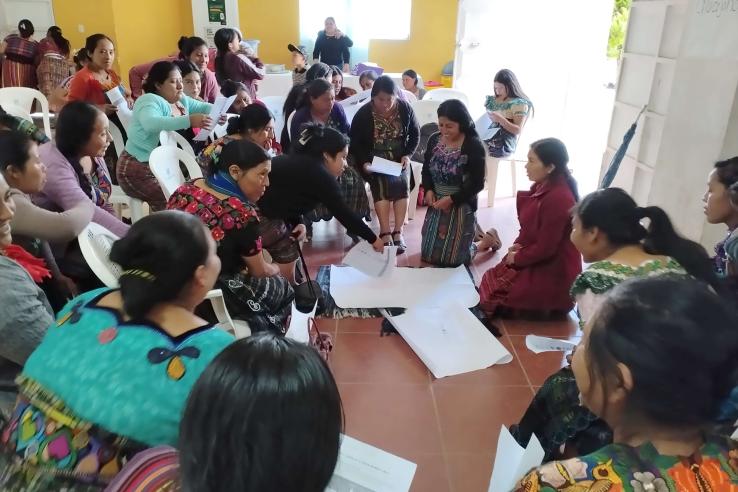
A new lab to test and improve social programs in Guatemala
J-PAL LAC and Universidad del Valle de Guatemala (UVG) were awarded support from the Fund for Innovation in Development (FID), a fund chaired by J-PAL co-founder and Nobel laureate Esther Duflo, to help establish a new Social Development Innovations Lab in Guatemala’s Ministry of Social Development.
The new lab will be embedded within the Vice Ministry of Policy, Planning, and Evaluation. Initial areas of work include Beca Artesano and Bono Emergencia, two programs focused on social protection, as well as innovations linked to Mano a Mano, the government’s multisector poverty-reduction strategy. Through these pilots, the Lab will help generate practical lessons on program design and implementation before scale.
This milestone builds on J-PAL LAC’s growing presence in Guatemala through Construyendo Futuros and its ongoing collaboration with MIDES and UVG, reflecting a broader effort to work from within government systems to test, learn from, and improve social programs.
Read more about the FID-supported Social Development Innovations Lab in Guatemala »
J-PAL LAC at gLOCAL Evaluation Week 2026
J-PAL LAC joined several Spanish-language sessions at gLOCAL 2026. On June 3, the team hosted “IMPACTA: A Tool for Piloting and Learning in Social Programs,” featuring Claudia Macias, Acting Executive Director of J-PAL LAC, alongside public-sector partners from Chile and Argentina. Constanza Alarcón, Policy Manager at J-PAL LAC, was a speaker in an event on AI use in Guatemala’s SINSE initiative, and Shantal Aragón, Senior Training and Education Manager at J-PAL LAC, discussed Trinidad and Tobago’s national monitoring and evaluation system and program design.
Advancing gender equality through evidence and peer learning
J-PAL LAC's Community of Practice for Gender Equality and Evidence Use brings together leaders from the region to exchange experiences, discuss evidence, and learn from one another. Through virtual sessions, participants explore practical strategies to improve program design, implementation, and evaluation, building an evidence-informed community working toward gender equality. To support this work beyond the discussions, explore our Practical Guide to Measuring the Empowerment of Women and Girls in Impact Evaluations »
AI for social good in LAC
As AI becomes embedded in development programs, J-PAL is accelerating efforts to build rigorous evidence on its use for social good. Frontier research is already underway across LAC, on topics such as AI-powered tools to strengthen children’s writing skills, chatbots to support educational outcomes, machine learning and satellite imagery to detect deforestation, and applications in procurement and government decision-making. Learn more about the research projects supported by J-PAL in LAC »
EVIDENCE IN LAC
Can ecotourism promote economic development while protecting forests?
A study by J-PAL invited researcher Santiago Saavedra (Universidad del Rosario) evaluated the impact of promoting ecotourism on economic opportunities and environmental conservation in Colombia. Municipalities were randomly assigned to either receive support for ecotourism promotion or serve as a comparison group. The researcher found that the intervention increased the number of tourists and workers employed by local businesses in treated municipalities. It also led to a significant reduction in deforestation around ecotourism sites, suggesting that expanding economic opportunities through sustainable tourism can encourage local communities to preserve forests. Read the study »
Can educational mentoring programs improve children's learning outcomes at scale?
A study by Francesco Agostinelli (University of Pennsylvania), Ciro Avitabile (World Bank), and J-PAL invited researcher Matteo Bobba (Toulouse School of Economics) examined the scalability of an educational mentoring program in Mexico. The researchers evaluated the program through two field experiments and analyzed the government's implementation at scale. While the original large-scale program had limited effects on children's outcomes, a revised version with enhanced mentor training proved effective when implemented at scale. The study also found that stronger mentor–parent relationships are a key channel underlying increased effectiveness, as improvements in the quality and quantity of interactions between mentors and parents boosted parental engagement with schools and local communities, helping to explain the program’s successful expansion. Read the study »
MEDIA HIGHLIGHTS
La Tercera
Nexo
Por que a agenda de inclusão produtiva é relevante para a democracia?
Pontificia Universidad Catolica de Chile
Académica del Instituto de Economía UC, Jeanne Lafortune, es elegida miembro afiliada de BREAD
OKR Agency
UVG presenta estudio sobre estrategia Mano a Mano
R7
Estúdio News aborda a participação feminina no mercado de trabalho