

Maharashtra announces India’s first sulfur dioxide emissions market in partnership with Emissions Market Accelerator
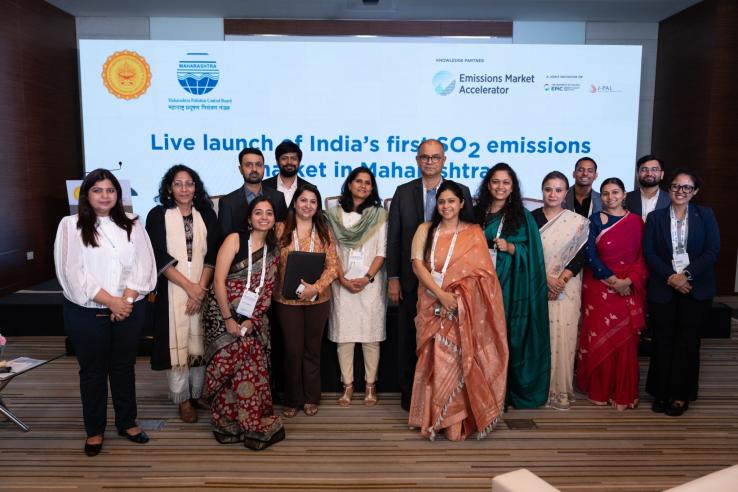
The Government of Maharashtra has made a significant step towards achieving cleaner air and a stronger economy by announcing India’s first sulfur dioxide (SO2) pollution market. The announcement was made at an event in the presence of Honourable Smt. Pankaja Munde, Minister for Environment and Climate Change, Government of Maharashtra in Mumbai on 17th November 2026. Earlier on World Earth Day on 22nd April 2026, Maharashtra Pollution Control Board (MPCB) had launched mock trading for the emissions trading market for sulphur dioxide (SO2) - advancing a key expansion of India’s proven approach to reducing industrial emissions at a lower cost. Under the new statewide Maharashtra SO₂ Emissions Trading Scheme, approximately 130 million people will benefit from improved air quality in Maharashtra.
This pioneering market will be executed by MPCB in close collaboration with the Emissions Market Accelerator (EMA) team - a global partnership between the Energy Policy Institute at the University of Chicago (EPIC) and the Abdul Latif Jameel Poverty Action Lab (J-PAL) to scale emissions markets across the Global South.
Speaking at the event, Smt. Pankaja Munde, Minister for Environment and Climate Change, Government of Maharashtra said
“As we become increasingly urbanised, with more technology and industries, we are also experiencing the growing challenges of pollution. We need to look at how technology, including AI, can help us monitor industrial pollution more intelligently and identify ways to make our systems more effective. Our role is not just to regulate industries or control pollution. We must also work alongside industry and encourage participation to create solutions that benefit both the environment and economic growth. We need to think beyond the immediate challenges and work towards leaving behind a cleaner, healthier environment for our future generations”.
Regarding the launch, Shri. Siddhesh Ramdas Kadam, Chairman of MPCB stated,
“Maharashtra’s SO₂ emissions trading scheme is a feather in the cap for the state and a testament to what we can achieve through innovation and collaboration. Our approach is not to control, but to grow together with industry. Without the active participation of the industries, and the support of our knowledge partners, the University of Chicago, the Emissions Market Accelerator and J-PAL, this would not have been possible. This event will mark a day in the history of the state of Maharashtra where sulphur dioxide emissions trading scheme was launched.”
Prof Michael Greenstone, the Milton Friedman Distinguished Service Professor in Economics and Director of EPIC and Co-Chair of EMA said,
“Maharashtra has long been a pioneer in bold environmental initiatives, and this SO2 pollution market is the latest example. The evidence from India shows that a market like this can cut emissions while lowering costs for industry and helping the economy grow. We are thrilled to work with our government partners to make that happen in Maharashtra.”
Greenstone, along with his colleagues Rohini Pande, Anant Sudarshan, and Nicholas Ryan, are working with the government of Maharashtra in rolling out this initiative.
The SO2 market is designed to effectively control pollution by enabling participating plants to trade emission permits. This incentivizes plants with lower costs of reducing SO2, to make substantial reductions and sell permits to others facing more expensive pollution reduction processes.
Earlier, the Department of Environment and Climate Change, Government of Maharashtra and MPCB signed a Memorandum of Understanding with the University of Chicago Trust and J-PAL South Asia to address industrial air pollution in Maharashtra. The Department had also issued a government resolution stating the implementation of a pilot project of the emissions market for sulphur dioxide for select industries in Maharashtra.
Prof. Rohini Pande, Henry J. Heinz II Professor of Economics and Director of the Economic Growth Center, Yale University commented,
“This is a revolutionary initiative by the Government of Maharashtra to improve air quality. It is the result of years of infrastructure development and advocating the integration of high-quality evidence to design policies that can have a lasting impact on people's lives. We are very excited to be working with our government partners to roll out this pilot program.”
Prof. Nicholas Ryan, Associate Professor of Economics, Yale University, added,
“An emissions market can work for many environmental challenges, but needs to be tailored to each case. We have worked closely with MPCB to go through the details of industry coverage, emissions monitoring and trading rules to give the market a strong foundation. We hope that other Indian states and national environmental markets will follow the Maharashtra model.”
Balaji Srinivasan, Co-Chair of EMA, who has played a key role in coordinating this initiative, shared insights from international experiences. He stated
“There is a lot of evidence indicating the potential of an SOx market in reducing pollution. In the United States, it cut pollution by 96%. So, other countries and Indian states are looking to the Maharashtra SO2 pollution market with enormous hope.”
The proposed pilot in Maharashtra builds on the successful implementation and evaluation of the world's first particulate (PM2.5) pollution market in Surat, Gujarat, which launched in 2019. Members of the EMA Scientific Advisory Council - Michael Greenstone, Rohini Pande, Nicholas Ryan and Anant Sudarshan led a collaboration between Gujarat Pollution Control Board, J-PAL South Asia and EPIC India on this initiative. The research experiment in Surat demonstrated that air pollution can be reduced while also reducing compliance costs. The success in Gujarat led to the creation of EMA, which is now helping to expand emissions markets in four Indian states and is discussing the prospects of additional markets internationally.
Tithee Mukhoppadhyay, Deputy Executive Director J-PAL South Asia, Advisor to EMA said,
“Maharashtra’s statewide market shows how rigorous scientific evidence can scale into transformative public policy and creating meaningful impact for millions. The Surat pilot proved that emissions trading cuts industrial pollution without hurting economic growth, and we applaud MPCB for bringing this data-driven solution to scale”
The announcement builds on years of research, collaboration and regulatory preparation, demonstrating how rigorous evidence can inform the design and implementation of environmental policies.
About J-PAL South Asia
The Abdul Latif Jameel Poverty Action Lab (J-PAL) is a global research center working to reduce poverty by ensuring that policy is informed by scientific evidence. Anchored by a network of over 1300 affiliated researchers at universities around the world, J-PAL conducts randomized impact evaluations to answer critical questions in the fight against poverty. J-PAL South Asia is hosted by the Institute for Financial Management and Research (IFMR). J-PAL South Asia’s climate initiative, SARWA, identifies, tests and scales evidence-backed climate solutions with Indian governments with over 10 departmental collaborations ongoing across a diverse set of thematics including water access and conservation, pollution reduction, climate resilience and energy access and transition.