
African Scholar Spotlight: Oluwaremilekun Adebisi
This post is part of our ongoing series showcasing the work and perspectives of economists from the African continent who are leading randomized evaluations. Through our African Scholars Program, we hope to help create more opportunities for African researchers to advance the research agenda on the continent through randomized evaluations. In this spotlight, we speak with Oluwaremilekun Adebisi of the University of Ilorin in Nigeria.
What drew you into the field of development economics and in particular, working with impact evaluations?
One of the things that drew me into development economics was my experience during graduate school, when I worked closely with at-risk people, especially women and rural community dwellers. I could see how they faced diverse challenges: low economic opportunities, lack of education, weak infrastructure, and general livelihood struggles. I felt their pain and their needs deeply, but I didn’t have the immediate capacity to solve their issues.
That’s when I realized that one of the ways I could contribute meaningfully was to become their voice through research, making their challenges visible and recommending practical solutions to policymakers who have the power to implement interventions.
Impact evaluations, especially randomized controlled trials, gave me a rigorous and effective way to test which interventions actually work. For me, it’s about ensuring that policies are not just good on paper, but that they bring real change to people’s lives.
What are your broad research interests?
My research interests are broad but interconnected. They include development economics, gender, women’s empowerment, rural livelihoods, climate change, food security, and financial inclusion. At the heart of them, I am interested in how we can design and test interventions that improve the well-being of at-risk groups, particularly women, girls, and rural households.
What are you using J-PAL initiative funds to do? What research questions are you trying to answer?
I’ve received several J-PAL funding awards:
Using proposal development grant (PDG) funds awarded by the Learning for All Initiative (LAI), I’m working on a project titled “Empowering Girls’ Education in Crisis-Affected Regions of Northern Nigeria through Mobile Learning Initiatives.” This project is testing the feasibility and effectiveness of bringing education directly to girls at their doorsteps through mobile learning. The central question is: Can mobile learning help girls in fragile regions gain consistent access to education despite the crises around them?
Using PDG funds awarded by the Jobs and Opportunity Initiative (JOI), I’m working on a project titled “Breaking Barriers: Soft Skills, Big Impacts — Transforming Women-Led Businesses in Nigeria’s Informal Sector.” With this project, I am exploring which soft skills matter most for informal women entrepreneurs, and whether building those skills can strengthen their businesses and economic resilience. It’s also about learning how to strengthen partnerships that support women in the informal economy.
Both projects are deeply connected to the Nigerian context, where girls in crisis regions risk being left behind in education, and where women entrepreneurs, who make up a large share of the informal sector, struggle without adequate tools to grow their businesses.
What do you see are the big unanswered research questions that RCTs may be able to help answer? Does this relate to any projects you are excited to work on in the future?
A big unanswered question for me is: How can policies and development efforts become truly inclusive of at-risk populations, especially women, girls, rural dwellers, and displaced communities, in ways that improve livelihoods and overall wellbeing?
For example, I’m excited about future projects that test community- and parent-led education models in crisis-affected areas, or how digital financial inclusion tools can help rural women access employment and economic opportunities, particularly in agriculture. RCTs can help explore these questions in a rigorous way.
How can organizations like J-PAL continue to build on the support they provide to local researchers in running randomized evaluations?
The support I’ve received from J-PAL has been truly transformative. It has allowed me to test ideas that otherwise would have remained on paper, provided mentorship and technical guidance, and connected me to a network of researchers who are just as passionate about development. It has also validated my research direction and encouraged me to pursue innovative approaches.
Looking ahead, I believe organizations like J-PAL can build on this support by expanding mentorship opportunities for early-career African scholars, creating more platforms where we can present findings to local policymakers, and supporting small exploratory grants to test feasibility before scaling to larger RCTs.
What advice would you give to scholars who are considering applying to J-PAL for funding?
Be clear and focused about why your research matters. Show how your idea is not only rigorous but also relevant to your local context. Don’t worry about starting small; an exploratory project can be an important first step. Remember, J-PAL is not only looking for polished ideas; they’re also looking for potential. The application process is supportive, and the feedback itself is invaluable.
Early on, I sometimes tried to do too much at once in my funding applications. My proposals were broad instead of zeroing in on one clear question. I also assumed reviewers would automatically see the importance of my research without me making it clear. I’ve since learned that clarity and focus are everything. A strong application is one that communicates a compelling question simply and directly.
What surprised you the most about how the funding process works?
I was surprised in a good way at how collaborative the process is. I expected it to feel like a strict “yes or no,” but instead, it’s very iterative. The feedback from J-PAL was as valuable as the funding itself, and the team, including mentors, were approachable and supportive throughout. It made me realize that funders really do want us to succeed, and that they see themselves as partners in the research journey.
Do you have advice to offer other young aspiring African scholars thinking about a career in economic research?
Yes, stay curious and persistent, but always ground your research in the real challenges facing your communities. The most impactful questions come from the lived experiences of beneficiaries. Build strong technical skills, stay humble and empathetic, and never hesitate to seek mentors or collaborate with peers.
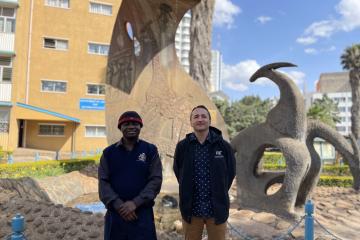
In this post, Carlos Guzman, finance and operations manager at J-PAL Global, spoke with Dr. Japheth Awiti Osotsi Stanley, a lecturer in the School of Economics at the University of Nairobi. Japheth’s primary research interests relate to human capital, labor markets, health, and poverty alleviation.
This post is part of our ongoing series showcasing the work and perspectives of economists from the African continent who are leading randomized evaluations.
In this post, Carlos Guzman, finance and operations manager at J-PAL Global, spoke with Dr. Japheth Awiti Osotsi Stanley, a lecturer in the School of Economics at the University of Nairobi. Japheth’s primary research interests relate to human capital, labor markets, health, and poverty alleviation.
What drew you to the field of development economics and working with impact evaluations?
I’m passionate about the field of development economics because its goal is to improve peoples’ standards of living. To achieve this goal, many institutions, including governments, design and implement interventions. My goal as an African Scholar is to evaluate whether these interventions work—hopefully before they are scaled up. My wish is for governments to first design and implement interventions at a small scale and then evaluate them in real-world settings to understand their impact. In the long run, I would like to see strategic investments in interventions that have been rigorously evaluated and shown to improve peoples’ standards of living.
One of your projects was recently funded by J-PAL’s Jobs and Opportunity Initiative. What research question are you trying to answer through this project?
One of the biggest challenges we face in the world today is unemployment among youth, which is more pronounced across African countries. An idea that has been discussed recently is that certain soft skills, including interpersonal communication and self-control, which are not taught as part of formal curricula in schools, have the potential to alleviate unemployment. These soft skills have the potential to enable young people to tell their personal and professional stories effectively when participating in job interviews or pitching business ideas to potential investors and customers.
The Ajira Digital Program trains young people in soft skills to bridge their transition between school and employment. This program, led by the Kenyan government, provides young workers with tools, training, and mentorship to earn an income through online workspaces. My project focuses on understanding which features of the program effectively empower young adults to get a job, create their own job, or stay employed. If the Ajira project effectively increases employment, the results have the potential to help inform formal school curricula.
What do you see as some of the big research questions in Kenya that randomized evaluations may be able to help answer? Do these questions relate to any studies you are excited to work on in the future?
I am interested in understanding why there is high unemployment, especially amongst young people, despite many investments in employment programs by governments, NGOs and private institutions targeting the same group. Randomized evaluations allow us to test whether these interventions alleviate labor market issues so that, in the future, decision-makers are informed when making investments to improve people’s standards of living.
I am also interested in researching our education system. If given the opportunity to design an educational system from scratch, what kind of curriculum should we implement to effectively prepare youth for the labor market and employment? Many countries around the world, especially in Africa, struggle with this question. I would like to design and implement an intervention that helps us understand what educational curricula could address this problem.
How can organizations like J-PAL continue to build on the support they provide to researchers based in Africa?
J-PAL is the first organization that I know of which offers proposal development grants, which makes it very unique within international development. Funding opportunities that require complete proposals can be cost-prohibitive for scholars who don’t have resources to travel and collect data for developing these proposals.
J-PAL’s proposal development grants allow African scholars to expand efforts to generate locally grounded research while designing, implementing and running evaluations that have policy impact and drive our own research agenda. It also generates mentoring and coauthoring relationships, as well as opportunities to teach how to conduct randomized evaluations in our own universities. The J-PAL African Scholars mentoring program and training opportunities have been a great source of support for developing successful proposals.
Two pieces of advice that I can offer are, first, that J-PAL calls for proposals around specific topics within research initiatives. It would be helpful if African scholars, like myself, have the opportunity to propose topics for funding calls related to policy-relevant research that is urgently needed in African countries. I see a great need for investments in rigorous research on health and human capital interventions in Africa.
Second, many organizations in the international development space prefer to fund evaluations of large government programs. Since these programs usually involve a significant amount of financial resources, they have great visibility and are very attractive for evaluations. One significant challenge with evaluating these programs is that there can be confusion between evaluations and audits of the program, or government officials can have concerns about public scrutiny around evaluation results. In addition, It would be helpful if evaluations of small-scale interventions are also considered alongside evaluations of large-scale government interventions at the time of selecting proposals. Such small-scale interventions, if found to work, can then be marketed to governments for scale-up.
Do you have advice to offer aspiring African scholars thinking about a career in economic research?
One of the biggest challenges we have in Africa is the lack of opportunities from the government to train early career researchers. My advice to aspiring African Scholars is to take advantage of organizations like J-PAL that offer multiple educational, training, and mentoring opportunities to build a portfolio of empirical research and lead your own research agenda.
It is also critical to connect and collaborate as much as possible with other researchers doing similar work. This is a great opportunity to learn from each other, improve our work, and generate more impactful research.
Dr. Faith Masekesa joined J-PAL Africa as a postdoctoral research fellow to support our administrative data partnership with the City of Cape Town. Her research interests span development economics, econometrics, experimental and behavioral economics, social protection and social policy.
The African Scholars Spotlight series highlights the work and journey of economists from the African continent who are working on issues of poverty and using experimental methods.
Dr. Faith Masekesa joined J-PAL Africa as a postdoctoral research fellow to support our administrative data partnership with the City of Cape Town. Before joining, she worked as a senior research manager at The Asian Banker and as a research associate at the Southern African Social Research Institute. Faith holds a PhD in development economics from the National Graduate Institute for Policy Studies in Tokyo. Her research interests span development economics, econometrics, experimental and behavioral economics, social protection and social policy.
Could you tell us about what led you to J-PAL and why you want to pursue a career in academia?
I value the opportunities academia offers for cross-disciplinary thinking and research. I’ve also always wanted to play my part in contributing to Africa’s sustainable development, which I believe can only be achieved through evidence-driven policies. I enjoyed the behavioral and experimental courses I took during my studies, and when a professor pointed me in the direction of J-PAL, it seemed like a natural fit. My goal is to become an effective policy practitioner and eventually a professor so that I can share my skills and knowledge with a wider audience of aspiring researchers.
What has the path to an academic career been like for you? Were there any challenges you faced along the way?
Getting into academia was by no means easy. Starting right at the beginning, finding funding for postgraduate studies was incredibly difficult, and figuring out which programme to choose took me quite some time. Putting together research proposals and finding a suitable supervisor willing to cover my topic were daunting tasks, not to mention the challenging requirements of obtaining high GRE and GPA scores.
The journey into academia can often feel like an endless series of hoops one has to jump through unassisted, and I think this has a very real chance of putting aspiring scholars off the idea of pursuing an academic career. This is especially true considering that many students struggle with confidence issues and, despite being interested in academia, may feel too nervous to attempt the jump into PhD programs.
What or whom had the most impact on your career journey so far?
I was lucky to have a very supportive PhD supervisor and sub-supervisor who helped me during and after my PhD studies. It was also very fortunate that the National Graduate Institute for Policy offered a course in experimental economics, as it helped build my confidence in pursuing behavioral/experimental research. I think there is a significant gap in terms of support provided to students in the pre-PhD stage, though, and more students would consider pursuing research as a career if they were better guided into it.
Do you have advice to offer other young aspiring African scholars thinking about a career in economic research?
It can be a fulfilling career because your work will play a part in improving the welfare of the poor and the advancement of developing countries. There are many problems in the world which you can play a part in solving by either doing individual research or collaborating with other researchers across the globe. Also, the beauty of research is while you are conducting a study, you will also be learning more about that particular case as there is no one size fit all when it comes to policies for development. Furthermore, with a career in economic research you have the ability to focus on activities that you find to be interesting.
In this post, we speak with Monica Lambon-Quayefio, a senior lecturer in the Department of Economics at the University of Ghana. Monica’s primary research interests include health economics, spatial econometrics, development, and experimental economics.
This post is part of our ongoing series showcasing the work and perspectives of economists from the African continent who are leading randomized evaluations.
In this post, we speak with Monica Lambon-Quayefio, a senior lecturer in the Department of Economics at the University of Ghana. Monica’s primary research interests include health economics, spatial econometrics, development, and experimental economics.
What drew you to the field of development economics and, in particular, working with impact evaluations?
The everyday issues I have been surrounded by growing up in Ghana—and even now— drew me to development economics. I was not always interested in impact evaluations; in graduate school, I started to focus on agricultural economics but was unable to write my thesis on my topic of choice due to data issues. As such, I veered into health economics and wrote my PhD thesis on women autonomy and child health outcomes.
When I finished graduate school, impact evaluations had started to become popular among development economists. I was fascinated and thought that they were a neat way to isolate the effects of different interventions. So, I started to look for fellowships to acquire the necessary skills to practice and implement impact evaluations myself. I was also fortunate to work with and receive the support of senior colleagues, such as Robert Darko Osei, at the University of Ghana.
My first time conducting an impact evaluation was with Christopher Udry on an agricultural finance project funded by the Center for Effective Global Action (CEGA). We were looking at testing the effectiveness of a digital finance tool to help smallholder farmers get access to finance to grow crops and increase profit. My experience taught me how to set expectations with implementing partners as well as the value of incorporating a qualitative component prior to the launch of a randomized evaluation to better appreciate the study context and ensure that it aligns with the research design.
What are your broad research interests?
My research interests primarily lie in agriculture, women’s empowerment, and children’s health. For instance, I am currently working with Edward Asiedu and BRAC USA on a food security project funded by J-PAL’s King Climate Action Initiative (K-CAI). We are studying how providing agricultural training to farmers on practices and technologies can help them adapt to climate change and improve productivity in Liberia.
In particular, our project is focused on examining the training’s differential impact on women, because they form a large base of the labor force. Furthermore, the country context of Liberia is unique in terms of gender dimensions because the war has caused women to outnumber men in the population, leading to women often being farmers and landowners.
One of your current projects was recently funded by J-PAL Africa’s Digital Identification and Finance Initiative. What research question are you trying to answer through this project?
I am using the funds to pilot an intervention on informal pensions in Ghana, where a sizable proportion of the population works in the informal sector. While workers in the formal sector typically earn pensions for retirement, workers in the informal sector usually have little to no retirement savings. Instead, they depend on financial support from their children and other family members, which is not a guaranteed source of income. Thus, my team wanted to study how an intervention could encourage workers in the informal sector to contribute to their own pensions over time.
The government of Ghana had recently permitted smaller pension companies to extend their services to people in the informal sector, so my research team partnered with an organization with this type of scheme, which was underutilized due to people’s lack of awareness. My team conducted a qualitative study using initiative funds before project implementation to gauge informal workers’ initial attitudes toward the pension scheme. Through this step, we better understood the issues at hand and adjusted the intervention accordingly.
Our first research question is to understand whether training sessions for informal sector workers can lead them to increase their pension contributions. Pension contributions are linked to individual's national identification cards (NID) so our intervention reminds participants of this link to increase their trust in the system. Our second question is to study whether training the participants about special features (relating to pauses or increasing contributions depending on income flow) could increase usage. The results will help inform how these pension schemes can be better designed in the future.
What are some other research projects that you’re most excited about?
I am a co-investigator, alongside Nkechi Owoo, on a project funded by J-PAL’s Jobs and Opportunities Initiative (JOI) to investigate personal motivation training and cultural norms surrounding women-owned businesses in Africa. African women face numerous cultural barriers to their business growth. These include spouses’ curfews, childcare obligations, and travel limitations. Training husbands could help them better understand the importance of business growth for their families, so I am conducting training modules to study the husband’s role in the growth of a woman-owned business.
I am also working with Edward Asiedu on another JOI-funded project to examine the effects of women’s social networks on their businesses. During the Covid-19 pandemic, we created a WhatsApp group for women where they could engage in knowledge sharing and networking related to their businesses. Results indicate that this intervention was highly cost-effective and showed that educational videos on business collaboration as part of the program reduced the likelihood of collaboration with friends and family and increased formal collaboration. Additionally, our preliminary findings show increases in innovation and profitability.
How can organizations like J-PAL continue to build on the support they provide to researchers based in Africa?
I appreciate how J-PAL’s pilot grants allow researchers to test ideas through a small-scale intervention, leading to a better understanding of the issues at hand and the appropriate program modifications. When I was a relatively inexperienced researcher, pilot grants felt more accessible compared to larger RCT grants. Having run three pilot projects now, I am confident in my ability to design interventions, identify threats, and test hypotheses. I find J-PAL’s pilot grant scheme to be helpful to African scholars.
Furthermore, I appreciate J-PAL’s occasional training sessions on impact evaluations. I am currently teaching impact evaluation to PhD students, and I will be receiving instructional support from Clare Hofmeyr, a training manager at J-PAL Africa, as part of J-PAL’s efforts in assisting African scholars with teaching this material.
One area J-PAL could continue to improve upon in its initiative funding model to African scholars is by covering costs upfront. Currently, initiatives require African researchers to pre-finance their projects, which can make implementation difficult if universities are unable to front the costs. Personally, I have seen this result in delays in award setup and funding.
Well noted—this is something we are trying to incorporate into our funding model. Do you have advice to offer other aspiring African scholars thinking about a career in economic research?
Knowing economic theory is different from applying economic knowledge, so I have found it helpful to seek opportunities to apply knowledge and get involved in projects. I am grateful to have worked on projects from design to implementation to analysis alongside Chrisropher Udry and experienced scholars at the University of Ghana. In short, my biggest piece of advice is, “Get your hands dirty!”
Monica Lambon-Quayefio is a Researcher and Lecturer in the Department of Economics at the University of Ghana. Her research interests include health economics, spatial econometrics, development, and experimental economics. Her recent work is focused on neonatal and infant mortality, as well as impact evaluations of remittances on savings and investment in education and asset accumulation. She teaches economics and other quantitative courses at the undergraduate and graduate levels. She has published articles in the Proceedings of the National Academy of Sciences, Journal of Demographic Economics, Review of Development Economics, and PLOS One.
Monica has received a number of fellowships including the Matasa Fellowship from Mastercard Foundation and Institute of Development Studies in the UK, Additional Insights International Research Fellowship from New York University, Structural Transformation of African and Asian Agriculture and Rural Spaces Fellowship from Cornell University, and the African Social Research Initiative Fellowship from the University of Michigan. She has also presented her research work at international conferences such as the PopPov, PEP, and UNU-WIDER.
Over the course of 2022 and 2023, J-PAL is publishing a series of blog posts that highlight the research interests and ongoing evaluations of researchers based in Africa who are working on issues related to poverty and economic growth. Each post will also showcase topics or unanswered questions researchers view as high-priority in their countries and regions, and highlight their advice for aspiring African researchers seeking a career in economics.
To hear more from Monica and meet other researchers based in Africa, watch the following video: