The 2019 Nobel Prize-winning scientific movement that can transform US policymaking
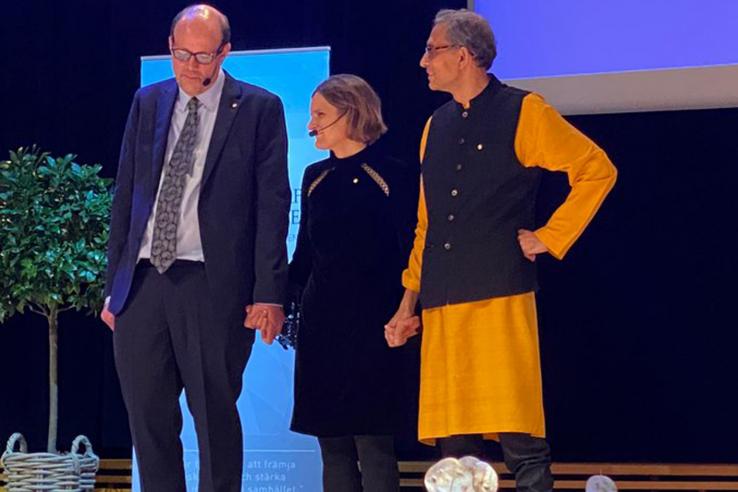
Today, co-founders of the Abdul Latif Jameel Poverty Action Lab (J-PAL), Abhijit Banerjee and Esther Duflo, and J-PAL affiliate, Michael Kremer, were awarded the 2019 Sveriges Riksbank Prize in Economic Sciences in Memory of Alfred Nobel. The award recognized “their experimental approach to alleviating global poverty.”
The Nobel laureates launched a movement that revolutionized international development. Their approach also has the potential to transform policymaking here at home. In fact, this type of work has already begun. The same methodology that helped millions of students learn to read in India is shedding light on how to reduce violent crime in Chicago and increase preventive health care for African-American men in Oakland.
Randomized evaluations—the same method used to decide what new drugs to approve—are a powerful tool to answer critical policy questions because they can generate clear evidence on a program or policy’s impact, providing straightforward results that decision makers can apply. Through J-PAL’s collaboration with governments and implementing organizations, rigorous research conducted by the Nobel laureates and other J-PAL affiliates has helped scale up effective programs, reaching more than 400 million people globally.
This is what inspired us to launch the J-PAL North American office. As Duflo said when she learned of the prize, “the hope … is that some of this rigor that we tried to develop in the poor countries moves back up north."
As one example, many students enter high school several years behind grade level and often fall further behind, putting them at high risk of dropping out. Moreover, the frequent mismatch between the classroom curriculum and a student’s current learning needs can make it hard to catch up. This learning gap is particularly pronounced between students of color and white students.
One promising approach is to provide intensive school-based tutoring to high school students who have fallen far behind. This has been used by a non-profit organization devoted to supporting under-served young people in school. But does it work?
By using a lottery to choose which boys would receive two-on-one tutoring, researchers found that those who received tutoring learned almost two extra years of math in a single year. These remarkable results starkly contrasted with widespread pessimism that disadvantaged students cannot catch up academically after they reach adolescence. By leveraging this compelling evidence, the program has expanded to serve thousands of additional students in the US.
This example shares many parallels with a partnership Banerjee and Duflo built with an education NGO in India. Their “teaching at the right level” intervention helped kids catch up in school, and the evaluation results enabled the approach to scale up to millions of children across India and across sub-Saharan Africa. Although the contexts of India and Chicago are radically different, it’s inspiring to see commonalities in both the intervention approach and in the focus on experimental evidence that is helping bring it to scale.
The history of using rigorous evidence to inform social policy in the US dates back to the 1960s and 1970s, when landmark randomized evaluations like the RAND Health Experiment and the Negative Income Tax Experiments were conducted. Evaluation organizations like MDRC, Mathematica, and Abt Associates helped catalyze this work and continue to champion the methodology today. And over the past six years, J-PAL North America’s network has catalyzed more than eighty evaluations tackling issues ranging from improving health care delivery to reducing and preventing homelessness.
But today, rigorous evidence of policy reforms is unfortunately still the exception, not the norm. A recent review examined studies of US health policy interventions—such as health insurance expansions—and compared them to studies of US medical interventions—such as new medical devices or drugs; less than twenty percent of health policy intervention studies were randomized, compared to eighty percent of medical intervention studies. This needs to change. The same tools used to determine which medicines work should also determine how best to deliver them.
There are hopeful signs that this approach may become more common. One encouraging development is the Foundations for Evidence Based Policymaking Act that passed into law this January, requiring federal agencies to use data and evaluation to inform which policies and programs are most effective. We also see growing demand from state and local government leaders who partner with researchers to jointly design experimental analysis of their programs.
The prize is an incredible validation of the value of science in policymaking. Let's let this prize serve as a beacon for more evidence to be generated both abroad and here at home.

I was in the mountains of Montana with a patchy connection when the 2019 Economics Nobel Prize was announced. As the news spread across time zones, my phone’s notifications kept buzzing. While I wasn’t at home with my J-PAL colleagues to toast the new laureates, I was incredibly inspired by the spirit of community and celebration resonating across the globe on their behalf.
Abhijit Banerjee, Esther Duflo, and Michael Kremer have an incredible number of accomplishments between the three of them, and I count this community that they’ve built to be among the most impressive. This prize has doubled as a well-deserved celebration of a coalition of NGO staff, research assistants, policymakers and partners worldwide.
The scope of this global community was reflected immediately. One of the most heart-warming parts of learning that Abhijit, Esther, and Michael received the 2019 Nobel Prize in Economics was seeing Twitter flood with personal anecdotes of the kindness of all three. My phone’s notifications filled with pictures of people on nearly every continent raising a glass in celebration of “their” Nobel.
The morning of the announcement, the first words Abhijit said at the press conference were, “It’s wonderful to get this prize, but it’s particularly wonderful, I think, because it’s a prize not for us, but also for the entire movement.” My favorite images illustrating the breadth of this movement are from a party in Western Kenya, where a room full of elated attendees are huddled around a computer screen to connect with Michael and Esther over Skype.
Rachel Glennerster, former J-PAL Executive Director, celebrates the Nobel prize announcement over Twitter.
The image above depicts the region of Kenya where Michael first pioneered the experimental approach to development economics for which the prize was awarded. Dozens of people across long-time partner organizations, local staff of IPA, J-PAL and other organizations, alumni of all these groups, and others all came together for an impromptu celebration of the prize.
Seeing these global festivities reminded me why I joined J-PAL in the first place. When I met Abhijit, Esther, and Michael ten years ago I was immediately struck by their humility and determination to share the spotlight. In the years since, these tendencies have permeated everything about how J-PAL is structured and how we do our work. The three of them made a deliberate choice as their influence grew to make their endeavor one that lifted up the work of countless others along the way, and this prize is a recognition of that choice.
These celebrations also highlight something unique about randomized evaluations: They can’t be done in isolation by researchers alone. They rely on dedicated partners who are willing to invest in the learning process at all levels of operation. From the heads of NGOs and government agencies to the individual tutors and case managers implementing programs on the ground, our partners are both essential and extraordinary.
The very goal of randomized evaluations is to understand how a program or policy changes lives in the real world. Without partners who implement these programs on the ground, this work would be impossible. Across the globe, partners serve as the crucial link from research to impact. Our partners provide a deep understanding of the needs of their communities and the questions that must be asked. Because of this, our partners are vital voices in shaping our research agendas and ensuring that the work we do is relevant and valuable.
In the J-PAL North America regional office, we’ve received messages from our state and local partners from over the years offering congratulations on the Nobel prize while remarking on how they feel as though they’re a part of the celebrations.
These messages speak to why we launched the North America office in 2013. Abhijit, Esther, and Michael’s vision is truly a global one. This methodology, approach to partnerships, and dedication to actionable results has the enormous potential to impact lives and reduce poverty everywhere. To us, this meant asking these questions, forming these relationships, and applying these tactics in countries like the United States. We’ve found that the approach has resonated here in the same way it has in other parts of the world for over 15 years.
There is a tremendous demand for evidence-based solutions in North America, and the movement around evidence continues to grow. Just this month, we’ve announced nine new partners through our State and Local Innovation and Work of the Future Initiatives. Over time, we’ll work with these remarkable agencies and organizations to design evaluations of their programs that range from systems to support jobseekers to methods to reduce opioid overprescription.
J-PAL North America is eager to continue to grow our community and engage with new and existing partners on some of the most pressing policy issues of our time, including the changing nature of work, housing stability, and health care quality and accessibility. While these challenges are complex, Abhijit, Esther, and Michael’s Nobel Prize reminds us that if we trust in our communities and in our methods, this work will impact lives for the better.
Thank you to the state and local governments, implementing partners, funders, and researchers who have partnered with us to rigorously study what programs and policies meaningfully reduce poverty in North America. Our work would not be possible without the collaboration and support from each of you. As Esther wrote in an email to all J-PAL staff the morning of the announcement, “This is your moment.”
Automation, artificial intelligence, and other new technologies have the potential to make work more efficient and expand the possibilities of what we can do and create. These same technologies, however, have serious implications for the future of our economy and labor market: some jobs will become obsolete, while others will be created. With the rise in income inequality and stagnating educational attainment, these shifts are likely to disproportionately harm lower-wage workers. From newspaper headlines to the presidential debate stage, public discourse on the work of the future has surged in recent years with many voicing great concern.
Across the country, policymakers, industry leaders, and social service providers are actively seeking potential solutions to these challenges. While innovative approaches—from portable benefits to targeted job retraining—may hold promise, many well-intentioned ideas remain unproven, leaving policymakers without the necessary evidence to assess whether they will be helpful, neutral, or harmful. Last year, J-PAL North America launched the Work of the Future Initiative to bring rigorous research into the conversation.
In April, we convened academic experts, philanthropic and private sector partners, and representatives from government and non-profit organizations to launch the Work of the Future Initiative. The day-long event was filled with panels, presentations, and productive conversation. Matthew Notowidigdo, a J-PAL affiliate and co-chair of the initiative, presented the initiative's research agenda co-authored with co-chair David Autor and Anran Li, synthesizing the rigorous research to date on the work of the future and identifying areas requiring further research. Sarita Gupta, then Co-Executive Director of Jobs With Justice, challenged the audience to center working people in the conversation.
The goal of the launch was to bring together thought leaders from across sectors seeking to support workers in the face of the shifting labor market. For months following the event, we continued to cultivate relationships with attendees, expand outreach to new organizations, and build upon the energy and momentum inspired by the day’s discussions, all in the hopes of finding potential partners to apply to our Work of the Future Innovation Competition.
J-PAL’s proven innovation competition model catalyzes research that is most relevant to practitioners and policymakers by directly involving them in the process. Organizations with innovative programs or strategies to mitigate the burden caused by the changing nature of work were invited to submit letters of interest. After receiving several promising proposals, we selected four partners: the Center for Work, Education and Employment; Checkr; the City of Los Angeles; and Montana Department of Labor & Industry. Over the course of the coming year, J-PAL staff will work alongside these organizations to think through and design randomized evaluations of their programs and policies.
"It's exciting to see so many promising proposals in just the first year of the initiative," says Lawrence Katz, co-scientific director of J-PAL North America and academic advisor to the Work of the Future Initiative. "We're hopeful that the initiative can continue to generate this level of enthusiasm as it seeks to develop promising programs and identify effective methods to help workers navigate the shifting labor market."
Engaging in research and leveraging data is essential to the success of many organizations. Barabara Wagner, Chief Economist for the Montana Department of Labor & Industry, emphasizes that using data and research allows the department to have a greater impact on workers, businesses, and the economy by focusing resources on the best solutions. This is true for both public sector and private sector partners. At Checkr, the organization’s Co-Founder and CEO Daniel Yanisse views rigorous research as a tool to develop better products as the company hopes to ensure a fairer, more inclusive hiring process for its clients.
While research can be a powerful tool, organizations ranging from small nonprofits to large government agencies often face barriers that hinder them from meaningfully leveraging research and data in their operations and decision-making. In partnering with J-PAL, organizations have the opportunity to shape their engagement with J-PAL to best address their challenges and needs. This can include customized training efforts to grow partners’ internal capacity to design and run randomized evaluations long after the partnership with J-PAL has ended. “We’re excited about the training that J-PAL will provide to support the professional development of our team and expand our capacity to conduct more robust policy evaluations,” says Amanda Daflos, Chief Innovation Officer in the Los Angeles Mayor’s Office.
For many organizations, partnering with J-PAL is a unique opportunity to engage in rigorous research. As Katy Hamilton, Chief Executive Officer of the Center for Work, Education and Employment (CWEE), says, “It’s rare for a nonprofit of our size to have an opportunity like this to learn from the foremost thinkers in the space of academic assessments and social programs.” Hamilton adds, “I hope that the team here at CWEE is able to learn, and then we can apply those learnings to the work that we’re doing. We can really exhaust a cadence of doing that month over month, year over year and be an example for the field.”
Each selected partner brings new and promising approaches to pressing questions related to the work of the future. As we collaborate with them over the next year, we hope to catalyze new research and identify generalizable insights that will have implications far beyond their original contexts.
These new partnerships, as well as the two randomized evaluations the initiative has funded to date through our researcher-facing requests for proposals, are just the beginning of the impact that the Work of the Future Initiative hopes to have. As the initiative continues to grow, our hope is to re-shape the conversations surrounding supporting workers and the shifting labor market to center rigorous evidence and the valuable lessons it can teach us.
To stay informed about our work in this space, subscribe to our Work of the Future Initiative mailing list and the J-PAL North America monthly newsletter.
This post first appeared on the Teaching at the Right Level blog.
It’s late 2016, and I’m standing at the back of a classroom in rural Eastern Province, Zambia, together with my colleague Emily Cupito and Ministry of General Education Principal Education Standards Officer, Mahuba Hazemba. A teacher stands at the front of the class describing a new maths concept, occasionally asking a question to the class. A few children confidently raise their hands to answer, while many others stare down at their desks hoping not to be called on.
A bell rings, indicating that the class is over, and the next lesson is starting. There is an instant change of mood as some children join the class while others leave. Desks are quickly moved out of the way as children enthusiastically find a spot to sit on the floor. The teacher, too, moves away from the chalkboard and towards the centre of the classroom.
As the lesson gets underway, the desk-starers from the previous class now have chalk in hand and are working together to write a set of words on the floor. It’s hard to know exactly what these children are thinking or feeling, but they’ve transformed from the previous class and appear excited by the opportunity to engage and learn.
I was observing a Catch Up class – a foundational skills programme based on the Teaching at the Right Level approach, pioneered by Indian education organisation Pratham and informed by years of iterative rigorous research spearheaded by 2019 Nobel laureates Abhijit Banerjee and Esther Duflo.
Years earlier, Banerjee and Duflo, co-founders of J-PAL, together with Pratham, planted the seed that led to the buzzing classroom filled with engaged and empowered children I witnessed.
Concerned by the large numbers of children in India who were in school but not learning, Pratham, Banerjee and Duflo asked the question: What if we start with what children actually know, instead of what they’re supposed to know, and see if we can make progress from there?
Pratham developed an approach to improve learning in the classroom. First, identifying what children knew through a simple reading and mathematics assessment. Second, grouping children based on their learning level rather than their age or grade. Finally, focusing on building foundational skills for children in middle and upper primary school, through innovative, engaging classroom methodology, to ensure they had the basics before exiting primary school.
Pratham and J-PAL tested the approach through a series of randomized evaluations. For over 20 years, the model was refined in the pursuit of a cost-effective and scalable way of ensuring that all children are equipped with basic maths and reading skills. The fruits of these efforts have been the development of what we now refer to as the Teaching at the Right Level approach.
Several countries in Africa face the same challenges now that Banerjee, Duflo, and their colleagues at Pratham interrogated all those years ago. With support from Co-Impact, Pratham and J-PAL have partnered to form TaRL Africa, a team that supports governments and organisations in more than ten countries working to address the learning crisis in Africa.
The strong research roots of Teaching at the Right Level, combined with Pratham and J-PAL’s efforts to create a nurturing environment in which TaRL interventions can grow, has contributed to a budding Teaching at the Right Level Africa Community of Practice committed to solving the learning crisis, and inspired by the way rigorous research has demonstrated the approach’s ability to improve learning outcomes.
Since 2016, I have been fortunate enough to stand at the back or sit on the floor of several classrooms across Africa, observing and participating in a quiet revolution as children stop staring at their desks and start raising their hands. We look forward to taking this effort forward with our partners to reach millions of students in the coming years.